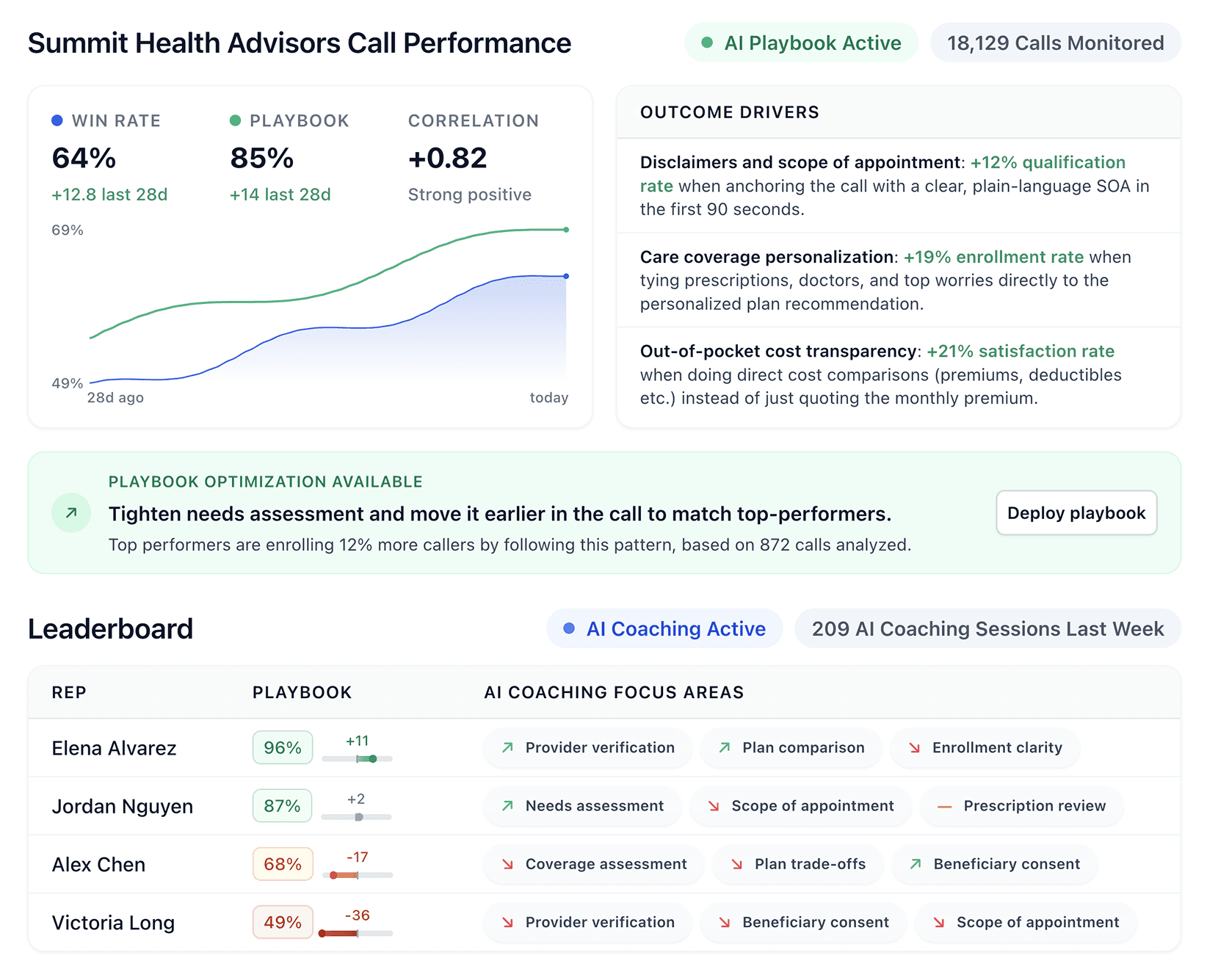


A call center quality assurance scorecard gives managers a consistent way to review calls, track agent performance, and improve sales conversations.
This guide shows how to build a call center quality assurance scorecard, the KPIs to track, and includes examples and a template you can use.
What is a call center quality assurance scorecard?
A call center quality assurance scorecard is a tool used to evaluate sales calls against specific criteria. It helps managers measure how well reps follow the sales process, handle objections, and meet compliance requirements.
This creates a consistent system for reviewing calls and coaching agents.
QA scorecard vs. agent performance scorecard: What's the difference?
These two tools are often confused, but they serve different purposes. You need both to get a complete picture of rep performance.
Agent performance scorecard:
Tracks outcome metrics like close rate, calls handled, and quota attainment
Used by managers to monitor productivity and set individual goals
Tells you what results a rep is producing
QA scorecard:
Evaluates the quality of individual call interactions
Tracks process adherence, compliance, objection handling, and sales technique
Tells you how those results are being produced
Think of it this way: a performance scorecard shows you a rep's close rate is 18%. A QA scorecard shows you they're skipping the qualifying step on 60% of calls, which explains why.
Both tools work together. QA data explains the "why" behind performance numbers.
Key metrics and KPIs tracked in a QA scorecard
A strong QA scorecard tracks both sales process metrics and compliance metrics. For B2C inside sales teams, the most important KPIs include:
1. Process metrics
Qualifying question rate: Did the rep ask the right discovery questions?
Objection handling score: How effectively did the rep respond to resistance?
Call opening adherence: Did the rep follow the required opening steps?
Close attempt rate: Did the rep ask for the sale or the next step?
2. Compliance metrics
Disclosure completion rate: Were required disclosures read at the correct points in the call?
Script adherence: Did the rep stay within approved language during sensitive moments?
Prohibited language flags: Did the rep avoid unapproved claims or promises?
3. Outcome-linked metrics
First-call close rate by QA score: Do higher-scoring reps close more deals?
Compliance pass rate: What percentage of calls meet regulatory standards?
Coaching response rate: Do reps improve after receiving QA feedback?
Tracking these metrics over time helps identify which behaviors drive revenue and where coaching should focus.
Why your sales team needs a QA scorecard
A QA scorecard gives sales managers a consistent way to review calls and coach reps. It breaks conversations into measurable behaviors so teams can see what top performers do differently and where others struggle.
For high-volume B2C sales teams, this makes coaching more objective and scalable. Instead of relying only on quota results, managers can improve the specific call behaviors that lead to more closed deals.
1. Benefits for your reps
Reps receive clear, objective feedback tied to specific moments in the call. They understand what worked and what to change in the next conversation.
Without a scorecard, feedback stays vague. With one, a rep hears something concrete like, “You skipped the qualifying step at the three-minute mark. Here's what to ask instead,” which helps shorten the path to full performance.
2. Benefits for your managers
Managers no longer have to rely on gut feel or a few spot-checked calls to decide how to coach their team. QA scorecard data highlights exactly where each rep needs improvement so managers can focus coaching on the right behaviors.
For managers with large teams, reviewing every call is not realistic. A QA scorecard gives them a clear, structured view of performance across the whole team without spending hours manually listening to recordings.
3. Benefits for your business
Teams that coach using scorecard data improve close rates because they can see which behaviors lead to conversions.
For teams in Medicare, insurance, and home services, a QA scorecard also protects the business. Compliance items built into the scorecard confirm that required disclosures and qualifying steps happen consistently across calls, even when managers cannot review every interaction.
Key components of a sales call QA scorecard
A strong QA scorecard covers the full arc of a prospect interaction. Each section should reflect what "good" looks like for your specific sales process.
Call opening
Did the rep introduce themselves and the company clearly?
Did the rep confirm the prospect's identity or eligibility where required?
Did the rep read any required disclosures at the start of the call?
Needs discovery
Did the rep ask qualifying questions before pitching?
Did the rep identify the prospect's situation and key concerns?
Did the rep use your team's approved lead-discovery tactics?
Product presentation
Did the rep accurately explain the product or plan?
Did the rep connect the product to the prospect's specific needs?
Did the rep avoid making claims that are not approved or documented?
Objection handling
Did the rep acknowledge the prospect's concern before responding?
Did the rep use approved language to address common objections?
Did the rep stay on script during high-risk moments?
Compliance
Did the rep follow the required qualification process?
Were all mandatory disclosures read at the correct points in the call?
Did the rep avoid prohibited language or off-script promises?
Closing
Did the rep ask for the sale or the next step clearly?
Did the rep confirm next steps with the prospect before ending the call?
Did the rep close the call professionally and within guidelines?
Scoring methods: Which one fits your team?
Two main scoring methods work for sales QA scorecards. Most high-volume teams use both.
Pass/fail (binary scoring)
Pass/fail works best for compliance and process items where there’s no grey area. Either the rep read the required disclosure, or they did not. Either they confirmed eligibility, or they skipped it.
Best for: Required disclosures, qualification steps, prohibited language checks, and regulatory compliance.
Weighted scoring (0-5 scale)
Weighted scoring works better for evaluating judgment and skill because performance often falls on a spectrum. A rep may handle an objection adequately on one call and exceptionally well on another, and a scale captures that difference.
Best for: Needs discovery quality, objection handling, product explanation, and closing technique.
Hybrid approach
Most teams combine both. Use pass/fail for compliance items and weighted scoring for sales skill items. This keeps compliance non-negotiable while still capturing the nuance in rep performance.
How to build a call center quality assurance scorecard
Step 1: Start with your top performers
Before writing a single scorecard question, listen to your best reps. What do they do on calls that lower performers do not? The scorecard should reflect those behaviors, not generic sales tips.
Step 2: Define your sections and criteria
Group your criteria into 3-4 sections with 2-5 questions each. Cover the full call arc: opening, discovery, presentation, compliance, and close.
Keep each question specific and measurable. "Was the rep professional?" is too vague. "Did the rep read the required disclosure before discussing plan options?" is scoreable.
Step 3: Assign weights by priority
Not every question carries the same importance. In regulated industries, compliance items should carry more weight because a missed disclosure creates more risk than a weak close. Your scorecard should reflect these priorities by assigning higher weight to the areas that matter most.
Step 4: Write clear scoring guidelines
Define what each score level means so every manager and QA reviewer grades calls the same way. Without clear definitions, one reviewer’s “3” can easily become another reviewer’s “5.”
Run calibration sessions with your QA team before launching the scorecard to align everyone on scoring standards.
Step 5: Pilot on recorded calls
Test your scorecard on 20 to 30 recorded calls before rolling it out. This helps identify questions that produce inconsistent scores or fail to separate strong calls from weak ones. Adjust the scorecard before launch to evaluate performance more accurately.
Step 6: Connect scores to coaching
Scorecard data only matters if it leads to action. Use the results to guide specific coaching conversations and give reps clear steps to improve on their next call.
Reps should understand the score they received, why they received it, and what to do differently on the next call.
Step 7: Review and update regularly
Sales processes change, compliance rules evolve, and new objections appear during enrollment periods. Review your scorecard every quarter and update it to reflect how calls actually happen today.
Call center QA scorecard examples
Every team's scorecard looks a little different. Here are three formats built for high-volume B2C sales operations.
Example 1: Basic compliance checklist (pass/fail)
Best for regulated industries where missing a single step is a critical failure.
Criteria | ✅ Pass | ❌ Fail |
The rep introduced themselves and the company | ☐ | ☐ |
Required opening disclosure read | ☐ | ☐ |
Prospect eligibility confirmed | ☐ | ☐ |
Required mid-call disclosure read | ☐ | ☐ |
The rep avoided prohibited language | ☐ | ☐ |
Next steps confirmed before close | ☐ | ☐ |
Example 2: Weighted sales skill scorecard (0-5 scale)
Best for evaluating the quality of sales technique and rep judgment.
Category | Weight | Score (0-5) | Weighted total |
Call opening | 15% | ||
Needs discovery | 25% | ||
Objection handling | 25% | ||
Product presentation | 15% | ||
Closing technique | 20% | ||
Total | 100% |
Example 3: Hybrid scorecard (compliance + sales skill)
Best for teams that need to evaluate both compliance and performance on the same call.
Uses pass/fail for all compliance and process items. Uses a 0-5 scale for sales skill items like discovery, objection handling, and close quality.
This gives a complete picture of the call: whether the rep stayed inside the rules and how well they performed within them.
Call center quality assurance scorecard template
This template is built for high-volume B2C inside sales teams. Adapt sections and criteria to match your specific sales process and compliance requirements.
Section 1: Call opening (20%)
📋 Criteria | ⚖️ Scoring | 🔢 Score |
The rep introduced themselves and the company clearly | Pass / Fail | |
Required disclosure read at call opening | Pass / Fail | |
Prospect identity or eligibility confirmed | Pass / Fail |
Section 1 score: ___ / 3
Section 2: Needs discovery (25%)
📋 Criteria | ⚖️ Scoring | 🔢 Score |
The rep asked qualifying questions before pitching | 0-5 | |
Rep identified the prospect's situation and key concerns | 0-5 | |
Rep used approved lead-discovery tactics | Pass / Fail |
Section 2 score: ___ / 11
Section 3: Compliance (25%)
📋 Criteria | ⚖️ Scoring | 🔢 Score |
Required mid-call disclosures read at the correct points | Pass / Fail | |
Rep followed the qualification process | Pass / Fail | |
Rep avoided prohibited language or unapproved claims | Pass / Fail | |
Rep stayed on the approved script during high-risk moments | Pass / Fail |
Section 3 score: ___ / 4
Section 4: Objection handling and closing (30%)
📋 Criteria | ⚖️ Scoring | 🔢 Score |
The rep acknowledged the prospect's concern before responding | 0-5 | |
Rep used approved objection-handling language | 0-5 | |
The rep asked for the sale or the next step clearly | 0-5 | |
Rep confirmed next steps before ending the call | Pass / Fail |
Section 4 score: ___ / 16
Total score: ___ / 34 |
Notes and coaching actions: |
Best practices for using a QA scorecard
A QA scorecard is only as good as how you use it. These practices help you turn evaluations into real rep improvement, not just a paper trail.
1. Keep criteria specific and scoreable
Every question should have a clear answer that a reviewer can confirm from the recording. Vague criteria like “rep was friendly” lead to inconsistent scores, while specific criteria like “rep acknowledged the prospect’s concern before responding” produce more reliable evaluations.
2. Balance compliance with sales skill
Your scorecard should measure both compliance and sales technique. A rep who passes every disclosure but cannot handle objections still needs coaching, while a skilled closer who skips required disclosures creates compliance risk.
3. Score more calls than you think you need
Five calls per rep per week may sound like a lot, but for most high-volume teams it represents less than five percent of total calls. Scoring more conversations gives a clearer picture of real performance.
4. Use scores to guide coaching, not just reporting
A scorecard sitting in a spreadsheet does nothing. Each evaluation should lead to at least one clear coaching note the rep can apply on their next calls.
5. Calibrate your QA team regularly
Run monthly calibration sessions where reviewers score the same call independently and compare results. If scores vary widely, reps are being evaluated inconsistently. Calibration keeps your QA process fair.
6. Refresh the scorecard before major sales periods
Sales environments change quickly. For Medicare and insurance teams, update the scorecard before the Annual Enrollment Period, so it reflects new plans, updated compliance rules, and the latest objections prospects raise.
Common mistakes to avoid
Even well-designed scorecards fail when they're applied the wrong way. These are the pitfalls that keep QA programs from driving real results.
❌ Common mistake | ⚠️ Why it causes problems | ✅ What to do instead |
Scoring too few calls | Reviewing only a handful of calls can distort performance data if those calls happen to be unusually good or bad. | Score a larger sample of calls each week to get a more accurate view of rep performance. |
Making scorecards too complex | A scorecard with 40+ criteria takes too long to complete and overwhelms reps with feedback. | Focus on the 15-20 behaviors that have the biggest impact on performance. |
Skipping compliance weighting | In industries like Medicare, insurance, and home services, compliance failures carry legal and regulatory risk. | Assign a higher weight to compliance-related questions in the scorecard. |
Using vague criteria | Vague prompts like “rep showed empathy” lead to inconsistent scoring across reviewers. | Use measurable criteria such as “rep acknowledged the prospect’s concern before responding.” |
Not connecting scores to coaching | A scorecard without follow-up action becomes a reporting exercise instead of a performance tool. | Turn every evaluation into at least one clear coaching action for the rep. |
Letting scorecards go stale | Compliance rules and sales processes change over time, especially during enrollment periods. | Review and update your scorecard regularly so it reflects current |
How AI changes QA for high-volume sales teams
Manual QA has a coverage problem. In most contact centers, managers review only a small sample of total calls. The majority of conversations never get evaluated.
AI-powered QA changes that by automatically evaluating every call against your scorecard. Instead of relying on a small sample, teams can score 100% of interactions.
Here’s what Alpharun adds:
Automatic QA scoring on every call: Alpharun evaluates every interaction against your QA scorecard so managers see performance across the entire team.
Custom scoring criteria: Teams can build scorecards that include required disclosures, qualification steps, objection handling, and close attempts.
Post-call coaching notes for reps: After each call, reps receive short feedback highlighting what they did well and what to improve on in the next conversation.
Manager performance digests: Weekly summaries show trends across the team so managers know exactly where coaching should focus.
Compliance monitoring at scale: Alpharun checks every call against your compliance rules and flags missed disclosures or risky language.
Fast integration with your call infrastructure: Alpharun integrates with platforms like Five9 and Genesys, so it connects directly to the systems most high-volume B2C sales teams already use.
Book a demo to see how Alpharun evaluates every call automatically.
Frequently asked questions
What is the difference between a QA scorecard and an agent performance scorecard?
The main difference between a QA scorecard and an agent scorecard is what they measure. A QA scorecard measures how a rep handles a specific call, while an agent scorecard tracks outcomes like close rate, call volume, and quota attainment.
What should a sales call QA scorecard include?
A sales call QA scorecard should include criteria across the full call flow. This typically covers the opening and disclosures, discovery questions, product presentation, objection handling, compliance checks, and closing behavior.
How many calls should you score per rep each week?
Manual QA programs typically score between one and five calls per rep per week. This represents only a small portion of total call volume, which is why many teams use AI tools to evaluate more interactions.
How often should you update a QA scorecard?
Review your QA scorecard at least once per quarter. Update it whenever compliance rules change, your sales process evolves, or new objections become common.
What scoring method works best for a call center QA scorecard?
Most teams use a hybrid scoring approach. Teams score compliance and required steps as pass or fail, and they score sales skills like discovery and objection handling on a weighted scale.