Are you wondering, "What is a sales cycle?" Learn the 7 stages that consistently shorten cycles, how to calculate yours, and begin closing deals faster in 2026.

Some B2B teams close deals in 30 days. Others take six months for the same sale. The difference comes down to understanding the 7 stages that control speed and knowing exactly where deals move and where they stall.
This is what a sales cycle is and how to make yours faster in 2026.
What is a sales cycle?
Most teams confuse the cycle with the process or the pipeline, which is why their forecasts miss, and their reps underperform. Here’s what you need to know:
Attribute | Sales Cycle (The Journey) | Sales Process (The Map) | Sales Pipeline (The View) |
Definition | Total time and stages from first contact to close | Repeatable steps reps follow to close deals | Visual snapshot of all active opportunities and their value |
Primary Focus | Velocity and time. How fast do we move? | Methodology and quality. How well do we execute? | Volume and health. How much revenue is at stake? |
Key Metric | Sales cycle length (avg days to close) | Conversion rate between stages | Weighted pipeline value |
Perspective | Individual: Rep performance and buyer response | Organizational: Company playbook | Managerial: Forecasting and quota tracking |
Question Answered | How long until this prospect becomes a customer? | What specific action should the rep take next? | Do we have enough deals to hit this quarter’s target? |
Optimization Factor | Reduce friction and apply AI coaching in real time | Train reps on sales techniques and scripts | Generate demand and clean CRM data |
Impact for Alpharun | AI shortens cycles by training reps to close faster | Standardizes the process so all reps perform like top sellers | Provides clean data so pipeline forecasts reflect reality |
A sales cycle is the sequence of stages that happen when you sell something. You can see where each deal sits, what comes next, and how long it should take.
This visibility is what separates struggling teams from winners because they know what happens (the cycle), how it happens (the process), and where deals are right now (the pipeline).
Sales cycle vs. sales process vs. sales pipeline
Teams mix these up constantly, and confusion kills deals.
Here’s the breakdown:
Sales Cycle (WHAT): The buyer’s path from first contact to signature
Sales Process (HOW): What your reps actually do at each stage
Sales Pipeline (VISUAL): A snapshot of every active deal and where it stands
You can’t fix what you measure wrong, which is why accurate stage definitions matter so much.
When your CRM says “demo scheduled” but your rep never checked budget authority, your pipeline feeds you bad data. That bad data leads directly to missed forecasts, blown quotas, and hours wasted on deals that were never real to begin with.
The revenue impact of a defined sales cycle
HubSpot says that companies with a formal sales process show 28% higher revenue than those without one. There are three reasons why:
Predictability: You forecast with numbers, not feelings. Know your conversion rates between stages and time-in-stage averages? You can project pipeline health months out.
Scalability: New reps ramp faster when they follow a documented cycle. High-volume teams need this because hiring speed drives expansion.
Efficiency: You spot exactly where prospects drop off. After discovery? During negotiations? Track by stage, or you’re guessing at bottlenecks.
Why understanding your sales cycle is important
Mapping your sales cycle moves you from guessing to knowing, which separates teams that scale predictably from those hoping their best reps carry the load.
Predictable forecasting: Teams with defined cycles forecast more accurately because they know where deals stand and what comes next. You project revenue based on the pipeline stage instead of a gut feeling.
Faster onboarding: New reps with a documented cycle ramp faster. Those who wing it take twice as long to close their first deal.
Identify bottlenecks: When most qualified leads drop after demos, you know to fix your presentation, not your prospecting. Visibility shows you where deals die.
Consistent experience: Standardized cycles ensure every prospect gets the same level of attention, building trust and increasing referrals across your entire customer base.
The 7 stages of a sales cycle
To master your market, you must first master the mechanics of the deal.
While every B2B organization has its nuances, the most successful high-volume teams follow a standardized seven-stage framework. This structure provides the data points you need to identify where deals move and where they stall.
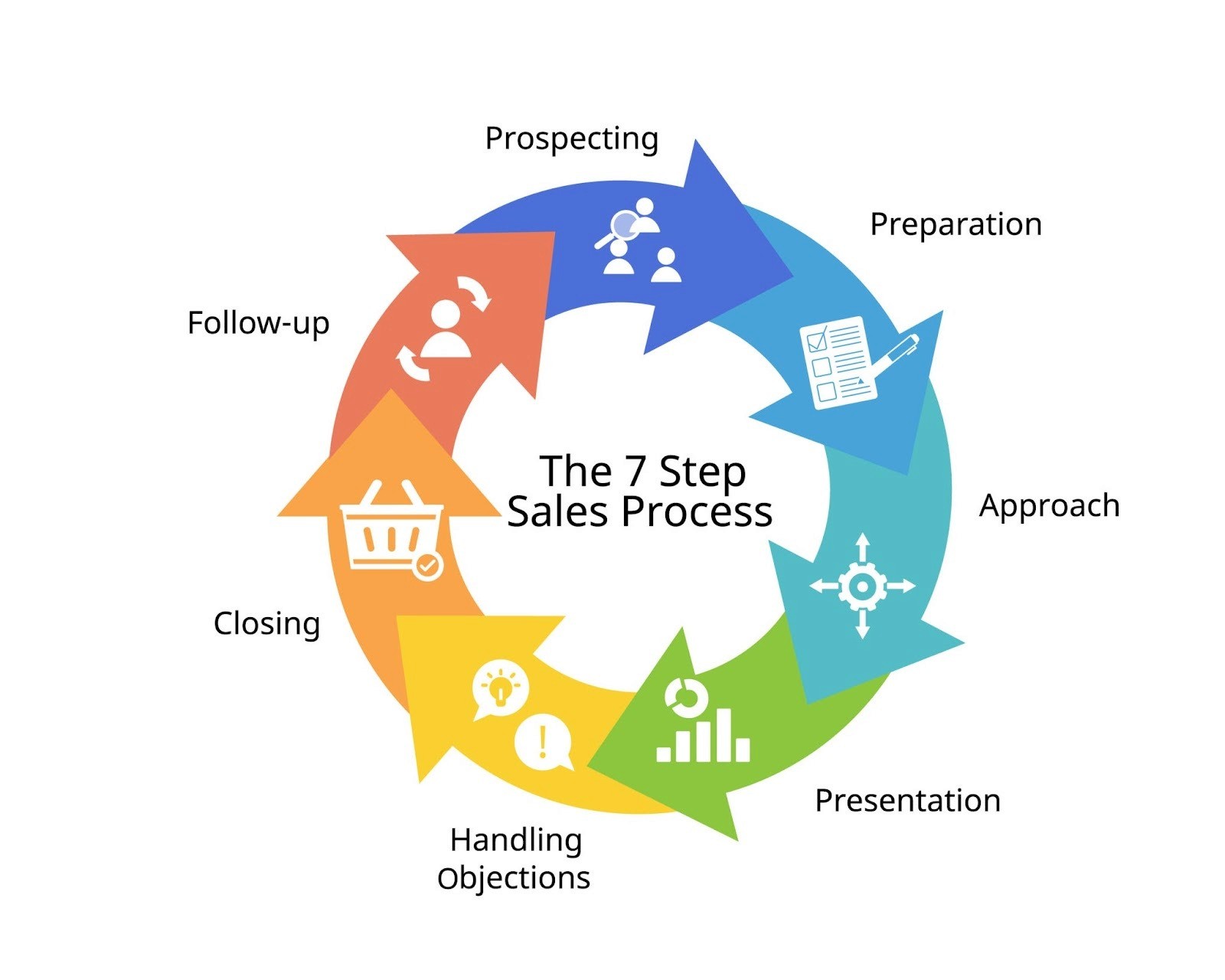
Stage 1: prospecting and lead generation
Prospecting is the foundation of your revenue engine. The goal? Identify potential customers who fit your ideal customer profile (ICP).
In high-volume environments, the temptation is to spray and pray, but the data tells a different story. Quality at the top of the funnel dictates velocity at the bottom.
What works:
Spend 80% of prospecting hours on accounts that match at least three ICP criteria
Use LinkedIn outreach, cold email, and referrals with surgical precision
Let AI tools scan intent signals so reps only reach out to accounts in active buying windows
Red flag: If only 20% of your prospects qualify for the next stage, your ICP is too broad. You’re burning rep time on dead-on-arrival leads.
Stage 2: making initial contact
This is your first touchpoint, whether it’s a call, email, or LinkedIn message. The objective? Earn five minutes of their time. Don’t focus on selling the product yet.
Start with relevance, not features. Mention a specific trigger event like a recent funding round, job change, or company news within the first 10 words of your outreach.
Curiosity is more powerful than features at this stage.
Watch for this: High open rates on emails but 0% reply rates. This usually means your subject line works, but your hook is not relevant.
Stage 3: lead qualification
This stage protects your sales cycle length. You must determine if a prospect has budget, authority, need, and timeline (BANT) to move forward.
Ask strategic discovery questions and map stakeholders. One of the best questions you can ask: What happens if you do nothing about this problem? This forces prospects to articulate the cost of inaction, which creates immediate urgency.
Don’t confuse interest with qualification. Many tire-kickers are happy to take a demo but have no power to sign a check.
Red flag: If a prospect refuses to discuss budget or timeline after the first call, they’re likely on a fact-finding mission rather than a buying journey.
Expert insight: Lead qualification is not a one-off checkpoint. It’s a continuous thread that runs through every stage of the deal.
Stage 4: presenting your solution
This is the demonstration stage, where you’re no longer selling a tool. You’re selling a solution to a specific pain point discovered in stage 3.
Research from RAIN Group shows that 58% of buyers say sales meetings aren’t valuable because sellers fail to deliver value. A huge reason this can happen is when the conversation feels like a generic product pitch instead of a tailored discussion about their specific goals and challenges.
How to make your demo count:
Start with their specific problem before showing any software
Use their actual data or workflow in the demonstration
Share ROI calculations and relevant case studies
Make the prospect see themselves in your presentation
If the prospect can’t see themselves in your demo, the psychological distance to a ‘yes’ remains too great.
Red flag: If the prospect is silent during the demo and doesn’t ask, “How does this work for us?” you’ve lost their engagement.
Stage 5: handling objections
Objections aren’t a no. They’re requests for more information.
Whether the concern is price, timing, or a competitor, this stage is where skilled reps earn their commissions. Address doubts with data instead of defensiveness.
Never argue. Acknowledge the concern (“That makes sense”), ask a clarifying question, and respond with data.
Common objections and how to handle them:
Too expensive: Pivot to the ROI and the cost of the status quo
Not the right time: Quantify the revenue lost by waiting another quarter
Happy with our current solution: Highlight specific gaps they may not realize exist
AI advantage: Conversation intelligence surfaces which objections your reps struggle with most, allowing for targeted coaching to close those gaps.
Stage 6: closing the deal
This stage is about momentum. Negotiating terms and securing a signature require equal parts project management and persuasion.
One key is to discuss next steps on every single call. Momentum dies when a call ends without a clear action and timeline. Then deals drift into the danger zone where prospects go quiet and never respond.
Closing techniques that work:
Assumptive Close: Should we start the implementation on Monday?
Alternative Choice: Would you prefer annual or bi-annual billing?
Final negotiations, procurement coordination, and contract signing all happen here.
Red flag: If the prospect stops responding after you send the contract, it means you didn’t build enough value in stage 4 or 5.
Stage 7: follow-up and nurture
For high-volume SaaS teams, the cycle doesn’t end when the contract is signed because retention is the growth engine that compounds revenue over time.
A 5% increase in customer retention can increase profits by 25% to 95%, which is why post-sale nurture matters as much as closing the deal itself.
Make retention part of the sale:
Schedule your 30, 60, and 90-day check-ins before you even close the deal
Run onboarding calls and Quarterly Business Reviews (QBRs)
Identify upsell opportunities based on usage patterns
Don’t close and ghost. Leaving the customer success team to pick up the pieces without a proper handoff will lead to early churn.
Red flag: Low usage rates in the first 30 days. If they aren’t using the tool immediately, they won’t renew in a year.
How to calculate your sales cycle length
You cannot manage what you don’t measure. While understanding the stages of a sales cycle matters for strategy, calculating its duration is critical for operations.
A standardized formula helps you move away from anecdotal evidence (it feels like it takes two months) to concrete data that drives your hiring, budgeting, and revenue targets.
The basic formula
Your average sales cycle length is the average number of days it takes for your team to close a deal from first contact to contract signing.
You don’t need complex software to find your sales cycle length. You just need your CRM data and a simple calculation.
The formula:
Total # of days to close all deals ÷ total # of deals closed = average sales cycle length
Example: Let’s look at a typical Q1 for a mid-market SaaS team.
Total deals closed: 20
Time per deal: Deal 1 took 45 days, deal 2 took 67 days, deal 3 took 30 days, and so on
Sum of days for all 20 deals: 1,240 days
Calculation: 1,240 days ÷ 20 deals = 62-day average cycle
Why this matters: If your goal is to grow revenue by 20% next quarter, you now know that any new lead generated today won’t hit your bank account for at least two months. This insight lets you forecast accurately instead of hoping deals close faster than they actually do.
Calculating conversion rates between stages
Your conversion rate measures what percentage of prospects successfully move from one stage to the next.
Think of it like a funnel: you pour 100 prospects into the top at stage 3 (qualification). Only 45 make it through to stage 4 (demo), so that 45% conversion rate tells you exactly where deals are leaking out.
The formula:
(# of opportunities in stage B ÷ # of opportunities in stage A) × 100 = Conversion %
Example: Your team qualified 100 prospects (stage 3), but only 45 of them progressed to a product demo (stage 4). Your conversion rate for that transition is 45%.
How to use this: If the industry average for your sector is 65%, this 20% gap points to a specific problem. Are your reps failing to build enough value during the discovery call? Is your demo scheduling process so clunky that prospects lose interest before they even see the product?
You pinpoint exactly where the cycle breaks down by measuring these micro-conversions. Instead of saying “our cycle is too long,” you can say “we’re losing deals between qualification and demo, and here’s why.”
Industry benchmarks to compare against
Industry benchmarks show you the average cycle lengths across different sectors and company sizes. These numbers give you a reference point to gauge whether your team is performing ahead of or behind the market.
A common question among VPs is: “How long is a typical sales cycle?” While you should always compete against your own historical data first, benchmarks help you understand if you’re moving at market speed or dragging behind.
Industry/Segment | Average Sales Cycle Length |
SaaS (SMB) | 30-60 Days |
SaaS (Mid-Market) | 60-90 Days |
SaaS (Enterprise) | 120-180+ Days |
Professional Services | 30-45 Days |
Manufacturing & Hardware | 90-180 Days |
Key terms explained:
SMB (Small and medium businesses): Companies with fewer than 500 employees. Smaller deal sizes, faster decisions.
Mid-Market: Companies with 500-2,500 employees. More stakeholders involved, moderate deal complexity.
Enterprise: Companies with 2,500+ employees. Multiple departments, long procurement cycles, largest deal values.
The caveat: Treat these numbers as a directional guide, not an absolute truth.
Your ACV (Annual Contract Value, meaning the yearly revenue you earn per customer), the number of decision-makers involved, and whether your category is new or established will significantly shift these timelines.
An enterprise deal with multiple stakeholders and a six-figure contract naturally takes longer than a $5,000 SMB sale. Use these benchmarks to spot red flags rather than to set rigid expectations.
How to shorten your sales cycle
Shortening your cycle isn’t about rushing prospects. It’s about removing friction and administrative drag that stalls momentum. Follow these steps to shorten your sales cycle:
1. Tighten your ICP: Stop selling to bad-fit prospects. Analyze your fastest wins and qualify ruthlessly against those patterns so reps only work accounts where the need is immediate.
2. Prioritize high-intent leads: Use AI scoring to identify prospects showing real buying signals like repeated site visits or email engagement.
3. Multi-thread early: Single-threaded deals die when your champion leaves. Ask “Who else needs to approve this?” during qualification and get intro calls with all stakeholders upfront.
4. Automate repetitive tasks: Free reps from data entry and scheduling so they can focus on tailoring presentations and building relationships instead of chasing calendar invites.
5. Align sales and marketing: When marketing delivers sales-ready leads instead of prospects who need three education calls, your qualification stage shortens dramatically.
6. Discuss next steps: End every call with a specific action and firm date to keep momentum alive.
7. Provide ROI tools early: Give prospects calculators and business case templates after demos so they can sell internally without delays.
8. Train on objections: Weekly role-plays on common objections keep reps from losing days to “let me check with my manager.”
Tools and technology for sales cycle management
Having a world-class sales process is only half the battle because the other half is having the right technical infrastructure to execute it at scale.
Modern sales cycle management tools don’t replace a solid methodology. They act as a force multiplier by automating the grunt work so your reps can focus on high-value human interaction.
The foundation: CRM for a sales cycle
A robust CRM like Salesforce, HubSpot, or Pipedrive is non-negotiable. It serves as your single source of truth by centralizing deal data and tracking how opportunities move from one stage to the next. Then you can measure conversion rates and identify where deals are leaking.
Execution: sales engagement and automation
Sales automation software like Outreach, Salesloft, or Yesware keeps the cycle moving by automating repetitive touches. These platforms handle email cadences, follow-ups, and social touches that prevent leads from going cold.
Insight: conversation intelligence
Tools like Gong or Chorus.ai record and analyze sales calls to identify successful speech patterns. This allows managers to review what was said and share the best tactics across the entire team instead of keeping them locked in your top performers’ heads.
The new frontier: real-time AI sales coaching
Traditional tools look backward at what happened. The emerging category of real-time AI sales coaching assists reps as the conversation is happening.
What to look for in AI coaching platforms:
Live objection-handling prompts during calls
Automated performance feedback after each conversation
Predictive deal scoring based on conversation quality
Platforms like Alpharun combine these capabilities to help reps navigate complex objections and maintain momentum without waiting for manager feedback.
When selecting your stack, prioritize tools that offer seamless integration and AI-powered insights.
Your next steps to optimize your sales cycle
Now that you understand what a sales cycle is, why it matters, and how top teams optimize theirs, it’s time to turn these insights into revenue. Don’t let your cycle length be a black box.
Take control of your sales velocity with these three immediate actions:
Calculate your baseline: Use the sales cycle length formula above to measure your current performance. Compare your results against industry benchmarks to determine if your cycle is a competitive advantage or a bottleneck that’s costing you deals.
Audit your conversions: Map your conversion rates between each of the seven stages. Identify where your deals are stalling because that’s your primary target for optimization and where coaching will have the biggest impact.
Implement quick wins: Start with multi-threading and mandating next steps on every call. These high-impact tactics deliver measurable results within weeks, not months. They require no additional budget or headcount to execute.
Modern sales teams no longer just track their cycle. They accelerate it with intelligence.
Making sales cycle optimization easier
Building a sales cycle strategy is one thing. Executing it across 50+ reps without losing quality is another. Why? Traditional coaching can’t scale.
Managers can only review a handful of calls per rep monthly, so most reps go weeks without feedback on what’s working or failing at each stage of the cycle.
Alpharun solves this. It analyzes every call, extracts patterns from top performers, and delivers instant coaching without doubling headcount.
Here’s what you can do with Alpharun:
Build playbooks from your best calls: Alpharun analyzes thousands of calls to discover what your top performers do differently at each stage of the sales cycle and turns that into a repeatable process.
Coach every rep, not just a lucky few: Gain personalized feedback for each rep based on granular call analysis. Managers get team dashboards that pinpoint where coaching is needed, so they don’t have to guess which calls to review.
See what’s actually happening on calls: Fine-grained analysis breaks down every call by content, compliance, and behavior. Managers get objective visibility into hundreds of daily calls instead of relying on spot checks to understand where deals stall.
Handle volume with AI voice agents: Deploy voice agents trained on your sales process for lead qualification, intake calls, and after-hours coverage. Reps focus on closing, and AI handles repetitive screening work at the top of the cycle.
Stay compliant in regulated industries: Built-in compliance protocols for Medicare, insurance, financial services, and healthcare keep your team compliant as you scale. Updates roll out automatically as regulations change.
Launch fast with enterprise-grade security: SOC 2 Type II, HIPAA, and GDPR-compliant, with end-to-end encryption. Dedicated AI engineers help you deploy a custom playbook in about two weeks.
Ready to scale coaching across your high-volume team and shorten your sales cycle? Book a demo to see how Alpharun works with your sales org.
Frequently asked questions
What is the difference between a sales cycle and a sales pipeline?
A sales cycle is the time and stages a deal takes from first contact to close. A sales pipeline is a visual snapshot of all active deals at different stages, showing the total volume and value of opportunities moving through your funnel.
What is a B2B sales cycle vs. a B2C sales cycle?
B2B sales cycles last 30-180 days because they involve multiple stakeholders, higher deal values, and longer approval processes. B2C sales cycles range from minutes to weeks, since they’re transactional, involve one or two decision-makers, and involve lower price points.
How can I track my sales cycle?
Use your CRM to record the date each deal enters and exits every stage, then calculate conversion rates between each one of them. This data shows you which stages need optimization and which reps need coaching at specific points in the cycle.
What factors affect sales cycle length?
Product complexity, price point, number of decision-makers, and company size all affect cycle length. Enterprise deals with multiple stakeholders and six-figure contracts naturally take longer than SMB sales with one decision-maker.

