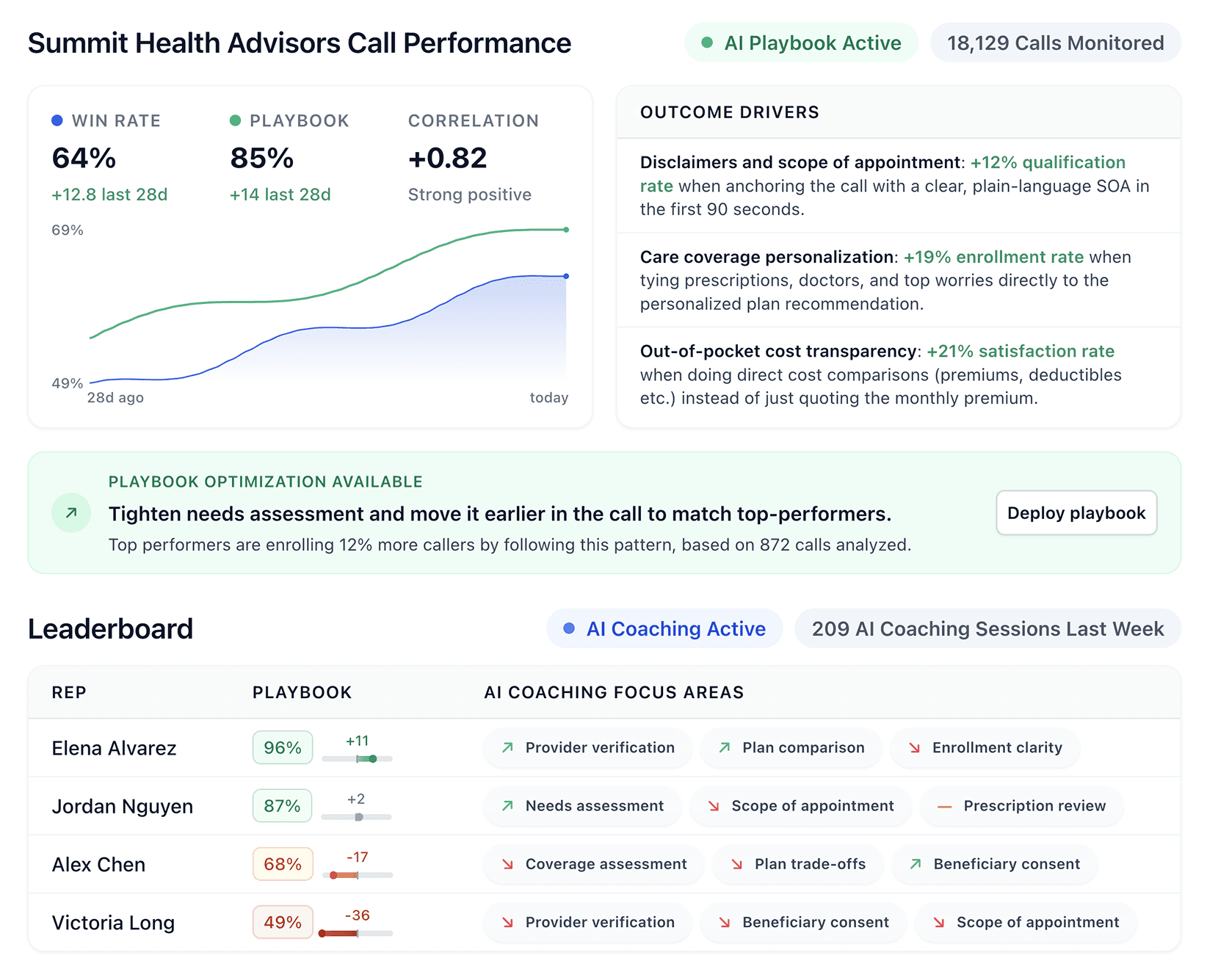


A sales playbook turns your best sales tactics into a repeatable system your whole team can use, from prospecting to closing.
Keep reading to learn what a sales playbook is, why it matters, and how to build one that helps every rep sell like your top performer.
What is a sales playbook?
A sales playbook is a documented guide that defines your sales process, messaging, and best practices. It gives reps a clear framework for moving prospects from first contact to closed deal.
Think of it as your sales operations manual. Your playbook shows reps which actions to take at each stage, what to say during objections, how to position your product against competitors, and when to escalate deals. It eliminates guesswork and replaces it with proven tactics.
The playbook answers: "What should I do next?" at every point in the sales cycle.
What's inside a sales playbook
A sales playbook is a practical guide for your team. It shows reps what to say, what to do, and what to use at every stage of the sales cycle. It turns plans into clear steps that help everyone sell with confidence.
Your playbook template should cover:
Target buyer profiles: Who you sell to, their pain points, and their decision-making process
Sales process stages: Clear steps from prospecting to close
Qualifying criteria: How to identify good-fit prospects
Messaging frameworks: Key value props and positioning for different personas
Objection responses: Proven answers to common pushback
Competitive intelligence - How you stack up against alternatives
Deal criteria - When to pursue, pause, or walk away from opportunities
Tools and resources - Templates, scripts, and assets reps need
Success metrics - How performance gets measured
How a sales playbook differs from a sales process
A sales process maps the stages a deal moves through. Sales playbooks tell reps what to do at each stage.
Your sales process might look like: lead → qualification → demo → proposal → close.
Your playbook explains:
How to qualify leads (questions to ask, red flags to spot)
How to run an effective demo (talking points, customization by persona)
What goes in a proposal (pricing structure, terms, case studies)
Closing tactics that work (trial closes, handling final objections)
The process is your roadmap. The playbook is your GPS with turn-by-turn directions.
Why sales teams need a playbook
A sales playbook turns scattered sales tactics into a repeatable, proven system. It helps teams perform consistently, ramp faster, and deliver a unified customer experience.
Codifies what works
Your best reps know exactly which questions to ask, when to share pricing, and how to handle objections. When that knowledge is not written down, it disappears when they leave or stays trapped in their heads.
A sales playbook captures proven tactics and turns them into a repeatable system. New hires ramp in weeks instead of months, and every rep uses the same strategies that drive top performance.
Scales performance across the team
When only part of the team hits quota, the problem is not talent. It is access to knowledge. Top performers follow a mental playbook. Writing it down gives everyone the same tools to succeed.
Strong sales enablement programs turn that shared knowledge into consistent execution. Companies with structured enablement see a 49% win rate compared to 42.5% without it.
A solid sales playbook makes those results possible by helping every rep sell at the level of your best performers.
Reduces ramp time for new hires
An average of 39% of new reps need 3 to 5 months to reach full productivity. Each slow month costs revenue.
A clear playbook cuts that time in half. It gives new hires the exact words, tactics, and preparation steps to use with every buyer. Instead of guessing, they start selling confidently from day one.
Creates consistency in customer experience
When every rep tells a different story, prospects get mixed messages. One talks price, another focuses on features, and another sells vision.
A unified playbook template keeps the team aligned. Every rep highlights the same value, handles objections the same way, and delivers a consistent buying experience that builds trust and increases conversions.
Types of sales playbooks
Different sales teams need different playbooks. Each one focuses on the unique strategies, tools, and conversations that fit the team’s selling style and customer journey.
inside sales playbook
Inside sales playbooks focus on high-volume, phone-based selling with short sales cycles. These work for sales development representative (SDR) teams making 50+ calls per day or inside account executives closing deals in 1-3 conversations.
Key components:
Call scripts for cold outreach and follow-ups
Email sequences that move deals forward
Qualification checklist to filter good leads fast
Objection responses for common pushback (budget, timing, competition)
Time-saving workflows for customer relationship management (CRM) updates and admin tasks
Inside sales playbooks emphasize speed and efficiency. Reps need quick reference guides they can check between calls, not 50-page documents.
Outside sales playbook
Outside sales playbooks support field reps managing longer, relationship-driven deals. These cover in-person meetings, multi-stakeholder navigation, and complex negotiations.
Key components:
Account research templates for pre-meeting prep
Discovery question frameworks for uncovering needs
Stakeholder mapping guides to identify decision makers
Presentation structures for different meeting types
Proposal templates and negotiation tactics
Post-meeting follow-up sequences
Outside playbooks provide depth over speed. Reps reference them during deal planning, not during live conversations.
B2B sales playbook
B2B sales playbooks address longer sales cycles, multiple decision makers, and enterprise-level complexity. These work for companies selling software, professional services, or high-value products to other businesses.
Key components:
Ideal customer profile (company size, industry, tech stack)
Buying committee roles (economic buyer, technical buyer, end user)
Return on investment (ROI) calculators that quantify value
Security and compliance responses
Case studies organized by industry and use case
Implementation timelines and success criteria
B2B playbooks help reps handle complex decision-making and prove value to multiple stakeholders. They focus on consultative selling, not transactional closes.
Digital sales playbook
A digital sales playbook lives in your CRM or sales enablement platform instead of a static document. Reps access it during calls, get real-time suggestions, and see updates automatically.
Benefits:
Context-aware guidance that surfaces the right content at the right time
Search functionality to find answers fast
Version control so everyone works from the most current information
Usage analytics showing which content actually gets used
Integration with tools reps already use (email, video conferencing, CRM)
Digital playbooks adapt as your business changes. Update an objection response once, and every rep sees it immediately.
How to build a sales playbook
A sales playbook gives your team a clear path from finding leads to closing deals. It takes time to build, but once it’s done, it turns good sales habits into a simple, repeatable system that gets results.
Step 1: Map your current sales process
Start by writing down every stage a deal goes through, from first contact to closed-won. Focus on what happens now, not on what you want to happen.
Talk to your team to gather real insight. Ask:
What do you do at each stage?
What questions do prospects ask most often?
Where do deals stall most often?
What information do you wish you had earlier?
Review five to ten recent deals, both wins and losses. Look for trends such as stages that take too long or points where deals fall apart. Spot what top performers do differently to keep deals moving.
Step 2: Interview your top performers
Your best reps hold the secrets to what actually works. Sit down with them one-on-one and capture their process in detail.
Ask questions like:
How do you qualify leads?
What questions reveal a buyer’s real needs?
How do you respond to common objections?
What do you say when a prospect mentions a competitor?
How do you decide when to keep pushing or when to move on?
Record these conversations. Many top reps work on instinct, so hearing how they handle calls gives you phrases and tactics you can turn into playbook material.
Step 3: Analyze what’s working
Use data to back up what your team tells you. Let your CRM and call recordings show what drives results.
Check patterns such as:
Which discovery questions lead to more closed deals?
Which objection responses move the deal forward?
Which email templates get the best replies?
What content shared in demos helps win more deals?
How do top reps structure their outreach?
Compare what your data shows to what your current process says. If your best reps share pricing later than your process recommends, update the playbook to match what actually works.
Step 4: Create your first draft
Start simple. Build a version that covers the essentials before adding more detail.
Structure to follow:
Who we sell to
Buyer personas with goals, pain points, and objections
Ideal account profile
Disqualification criteria
Our sales process
Stage definitions and exit criteria
Average time in each stage
Key actions for reps and prospects
Messaging and positioning
Core value propositions
Competitive advantages
Use case examples by persona
Handling objections
Common objections by type
Proven responses with real wording
When to push and when to pivot
Tools and resources
Email templates and call scripts
Demo outlines
Proposal templates
Keep it practical. Each section should help a rep in a real conversation. For example, after reading a section on objections, they should know exactly what to say on a call.
Step 5: Test and refine
Share the playbook with a few reps first. Watch how they use it and gather feedback before launching it company-wide.
Track what happens:
Which sections get used most often?
Where do reps still ask for help?
Which parts feel outdated or confusing?
How does performance change for reps using the playbook compared to others?
Make updates weekly for the first month. Remove anything that adds clutter, and expand sections that reps find helpful. A playbook should evolve based on how your team sells in real life.
Using AI to continuously improve your playbook
Once you build your playbook, the next question becomes: how do you keep making it better?
Traditional playbooks stay static until someone manually updates them. Your team's best tactics evolve, markets shift, and competitors change, but the playbook stays the same until a manager finds time to revise it.
AI changes this completely. Modern AI platforms analyze every customer interaction to identify what's working right now and surface specific recommendations for improving your playbook.
What AI monitors to optimize your playbook
AI-powered platforms track performance signals across your entire sales team to spot patterns you can't see manually. They analyze thousands of conversations to find which tactics drive results and which ones fall flat.
Key metrics AI monitors:
Win rates by questioning approach: Which discovery questions lead to closed deals versus stalled conversations
Objection handling effectiveness: Which responses move deals forward and which ones create more pushback
Talk patterns of top performers: Specific phrases, timing, and conversation structures used by reps who consistently hit quota
Compliance adherence: Where reps skip required disclosures or miss regulatory language
Competitive positioning success: Which competitor comparisons resonate with buyers and which ones backfire
Deal velocity by stage: Where deals move quickly versus where they consistently stall
How AI turns insights into playbook improvements
AI translates performance data into specific recommendations for updating your playbook.
Example recommendations AI surfaces:
Discovery stage improvement: "Your top 20% of reps ask about budget constraints within the first 5 minutes of discovery calls. Reps who wait until later in the call have a 34% lower close rate. Update your discovery framework to include early budget qualification."
Objection handling update: "When prospects say 'we're already working with a competitor,' reps who respond with case studies comparing outcomes close 2.3X more often than reps who focus on feature comparisons. Add three comparison case studies to your objection handling section."
Compliance optimization: "12% of calls are missing the required disclosure statement in states with specific regulations. Add a mandatory checklist item at the 3-minute mark of every call in regulated states."
Competitive positioning refinement: "Deals where reps mention your implementation timeline advantage in the first demo close 41% faster. Add implementation speed to your primary value proposition for technical buyers."
These insights come from actual conversation analysis, not guesswork. AI identifies what works by studying your team's real interactions, then recommends playbook changes based on proven outcomes.
Making optimization automatic
The best AI platforms go beyond identifying improvements and help your team implement them instantly.
Here's how it works in practice:
AI analyzes all recorded calls to identify winning behaviors from your top performers. It spots patterns like specific questions that uncover needs, timing that keeps deals moving, and language that handles objections effectively.
The platform generates specific recommendations for updating your playbook based on what's actually working. You review these suggestions and approve the changes you want to implement.
Updates go live immediately. Your team gets real-time coaching based on the improved playbook during their very next call. Reps see exactly where to adjust their approach, down to the sentence level.
The system continuously learns. As your team implements new tactics, AI measures results and surfaces the next round of improvements. Your playbook gets smarter every week.
This creates a self-improving cycle where your playbook evolves based on real performance data instead of periodic manual reviews. Your team always uses the most effective tactics, and you spend less time guessing what works.
Sales playbook template
A sales playbook template gives your team a clear guide they can use every day. It helps new reps ramp faster and keeps experienced reps consistent.
Here’s a simple structure you can adapt to build your own:
Playbook cover and introduction
Start your playbook with a quick overview that sets the tone. Include:
Company overview and mission
Product or service summary
The purpose of the playbook and how to use it
The last updated date
1. Target customers
Help your team understand who to focus on and who to avoid. Include:
Ideal customer profile checklist
Buyer persona cards for three to five key personas
Qualification questions to confirm fit
Red flags that show a poor fit
2. Outline the sales process
Show the full sales journey from prospecting to close. Include a visual overview of the process showing:
Stage 1: Prospecting - key actions, talk tracks, and tools
Stage 2: Discovery - question frameworks and pain point mapping
Stage 3: Demo or presentation - agenda and personalization tips
Stage 4: Proposal - pricing structure, terms, and approvals
Stage 5: Negotiation - common requests and approval limits
Stage 6: Close - paperwork and handoff steps
3. Messaging
Give reps words that resonate with buyers. Include:
Value proposition statements for each persona
Competitive positioning against the top three alternatives
ROI framework and calculator
Case study library organized by industry and use case
4. Objection handling
Prepare reps for common objections before they happen. Example:
Objection: “Too expensive”
Why they say this: price concern or unclear value
How to respond: clear script focused on value and ROI
When to discount: after confirming specific criteria
Add similar responses for objections like:
“Not the right time”
“Already working with a competitor”
“Need to think about it”
5. Sales tools and resources
List everything reps need to sell effectively. Include:
CRM workflow guides
Email templates by stage
Call scripts for frequent scenarios
Demo setup instructions
Proposal templates
Contract and legal resources
6. Metrics and goals
Show how you measure success. Include:
Key performance indicators
Activity targets by role
Commission structure
How managers review performance
Build a playbook that scales performance
A sales playbook works best when it fits naturally into your team’s daily workflow. Alpharun makes this possible. Our platform captures what your top performers do, turns that into a custom AI model, and uses it to guide every sales call in real time.
Traditional analytics stop at surface data. Alpharun focuses on what really matters. Our AI studies your full sales process, including compliance steps and winning language. It then coaches each rep against that exact model to drive predictable, measurable results.
Alpharun helps teams:
Create playbooks customized for sales and compliance needs
Get AI coaching built from actual conversations
Identify and close skill gaps with clear performance analytics
Automate lead follow-ups using AI voice agents
Protect sensitive data with HIPAA and SOC 2 Type 2 compliance
Plus, Alpharun sends the agents short, digestible weekly coaching notes directly as well to take some of the work off the manager's plate. Alpharun exists to make extraordinary performance inevitable. We help every rep grow, every manager coach smarter, and every organization reach its highest potential.
Schedule a demo to learn how Alpharun helps your team reach peak performance.
Frequently asked questions
What format should I use for a sales playbook?
Others might tell you to use formats like PDFs or Google Docs for a sales playbook, but these formats quickly become outdated because they’re disconnected from real selling.
The best format stays current and is easy to use daily.
Modern sales teams use platforms like Alpharun that form a living link to the playbook of call coaching and performance tracking. Alpharun builds a sales paybook that stays relevant and updated with real data.
How often should the playbook be updated?
You should update your sales playbook whenever your process, product, or market changes. Review feedback from reps and adjust based on what’s working in real calls.
What metrics show the playbook is working?
The best metrics to track are win rate, ramp time, and quota attainment. You should also monitor call quality, deal velocity, and consistency across reps. If those improve, your playbook is driving results.
How do you ensure your sales team actually uses the playbook?
Ensure your sales team uses the playbook by making it a part of your reps’ workflow. Integrate it into your CRM, reinforce it during coaching sessions, and highlight wins that came from following it. Keep it short, practical, and easy to find so reps rely on it every day.