Will AI replace call center agents? Here's what AI handles, what human agents still own, how the job is changing, and how to run both on a phone team.

Will AI replace call center agents? Not entirely. AI is shrinking routine roles on phone teams, but agents are still needed for complex, emotional, and high-value calls.
Gartner predicts AI will autonomously resolve 80% of common customer service issues by 2029, and in July 2026, the LA Times reported that thousands of customer service workers face the ax as companies like Uber and Microsoft lean on AI.
Picture a Medicare sales floor in the first week of enrollment season. Two hundred reps, every phone lit up, and a VP in the back asking the question nobody on the floor wants to hear out loud: if AI can handle calls now, how many of these seats do we still need next year?
We've spent enough time on high-volume B2C sales floors to see how this plays out in practice. Here's what AI already does on a sales floor, what it still can't touch, how the agent's job changes, and how the strongest teams run humans and AI together.
Will AI replace call center agents? Not entirely
Gartner predicts agentic AI will autonomously resolve 80% of common customer service issues by 2029, a forecast the BBC put at the center of its look at whether AI means the end of call centers.
That still leaves people on the complex, uncommon, and high-stakes calls, and on a sales floor, those are the most valuable ones: the discovery calls, the objection-heavy closes, the enrollment that turns on one worried question.
The pressure is real, though. In July 2026, Uber cut 10% of jobs in its customer service operations and cited its push to embrace AI, and Forrester predicts AI will cut the number of customer-service jobs in half by 2030. Routine phone work is shrinking.
For a high-volume sales team, that's an opening. The real question for a sales leader is simpler: how do I point AI at the busywork so my reps spend all day on the calls that convert?
What AI already does in sales call centers
AI has taken over a chunk of the work that used to eat up a rep's whole day. The pattern is consistent: high-volume, structured, repeatable tasks.
Routes calls to the right rep
AI reads the caller's intent, history, and tone in seconds, then sends them to the rep best placed to close. Hot leads skip the hold music. (How AI works in call centers breaks down the mechanics.)
Captures after-hours leads
When the floor goes dark, AI can answer, qualify, and book a callback so reps start the morning with warm leads instead of a voicemail queue.
Transcribes and summarizes every call
AI writes the call summary and updates the CRM, which hands reps back the time they used to lose to after-call notes.
Scores every call against your playbook
Manual QA only ever reaches a small share of calls. AI scores 100% of them against the criteria you care about, from the opening disclosure to the close. (There are plenty more AI use cases in contact centers where that comes from.)
Flags sentiment and intent on every call
AI tags frustration or hesitation on every scored call, so a supervisor can see which calls went sideways and coach before the same moment costs the next sale.
None of it is why a customer picks your agency over the one down the street.
What AI still can't do on a sales call
Everything AI is good at shares one trait: it's predictable. Sales calls stop being predictable the moment real money or real emotion enters the room.
Win a hesitant, high-stakes decision
A 64-year-old comparing Medicare Advantage plans isn't buying a password reset. When the call turns into a half-spoken worry about a spouse's prescriptions, a good rep hears it and adjusts. AI tends to plow ahead.
Handle the objection nobody scripted
AI works well off known patterns. Throw it a curveball, a strange financial situation, an objection that blends three concerns at once, and a human adapts faster.
Build trust a consumer can feel
AI can imitate warmth. Plenty of customers still clock the difference, and on a one-call close, that doubt costs you the sale.
Make the compliance judgment call
AI can flag a missed disclosure. Deciding how to handle a gray-area TCPA or CMS moment mid-call still takes a trained human.
How the call center agent's job changes
If you're a rep reading this and wondering whether you're training your replacement, the job is changing shape: some roles shrink, and others are about to get a lot more valuable. The same goes for licensed advisors, financial educators, and care navigators who work alongside sales reps on regulated phone teams.
Roles that shrink
Tier-1 call routing, simple FAQ answering, and manual call logging go first. If a task follows the same script every time, assume AI will absorb most of it over the next few years.
Roles that grow
The work that's expanding: QA analysts who tune what "good" looks like, sales coaches, escalation and complex-sale closers, and the people who own the AI workflow itself. Someone has to decide what AI scores against and what to do with 100% call coverage.
The skills that keep you valuable
Judgment, objection handling, consultative selling, and knowing how to act on AI coaching when you get it. Reps who treat AI like a sparring partner ramp faster and close more. (For managers, this is where to focus your coaching.)
For managers, the shift is just as big. AI scores every call, so you stop guessing from a handful of spot-checks and start coaching from the full picture.
Why high-volume sales teams gain the most
The math is simple and a little brutal. A team running thousands of calls a day turns a one-point conversion lift into real money, fast.
That's why high-volume B2C floors see the biggest returns: Medicare and life insurance brokerages, consumer-direct mortgage lenders, and wealth management call centers. A small per-call improvement, multiplied across 50-plus reps doing 80 to 100 calls each, compounds quickly.
These teams also share the traits that make AI pay off:
High call volume: Automation has plenty to chew on.
Strict compliance rules: Monitoring every call beats spot-checking a handful.
Long ramp times: Post-call coaching at scale shortens the path to quota.
Why sales teams are adopting AI now: The cost math
Three costs have been draining call centers for years, and AI goes after all of them.
Turnover
Call center agent turnover hit 38% in 2022, according to SQM Group, which puts the cost of replacing an average-performing agent at $20,800. A lot of that churn traces back to burnout from the exact repetitive calls AI is built to absorb. Cut the grind, and you keep more of your good reps.
Staffing gaps
Volume spikes don't care about your headcount plan. Medicare's enrollment window forces the overstaff-or-understaff trap every year. AI flexes with the spike instead of triggering a hiring scramble.
Ramp and training
A new rep can take months to reach full productivity, and you're paying them the whole time. AI coaching on every call shortens that ramp and catches mistakes while they're still cheap to fix. It's one of the bigger automation trends reshaping budgets this year.
The hybrid model in practice
The best-performing floors split the work by what AI and people each do well.
AI takes the first touch
AI routes inbound calls, qualifies leads, and books appointments, so by the time a rep picks up, the lead is warm, and the context is already attached.
Humans take the close
Reps step in for the conversations that decide revenue: building rapport, working objections, and closing the deal. That's where experience earns its keep.
AI coaches after every call
Right after the call ends, AI scores it and shows the rep what worked and what to try next time. The feedback lands while the call is still fresh, long before a monthly review would.
Managers coach from data
Managers see patterns across the whole team, so they spend their time where it moves the number.
How to prepare your sales team for AI
Start with one sane first step and a way to measure it.
1. Start with the repetitive layer
Point AI at the work that drains reps without needing judgment: routing, after-hours capture, call logging, and QA scoring. Fast wins, low risk.
2. Pick AI that learns your process
Generic tools track surface-level metrics like talk-to-listen ratio. Look for a platform that learns your actual sales process and compliance rules, then coaches against them.
3. Sell the team on the hybrid model
Reps resist tools that feel like surveillance. Show them AI that makes their next call easier and their bonus bigger, and most of the resistance fades.
4. Measure the numbers that move
Track close rate, ramp time, and compliance pass rate before and after. Let the numbers make the case, then expand from there.
How Alpharun scores every call and coaches reps right after
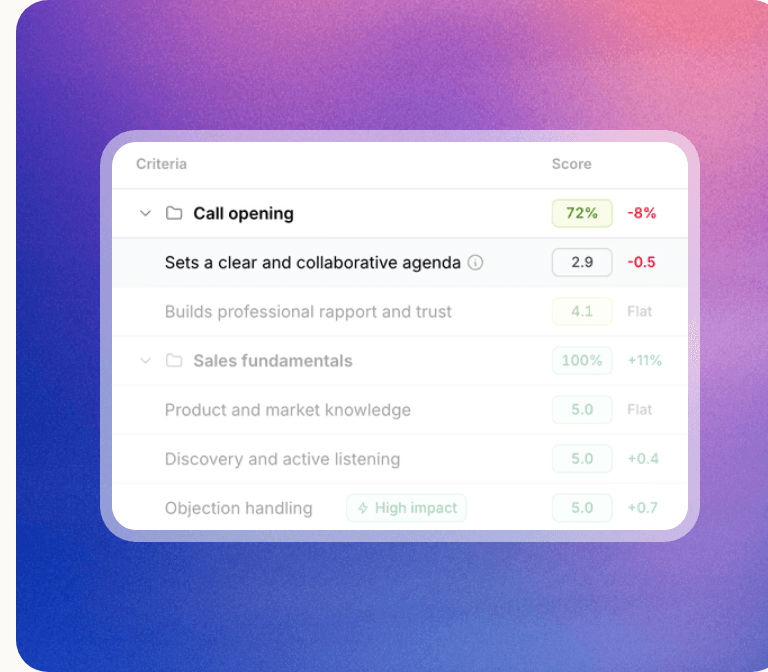
Alpharun's call scorecard, breaking a rep's call opening and sales fundamentals into scored criteria.
The hybrid model leaves one problem open: knowing what your best reps do differently, then getting everyone else to do it too. Top performers often bring in far more revenue than the middle of the floor, and most teams can't explain why.
Alpharun closes that loop. It's an AI sales coaching and QA platform built for high-volume phone teams in Medicare, life insurance, mortgage, wealth management, and healthcare.
Alpharun learns from your best calls, builds those tactics into a custom playbook, and scores every call against it, which tells you far more than a talk-to-listen ratio.
The coaching is specific, and it lands right after the call. A rep sees "At 2:34, here's what you could've said," tied to what works on your own floor. That's automated call scoring doing the heavy lifting a manager never has time for.
Compliance rides inside the same score. Alpharun builds your rules (recording disclosures, qualification steps, and lead-discovery tactics) straight into the model, so managers see who's following the process on every call, where manual QA only ever reached a small fraction. It's SOC 2 Type 2 and GDPR compliant, with HIPAA coverage for healthcare calls.
Managers get a weekly digest, and reps get short coaching notes sent straight to them, which takes work off the manager's plate.
With Alpharun, sales teams can:
Score every call against a playbook built from their own top performers.
Coach reps fast, with sentence-level feedback right after the call instead of weeks later.
Catch compliance misses on 100% of calls.
Shorten new-rep ramp with coaching specific to each call, plus AI role-plays built from real calls before reps take their first live call.
See which reps are closing and why, then scale it across the floor.
Keep managers on the coaching that moves the number, with every call already scored.
Bottom line: Will AI replace call center agents?
No. AI will replace the parts of the call center job that don't need human judgment, and it'll make the reps who stay more valuable.
The teams adopting it now are already coaching faster, capturing more after-hours leads, and scaling what their best reps do. The gap between them and the holdouts widens every quarter.
If you run a high-volume sales floor, the move is to put AI on the busywork and your people on the calls that close. Book a demo with Alpharun to see what that looks like on your own calls.
Frequently asked questions
Will AI completely replace call center agents by 2030?
No. Even the aggressive forecasts leave people handling the complex, high-stakes calls: Gartner expects AI to resolve 80% of common customer service issues by 2029, and Forrester predicts AI will cut customer-service jobs in half by 2030, not to zero. Expect the job to shift toward higher-value calls as the routine ones get automated.
Are call center jobs safe with AI?
Most call center jobs are safe but changing. Routine tasks like tier-1 routing and simple FAQs shrink, while QA, coaching, escalation, and complex-sale roles grow. Reps who build judgment and objection-handling skills stay valuable.
What happens when AI can't handle a call?
A well-built system hands the call to a human with full context: what the caller wanted and what the AI already tried. A poorly built one drops the caller into a queue to start over, which is how you lose the sale.
Will customers trust talking to AI on a sales call?
Partly. Customers push back on bad bots that waste their time, so keep AI on quick tasks like routing and scheduling and keep humans on the pitch and the close.
Is AI accurate enough for regulated sales like Medicare and insurance?
Not on its own. AI can hallucinate or misread a gray-area rule, so humans stay in the loop for judgment calls. Building compliance checks into call scoring flags likely CMS and TCPA misses on every call, so a person can review them.
How soon should a high-volume sales team adopt AI?
Start now with the repetitive layer (call routing, after-hours capture, and call scoring), then expand as you measure the lift. Beginning with low-risk tasks builds buy-in before you touch the complex calls.

