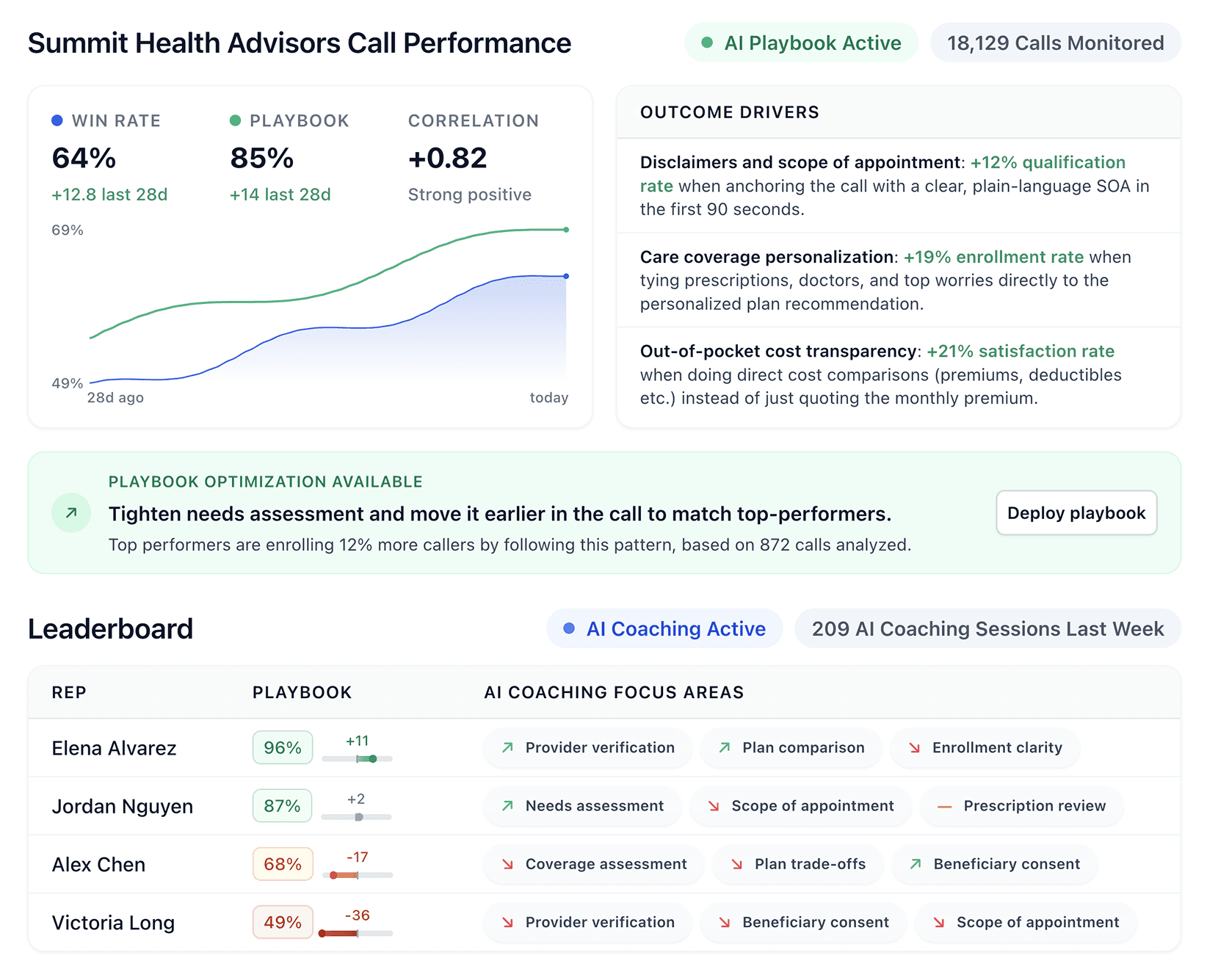


Automated quality management (AQM) uses AI to review every customer interaction, score agent performance, and deliver coaching at scale. If your team is still manually sampling calls, you're missing most of what's happening on the phones.
What is automated quality management?
Automated quality management is software that uses AI to run your quality assurance program at scale. It replaces manual call reviews with machine-driven analysis of every customer interaction.
Manual QA teams can only sample a fraction of calls, leaving most conversations unreviewed. AQM changes that by analyzing every interaction, transcribing conversations, scoring them against your criteria, and flagging coaching opportunities.
AQM works across voice calls, chat, and email. It gives QA leaders, supervisors, and managers complete visibility into agent performance without the need for hours of manual listening.
QM vs. QA vs. AQM: What's the difference?
These terms get used interchangeably, but each one describes a different scope. Here's the breakdown.
Quality management (QM) is the whole system. Standards, monitoring, coaching, process improvements. If your call center has a way of defining "good" and pushing agents toward it, that's QM.
Quality assurance (QA) lives inside QM. It's the evaluation layer of your quality assurance program. Someone listens to a call, checks it against a scorecard, and decides whether the agent passed. When done manually, QA teams can only sample a fraction of conversations.
Automated quality management (AQM) removes the bottleneck. AI scores every interaction, tracks trends over time, flags compliance risks, and triggers coaching workflows. Managers stop digging through calls and start acting on insights.
When you're comparing platforms, ask whether they automate the scoring step alone or the full quality cycle. That's where the real time savings show up.
Key components of automated quality management
AQM platforms combine several capabilities into one system. Not every tool includes all of these, so knowing what to look for helps you compare solutions.
AI-powered transcription and analysis
Every call is automatically converted to text. From there, the AI analyzes language patterns to detect sentiment, topics, objections, and compliance phrases. This foundation powers everything else in the system.
Custom QA scorecards
Generic scorecards miss what matters for your business. AQM lets you define "good" based on your actual workflows. Criteria might include greeting quality, disclosure delivery, objection handling, and close attempts. The scorecard becomes your standard for every evaluation.
Speech and text analytics
Words alone don't tell the full story. Speech analytics identifies tone shifts, dead air, talk-over patterns, and keyword usage. These signals reveal conversation quality that script adherence alone can't capture.
Calibration tools
If reviewers can't agree on how to score the same call, your data falls apart. Calibration tools bring supervisors onto the same page and track alignment over time across both human reviewers and the AI.
Coaching workflows
Insights without action don't change behavior. Coaching workflows turn flagged moments into assigned tasks. Managers get specific calls to review, agents receive feedback tied to exact moments, and the system tracks completion.
Compliance monitoring
In regulated industries, one missed disclosure can trigger an audit. AQM flags risky phrases, skipped disclosures, and prohibited claims in real time. Every interaction creates an audit trail, so managers have documentation ready when regulators come asking.
Dashboards and reporting
Leaders need visibility across agents, teams, and time periods. Dashboards surface trends that inform where to focus coaching and training. Instead of digging through spreadsheets, managers see priorities at a glance.
How automated quality management works
Now that you know what's inside an AQM system, here's how those components work together. The process follows a cycle, with each step feeding the next.
Capture
Everything starts with getting call data into the system. AQM platforms connect to your dialer so recordings and transcripts sync automatically. This removes the bottleneck of manual uploads and ensures every conversation makes it into the analysis queue.
Transcribe and analyze
With calls flowing in, AI transcribes the audio and analyzes each conversation. It looks for more than keywords. Sentiment shifts, objection handling, pacing, and overall conversation arc all factor in.
The best AQM systems study your highest performers and build a model of what "winning" sounds like for your specific team.
Auto-score
Consistency matters. AQM scores every call against the same criteria, so results don't vary based on who reviewed it or what shift it came from. You control the scorecard:
Required disclosures that must appear on every call
Qualification steps unique to your sales process
Compliance requirements for regulated industries
Close tracking that filters by whether reps followed compliance rules
Surface insights
Raw scores don't drive improvement. Trends do. AQM dashboards surface patterns across agents, teams, and time periods.
Managers can see which reps struggle with objections, which scripts underperform, and which compliance gaps keep recurring. Drilling into specific moments shows exactly where calls went off track. (Check out our call center quality assurance checklist).
Trigger coaching
Data only matters if someone acts on it. AQM assigns coaching tasks to managers with the exact calls attached. Advanced systems also send bite-sized feedback directly to agents, so reps can adjust while the conversation is still fresh in their minds.
Why contact centers switch from manual QA to AQM
Most contact centers still rely on manual QA. Here's where it breaks down:
Challenge | Impact |
Limited coverage | Only a fraction of calls get reviewed. The rest create blind spots. |
Slow feedback | Coaching lands days or weeks after the call. By then, agents have forgotten the details. |
Inconsistent scoring | Two reviewers score the same call differently. Data becomes unreliable. |
Cost and time | Managers spend hours listening instead of coaching. |
No trend visibility | Patterns across agents and teams stay buried in spreadsheets. |
Manual QA worked when call volumes were lower. At scale, it creates gaps that hurt performance and compliance.
Benefits of automated quality management
When every call gets reviewed, it becomes a chance to get better. Here's what changes when AQM is running behind the scenes.
Complete visibility
Manual QA catches only a sliver of what's happening on the phones. AQM reviews every conversation, so leaders finally see the full picture instead of guessing from a few random samples.
Better coaching
Vague feedback like "work on your objections" doesn't help anyone. AQM lets managers point to the exact sentence where a call went sideways. They can show what happened, compare it to how a top rep handled the same moment, and give advice that actually sticks.
Faster improvement
Waiting three weeks for feedback is like getting notes on a test you already forgot. AQM delivers coaching while the call is still fresh, so reps can adjust quickly and see results faster.
Lower risk
Compliance mistakes tend to snowball. AQM flags errors right away and sends managers weekly summaries of where problems keep popping up. Coaching happens before bad habits set in, keeping your team on the right side of regulators.
Happier teams
Nobody likes getting blindsided by a bad review. When you score fairly and set clear expectations, reps feel supported instead of caught off guard. They stick around longer, and they actually want to get better.
Why contact centers need automated quality management
Contact centers face challenges that make manual QA nearly impossible. High call volumes, tight margins, and compliance pressure demand a different approach.
Here's why AQM fits this environment better than traditional methods:
Call volume overwhelms manual review
A busy contact center handles thousands of calls per day. Manual QA teams can only listen to a tiny fraction. That leaves most conversations unreviewed and most coaching opportunities missed. AQM removes the bottleneck by automatically scoring every call.
Top performers outpace the rest
In most contact centers, a handful of reps close at two or three times the rate of everyone else. The gap is obvious, but the reason behind it stays hidden. AQM identifies what top performers do differently and gives managers a way to spread those behaviors across the team.
Compliance stakes are high
In regulated industries like Medicare, insurance, and financial services, one bad call can trigger fines or audits. Manual QA can't catch every missed disclosure or risky phrase. AQM monitors every interaction and flags compliance issues before they become patterns.
New hires take too long to ramp
Training gets reps started, but real learning happens on the phones. Without fast feedback, new hires repeat the same mistakes for weeks. AQM shortens ramp time by delivering coaching while calls are still fresh, so reps improve with every conversation.
Managers have limited bandwidth
Most managers don't have time to listen to calls, build coaching plans, and run a team. Something always slips. AQM handles the review work and surfaces priorities, so managers spend their time on coaching instead of digging through recordings.
What to look for in automated quality management software
Not all AQM tools deliver the same results. Here's what separates effective platforms:
Custom scorecards, not just templates. Generic criteria miss what matters for your business. Look for systems that let you define scoring based on your specific workflows and compliance requirements.
Sentiment and topic detection. KPIs show outcomes. Sentiment models reveal why. Understanding the emotion behind a prospect's tone helps managers coach root causes.
Root cause analysis. When metrics drop, you need to know why. Good AQM traces performance changes back to specific behaviors or process breakdowns.
Coaching workflows built in. Dashboards alone don't change behavior. The system should create tasks, track completion, and connect feedback to specific call moments.
Integrations with your stack. AQM works best when it connects to your dialer, CRM, and workforce tools.
Security and compliance certifications. For regulated industries, SOC 2 Type 2 compliance matters.
How to implement automated quality management
Making the switch from manual QA to AQM isn't something you do overnight. But with the right approach, most teams get up and running within a few weeks. Here's how to make it happen:
Step 1: Define success metrics
Start by deciding what improvement looks like for your team. Set targets for conversion rates, compliance scores, coaching completion, and how performance spreads across agents. These benchmarks will tell you whether AQM is working.
Step 2: Build your scorecard
Identify the criteria that actually matter. Include compliance requirements, conversation quality markers, and close behaviors. Most teams start with 10 to 15 criteria and refine over time as they learn what predicts success.
Step 3: Calibrate with your team
Get supervisors aligned on scoring standards before the system goes live. Run calibration sessions where everyone scores the same calls, then compare results. Track agreement rates and resolve differences early.
Step 4: Connect your data sources
Integrate AQM with your call platform so recordings and transcripts flow in automatically. Most platforms connect with major dialers like Five9 and Genesys within a few days. The faster this step happens, the sooner you start seeing insights.
Step 5: Establish coaching workflows
Decide who reviews insights, who coaches which agents, and how often feedback happens. Build these rhythms into your weekly management cadence so coaching becomes a habit, not an afterthought.
Step 6: Monitor and adjust
Review trends weekly and adjust scorecard weights based on what actually predicts outcomes. Your playbook should evolve as you learn what works for your team.
Scale what your best reps do with Alpharun
Somewhere in yesterday's calls, a rep skipped a disclosure. You just don't know which one yet.
In regulated industries, compliance isn't a nice-to-have. One missed script line can trigger an audit. One risky phrase can cost you a contract. Manual QA catches a fraction of these problems. The rest hide until it's too late.
Alpharun watches every call so you don't have to. The platform scores conversations against your compliance rules in real time and alerts managers before small slip-ups turn into patterns.
What's included:
Automated QA across every call so nothing slips through the cracks, and managers stop relying on random samples.
Compliance criteria are built directly into scoring to catch missed disclosures and risky phrases before they become patterns.
Manager dashboards showing risk areas by rep and team, so you know exactly where to focus coaching this week.
Custom playbooks that teach compliant selling from day one, so new hires learn the right way before bad habits form.
And because you're in a regulated industry, Alpharun holds up. The platform meets HIPAA and SOC 2 Type 2 standards and connects directly to Five9, Genesys, and every major platform your team already uses.
Stop wondering which calls have problems. Schedule a demo and see how Alpharun surfaces them for you.
Frequently asked questions
What does automated quality management do?
AQM uses AI to review every customer interaction, score agent performance against your criteria, and deliver coaching insights. It replaces manual call sampling with complete coverage across voice, chat, and other channels.
How is automated quality management different from manual QA?
Manual QA depends on humans listening to calls one by one, which limits how many conversations are reviewed. AQM uses AI to score every interaction, removing sampling gaps and speeding up the feedback loop.
What should an AQM scorecard include?
Include criteria that predict success for your business. Common items like greeting quality, disclosure delivery, objection handling, compliance phrases, and close attempts. Customize based on your specific workflows rather than using generic templates.
Can automated quality management monitor compliance?
Yes. AQM catches missed disclosures, risky phrases, and prohibited claims before they become audit problems. Alpharun, for example, meets SOC 2 Type 2 and HIPAA standards with compliance rules built into scoring.
Is automated quality management only for contact centers?
No. AQM works for any team with customer conversations to evaluate. Inside sales teams, customer support, and service organizations all benefit from automated scoring and coaching. Teams just need recorded interactions to get started.