

A call center performance improvement plan template gives managers a structured way to address underperformance without guessing what needs to change.
This guide covers how to create your template, real examples for sales reps, and the metrics that matter for high-volume call centers.
What is a call center performance improvement plan?
A performance improvement plan (PIP) is a document that outlines specific performance gaps and the steps needed to close them.
The plan identifies where a rep falls short and lays out clear goals, deadlines, and measures of success. PIPs work best when they focus on coaching and development, with the ultimate goal of helping reps reach quota.
For high-volume sales call centers, PIPs address issues like missed close rates, low QA scores, or failure to follow the sales process.
When to use a performance improvement plan
Use a PIP when a rep's performance impacts revenue or team results.
Signs you need a PIP:
Close rates fall below the team average for 60+ days
QA scores stay under your threshold (example: below 85%)
The rep skips steps in your qualification process
Adherence issues affect call volume (late logins, extended breaks)
Ramp time extends beyond your target window
A PIP is not the right tool for every situation.
Don't use a PIP when:
The issue is a personality conflict between the manager and rep
The rep lacks the tools or training to succeed (fix the gap first)
Serious policy violations occurred (theft, fraud)
Performance problems went unaddressed for years
Call center performance improvement plan template: How it works
Every PIP should include these sections:
1. Employee information
Name, ID, department, job title, supervisor, and date of PIP issuance.
2. Reason for the PIP
State the specific performance issues. Use data to support your claims.
Example for sales reps:
Enrollment rate at 12% vs. team average of 22%
QA scores at 71% vs. required 85%
Failed to use the required recording disclosure on 40% of calls
3. Performance expectations table
Create a table with four columns: Performance Area, Current Performance, Expected Standard, and Improvement Needed.
Performance Area | Current | Expected | Improvement Needed |
Close/Enrollment Rate | 12% | 22%+ | Follow qualification process |
QA Score | 71% | 85%+ | Improve call handling |
Adherence | 82% | 95%+ | Reduce tardiness |
4. Improvement action plan
List specific actions, who is responsible, and deadlines.
Example actions for sales reps:
Shadow top-performing agents (2 hours per week)
One-on-one coaching sessions with the manager (twice weekly)
Review call recordings with feedback (3 calls per week)
Complete refresher training on the sales process
Use a call flow checklist during every interaction
5. Monitoring and evaluation
Define how you will track progress:
Weekly QA score reviews
Daily adherence reports
Bi-weekly one-on-one meetings
Mid-point review at day 30
6. Expected outcomes and consequences
State what happens if the rep meets goals and what happens if they don't.
If the rep meets their goals: Close the PIP. The rep returns to regular performance monitoring.
If improvement is not achieved: Further action, up to and including termination.
7. Acknowledgment and signatures
Include space for employee comments and signatures from the employee, manager, and HR.
How to write a performance improvement plan (step by step)
Step 1: Confirm a PIP Is the Right Tool
Ask: Can the rep fix this performance issue? Will the outcomes add value? Is this rep worth the investment? If yes, proceed. If no, consider other options.
Step 2: Gather Performance Data
Pull QA scores, close rates, adherence reports, and call recordings. Use facts to support every point.
Step 3: Identify the Root Cause
A rep might miss quota because they skip discovery questions. Or because they don't handle objections well. Or because they rush calls. Find the actual problem before writing the plan.
Step 4: Involve the Rep
Share the data with the rep, ask for their perspective, and get their input on what support they need. PIPs work better when reps participate in creating them.
Step 5: Set SMART Goals
Goals should be SMART: Specific, Measurable, Achievable, Relevant, and Time-bound.
Example: Increase the close rate from 12% to 18% within 45 days.
Step 6: Define Support and Resources
What training will you provide? How often will you meet? Who will mentor them?
List every resource the rep will receive.
Step 7: Schedule Check-Ins
Weekly meetings keep the plan on track. Don't wait until the end to review progress.
Step 8: Document Everything
Keep records of every meeting, every metric update, and every coaching session.
Performance improvement plan examples for sales reps
Example 1: Low close rate
Goal: Increase enrollment rate from 12% to 20%
Problem: Rep skips qualification questions and moves to pricing too fast. Calls end without addressing objections.
Root cause: Rep does not follow the sales process. Lacks training on objection handling.
Action plan:
Shadow top performer for 4 hours per week
Complete objection handling training within 7 days
Manager reviews 5 calls per week with feedback
Use a qualification checklist on every call
Check-ins: Every Monday at 9 AM for 60 days
Metrics: Close rate, QA scores, checklist compliance
Example 2: Low QA scores
Goal: Raise QA score from 71% to 85%
Problem: Rep fails to read the required recording disclosure. Skips compliance questions. Incomplete call notes.
Root cause: Rep rushes through calls. Does not follow the required steps.
Action plan:
Review compliance requirements in a training session
Listen to 3 top-performer calls per week
Manager scores 5 calls per week with written feedback
Rep completes call wrap-up notes within 2 minutes of each call
Check-ins: Every Wednesday at 10 AM for 45 days
Metrics: QA score, compliance pass rate, and call note completion
Example 3: Adherence issues
Goal: Increase adherence from 82% to 95%
Problem: Rep logs in late, takes extended breaks, and logs out early.
Root cause: The rep feels overwhelmed by call volume and extends breaks to recover between difficult calls. They are unaware of how small time gaps throughout the day add up to affect their total available time and call count.
Action plan:
Review schedule expectations in a one-on-one meeting
Daily adherence check-ins for the first two weeks
If issues are scheduling-related, explore shift adjustments
Set calendar reminders for login, breaks, and logout
Check-ins: Daily for first 2 weeks, then weekly for 4 weeks
Metrics: Login time, break duration, logout time, total available time
How to deliver a performance improvement plan
The way you present the PIP matters as much as what's in it.
Step | What to do |
Hold a private meeting | Deliver the PIP in person or by video call. Avoid email for this conversation. |
Lead with support | Start by acknowledging the rep's strengths. Explain that the goal is to help them succeed. |
Use data to support your points | Reference specific metrics and call examples. This removes personal bias from the conversation. |
Walk through the plan together | Review each section. Answer questions. Let the rep respond. |
Get written acknowledgment | Ask the rep to sign. This confirms they understand the plan, even if they disagree. |
Follow up in writing | Send the rep a copy of the signed plan and summarize the discussion. |
A well-delivered PIP sets the tone for the entire improvement process and gives the rep a clear path forward.
How often should you review the PIP?
PIPs commonly last between 30 and 90 days, depending on the circumstances.
Recommended schedule:
Week 1: Initial meeting to launch the PIP
Weeks 1-4: Weekly check-ins to review metrics and coaching
Day 30 (if PIP is 60 days): Mid-point review to assess progress
End of PIP: Final review to determine outcome
Keep check-ins short but focused. Use data and document each meeting.
Common mistakes when using PIPs
Even well-intentioned PIPs can fail if managers fall into common traps.
Here are the mistakes to avoid:
1. Using PIPs only as a termination tool.
Reps and managers both lose trust in the process. When reps see a PIP as a firing countdown, they disengage or start job hunting instead of focusing on improvement. The PIP becomes a self-fulfilling prophecy.
2. Setting vague goals
"Improve performance" means nothing. "Increase close rate from 12% to 18% in 45 days" is clear. Vague goals leave reps guessing what success looks like and make it harder for managers to measure progress.
3. Skipping check-ins
Progress stalls when managers don't follow up. Small wins go unnoticed, which kills motivation during an already stressful period. Regular check-ins also catch new problems before they derail the plan.
4. Not involving the rep
PIPs work better when reps help create them. Reps who have input on their action plan feel ownership over the outcome. They're more likely to commit to goals they helped set.
5. Waiting too long to act
Address performance issues early. Don't let problems grow for months. The longer underperformance continues, the harder it is to change habits and the more revenue the team loses.
How Alpharun helps call centers coach underperforming reps
A call center performance improvement plan template creates more work for managers: reviewing calls, tracking metrics, and holding check-ins.
Alpharun takes most of that off their plate through:
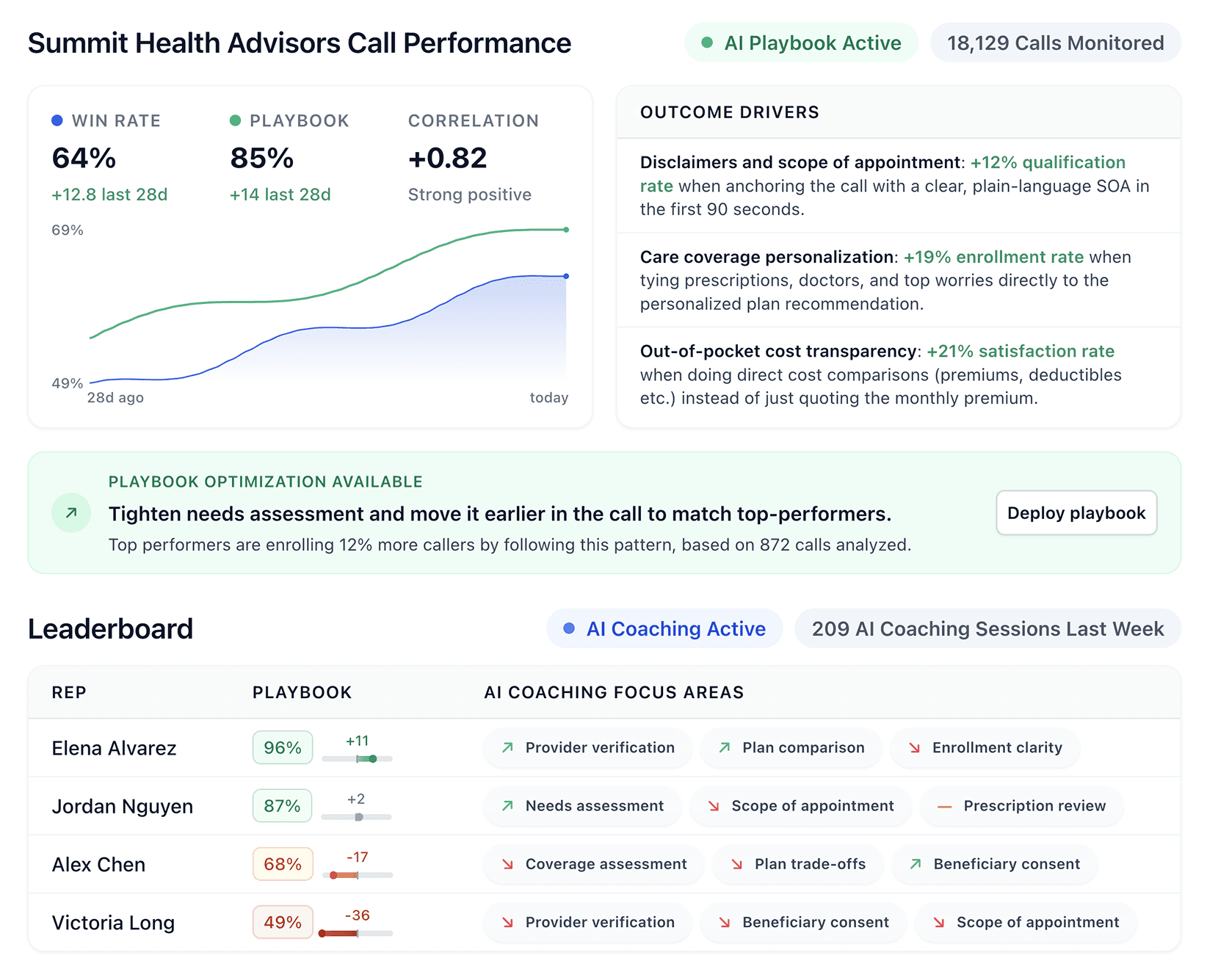
Automated QA across 100% of calls: Alpharun scores every call and flags where reps struggle, so managers don't have to dig through recordings.
Coaching notes sent directly to reps: Reps receive feedback based on what your top performers do differently, without waiting for a manager review.
Sentence-level insights: Reps see the exact moments they need to change, tied to specific phrases from your best closers.
Custom playbooks from your winners: Coaching based on your actual top performers, not generic scripts.
SOC 2 Type 2 compliant: Built for regulated industries like Medicare and insurance.
This guide for creating your call center performance improvement plan template helps. For call centers running multiple PIPs at once, Alpharun makes it possible to give every rep the attention they need without burning out your managers.
Schedule a demo to see how Alpharun scales what your top performers do while taking busywork off your managers' plates.