

An effective sales onboarding process cuts ramp time, reduces early turnover, and turns new hires into quota-carriers before they cost more than they bring in.
This guide covers the full framework, 90-day timeline, and metrics to make that happen.
The cost of poor onboarding
Every rep who leaves before reaching full productivity takes that investment with them, and the goal is simple: get new hires generating revenue before they cost more than they bring in.
Training a new sales rep costs between $10,000 and $15,000, and inside sales turnover rates between 30% and 45% a year mean that money rarely sticks around long enough to pay off. Some teams see turnover hit 60%.
The true cost goes well beyond the training budget. According to a study by DePaul University in 2012, replacing a single sales rep averages $115,000 once you factor in recruiting, training, and lost revenue. Today, with inflation, that estimate exceeds $150,000.
On a 100-rep team with 35% turnover, that's over $4M a year. Dropping turnover by just 10 points recovers more than $1M of that annually. Every month cut from ramp time is a month of full-productivity revenue back in the business.
Why most sales onboarding fails
Four mistakes kill most onboarding programs:
Too much information, not enough practice. New reps sit through hours of presentations but never practice real conversations. They forget 70% of what they learned within a week.
Training happens once, then stops. Reps complete onboarding but get no ongoing coaching. Performance plateaus or declines without continuous skill development.
One-size-fits-all approaches. Every rep learns differently. Some need more role-play practice. Others need help with objection handling. Generic training ignores these differences.
No clear playbook from top performers. Teams don't know which behaviors drive conversions. Training relies on outdated frameworks instead of real data from successful calls. New reps start blind, missing the specific tactics that win in your market.
The four-stage sales onboarding framework
A structured onboarding process moves through four clear stages: Prepare, Train, Practice, and Optimize. Each one builds on the last, so reps always know what comes next and nothing falls through the cracks.
🗂️ Stage | 📅 Timeline | 🎯 Focus | ✅ Key Activities |
1. Prepare | Before day one | Reduce anxiety, set expectations | Welcome package, schedule, tool access, team intro video |
2. Train | Days 1 to 30 | Product knowledge, team integration | Call shadowing, product quizzes, problem-solution flashcards |
3. Practice | Days 31 to 60 | Skill building, real call practice | Role-play, objection handling, CRM training, AI simulations |
4. Optimize | Days 61 to 90 | Independent performance, coaching | Progressive targets, twice-weekly coaching, call review sessions |
Stage 1: Prepare (before day one)
Most onboarding anxiety happens before the job even starts. Pre-boarding cuts that down by sending welcome packages and introductory materials before the official start date.
Share these early:
Welcome message from the team
First week schedule
Tool login credentials
Product overview documents
Short video introducing the team
Culture starts here, too. Reps who feel connected to a team before day one have measurably higher 90-day retention.
Pair each new hire with a tenured rep before the start date, include a note explaining what the team values, and set clear expectations for what good performance looks like at 90 days. Clarity from day one reduces anxiety and improves early engagement.
Stage 2: Train (days 1 to 30)
Before anything else, define the five core competencies your reps need to master: product knowledge, objection handling, discovery questioning, CRM fluency, and call structure.
Every activity in this stage maps back to one of these five, making it easy to spot gaps before reps ever get on a live call.
This is where reps learn your products, meet the team, and get comfortable with basic processes. They shadow experienced reps and practice with low-stakes scenarios, but the training only works if it connects features to real customer pain points.
Skip the feature lists and show reps how the product solves actual problems:
Record senior reps explaining product benefits
Create problem-solution flashcards
Run daily 10-minute product quizzes
Share customer success stories
Reps learn faster when they can see how the product helps customers succeed, not just what it does.
Stage 3: Practice (days 31 to 60)
By day 31, reps should be able to pass a product knowledge assessment, explain the top five customer objections and your responses, and navigate the CRM without help. If they cannot, do not advance them to live calls.
Use AI simulations to close those gaps first, because moving underprepared reps to real prospects hurts their confidence and your pipeline at the same time.
Once they are ready, reps start taking calls with support nearby, refining their pitch through daily role-play and AI call simulations that give them a safe place to make mistakes before it counts.
Build your scenarios from your top performers' actual calls, not generic scripts:
Handle common objections
Practice discovery questions
Work through pricing discussions
Navigate difficult scenarios
Reps who practice what actually works in your sales process pick up the exact language and timing that close deals.
Stage 4: Optimize (days 61 to 90)
Reps work toward specific targets. They handle calls independently and receive regular coaching. You measure their progress against clear metrics.
Set progressive goals:
Week 1 to 2: Complete product certification, then shadow 10 calls
Week 3 to 4: Take 5 calls per day with a supervisor listening
Week 5 to 8: Convert 2 qualified leads per week
Week 9 to 12: Hit 60% of full quota
Review progress weekly, adjust goals based on performance, and celebrate wins publicly. Regular check-ins during this stage let managers catch bad habits before they stick, so schedule coaching sessions at least twice a week.
Each session should follow a simple structure:
Review a recent call recording
Identify one specific area to improve
Practice the corrected approach
Set a clear goal for the next session
Reps who master the fundamentals before moving to advanced techniques ramp faster and retain more. AI-powered platforms support this by automatically analyzing calls, flagging mistakes, and delivering personalized training, freeing managers to focus on coaching that actually moves performance forward.
Manager enablement: Why your managers need onboarding too
Most organizations invest heavily in rep training and almost nothing in equipping managers to coach effectively. According to Gartner, only 55% of chief sales officers say their frontline sales managers consistently meet performance expectations.
Three things fix this:
🎯 What managers need | 💡 What it looks like |
A calibrated scoring standard | Shared rubric so two managers watching the same call reach the same conclusions |
A coaching conversation framework | One observation, one behavior to change, one practice scenario, one goal for next week |
Performance data before the conversation | Review call scores and benchmarks before the session, not during it |
When managers are properly enabled, coaching becomes consistent and measurable across the entire team.
What a great sales onboarding process actually looks like
Most teams treat onboarding as an event. The best teams treat it as a system, and the difference shows up in quota attainment within the first six months.
Event-based onboarding ends after week four. System-based onboarding builds coaching, feedback, and reinforcement directly into the workflow, so reps keep improving long after formal training ends.
Three principles separate the two:
Start with outcomes, not content
Before building a single training module, define what a fully ramped rep looks like at 30, 60, and 90 days. Then work backward to figure out what needs to be in place by when. Most teams do this in reverse and wonder why the training does not stick.
Build from your best performers
Generic frameworks teach industry averages. Your top reps already know what works in your market, and your onboarding process should codify their behaviors, not replace them with someone else's playbook.
Treat onboarding as the first chapter of ongoing development
Sales Management Association found that companies investing in continuous rep development see 50% higher net sales per employee. Onboarding is where you establish those habits, not where you finish building them.
Measuring sales onboarding process success
Once your reps move through all four stages, here's how to know if the framework is actually working. Track these metrics to know if your onboarding works.
📊 Metric | 📏 What it measures | 🎯 Target |
Time to first sale | How long after training before a rep closes | Under 30 days |
Ramp-up time | Time until reps hit average team productivity | Under 90 days |
30-day retention | Percentage of new hires who stay past month one | Above 90% |
90-day quota achievement | Percentage hitting 60%+ of full quota by day 90 | Above 70% |
The metrics above are lag indicators. They tell you how onboarding performed after the fact. To catch problems early, track these lead indicators during the process:
Call shadowing completion rate (Stage 2): Are reps completing scheduled shadow sessions?
Role-play assessment scores (Stage 3): Are practice scores trending up week over week?
Coaching session adherence: Are managers completing twice-weekly sessions consistently?
Product knowledge quiz scores: Are reps hitting 80%+ by day 20?
If lead indicators are slipping, you can intervene before an underprepared rep ever reaches a live call.
Calculating ROI
Use this model to quantify the return on your onboarding program:
(Productivity gain per rep x headcount) - (Onboarding program cost) = ROI
If your average rep generates $15K per month at full productivity and your onboarding cuts ramp time from 9 months to 5 months, each rep reaches full output 4 months earlier, worth $60K per hire. Across 20 new hires, that's $1.2M in recovered productivity.
Track these numbers quarter by quarter, and let modern platforms do the heavy lifting. AI tools build compliance rules directly into the scoring model, so evaluations stay consistent across every rep and team without manual spot checks.
Everboarding: What happens after day 90
The biggest mistake in sales onboarding is treating day 90 as the finish line.
Sales skills decay fast without reinforcement. Ebbinghaus's forgetting curve shows that people forget up to 70% of new information within 24 hours and 90% within a month. Onboarding information is no exception.
Everboarding is the answer. It's not a new training program. It's the extension of the same coaching system reps built habits around during days 1 to 90:
Monthly playbook updates based on new call data from top performers
Quarterly skill reassessments using the same five competency framework from onboarding
Weekly coaching sessions, reduced from twice weekly after day 90
Self-review cadences where reps review one call per week and bring observations to their next session
The teams that maintain performance past day 90 are the ones that never stopped coaching. Onboarding ends, development doesn't.
Common sales onboarding process mistakes to avoid
These mistakes slow down new reps and hurt long-term performance, but they’re easy to fix once you know what to look for.
Rushing through product training
Reps who don’t fully understand your product struggle to answer questions, handle objections, and build trust. Strong product knowledge builds confidence and leads to smoother early calls.
Skipping role-play practice
New reps need repeated practice in a safe environment before talking to real customers. Role-plays help them learn openings, objections, and transitions without the pressure of live calls.
Forgetting about culture
Reps who don’t feel connected to the team often burn out faster. Simple steps like introductions, shadowing, and team check-ins help new hires feel supported and stay longer.
Inconsistent coaching schedules
Coaching only works when it happens consistently. Missed sessions slow down progress and make reps feel like their development is optional rather than part of the job.
Measuring only speed metrics
Average handle time matters, but conversion rates and customer satisfaction matter more. Balance efficiency with effectiveness to build reps who close deals, not just finish calls quickly.
Making extraordinary performance the standard
The best high-volume sales teams don't hope their reps succeed. They build systems that make success the only logical outcome.
Your onboarding program should:
Start strong with pre-boarding
Follow a clear 30-60-90 structure
Focus on practical skills
Include daily practice
Set measurable goals
Provide consistent coaching
Use technology strategically
Reps who complete this type of program start generating revenue faster, stay longer, and perform at higher levels.
Transform your onboarding from a cost center into a competitive advantage. When every new hire reaches peak performance in 90 days instead of 9 months, your entire revenue trajectory changes.
Ready to build a high-performance sales team?
Your inside sales team ramps faster when new reps get clear coaching and structured practice. Effective sales onboarding drives revenue sooner and reduces turnover.
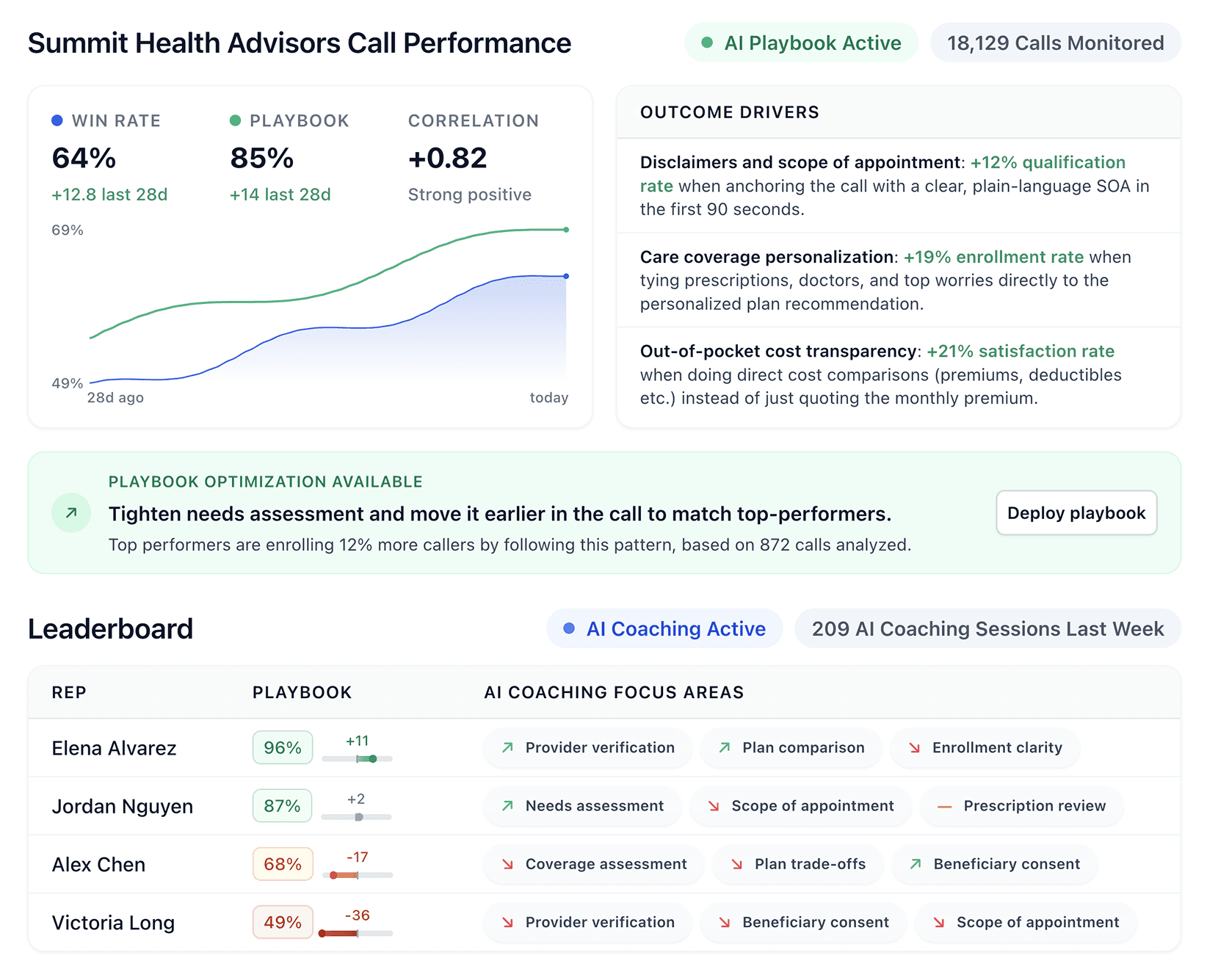
Alpharun analyzes thousands of your top performers' calls to find what drives conversions, then builds those behaviors into a custom playbook. New hires learn what works in your business, not generic frameworks.
You get both coaching that scales your top performers' winning behaviors and AI agents that handle scheduling and after-hours qualification, so reps can focus on selling.
What Alpharun helps you do:
Builds custom playbooks from your best calls, not generic frameworks
Coaches reps in real-time with sentence-level feedback during live calls
Sends targeted coaching notes to reps and weekly performance rollups to managers
Continuously learns from your best performers to refine coaching tactics
Uses AI agents for repetitive tasks like scheduling and after-hours qualification, so reps focus on closing
Stays compliant with SOC 2 Type 2 and HIPAA security for regulated industries
Turn your best calls into everyone's playbook. See how Alpharun scales winning behaviors across your team. Book a demo with Alpharun.
Frequently asked questions
What is a sales onboarding process?
Sales onboarding trains new reps to convert prospects into customers. The process covers product knowledge, sales techniques, call handling, and specific revenue conversion methods tailored to your team's sales environment.
How long should sales onboarding last?
A structured sales onboarding process typically runs 30 to 90 days, broken into clear phases: foundation building, skill development, and performance focus. Each phase builds on the previous one.
What metrics should you track during sales onboarding?
The four most important metrics are time to first sale, ramp-up time, 30-day retention, and 90-day quota achievement. Tracking these quarter by quarter shows whether your onboarding program is improving over time.
Why do most sales onboarding programs fail?
Most programs fail because of too much information without enough practice, training that stops after day one, generic one-size-fits-all content, and no playbook built from real top-performer data.
What is the difference between onboarding and ongoing coaching?
Onboarding covers the structured ramp period, typically the first 90 days. Ongoing coaching continues after onboarding ends and focuses on continuous skill development, call review, and performance improvement over the long term.