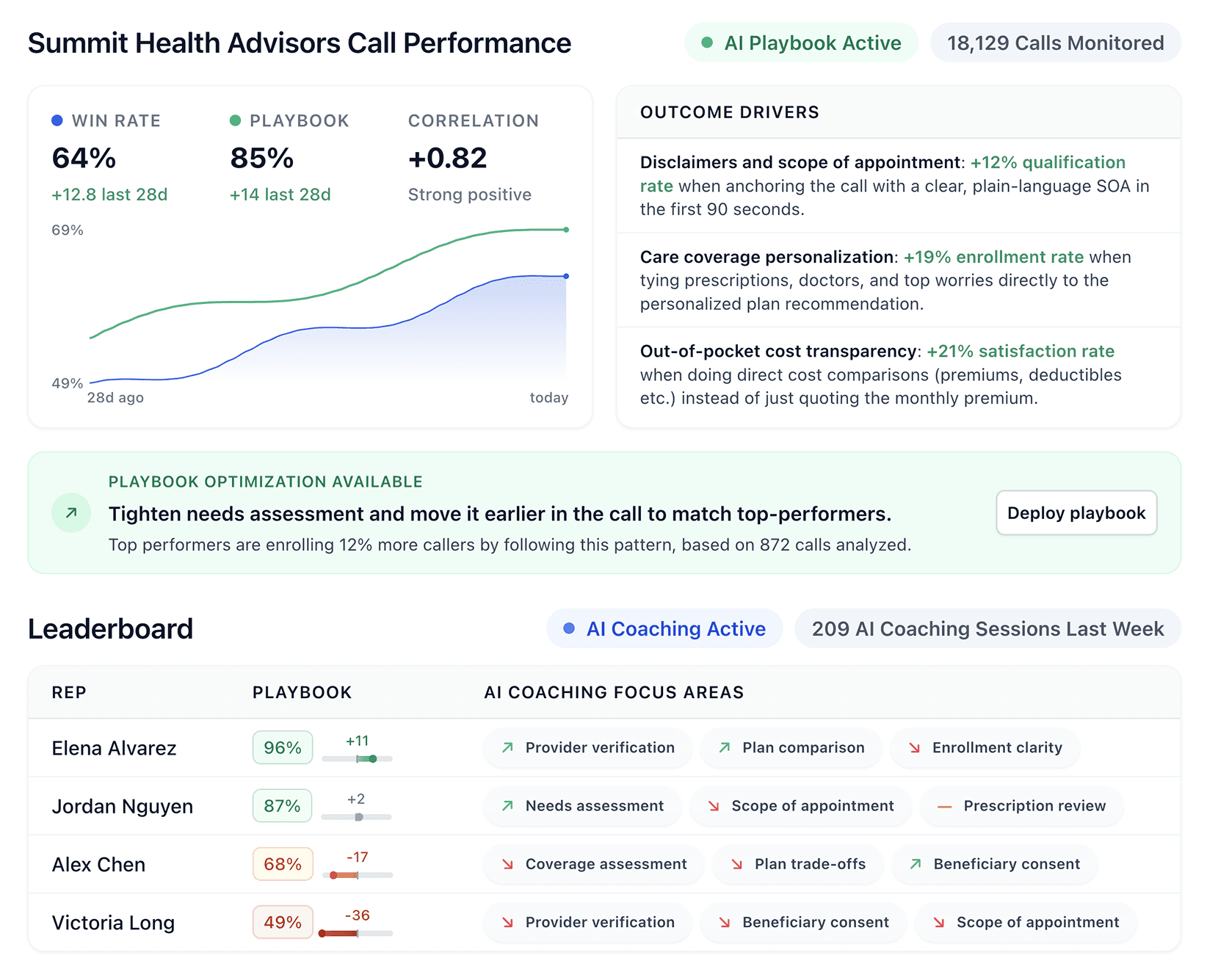


Most call centers track dozens of metrics and act on almost none of them. Call center business intelligence changes that by turning raw call data into decisions your managers can make today.
What is call center business intelligence?
Call center business intelligence (BI) is the practice of collecting, analyzing, and acting on data from your call center operations to improve sales performance, rep development, and compliance outcomes.
It covers everything from QA scores and call recordings to rep-level conversion rates and compliance pass rates. The goal is to give managers a clear, data-driven view of what’s happening across their team, rather than relying on instinct.
For high-volume B2C sales teams, BI serves as the infrastructure that tracks which reps are closing, why they’re successful, and how the rest of the team can improve.
Why most call centers are flying blind
Here's the problem most sales managers won't say out loud: They're making coaching decisions based on two or three calls per rep per week.
At 50-plus reps running 80 to 100 calls per day, that puts the sampling rate below 5%, leaving the remaining 95% of calls without QA scores, compliance checks, or any coaching signal.
Industry benchmarks show that most manual QA programs review only 2-5% of calls, making this level of visibility the norm rather than the exception.
Reps who struggle often lack clear, sentence-level guidance, so the same patterns repeat across calls. With better visibility, managers can catch where calls start to go off track and show how top performers handle those exact moments differently.
4 core components of call center business intelligence
Understanding BI starts with knowing what data it actually covers. For a high-volume B2C sales floor, these are the areas that matter.
🧩 Component | 🔍 What it shows | 🛠️ How it’s used |
Performance data | Output metrics like conversion rate, AHT, and call volume | Identifies who is ahead, who is behind, and where to focus |
QA and compliance | Whether reps follow the required steps across calls | Surfaces consistency, missed actions, and compliance risk |
Conversation data | What actually happens inside the call | Breaks down how calls are run and where outcomes are decided |
Rep development | How performance changes over time | Tracks progress and shows whether coaching is working |
1. Performance data
Performance BI tracks the output metrics your floor runs on: conversion rate, calls per hour, AHT, and close rate by rep, team, and call type.
Most floors already have this layer, and it’s useful for spotting who’s ahead or behind at a glance. You can see which reps are closing, which teams are missing quota, and where handle time is creeping up across the day.
Where it becomes more useful is in how you break it down. Looking at averages across the whole floor hides too much. The real signal shows up when you segment:
By call type, inbound vs outbound, new lead vs follow-up
By time block, morning vs afternoon performance
By rep cohort, new hires vs tenured agents
By lead source or campaign
You might see one team closing well on warm transfers but falling behind on cold outbound, or a rep with strong volume but low conversion because their calls run short.
Performance data gives you the scoreboard and helps you decide where to look. It tells you who is ahead, who is behind, and where to focus your time on the floor.
2. QA and compliance scoring
QA data tracks whether calls meet required standards across the floor. It scores each interaction against defined criteria, disclosures, qualification steps, script adherence, and required actions, like close attempts.
On most floors, managers review a few calls per rep each week and use that as the baseline. With reps running 80 to 100 calls a day, most interactions go unchecked, leaving gaps in both coaching and compliance visibility.
When you expand that coverage, QA starts to show consistency instead of isolated moments:
Which reps follow compliance steps across every call
Where required questions or disclosures are missed under pressure
How often key actions, like close attempts, are skipped
This layer gives you a reliable view of how well the team is following the playbook across real call volume, which helps managers spot risk earlier and step in before issues compound.
3. Conversation data
A rep can run dozens of calls in a day, and the difference between a closed deal and a lost one often comes down to a few lines in the conversation. Most teams see the outcome and the AHT, but the actual flow of the call determines performance.
Conversation-level data looks at how the call unfolds from start to finish and connects each part of the conversation to the result.
When you break calls down this way, you start to see:
How reps move from discovery into the pitch and what gets skipped
Where callers hesitate or disengage during the conversation
How objections are handled and what happens right after
Whether the rep creates a clear path to close or loses momentum
Managers can walk through a call, show exactly what was said, and connect that moment to how top performers handle the same situation, giving reps something they can recognize and apply on their next call.
4. Rep development data
A rep can go through weeks of coaching and still show the same results. Scores move slightly, then stall, and it’s hard to tell which feedback actually made a difference.
Development data tracks how a rep performs over time by connecting QA scores, conversion rates, and coaching notes into a single timeline. Instead of looking at one week in isolation, you can see how performance changes across multiple coaching cycles.
That makes it easier to answer questions that come up every week on the floor:
Did the last coaching session improve the close rate, or did it stay flat
Is AHT coming down because of better control, or because steps are being skipped
Are compliance scores holding steady as call volume increases
Which reps are improving steadily, and which ones plateau after early gains
Managers end up chasing the latest score or the last call they heard, even when the same issue has been showing up for weeks.
With a clearer view over time, it’s easier to see what’s actually improving, what’s stuck, and where coaching is landing, so time goes toward reps who need it instead of repeating the same feedback.
Benefits of call center business intelligence
Call center business intelligence brings visibility into how calls are run, how reps improve, and where performance breaks down. That visibility makes coaching more precise and decisions easier to act on.
Managers see the full picture across every call
Most teams are working off a small slice of calls and treating it like the whole story. On a 60-rep team running 80 calls a day, manual QA might cover around 180 calls a week. The actual volume is closer to 4,800.
With full coverage, managers can see how each rep performs across their workload. Patterns surface earlier, underperformance becomes clearer, and strong reps stand out for the right reasons.
Coaching becomes specific and easier to apply
Reps hear the same feedback every week because managers are working from a limited context. “Handle objections better” or “slow down your pitch” leaves too much room for interpretation.
With full call data, feedback ties directly to real moments:
What the rep said before losing control of the call
How discovery was handled before the pitch
Where the close attempt was missed or rushed
Managers can walk through those moments and show what to change. Reps leave with a clear direction they can use on the next call instead of guessing how to adjust.
Compliance risk is managed across the full volume
In regulated environments, a single missed disclosure or incorrect statement creates exposure. When most calls go unreviewed, those risks build quietly across the day.
With BI-driven scoring, every call is evaluated against your compliance rules:
Required disclosures delivered at the right time
Qualification steps followed before discussing plans
Prohibited language is flagged consistently
Managers can see how often these issues occur and step in early, before they turn into larger problems or audit findings.
Rep ramp time shortens
New reps slow down when they rely on general training and scattered feedback. Progress stalls when they have to figure out what good looks like through trial and error.
With access to scored calls and real examples, they can see how strong calls are structured and where experienced reps spend time, which helps them focus on the right parts of the conversation and build consistency faster.
Revenue outcomes become traceable
Revenue data becomes more useful when it connects back to what happens in the call, giving managers a clearer view of how specific behaviors drive outcomes rather than only showing who is closing.
As more calls are analyzed, patterns begin to stand out: Reps who run full discovery tend to close more consistently, while those who move too quickly into the pitch leave opportunities behind.
Over time, that connection between behavior and outcome starts to shape how calls are run across the team, making it easier to reinforce what works and adjust early when performance begins to drift.
Best practices for using BI in a sales call center
It comes down to how consistently data is used to guide decisions across coaching, QA, and rep performance. The teams that get value focus on a small set of meaningful metrics, act on insights quickly, and build them into their weekly routines.
📌 Area | 🔍 What to focus on | 💡 Why it matters |
Scoring criteria | Track 8 to 15 metrics tied to your sales process and compliance requirements | Keeps QA usable and focused on what drives outcomes |
Coaching cadence | Use call data to prepare for every 1:1 and review recent calls first | Makes feedback specific and easier for reps to apply |
Trend data | Look at performance over weeks, not single scores | Helps separate short-term issues from ongoing skill gaps |
Compliance + performance | Keep both in the same workflow and view | Gives managers a complete view of how reps operate across calls |
Speed of feedback | Review and coach within 24 hours of the call | Keeps feedback tied to calls that reps still remember |
Top performers | Evaluate across quality, compliance, and consistency | Identifies approaches that can scale across the team |
1. Focus on the right scoring criteria
The temptation with BI is to track every metric available. The result is a dashboard nobody uses and a QA form that slows managers down.
Focus on 8 to 15 criteria that reflect how your sales process actually runs. For Medicare and insurance, that means pairing compliance pass-or-fail items with sales execution scores, while keeping them separate so feedback stays clear and usable.
2. Connect BI data to your coaching cadence
BI becomes useful when it feeds directly into coaching, with managers using call scores to prepare for 1:1s, focus on the highest-impact change for each rep, and track whether earlier feedback has improved performance.
Build this into a weekly routine, where each session starts with recent call data, to keep conversations grounded in what actually happened and make it easier for reps to apply feedback right away.
3. Use rep-level trend data, not only snapshots
A single QA score only shows how a rep performed on one call or one day, which can be misleading when call volume and conditions change throughout the week.
Looking at performance over several weeks gives a clearer view of how a rep is actually progressing. A drop from 4.2 to 2.8 over six weeks usually shows something breaking in how the rep is running calls, while a steady 2.8 points to a skill gap that has been there from the start.
Those two cases need different coaching, and trend data makes that easier to see without guessing.
4. Build compliance scoring into the same workflow as performance scoring
When compliance and coaching live in separate systems, managers lose visibility. Findings sit in reports that never make it into coaching conversations.
Bringing compliance into the same rep-level view as performance data keeps everything in one place. Managers can see how compliance and sales execution show up together across calls, making it easier to coach both without switching contexts.
Key takeaway: Set compliance as the baseline for every call and coach performance on top of it, so reps build habits that hold up under both sales pressure and regulatory review.
5. Act on the data within 24 hours of a call
Timing changes how feedback lands. A rep coming off a call still remembers the conversation: what the caller said, where they hesitated, and how they responded. A few days later, that detail is gone, and the feedback turns into a recap instead of a correction.
Working off same-day or next-day data keeps coaching tied to calls the rep can still recall.
Managers can reference the moment, walk through what happened, and adjust it while the pattern is still active across their calls, which makes it easier for the rep to carry that change into the next set of conversations.
6. Use BI to identify your actual top performers
Close rate on its own can point you in the wrong direction, especially when strong numbers come from calls that skip steps or create issues later in the process. Looking across call quality, compliance, and consistency gives a clearer view of which reps run solid calls from start to finish.
Those reps tend to follow the process even when call volume picks up, handle objections without rushing, and keep compliance intact while still closing.
When you break down how they work through a call, it becomes easier to carry those patterns across the team in a way that holds up over time.
How Alpharun applies call center business intelligence in practice
Most BI tools stop at reporting, which leaves managers with numbers they still have to interpret and translate into coaching. Alpharun takes the same data and carries it through into how calls are reviewed, how reps are coached, and how performance is tracked over time.
Instead of separating performance metrics, QA scores, and conversation insights, everything sits in one flow that reflects how calls actually happen and how managers run their team day to day.
Here’s how that shows up in practice:
Scores every call across performance, QA, and compliance, so managers work from full coverage
Breaks down conversations and links behavior to outcomes, so coaching focuses on specific moments
Tracks rep performance over time so managers can see what is improving and where coaching is landing
Delivers call-level feedback quickly so reps can apply changes on their next calls
Surfaces which reps need attention and which calls to review before coaching sessions
Applies compliance checks across all calls so required steps and risk areas stay visible
Used this way, call center business intelligence becomes part of how the team operates rather than something managers check after the fact, with less time spent pulling reports and more time spent working through calls and improving performance.
Take a closer look at how this works with your own calls. Schedule a demo with Alpharun.
Frequently asked questions
How is call center BI different from standard reporting?
The main difference between call center BI and standard reporting is that reporting shows metrics, while BI connects those metrics to behavior. Reporting tracks things like AHT and close rate. BI explains what changed inside calls and why performance moved.
What data does call center BI analyze?
Call center BI analyzes call recordings, transcripts, QA scores, compliance checks, and rep performance data like conversion rate and AHT. It also includes coaching notes and links outcomes to specific behaviors inside calls.
Do you need a large team to benefit from call center BI?
No, you don’t need a large team to benefit from call center BI, but larger teams see the biggest impact. Teams with 50+ reps gain more because manual review covers a smaller share of calls. The value still applies anywhere managers can’t review every call.
How does call center BI connect to coaching?
Call center BI connects to coaching by using call data to guide feedback. Managers review scores before 1:1s, identify key behaviors, and use call examples to make feedback clear. This makes coaching more specific and easier for reps to apply.
How does call center business intelligence improve sales performance?
Call center business intelligence improves sales performance by linking rep behavior to outcomes across calls. It shows which actions drive higher conversion rates so managers can coach them directly and improve results more consistently.