

The difference between high-performing call centers and struggling ones is a better coaching system, and these 5 proven methods and 8 real examples show you how to build one.
Why call center coaching matters
Call center coaching directly impacts your team's close rates, quota attainment, and rep retention. It's the ongoing process of developing rep skills through feedback, practice, and behavioral guidance, not a one-time onboarding event.
Reps plateau without ongoing coaching. Most managers avoid it because preparing one session takes hours. But skipping it has a real cost.
Gallup estimates that 70% of the variance in employee engagement comes down to managers. When agents don't get consistent coaching, they leave.
Effective call center coaching delivers:
Better KPIs: Targeted, data-driven coaching boosts contact center productivity by 15%, per McKinsey, with top-performing coaches driving up to twice the average team's output.
Lower turnover: Only 21% of employees strongly agree that their performance is managed in a way that motivates them, which shows how rare good coaching is. When agents get regular coaching, they stay longer.
Financial impact: Replacing a trained agent costs 1.5 to 2 times their annual salary.
Scalable performance: Build frameworks that work across teams. Instead of spending hours on each session, create repeatable processes that scale to 50+ reps and beyond.
5 call center coaching methods
The best coaching approach depends on your team size, resources, and goals. Here are 5 proven methods you can use:
🗣️ Method | 👥 Team size | ⏰ Time/Week | ⭐ Best for |
1. One-on-one | Under 30 | 3-5 hours | Specific skill gaps |
2. Group coaching | Any | 30 min/session | Sharing team wins |
3. Group training | Any | 2 hours | New product rollouts |
4. Call review | Any | 1-2 hours | Remote teams |
5. Peer coaching | 20+ | Setup only | Future team leads |
Most managers combine these methods. They run group training for product launches, save one-on-ones for reps who need the most help, and use peer coaching to test if someone's ready to lead. Don't pick one method and force it on every situation.
Method 1: One-on-one coaching sessions
One-on-one sessions are individual 10 to 15-minute conversations where managers review a specific call with a rep and practice one new technique. You pick one call, listen to a key moment together, and practice the right way to handle it.
Best practices
Prep (5 min): Choose one strong call and one that needs work. Know what you want to teach before you start.
Session (10 min): Share what they did well. Play the mistake. Ask, "How would you say it now?" Practice the answer together.
Wrap up (2 min): Write down what the rep committed to. Check in one week later.
Why it works
Research shows 10 minutes is the ideal length for a learning segment, with 2-5 minute segments proving most effective for retention.
When to use it
Use it when you manage fewer than 30 agents or need to fix a specific skill gap. Don't use it for team-wide policy changes.
Method 2: Group coaching and peer learning
Group coaching is a short team meeting to analyze calls that went well. Top agents explain how they solved a tough problem so others can copy the approach.
Best practices
Find the win (10 min): Identify a call where an agent handled a difficult objection or complaint.
Group listen (15 min): Play key clips. Ask the team, "What words did they use here that kept the conversation moving?"
Build the playbook: Turn that technique into a template everyone can use right away.
When to use it
Use group coaching when you need the whole team to learn a new technique fast or when you want to boost morale by showing success stories. It's perfect if you have too many agents to meet with everyone weekly for a one-on-one.
Method 3: Group training and skill-building
Group training is a short workshop where the whole team learns a new skill at the same time. The goal is for everyone to master a tool, product, or technique together.
Agents should participate more than they listen.
Best practices
Show the why (5 min): Explain the benefit. "With this closing technique, you'll spend less time pushing and close more deals."
Show the example (10 min): Use a short audio or video clip of it done right. Let the example do the work.
Practice in pairs (15 min): Agents split up and practice the script together. Walk around and correct in the moment.
Final challenge (5 min): Run a quick competition or role-play to reward whoever applies it best.
When to use it
Use this when you launch a new product, change software, or notice the whole team failing at the same thing. Perfect for creating a common knowledge base.
Method 4: Call recording review and feedback
Call recording review means listening to calls and leaving specific comments at exact moments in the audio. Agents get feedback they can revisit multiple times to understand what to change. Think of it like a sports video review. You analyze the play to correct the technique.
Best practices
Find the moment of truth (10 min): Don't listen to the full call. Jump to key points like the greeting, price explanation, or objection handling.
Tag and comment: Mark the exact second where the rep hesitated. Don't write "you did this wrong." Write: "Try a firmer transition phrase here to regain control."
Build a gold library: Save calls with great responses in a shared folder. Best-in-class examples help agents visualize what good looks like.
Get the agent's response: Ask them to listen and reply with how they'll apply it on their next call.
When to use it
Use this when you have a large team and can't sit with everyone daily. Perfect for remote agents. Use it to maintain consistent quality standards.
Method 5: Peer-to-peer coaching programs
Peer coaching is a buddy system where experienced agents help newer ones. Advice from a teammate often lands better than feedback from a manager, and it feels less like surveillance and more like sharing what works.
Best practices
Pick your mentors (10 min): Select agents with strong numbers, patience, and the ability to explain their process clearly.
Cross-listening sessions (20 min): The mentor and learner listen to each other's calls. The learner learns from the mentor's wins. The mentor helps the learner spot gaps with less pressure.
Live shadowing: The new agent listens to the mentor's live calls to see how they handle tough situations in real time.
End-of-week check-in: They discuss what they learned. Mentors often discover new things by explaining their own process out loud.
When to use it
Perfect for onboarding new sales reps and reducing manager workload. Works incredibly well for improving team culture since it builds trust.
Try these 8 call center coaching examples with your sales team
Coaching works best when reps know what to change and how to practice it. These 8 examples give you clear scripts, data points, and steps you can use right away:
1. Coaching opening questions
Weak coaching tells reps to "ask better discovery questions" without showing what that looks like.
Here's what top-performing managers say instead:
"When buyers start a call, top performers guide the first 90 seconds with 4 to 5 qualification questions. This helps prospects confirm their own needs before price enters the conversation.
You asked one question, then moved straight to pricing. Jane follows her full question sequence, and 60% of her prospects self-qualify. Model her exact approach on your next ten calls."
Why it works: The rep sees what top performers do differently, gets a specific number to hit, and knows who to model.
How to implement: Analyze your top 10% of calls, count how many questions they ask before discussing price, and find the common ones they all use. Turn those into coaching points.
2. Coaching objection handling
Vague feedback like "you didn't handle that price objection well" leaves reps guessing what to change.
Here's a better approach:
"When buyers say 'That's too expensive,' top closers respond with a question, not a defense. Mike asks: ‘What were you expecting to invest?'
This helps him learn the buyer's budget before he explains the price. Your close rate on price objections is 15%. Mike's is 45%. Use his exact approach over the next week."
Why it works: The rep gets a specific phrase to use, understands the conversion gap, and has a clear practice goal.
How to implement: Filter calls by common objections, find which reps convert them most, and document their exact responses word-for-word. Share those as coaching points.
3. Coaching call structure
Generic feedback about "calls being too long" doesn't tell reps where they're losing time.
Here's the data-driven approach:
"Your average handle time is 18 minutes. Top performers average 12 minutes and still close more deals. They follow a simple rhythm: 3 minutes for discovery, 6 for presentation, and 3 for the close.
You spend 10 minutes in the presentation step, which creates extra confusion. Practice a tighter product explanation using the same structure your top peers follow."
Why it works: The rep sees the time breakdown, understands where they're losing time, and gets a specific structure to follow.
How to implement: Track handle time by call phase for your top performers, compare struggling reps to those benchmarks, and coach to the data.
4. Coaching compliance requirements
Telling reps to "follow the compliance script better" is too vague to drive behavior change.
More effective coaching:
"You missed the billing disclosure on three of your last five calls. This blocks us from closing those prospects in a compliant way. Top performers hit every compliance point while keeping a natural flow.
Listen to how Jennifer delivers the disclosure at the four-minute mark, after she builds trust. Mirror that timing in your next conversations."
Why it works: The rep knows which compliance point they missed, when to deliver it, and which peer does it best.
How to implement: Track compliance checkpoints by rep, flag patterns of missed requirements, and find top performers who hit 100% compliance with strong conversion rates. Share their timing and delivery with the rest of the team.
5. Coaching closing techniques
Vague advice to "close more assertively" doesn't give reps the language they need.
Here's what works:
"You ask for the sale in 40% of qualified calls. Top performers ask in 90%. Your close phrase is 'Does this sound good?' Top closers use a direct line: ‘Let me get you enrolled today. What payment method works best for you?’ Apply their phrasing so you can build the same habit."
Why it works: The rep sees their ask rate vs. top performers, learns the exact language that converts, and gets clear conversion data.
How to implement: Analyze what percentage of qualified calls include a direct ask, compare closing language between high and low performers, and track close rates by phrase used.
6. Coaching the qualification process
Generic reminders to "qualify prospects before pitching" don't show reps which questions to ask.
Try this instead:
"You're presenting to unqualified leads 60% of the time. That's the main reason your close rate stays low. Top performers qualify in the first two minutes with three questions: budget range, decision timeline, and current pain level.
If a prospect gives a disqualifying answer, they end the call in three minutes instead of spending fifteen. Your qualified-to-close rate is 25%. When you present to qualified prospects only, it rises to 45%. Work on those three questions this week."
Why it works: The rep understands the qualification framework, sees the conversion difference, and gets specific questions to ask.
How to implement: Define your qualification criteria, track how often reps disqualify bad-fit prospects early, and measure close rates for qualified vs. unqualified presentations.
7. Coaching responses to competitor mentions
Telling reps not to "let competitors derail your pitch" doesn't prepare them for the actual moment.
Here's coaching that converts:
"Competitors come up on 30% of your calls. Your conversion rate when they're mentioned is 18%. Top performers convert 40% of those calls by using this response: 'Great that you're looking at options.
What's most important to you in making this decision?' Then they reframe around your differentiators. Practice that exact question when a competitor comes up."
Why it works: The rep gets a specific phrase, sees the conversion gap, and understands the reframe strategy.
How to implement: Tag calls when competitors come up, calculate conversion rates for those calls by rep, and turn top performers' responses into scripted coaching points.
8. Coaching urgency creation
Vague guidance to "create more urgency" leaves reps unsure what to say.
Here's the specific language:
"You're not mentioning time-sensitive factors. Top performers reference urgency in 80% of calls. They say things like 'This pricing ends Friday' or 'We only have three spots left this quarter.'
Your same-call close rate is 22%. When you mention a deadline, it jumps to 38%. Add urgency language to every qualified call."
Why it works: The rep gets specific urgency language, sees the conversion lift, and knows when to use it.
How to implement: Identify time-sensitive factors in your sales process, track how often reps mention them, and measure same-call close rates with vs. without urgency language.
Implementation framework: Turn coaching into behavior change
Having great coaching examples means nothing if reps don't apply them. Use this framework to turn coaching into behavior change:
Before the coaching session: Pull 2-3 call recordings that show the specific gap. Find 1-2 examples from top performers showing the correct approach.
During the session: Play both examples. Point out the exact difference.
Example: "Notice how Jane asks about the budget before presenting? You jumped straight to pricing. That's why your qualified-to-close rate is 30% lower than hers."
Set a specific practice goal:
Provide real-time reminders: Use AI to flag when the rep misses the coached behavior during live calls. Immediate feedback drives faster adoption.
Example: "Practice Jane’s budget question on your next 10 qualified calls. Let's review those calls next week and track your close rate."
Follow up with data:
Celebrate improvements publicly: When a rep implements coaching and sees results, announce it to the team. Other reps will want the same lift.
Example: "Your close rate on those 10 calls improved from 25% to 38% when you asked the budget question first. Keep using that approach."
Coaching mistakes that drop win rates
Bad coaching habits are hard to spot because they look like effort. Here's what's actually hurting your win rates.
1. Coaching too many things at once
When you review a sales call, you might want to fix the opening, the value prop, the objection handling, and the close all at once. Reps can't improve five things at a time. They'll remember zero.
Fix: Pick one thing per session. Ask yourself what hurts close rates most. Start with a quick win. Save the other issues for next time.
2. Coaching without data
Most managers coach based on gut feeling or the last call they heard, which means you might spend three weeks on objection training when the real problem is qualification.
Fix: Listen to 5-10 calls before coaching anyone and check your sales analytics to find where deals actually fall apart and what your top reps do that others skip.
3. Not following up on previous coaching
Research shows that 70% of newly learned information disappears within a week, so when you coach someone on Monday and never follow up, reps either forget or assume you no longer care.
Fix: Check in within 7 days. Pull two calls from the week and listen. Say, "Last week, we worked on transition phrases. Let me hear how it's going." Keep a simple tracker so you remember what you coached and when.
How to build coaching examples from your own data
Generic coaching examples don't match your sales process. You need examples pulled from your own top performers' calls.
Step 1: Identify your top 10% by conversion rate
Don't use activity metrics to identify your top performers. Focus on the reps who close at the highest rate.
Step 2: Analyze 50-100 calls from each top performer
Look for patterns in the questions they ask, in how they handle objections, and in the phrases they use at key moments.
Step 3: Compare top performers to bottom performers
Find the behavioral differences, like how top performers might ask 5 questions before pitching, while bottom performers ask two.
Step 4: Turn differences into coaching points
Document the exact behaviors that separate winners from strugglers and attach real conversion data to each point.
Step 5: Coach reps to match top performer patterns
Give reps the exact questions, phrases, and timing to follow, then track whether they implement the changes.
Step 6: Measure conversion lift
Compare close rates before and after coaching. If reps don't improve, your coaching examples aren't specific enough.
How Alpharun helps with call center coaching
Tracking call center coaching metrics manually takes hours every week. Alpharun automates the process so you can focus on improving your sales reps instead of collecting data.
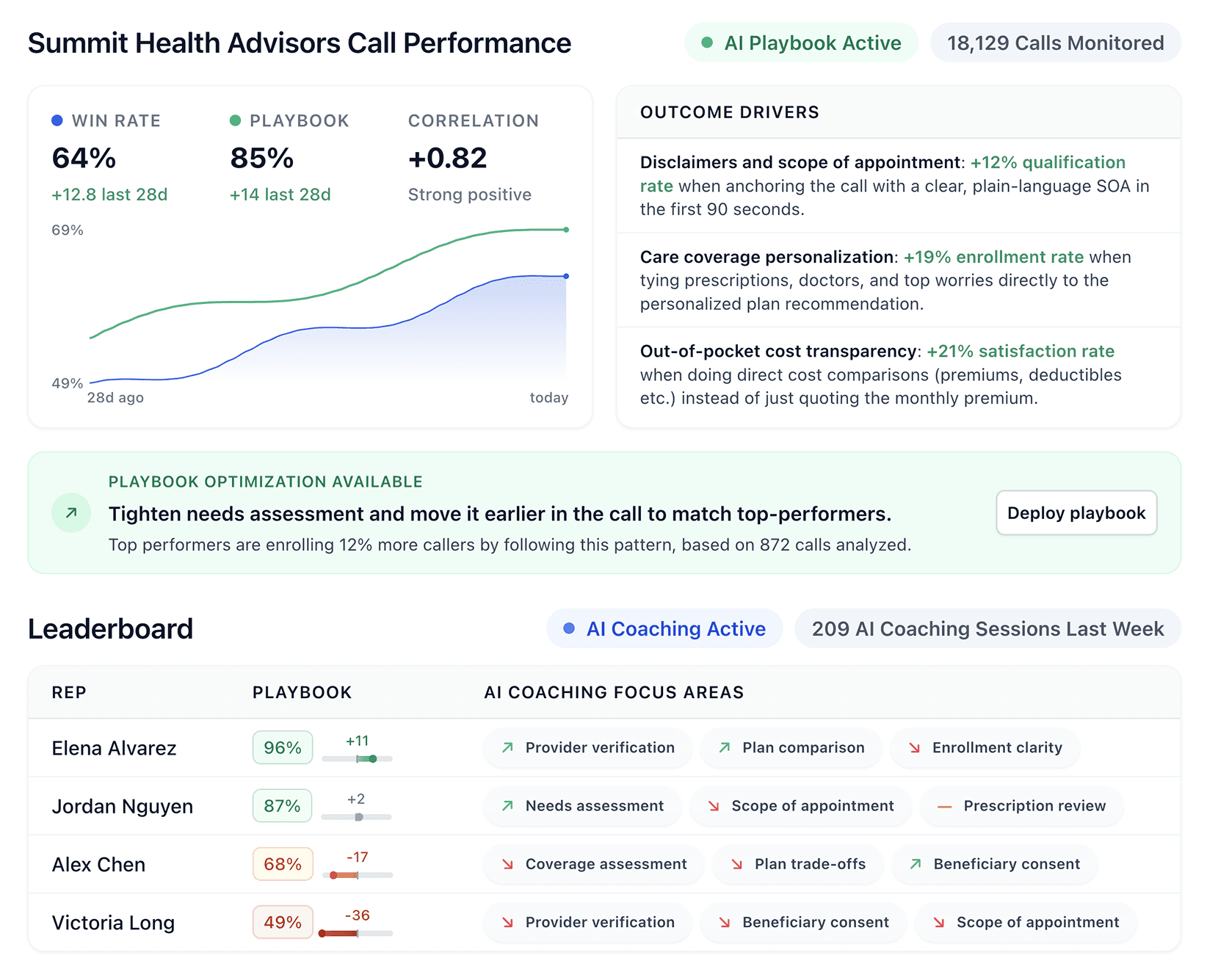
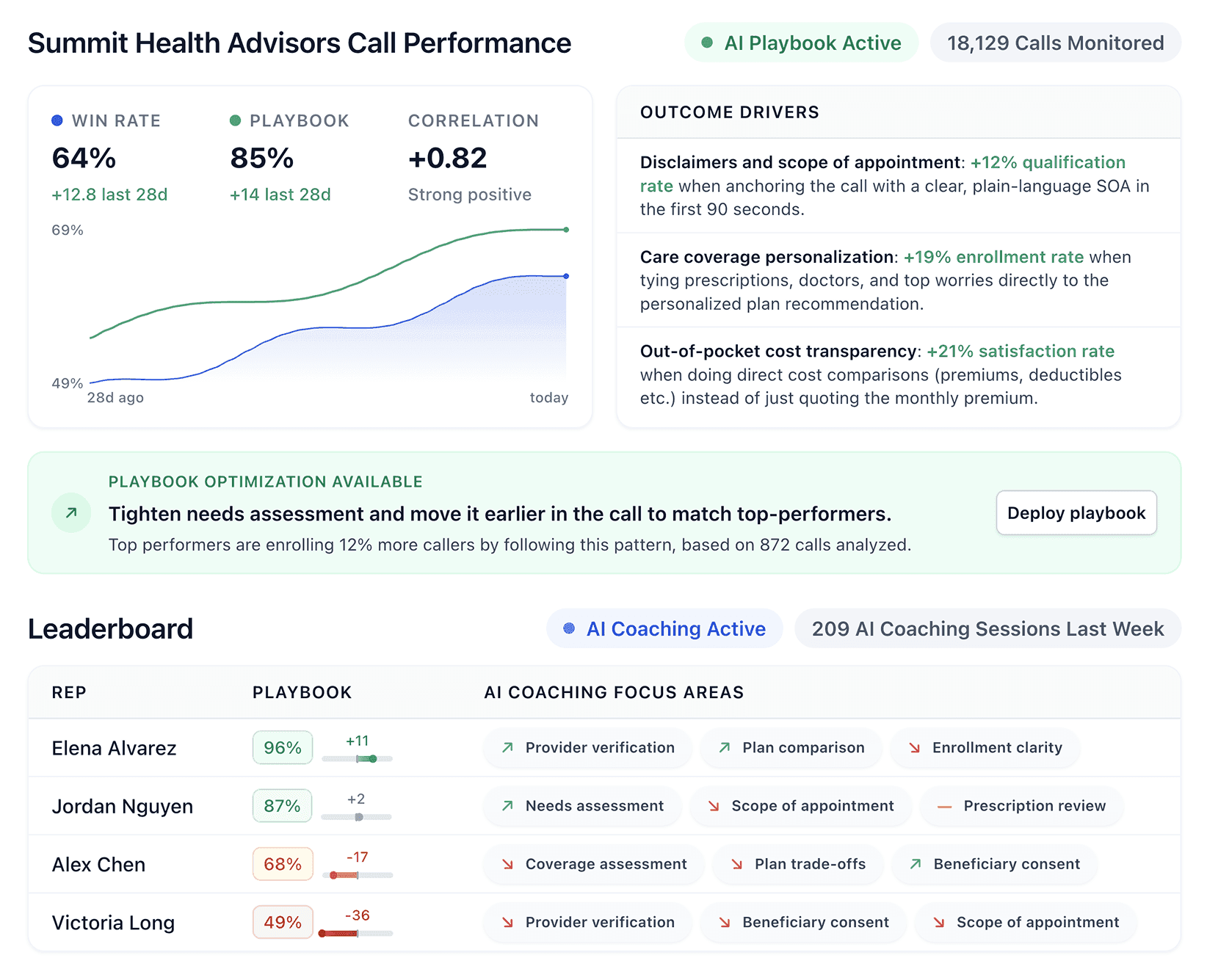
A custom playbook: Alpharun analyzes thousands of your best calls and builds a playbook based on what actually converts, not generic best practices.
Automated QA scoring: Every call gets scored against your specific sales process and compliance criteria, with no spot-checking required.
Real-time coaching: Your agents get sentence-level prompts during live conversations so they know what to say at the right moment.
Manager dashboards: See where each rep needs help, how they're progressing, and which behaviors separate your top performers from the rest.
AI voice agents: These handle after-hours qualification, scheduling, and intake calls so your reps stay focused on high-value conversations.
Enterprise-grade security: SOC 2 Type 2 compliant and built for regulated industries like Medicare, insurance, and financial services, with Five9 and Genesys integrations.
Call center coaching works best when you combine both: human reps coached to perform like your top 10% and AI agents handling repetitive work, like after-hours qualification.
Book a demo to see your coaching metrics in action.
Frequently asked questions
How long does it take to see results from call center coaching?
Most managers see changes in 2-4 weeks when coaching one specific behavior at a time. Close rates improve as reps practice new techniques on real calls, but without weekly follow-up, 70% of newly learned information disappears within a week.
What's the hardest part of coaching call center sales reps?
The hardest part is finding time. Listening to calls and prepping sessions can eat 10+ hours per week, and without data, most managers guess which behaviors close deals instead of knowing.
Do I need special software for call center coaching?
No, you don't need special software, but manual review limits you to a small sample of calls. Software scores every call, spots patterns across your team, and tracks which behaviors improve win rates, the difference between coaching 5 reps well and 50 consistently.
Can Alpharun help me coach sales reps?
Yes, Alpharun helps you coach sales reps by analyzing your best calls to find what top performers do differently, then building a custom playbook from your actual process. It scores every call, sends your agents coaching notes directly, and shows managers where each person needs help.