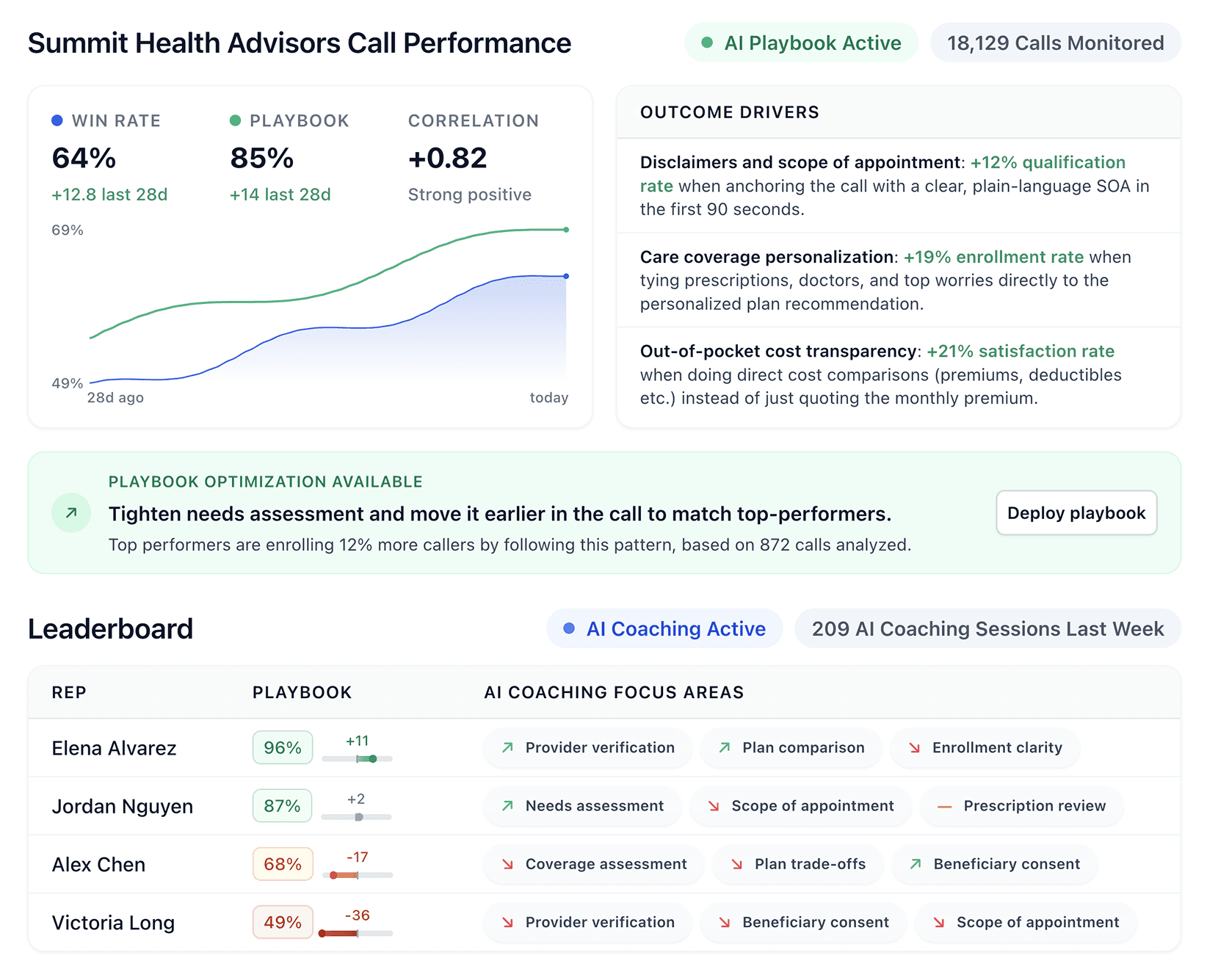


Most managers trying to improve sales performance start with training. Training helps, but it's rarely where the real problem lives.
On a high-volume B2C floor, the gap between your best reps and your average ones usually comes down to specific behaviors happening, or not happening, in specific moments on specific calls.
1. Find out what your top performers are actually doing differently
Before changing anything, figure out what's already working. Pull the last 30 days of calls from your highest-converting reps and look for patterns.
How do they open? How long do they spend on discovery before pitching? What do they say when a Medicare prospect says they need to think about it?
Most managers can name their top performers but can't articulate the specific behaviors that separate them. That's the starting point. If you can't describe what a great call looks like in concrete, behavioral terms, you can't coach anyone toward it.
Example: A Medicare brokerage notices their top three reps all ask about the prospect's current doctor before mentioning any plan. Their average reps skip straight to pricing. That one difference is worth building into every call.
2. Define what a good call looks like before you grade anyone
Scoring calls against vague criteria like "built rapport" or "handled objections well" produces inconsistent coaching and frustrated reps. Before you can improve sales performance, you need a clear standard for what each stage of a successful call looks like.
That means defining specific behaviors at each stage: what a strong opening sounds like, what discovery questions are expected, what the close should include, and what compliance steps are required. The benchmark should reflect what your top performers actually do in customer conversations.
Once the standard is documented, every rep knows what they're being measured against. That clarity alone tends to move performance before any formal coaching happens.
3. Stop sampling and start scoring every call
A manager reviewing five calls per rep per week sees about 5% of that rep's actual behavior. The other 95% goes unobserved, uncoached, and uncorrected. Patterns that would be obvious across 50 calls stay invisible across five.
This is how a rep spends three months reinforcing the wrong approach to a common objection before anyone notices. On a floor of 50 reps processing hundreds of calls daily, the math makes manual sampling structurally inadequate.
The shift to full call coverage, whether through AI-assisted QA or a more systematic review process, gives managers the actual picture rather than a guess.
4. Give reps feedback tied to specific call moments
"You need to be more confident on the close" is not useful feedback. A rep who hears that leaves the conversation without knowing what to change or when to change it.
Feedback that improves sales performance is specific and tied to a real moment. It sounds like:
"At the 3-minute mark, the prospect mentioned their specialist wasn't covered by their current plan. You acknowledged it and moved on. That's typically where your top closers ask a follow-up question about how often they see that specialist. Here's why that matters."
That kind of feedback gives the rep a mental replay of the moment and a clear alternative. It changes behavior faster than general advice because the rep can actually apply it on the next call.
5. Reinforce the behaviors behind top performance
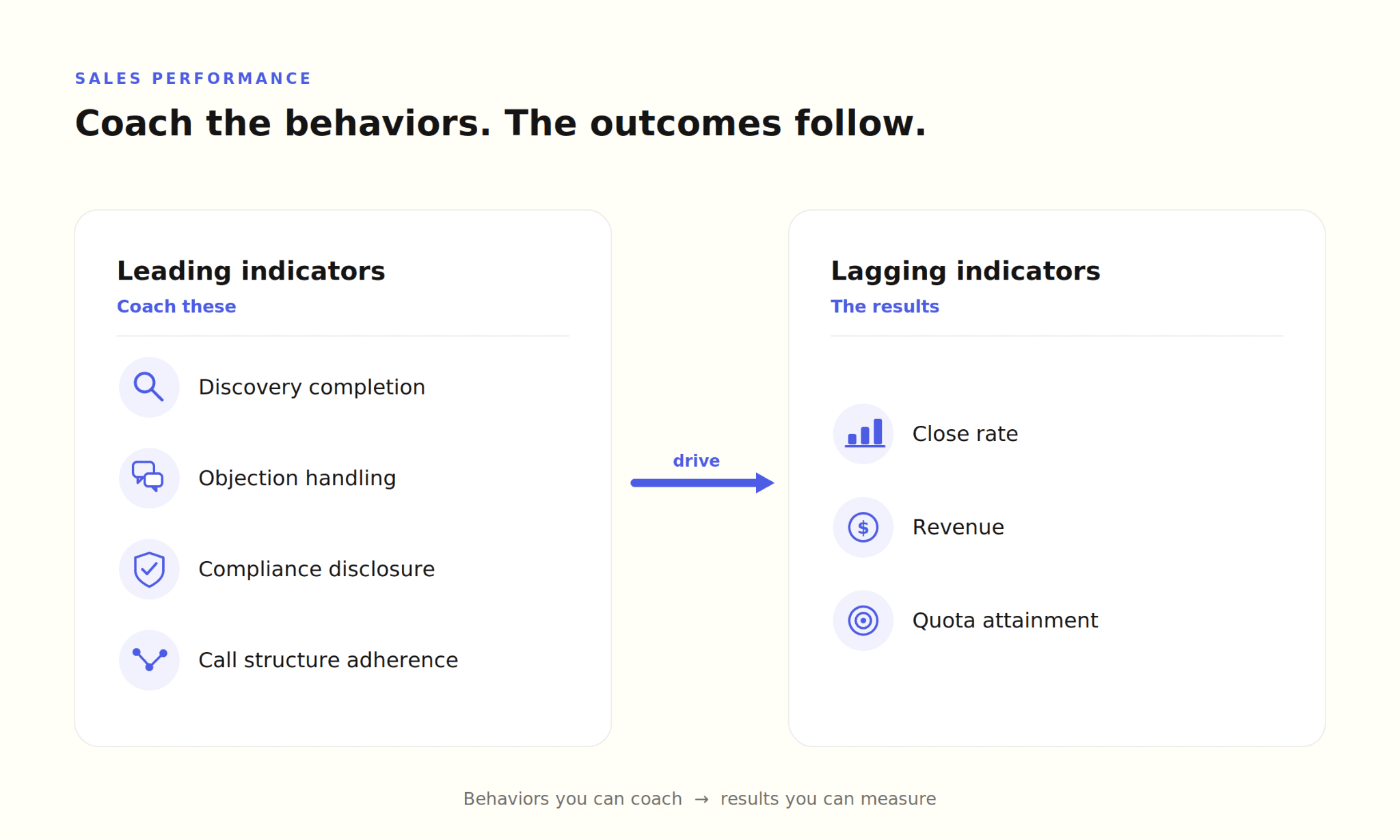
Close rate is a useful number. It's also a lagging indicator. By the time a rep's close rate drops, they've been making the same mistakes for weeks.
Leading indicators are the behaviors that drive outcomes. Common examples include:
Discovery completion rate: Are reps gathering the information needed to qualify effectively?
Objection handling response rate: Are reps addressing concerns instead of moving past them?
Compliance disclosure completion: Are required statements being delivered consistently?
Call structure adherence: Are reps following the conversation flow that top performers use?
Tracking these behaviors at the rep level helps managers spot coaching opportunities long before conversion rates start slipping.
Example: A home services sales floor notices that reps who skip the needs assessment step in week two of their ramp never fully recover their conversion rate in weeks three through eight. That's a coaching intervention point, not a performance review point.
6. Reduce ramp time by giving new reps a specific model to follow
New rep ramp time is one of the clearest indicators of whether a floor has documented what good performance looks like.
When onboarding relies on shadowing experienced reps and absorbing best practices by osmosis, ramp time stretches to three or four months. When new reps have a specific, behavioral playbook to follow from day one, it shortens.
The playbook should cover the opening word for word, the discovery questions expected in order, how to handle the two or three most common objections, and the exact structure of the close. It should be built from your team's actual best calls.
Reps who have a concrete model to practice against reach quota-level performance faster than reps who are figuring it out as they go.
7. Treat compliance as a performance driver
On Medicare and insurance floors, compliance and sales performance are often managed as two separate concerns. Compliance monitors for disclosures and prohibited language. Sales managers monitor for conversion rates. The connection between them rarely gets made.
A rep who skips the recording disclosure or rushes through the TPMO disclaimer creates more than a compliance issue. Those moments shape how prospects perceive the conversation. When trust erodes early, close rates often follow.
Building compliance criteria into the same scoring model as sales performance gives managers a complete picture rather than two partial ones.
8. Create a consistent coaching cadence
A rep who receives feedback once a month spends most of that month operating on memory and habit. Coaching works best when feedback arrives close to the behavior you're trying to change.
Weekly touchpoints don't need to be lengthy. A 15-minute session built around two or three specific moments from recent calls is often more effective than a monthly review covering dozens of topics at once.
Consistency matters for another reason: it signals that development is an ongoing process. Reps are generally more engaged with feedback when coaching is part of the weekly rhythm rather than an occasional event.
9. Focus coaching on the middle of the floor
Most sales organizations naturally focus on two groups: top performers who require little intervention and struggling reps who need immediate attention. The largest improvement opportunity often sits between those groups.
Consider where coaching effort can create the biggest return:
A rep moving from a 24% close rate to 30%
A rep improving objection handling consistency
A rep increasing discovery completion rates
A rep following the proven call structure more consistently
Across a high-volume sales floor, incremental gains from median performers can produce a larger revenue impact than improvements concentrated among a small group of low performers.
The goal is to identify the behavioral differences between average performers and top performers, then coach those behaviors systematically.
10. Track improvement trends, not snapshots
A rep's close rate this week shows current performance. The trend over the last eight weeks shows whether coaching is creating lasting improvement.
The metrics worth tracking over time include:
Close rate progression
Ramp time for new hires
Discovery completion rates
Objection handling effectiveness
Compliance adherence scores
New-hire cohorts are especially useful. If one cohort reaches quota in 10 weeks while a previous cohort required 14, something in onboarding, coaching, or enablement improved. If ramp times remain unchanged, the process likely needs adjustment.
The same principle applies to individual skills. If discovery completion rates have been a coaching priority for six weeks and the metric remains flat, the coaching approach deserves as much scrutiny as the rep's performance.
11. Turn your best calls into training assets
Your highest-converting calls contain examples of how successful reps handle real customer situations, real objections, and real buying decisions.
A rep who successfully navigates a difficult objection has already created a playbook for that moment. Capturing and sharing those conversations gives the rest of the team a practical example they can apply immediately.
The strongest coaching programs regularly surface:
Calls with exceptional objection handling
Discovery conversations that uncover key buying signals
Strong examples of compliance execution
Calls that recover after a difficult customer response
Over time, these examples become a living library of what good performance looks like inside your own sales environment. The benchmark comes from your highest-performing conversations rather than generic sales advice.
Turning coaching into a repeatable revenue system
The strategies above are proven, but the challenge is applying them consistently across dozens of reps and hundreds of calls every day.
Alpharun helps sales teams scale the behaviors that drive performance by analyzing every call against a custom playbook built from their top-performing conversations. That visibility helps managers:
Identify the behaviors top performers use consistently so managers can coach proven habits instead of relying on assumptions.
Spot coaching opportunities across every rep by analyzing the full call population and surfacing patterns that would otherwise go unnoticed.
Deliver post-call coaching tied to specific moments in real conversations while the interaction is still fresh in the rep's mind.
Track leading indicators like discovery quality, objection handling, and call structure adherence to catch performance issues before they show up in conversion rates.
Score compliance and sales behaviors in the same workflow so managers have a complete view of call quality, risk, and performance.
Managers get a clear view of where performance is improving, where reps are getting stuck, and which coaching priorities will have the biggest impact. Reps get targeted feedback while the conversation is still fresh.
Book a demo to see how Alpharun improves sales performance across your full team.
Frequently asked questions
What is the fastest way to improve sales performance?
The fastest way to improve sales performance is to identify the behaviors your top performers use and coach those behaviors across the team. Coaching tied to real call moments typically produces faster results than broad sales training.
How do you measure sales performance improvement?
Sales performance improvement is measured through both leading and lagging indicators. Leading indicators include discovery quality, objection handling, and call structure adherence, while lagging indicators include close rate, revenue, and quota attainment.
Why do sales reps plateau?
Sales reps often plateau when coaching becomes inconsistent or lacks specificity. Regular feedback tied to actual conversations helps reps continue improving instead of falling back on existing habits.
How can call centers improve sales performance without hiring more managers?
Call centers can improve sales performance by increasing coaching coverage and focusing manager time on the highest-impact opportunities. Analyzing every call helps managers identify performance gaps faster and prioritize coaching more effectively.
What are the most important sales coaching metrics to track?
The most important sales coaching metrics are discovery completion rate, objection handling effectiveness, call structure adherence, compliance completion, and close rate. Together, these metrics show both the behaviors driving performance and the outcomes they produce.