Learn the SNAP sales methodology: its four principles, three buyer decisions, example questions, and how to coach it on high-volume inside sales calls.

Picture the last customer you called who was clearly slammed. Kids in the background, three tabs open, half-listening. You walked them through four plan options and a full pricing breakdown; they said, "Let me think about it," and then nothing.
That buyer was frazzled, and the SNAP sales methodology was built for exactly that person. It's Jill Konrath's framework for selling to overwhelmed, time-starved buyers who default to "no" the moment a decision starts to feel like work.
We've listened to enough inside-sales calls to know the theory only gets you halfway. So here's how SNAP actually works, and how to make it stick with a floor full of reps.
What is the SNAP sales methodology?
The SNAP sales methodology is a framework for selling to overwhelmed, distracted buyers, built on four principles: keep it Simple, be iNvaluable, always Align, and raise Priorities. Sales strategist Jill Konrath introduced it for busy B2B buyers in her 2010 book, SNAP Selling: Speed Up Sales and Win More Business with Today's Frazzled Customers.
Her core observation has only gotten truer. Buyers are drowning in options and information. A Gartner survey released in June 2025 found that 61% of B2B buyers prefer a rep-free buying experience, and Gartner notes that many buyers feel overwhelmed and frustrated by the outreach they get from sellers.
Konrath calls that state frazzled customer syndrome. A frazzled buyer is distracted, forgetful, short on time, and a little scared of making the wrong call. You can hear it on a call: they interrupt, they circle back to questions you already answered, they go quiet.
The trap is that doing nothing feels safest. When a decision takes effort, a frazzled buyer's default move is to stay put, and the status quo wins. SNAP works by lowering the mental load at every step, so saying yes feels easier than staying stuck.
The same frazzled buyer picks up consumer calls, too: a 68-year-old comparing Medicare plans during open enrollment, or a homeowner juggling three insurance quotes on a 15-minute lunch break. If you sell to consumers by phone, this buyer is most of your pipeline.
SNAP selling at a glance
Before the deep dive, here's the whole framework on one screen.
Principle | What it means | What it looks like on a call |
|---|---|---|
Keep it simple | Strip every touch down to what the buyer needs to make the next decision | One clear recommendation, a short agenda, an obvious next step |
Be iNvaluable | Show up as the expert who makes the decision easier | You teach them something useful, even if they don't buy today |
Always align | Tie everything to what the buyer actually cares about | You lead with the priority they named |
Raise priorities | Make the problem urgent enough to act on now | You show the real cost of waiting, without fake deadlines |
The 4 SNAP principles, explained
Each letter fixes a different way calls fall apart with a frazzled buyer. Here's what each one looks like when a rep gets it right.
Keep it simple
When a frazzled buyer tunes out, it's usually because your pitch takes too much effort to follow. They're interested enough, but short on mental energy.
Simplicity is the whole game: Fewer options, a shorter explanation, one clear next step. If you're offering a Medicare shopper six plans, you've already lost them; walk in with the one or two that fit and explain why.
Cut the jargon too. Skip phrases like "value-based benefit design." A customer wants to know if their doctor is covered and what it costs each month.
Be invaluable
Prospects expect a rep to be an expert. The second you can't answer a straight question, you sound like every other person who's called them this week.
Make the decision easier: Bring the benchmark they didn't have, flag the risk they didn't see, and know your product and their industry cold. The goal is simple: they should hang up better informed than when they picked up, whether or not they buy.
That's how you earn a second call. Useful reps get picked up. Pushy ones get sent to voicemail.
Always align
Alignment means connecting everything you say to the thing the buyer has told you they're worried about, which is rarely the same as your product's best feature.
Lead with their priority: Then map your solution to it. If a driver's whole concern is their premium after a rate hike, don't open with roadside assistance. Talk about the premium first. You can read more on this buyer-first approach in our guide to consultative versus transactional selling.
When your pitch doesn't map to their world, they feel it, and they check out.
Raise priorities
Even a buyer who agrees your solution is great will stall if it doesn't feel urgent. "Raise priorities" means helping them see the cost of doing nothing.
Make the problem real and current: Spell out what waiting costs, like the coverage gap before a procedure, the Medicare enrollment window that closes December 7, or the premium that climbs again next cycle.
One honest caveat: manufactured urgency ("this rate expires Friday!") works once and then torches your credibility. Real urgency comes from the buyer's own situation, so use theirs.
The 3 buyer decisions in SNAP selling
Konrath says every buyer makes three decisions in order, and each one is a gate. Most reps pour their energy into the last gate while quietly losing at the first two.
Decision | What the buyer is asking | The rep's job |
|---|---|---|
1. Allow access | "Is this even worth my time?" | Earn the conversation with something relevant and simple |
2. Initiate change | "Is switching worth the effort and risk?" | Show that staying put costs more than changing |
3. Select resources | "Which option is the best fit?" | Prove you're the lowest-risk, best-aligned choice |
Decision one is about access: A frazzled buyer decides in seconds whether to engage. If your opener sounds like everyone else's, you're gone before you finish the sentence.
Decision two is about the status quo: This is where most consumer deals die. The buyer likes you fine, but changing anything feels risky, so they park it. Your job is to make the cost of waiting concrete.
Decision three is the actual choice: By now, they've decided to act, and they're comparing you to the alternative. Alignment and urgency decide who wins.
On a one-call consumer sale, these three decisions get compressed into a single conversation. You're earning access, beating the status quo, and closing in the same 20 minutes, which is exactly why simplicity carries so much weight.
Key SNAP selling terms
A few terms come up again and again in SNAP selling:
Frazzled customer syndrome: Konrath's name for a buyer who is distracted, short on time, and quick to say no when a decision feels like work.
Buyer's matrix: A planning grid that maps each decision-maker's role, goals and metrics, challenges, and what pushes them toward or away from change.
Go Zone: The state where a buyer is receptive and willing to engage with you. Every SNAP rule aims to keep the conversation here.
D-Zone: Where outreach gets ignored or deleted, and the sale stalls or disappears. Pushy closing and objection-handling tactics tend to land reps here.
How to implement SNAP selling step by step
SNAP is a discipline you run before and during the call. Here's the sequence.
Simplify everything: Short conversation, one clear message, needs-based recommendation.
Find the real decision-maker: On a consumer call, that's usually the person on the line, but confirm a spouse or adult child isn't the actual buyer.
Understand their goal: What are they really trying to fix or protect?
Become the trusted resource: Teach them something they can use.
Make the case for change: Show why the status quo costs them.
Solve their single biggest priority: Fix the one thing they care about most right now, and leave the rest for a later call.
Before a high-stakes call, strong reps fill out a buyer's matrix, a quick planning grid that keeps the conversation aligned.
Stakeholder | Top priority | How they measure it | Hot-button issue | Your value to them | Proof point |
|---|---|---|---|---|---|
Primary buyer | The outcome they care about most | Cost, coverage, timeline | What frustrates them today | The one capability that maps to their priority | A case, a number, a reference |
On a B2B deal, you'd build a row for each stakeholder. On a consumer call, the matrix collapses to one person, but the discipline holds: know their priority, bring proof, offer one clear next step. If you want to turn this into something repeatable across a team, it belongs in your sales playbook.
SNAP selling questions and examples
Great reps talk less and ask better. The right questions do the aligning for you. Borrow from pain-funnel-style discovery questions and keep them plain enough to say out loud on a call.
To surface the priority:
"What's the one thing you're hoping to fix here?"
"What's your current setup, and what's not working about it?"
To raise urgency:
"What happens if this stays the way it is for another few months?"
"Is there a date you're working against?"
To move toward a decision:
"If we solved the coverage gap, would that take this off your plate?"
Here's what it sounds like in practice.
A B2B example: A RevOps lead is buried under a Salesforce migration and a new sales process. The rep skips the 45-minute demo and sends a three-minute video showing one thing: how activity data flows in automatically. Simple got the reply. Alignment (their board wants cleaner pipeline numbers) got the meeting.
A consumer example: A Medicare advisor picks up a call during the Annual Enrollment Period. The caller is anxious and comparing plans on three websites at once.
The advisor keeps it simple (two plans that fit her doctors and prescriptions), stays invaluable (walks her through the compliance disclosures without rushing), aligns (her real worry is keeping her oncologist), and raises the priority (the enrollment window closes December 7). That's SNAP on a real floor.
SNAP selling vs SPIN and Challenger
SNAP isn't the only framework worth knowing, and it isn't right for every deal. Here's how it stacks up against the two you'll hear about most.
Methodology | Best for | Core approach | Ideal buyer |
|---|---|---|---|
SNAP | Overwhelmed buyers who stall at "no decision" | Reduce friction, align to priorities, create real urgency | Frazzled, time-pressed, managing too much |
SPIN | Buyers whose pain is still fuzzy | Situation, Problem, Implication, Need-payoff questions | Aware of symptoms, hasn't quantified the cost |
Challenger | Buyers who misunderstand their own problem | Teach, tailor, and take control of the conversation | Needs their thinking reframed before they'll act |
Pick SNAP when buyers are overwhelmed and deals stall because change feels like too much. Pick SPIN when you need question-led discovery to surface a buyer's real pain. Reach for the Challenger sales methodology when the buyer's mental model is wrong and needs reframing.
Most teams don't run one framework in a vacuum. Plenty pair a qualification model with SNAP as the engagement layer, the same way they might borrow the structure of the Sandler methodology for the middle of the deal. Use SNAP for how you talk to a frazzled buyer, and let the other frameworks handle what they're good at.
When to use SNAP selling (and when it's the wrong call)
SNAP fits some selling motions better than others, and forcing it where it doesn't belong just adds friction.
Use SNAP when:
Your buyers are overwhelmed and default to "no decision" more than they pick a competitor.
Deals stall at the top, with prospects going quiet after the first conversation.
You're in a crowded market where every buyer gets a dozen pitches a week.
Buyers resist change because it feels risky, even when they already see the value.
Look elsewhere when:
The buyer doesn't know they have a problem yet. That's Challenger territory.
You're deep in enterprise procurement with a long, multi-stakeholder cycle, where a qualification framework does more of the heavy lifting.
The honest read for high-volume inside sales: the full multi-stakeholder buyer's matrix is overkill on a one-call consumer close. But Simple, Align, and Raise priorities travel perfectly. Be iNvaluable just changes shape, becoming "be the calm, compliant expert in a stressful decision." Those are the pieces that move the needle on a phone floor.
How to coach SNAP on inside sales and call-center calls
A framework is only as good as how consistently your reps run it. On a busy floor, that's the hard part. So turn the four principles into a simple call rubric you can score and coach against.
Principle | What good sounds like | Red flag | Coaching action |
|---|---|---|---|
Simple | One clear recommendation and next step | Rep lists five options and loses the buyer | Coach the rep to narrow to the best-fit one or two |
iNvaluable | Rep teaches something useful early | Generic pitch, no insight | Build a bank of benchmarks and questions reps can bring |
Align | Rep leads with the buyer's stated priority | Rep pushes a feature the buyer didn't ask about | Replay the moment alignment slipped, then rehearse it |
Priority | Rep names the real cost of waiting | Rep leans on fake urgency or none at all | Practice tying urgency to the buyer's own timeline |
Every sales manager runs into the same wall. On a floor doing hundreds of calls a day, you can only listen to a handful. The rest go ungraded, coaching stays inconsistent, and the middle of your team never moves. Your top reps stay great, your strugglers keep struggling, and nobody can say exactly why.
This is the work Alpharun was built for. It scores every call against your SNAP criteria after the call ends and flags the exact moment a rep buried a frazzled buyer in options. If you're building this into onboarding, it pairs well with structured sales call training so new reps learn the standard from day one.
How Alpharun fits
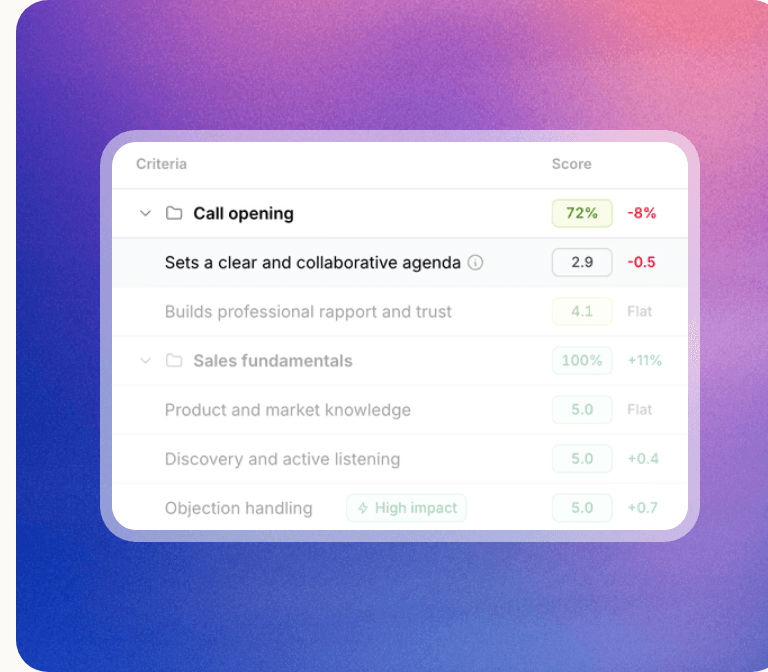
Alpharun's call scorecard, breaking a rep's call opening and sales fundamentals into scored criteria.
SNAP only pays off when every rep runs it the same way, on every call. That consistency is what breaks down at scale.
The reps who drift most are your middle performers, the exact group where better coaching moves revenue most.
Alpharun sits on top of your existing call system and grades every conversation against your playbook, so your human team performs at its best while the busywork of QA runs on its own.
It works with high-volume Medicare brokerages like Chapter, covering hundreds of advisors across hundreds of thousands of calls. Those advisors field frazzled callers all day during enrollment season.
With Alpharun, teams can:
Encode your SNAP standard into a bespoke AI playbook trained on your best calls
Score 100% of calls against your simple, invaluable, align, and priority criteria, up from the weekly handful a manager can review by hand
Surface the exact moment a rep overloaded a frazzled buyer or missed the priority
Send reps short coaching notes right after each call, tied to the exact moments where SNAP slipped
Send managers a weekly digest report of each rep's priorities and exactly what to coach next
Shorten ramp time by turning what top reps do into the standard everyone learns
Once the SNAP sales methodology becomes a scored, coached standard, the whole team starts sounding like your best rep. Book a demo with Alpharun to see how it grades your reps against the SNAP principles on every call.
Frequently asked questions
What does SNAP stand for in sales?
SNAP stands for keep it Simple, be iNvaluable, always Align, and raise Priorities. These four principles guide how reps engage overwhelmed buyers. Jill Konrath created the framework in her 2010 book SNAP Selling.
Who created the SNAP selling methodology?
Jill Konrath, a sales strategist and speaker, created the SNAP selling methodology. She introduced it in her 2010 book SNAP Selling: Speed Up Sales and Win More Business with Today's Frazzled Customers.
What are the 3 buyer decisions in SNAP selling?
The three buyer decisions are: allow access, initiate change, and select resources. Buyers first decide whether you're worth their time, then whether change is worth the risk, and finally which option to choose. Most deals stall at the first two.
Does SNAP selling work for inside sales and call centers?
Yes, SNAP selling works well for inside sales and B2C call centers. The Simple, Align, and Priority principles translate directly to phone conversations, where attention spans are short and buyers decide fast. Reps just compress the three buyer decisions into one or two calls.
What's the difference between SNAP selling and SPIN selling?
The main difference is the buyer: SNAP selling reduces friction for overwhelmed buyers who already know they have a problem, while SPIN selling uses structured questions to uncover pain they haven't named yet. Many teams use SPIN for discovery and SNAP for engagement.

