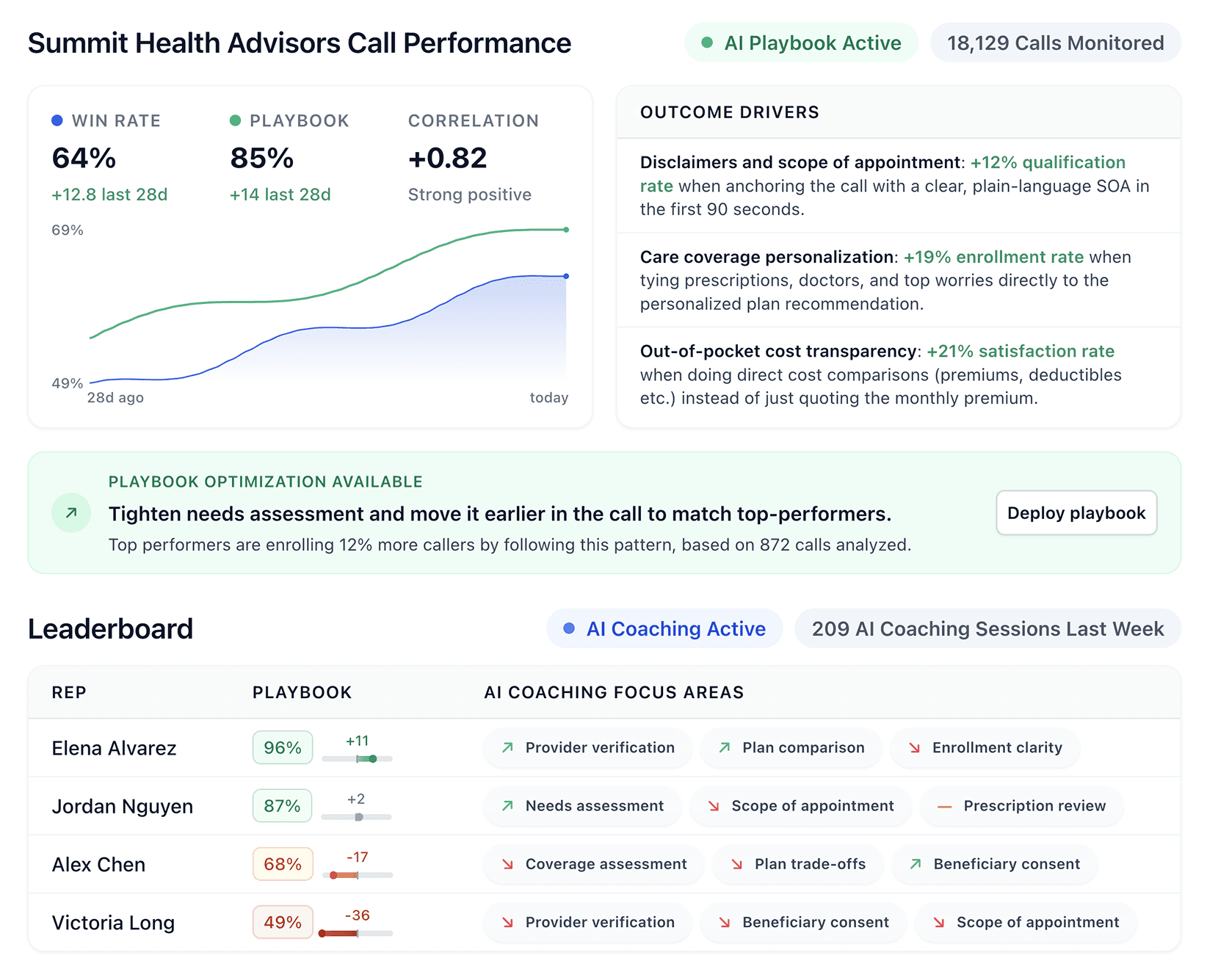


Sales call training works when it changes what reps do on their next call. Most call center training programs don't meet that bar.
Here's what actually moves rep performance on a high-volume B2C floor, with specific examples for Medicare, insurance, and home services teams.
Why most sales call training doesn't stick
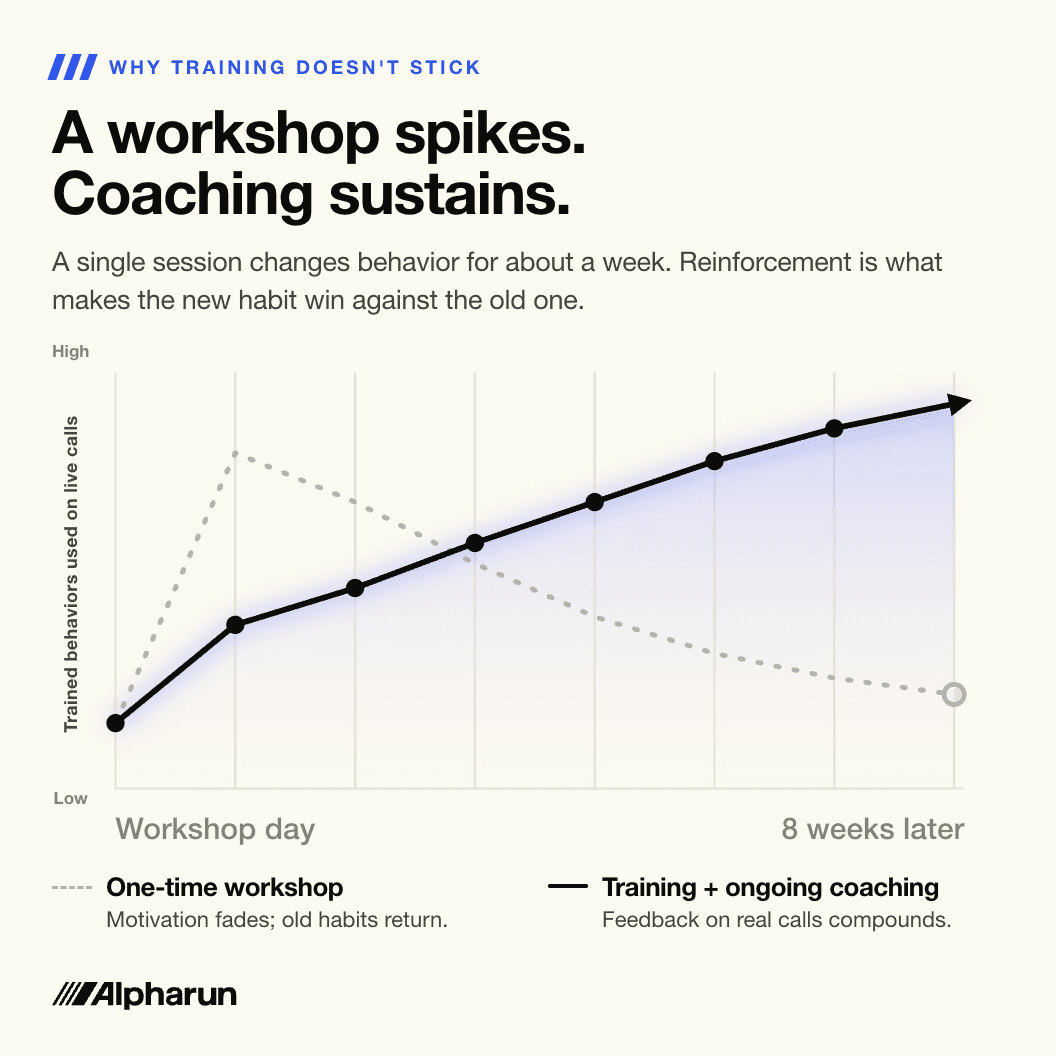
Most sales call training doesn't stick because a single training session rarely changes day-to-day behavior.
A team attends a workshop, practices a few roleplays, and leaves motivated. A week later, the same objections are being mishandled, the same discovery questions are being skipped, and the same habits have returned.
Knowing what to do and doing it consistently are different things. When reps are handling dozens of calls a day, familiar habits tend to win unless coaching and feedback reinforce the new behavior.
That's why the best sales teams treat training as the starting point. The improvement comes from what happens afterward.
What sales call training should actually cover on a B2C floor
Most generic sales call training focuses on the wrong things for high-volume B2C environments. The skills that matter on a 12-minute Medicare enrollment call are different from those needed on a 90-minute enterprise demo.
Here's what training needs to address for a call center sales floor:
The first 15 seconds
On a high-volume floor, the prospect has taken multiple calls that day from reps selling similar products. The opener is where most deals are lost before they start.
Training should cover specific, tested opening lines rather than generic guidance like "build rapport." A Medicare agent who opens with "I'm probably catching you at a bad time, but I'll be quick" will keep more prospects on the line than one who opens with "Hi, how are you today?"
That's a trainable, measurable, coachable behavior.
Discovery questions in the right order
Reps who close at the highest rates ask discovery questions before pitching.
On a home insurance call, that means asking about the prospect's current coverage, when it renews, and what they're paying before mentioning any product.
On a Medicare call, it means asking about the prospect's doctors and prescriptions before showing any plan.
Training that skips discovery and jumps straight to pitch mechanics is training reps to close prospects who were already going to buy. The reps who move the needle are the ones who convert hesitant prospects, and that starts with discovery.
The three or four objections that kill 80% of your deals
Every call center floor has a handful of objections that kill the majority of lost deals.
On a Medicare floor it's typically "I already have a plan" and "I need to think about it."
On a home services floor it's usually "I need to get another quote" and "now's not a good time."
Training should cover specific responses to those specific objections, practiced until they're automatic. Not generic objection handling theory. Exact language for the exact objections your reps face on your calls.
Example: A pest control rep hears "I already have a contract with someone else" on roughly 30% of outbound calls.
Rather than training a general "acknowledge and pivot" framework, a well-built training program would drill the specific response that your top converters use on that objection, word for word, until every rep delivers it with the same confidence.
The close sequence
Most reps who lose winnable deals lose them in the close. Either they never ask directly, they ask once and accept "I'll think about it," or they quote a price before the prospect has confirmed they want the product.
Training on the close sequence should be specific: when to ask, how to ask, what to say when the prospect hedges, and how to establish a next step when the call doesn't close on the first attempt.
Compliance language for regulated industries
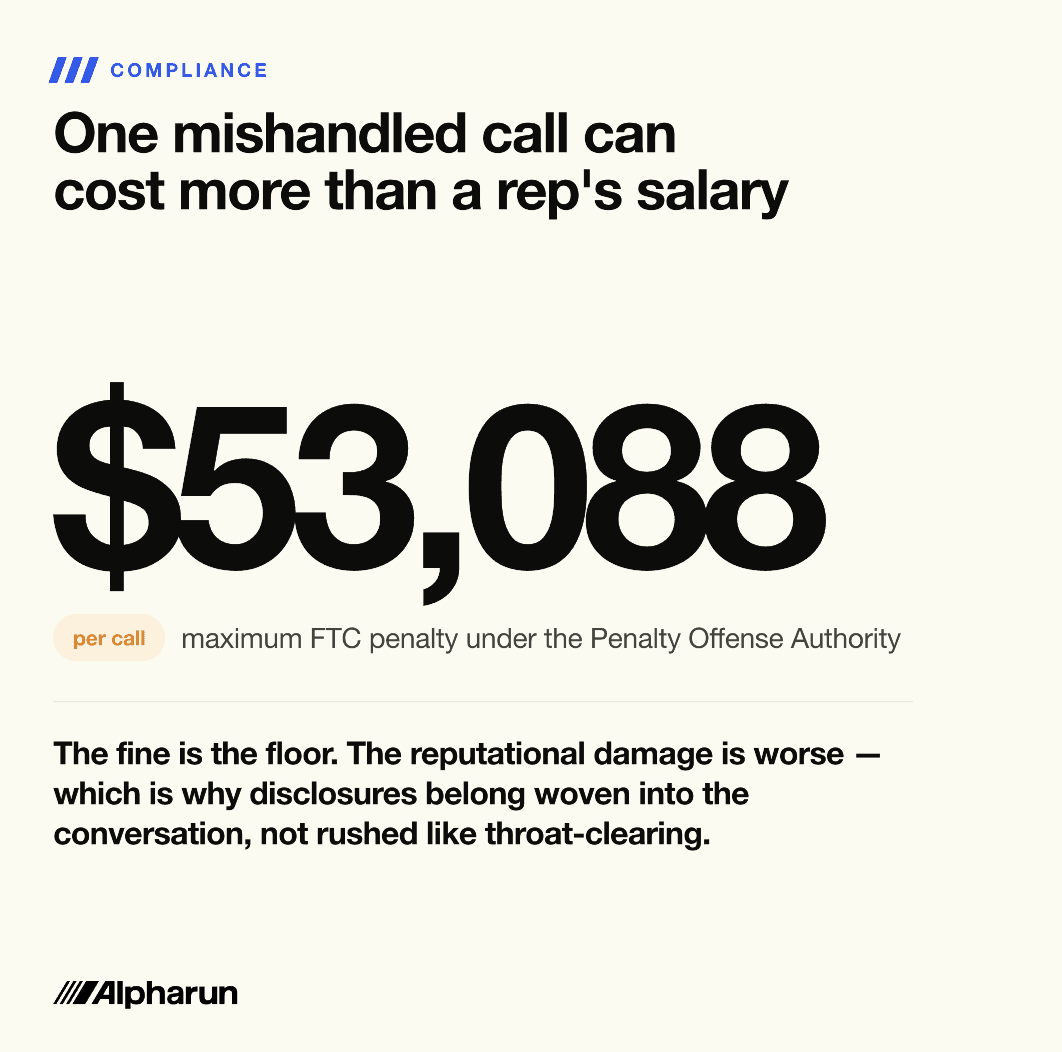
On a Medicare floor, the TPMO disclaimer has to land before certain conversations happen. On an insurance floor, specific disclosures are required before quoting. Most reps deliver these as throat-clearing, which signals to the prospect that the next part is throwaway.
FTC violations under the Telemarketing Sales Rule can reach $53,088 per violation, adjusted annually for inflation.
Training should cover how to bridge compliance language into the conversation naturally so it builds trust rather than killing the call's momentum. This is one of the most neglected areas of call center sales training and one of the highest-leverage ones.
How to deliver sales call training that actually changes behavior
Most call center managers know what good training looks like. The harder part is delivering it consistently when reps run 60 to 80 calls a day and managers are stretched across 20 direct reports.
1. Train with real calls from your own floor
The best sales call training uses conversations your reps recognize.
When a Medicare rep hears a top performer handle "I already have coverage" on a real call, with your leads and your offer, the lesson feels practical. It shows the team what works in the exact environment they sell in every day.
A simple training exercise:
Pull the first 60 seconds from five high-converting calls.
Transcribe the openings.
Play them during coaching.
Ask the team what the rep said, what they skipped, and why the prospect stayed on the call.
That exercise gives reps a concrete model they can copy on their next shift.
2. Use roleplay built around real objections
Roleplay works best when it mirrors the calls reps actually handle.
For a Medicare sales floor, that might include:
"I already have coverage."
"I need to talk to my spouse."
"I don't want to change doctors."
"I got too many calls last year."
Each scenario should be graded on specific behaviors: whether the rep acknowledged the concern, asked a useful follow-up, and moved the conversation forward.
Generic roleplay tends to feel disconnected from the floor. Specific roleplay gives reps practice for the next objection they are likely to hear.
3. Coach specific moments in the call
General feedback rarely changes behavior. Telling a rep to "be more confident" leaves them guessing.
A stronger version sounds like this:
"At the 2-minute mark, the prospect mentioned their cardiologist may be out of network. You moved past it. That was the moment to ask how often they see that doctor and whether keeping that provider matters."
That kind of feedback gives the rep a clear action for the next call.
The best coaching points include:
The exact moment in the call
What the rep did
What the rep could have asked or said instead
A real example from a top performer
4. Shorten the feedback loop
Feedback loses value the longer it waits.
If a manager reviews calls every Friday, a rep may repeat the same mistake hundreds of times before hearing about it. Same-day or next-day feedback works better because the rep still remembers the conversation and can apply the correction quickly.
Weekly coaching has a place, but behavior change happens faster when call-level feedback arrives close to the moment that needs improvement.
4 most common sales call training mistakes on a B2C floor
Even strong sales teams can struggle to improve when training focuses on the wrong things. These mistakes show up repeatedly across Medicare, insurance, and home services sales floors.
⚠️ Training mistake | 🔄 What happens | ✅ Better approach |
Training every rep the same way | Coaching misses individual skill gaps | Tailor training by experience level and performance patterns |
Treating training as a one-time event | Old habits return quickly | Reinforce through ongoing coaching and feedback |
Measuring completion instead of behavior | Activity looks good while results stay flat | Track call-level behaviors tied to performance |
Using generic best practices | Reps struggle to apply advice in real calls | Build training from your floor's highest-performing conversations |
1. Training every rep the same way
New hires and veteran reps rarely have the same coaching needs.
A rep in week two is still learning call structure, discovery, and objection handling. A rep with two years of experience usually needs help with a specific conversion bottleneck.
For example:
A new rep may struggle to control the opening of the call.
A mid-level rep may lose deals after pricing comes up.
A veteran rep may have plateaued on closing conversations.
When everyone receives the same training, some reps get overwhelmed while others tune out. The strongest programs tailor coaching to the skill gap that exists today.
2. Treating training as a one-time event
Many teams invest heavily in training days and very little in reinforcement.
A rep can leave a workshop energized, then spend the next week handling hundreds of calls with no feedback on whether they're applying what they learned. In most cases, familiar habits quickly take over.
A stronger approach includes:
Weekly coaching tied to recent calls
Monthly skill-focused training sessions
Ongoing call reviews and self-assessment
Clear follow-up on previous coaching topics
The goal is to create repetition until the behavior becomes part of the rep's normal process.
3. Measuring completion instead of behavior change
Training completion is easy to track, improvement is what actually matters.
A rep may finish every training module and pass every quiz while still skipping discovery questions or mishandling common objections on live calls.
Focus on behaviors that can be observed directly:
Discovery completion rate
Objection-handling effectiveness
Close attempt rate
Compliance adherence
Call structure adherence
These metrics show whether training is influencing what happens on the phone.
4. Teaching generic best practices instead of your own winning patterns
Advice like "build rapport" and "ask open-ended questions" sounds helpful, but it rarely tells reps what to do on their next call. The most effective training comes from analyzing your own top performers.
Questions worth asking:
What do top reps say in the first 30 seconds?
Which discovery questions appear most often on winning calls?
How do top performers respond to objections like "I already have coverage" or "I need to think about it"?
What does a successful close actually sound like on your floor?
Those answers create training that reflects your customers, your product, and your sales environment.
The sales floors that improve fastest treat training as a continuous system. They identify winning behaviors, reinforce them consistently, and measure whether those behaviors are showing up on real calls.
Building a sales call training system
A training system is the difference between a floor that improves continuously and one that improves in bursts and then plateaus.
A functional training system for a high-volume B2C call floor has four components:
A defined behavioral standard
What does a good call look like at each stage? This standard should be specific enough that a manager and a rep would grade the same call the same way. Build it from your highest-converting calls rather than a generic playbook.
Coverage of enough calls to see patterns
A manager reviewing five calls per rep per week sees roughly 1-2% of that rep's behavior. At that sample rate, patterns that are obvious across 50 calls stay invisible. The training system needs enough call coverage to surface what's actually happening.
A feedback mechanism that reaches reps quickly
Feedback tied to specific moments in specific calls, delivered close enough to the call that the rep remembers it.
A coaching cadence that makes development consistent
Weekly touchpoints focused on two or three specific behaviors from real calls that week. Not monthly reviews, not quarterly assessments.
How Alpharun supports sales call training across large teams
The training approach described above works. The challenge is applying it consistently across 50, 100, or 150 reps handling hundreds of calls every day.
Alpharun helps sales teams turn training into an ongoing coaching system by analyzing every conversation against a custom playbook built from their highest-performing calls.
With Alpharun, managers can:
Identify the behaviors top performers use to win more conversations
Turn those behaviors into a coaching standard for the entire team
Score every call against that standard automatically
Spot where reps are struggling, whether it's discovery, objection handling, compliance, or closing
Deliver feedback tied to specific moments in real calls
Track whether coaching is leading to measurable improvement over time
For Medicare, insurance, and home services teams, Alpharun also combines sales coaching and compliance monitoring in the same workflow. Required disclosures, qualification steps, and sales behaviors are evaluated on every call, giving managers visibility across the entire floor.
See how your top reps can become the coaching standard for the entire floor. Book a demo with Alpharun today.
Frequently asked questions
What is sales call training?
Sales call training is the process of developing rep skills for handling sales conversations, including opening calls, running discovery, handling objections, and closing. For high-volume B2C call centers, effective training focuses on specific behaviors tied to real call scenarios and includes ongoing reinforcement through call review rather than one-time sessions.
How do you train sales reps on objection handling?
The most effective way to train reps on objection handling is to identify the three or four objections that kill the most deals on your floor and build specific, practiced responses for each one. Responses should come from recordings of how your top converters handle those objections, not from generic frameworks. Reps should practice until the responses are automatic.
How long does sales call training take to produce results?
Sales call training produces visible results within two to four weeks when it includes specific behavioral goals, frequent call review, and feedback tied to real call moments. The timeline depends less on the quality of the training content and more on the consistency of the feedback loop following it.
What is the difference between sales call training and sales coaching?
The main difference between sales call training and sales coaching is that training teaches skills, while coaching reinforces them through feedback on real calls. The strongest call center programs combine both: training defines the standard, and coaching helps reps apply it consistently.