

Getting a new rep from their first call to full quota in a high-volume B2C call center takes months, and every week they're not there costs your business real money. These 27 call center training best practices are built to change that.
Call center training best practices for high-performing teams
Strong call center training comes from getting a few key areas right across the entire agent lifecycle.
These best practices are organized into: foundation and onboarding, coaching and feedback, skills and knowledge, process and systems, and culture and retention.
🧩 Area | 🎯 Focus | 🔑 What it drives |
Foundation and onboarding | Structured ramp, clear expectations, compliance-first training | Faster ramp time and fewer early mistakes |
Coaching and feedback | Timely feedback, focused sessions, real call examples | Stronger skill development and faster behavior change |
Skills and knowledge | Real call training, objection handling, compliance repetition | More confident reps and smoother conversations |
Process and systems | Integrated tools, automated QA, milestone tracking | Better visibility and more efficient coaching workflows |
Culture and retention | Recognition, performance visibility, continuous training | Higher engagement and lower turnover |
Foundation and onboarding
1. Build a structured onboarding program before your next hire starts
New reps ramp faster when they walk into a defined program with a clear sequence of what to learn first. Start with compliance, then move into your sales process, product knowledge, and finally the tools they will use daily.
Most onboarding programs run three to six months. Early focus should be on getting reps comfortable handling real conversations without creating compliance risk or confusing the customer.
Pro tip: Create a 30/60/90-day milestone map so both the rep and manager know what “ready” looks like at each stage.
2. Set performance expectations in week one
Agents improve faster when expectations are clear from the start. Share key metrics like conversion rate, call quality scores, and compliance pass rate before the first live call so reps know what success looks like.
Clarity shapes behavior. When reps understand how discovery or objection handling will be evaluated, they prepare with more intention.
3. Start compliance training before product training
In regulated environments like Medicare or insurance, compliance sets the foundation for every call. Reps need to understand required disclosures, prohibited claims, and call recording rules before discussing product details.
This sequence reduces early mistakes and builds confidence when reps move into live conversations.
4. Create a ramp checklist tied to live call activity
A ramp checklist gives structure to the transition from training to independent calls. It tracks whether reps have demonstrated key behaviors in real conversations before moving forward.
What to include:
Compliance disclosures delivered correctly on a live call
Needs discovery completed before pitching
Objection handled without script deviation
Close attempt made on a qualifying call
This approach makes readiness visible and keeps progression tied to actual performance rather than time spent in training.
5. Pair new reps with a strong performer for shadowing
Shadowing helps new reps absorb how strong calls actually sound. They hear pacing, tone, and transitions that are hard to capture in written materials.
Over a few sessions, patterns become easier to spot, especially in how experienced reps guide conversations and recover from difficult moments.
6. Record your best onboarding calls as training material
Your strongest calls are already happening inside your team. Capture them and turn them into a library that new reps can use during onboarding. Label clips by scenario, such as discovery, objection handling, or closing, so reps can quickly find relevant examples.
Access to real calls shortens the learning curve and gives reps a clear reference point for what strong performance sounds like.
Pro tip: Keep the library small and curated. Five to ten strong examples per scenario are easier to use than a large, unorganized archive.
Coaching and feedback
7. Score calls within 24 hours of them happening
Feedback works best when it stays close to the call. When reps review a call within a day, they still remember their intent, what the customer said, and where the conversation shifted, which makes it easier to connect the feedback to what actually happened and adjust on the next call.
Teams that keep reps engaged through timely feedback also see lower turnover, with some high-turnover teams reducing churn by up to 24%.
8. Focus each coaching session on one priority
When you try to cover everything in one session, nothing really sticks. A rep who leaves with a long list of fixes often ends up overwhelmed and unsure where to start.
Instead, pick the one behavior that will make the biggest difference on their next calls and center the conversation around it. Walk through it, show what good looks like, and make sure they know exactly what to do differently.
That kind of focus gives the session a clear direction and makes it much easier to see progress when you review their calls next time.
9. Use time-stamped examples in every session
General feedback points out the issue. Specific moments show where the call changed.
Compare these two approaches:
In one session, the manager says, “Your discovery needs work.” The rep leaves knowing something went wrong, but has no clear idea where or how to fix it.
In another session, the manager plays the clip at 4:26 and pauses when the rep jumps into product features before the rep understands the caller’s situation. Now the rep can hear the exact moment the call shifted and what was missing.
That difference changes the conversation. Instead of guessing, the rep can focus on what to do differently on the next call, and the feedback becomes something they can act on right away.
10. Separate your QA reviews from your coaching sessions
QA reviews focus on whether the rep followed the required steps. Coaching sessions focus on improving how the rep performs.
When both happen in the same conversation, compliance tends to take over, and development gets less attention. Keeping them separate allows each conversation to stay focused and more productive.
Pro tip: Share QA scores ahead of time so the rep can review their performance before the coaching session and come prepared to discuss it.
11. Build self-assessment into your coaching process
Ask reps to score their own calls before you share your evaluation. The comparison shows how they see their own performance and gives you a starting point for the conversation.
Different gaps call for different coaching approaches:
📊 Rep self-score vs. manager | 🔍 What it signals | 🎯 Coaching focus |
Rep scores higher | Overconfidence or blind spots | Calibrate standards using real examples |
Rep scores lower | Low confidence or uncertainty | Reinforce what worked and build confidence |
Scores align | Strong awareness | Focus on refining specific behaviors |
Starting with their perspective makes the conversation more collaborative and helps you adjust your approach based on how the rep already interprets their results.
12. Rotate your coaching focus week to week
When the same feedback repeats across sessions, it usually signals that the approach needs to change. The rep may need a different way to practice the behavior or more specific guidance.
Shifting the focus keeps sessions productive and helps build a broader skill set over time. For example, a coaching cycle might look like this:
📅 Week | 🎯 Focus area | 📝 What you work on |
Week 1 | Call opening | Clear intro, setting agenda, building early trust |
Week 2 | Discovery | Asking the right questions before pitching |
Week 3 | Objection handling | Responding to pricing or “not interested” pushback |
Week 4 | Closing | Asking for commitment and handling silence |
Each week builds on the last, while still giving the rep space to improve one area at a time. Over a month, the rep develops a more complete call flow rather than repeating the same feedback without making progress.
13. Deliver agent-level coaching notes after every call cycle
Short, targeted notes between sessions help reps act on feedback while calls are still fresh. This keeps improvement moving even when managers are not in a live session.
For teams with larger spans of control, this approach keeps coaching consistent without adding more meetings.
Pro tip: Keep notes short and tied to a single behavior so reps can apply them immediately on their next call.
Skills and knowledge
14. Build a searchable internal knowledge base
When reps have to rely on supervisors for answers, call flow slows down and confidence drops. A well-structured knowledge base gives them a reliable place to find answers quickly without interrupting the conversation.
What to include:
Plan and product details with clear coverage summaries
Approved responses to common objections
Compliance rules explained in plain language
Scripts and phrasing for required disclosures
Keep it current as rules, pricing, and products change. When reps trust what they are reading, they use it more confidently on live calls.
Pro tip: Structure your knowledge base around real call scenarios so reps can quickly match questions to answers during live calls.
15. Train on objection handling using real call examples
Scripts give reps structure, while real calls show how those responses sound in practice. Build a library of objection clips by type so reps can hear different approaches and start recognizing patterns in tone, timing, and phrasing that carry across calls.
For example, take the common objection: “I already have coverage.”
Script version:
“I understand. A lot of people I speak with already have coverage. Just so I don’t miss anything, can I ask what you like most about your current plan?”
Real call variation:
“Got it, most people I speak with are in the same spot. Before we go further, what made you choose your current plan in the first place?”
Both follow the same structure, but the delivery feels more natural and conversational in the second version. That exposure helps reps respond more naturally and adjust in the moment when conversations shift or take an unexpected turn.
16. Make compliance language automatic through repetition
Compliance breaks down when reps have to pause and think about what to say. Repetition builds familiarity, which helps disclosures come through clearly without interrupting the flow of the call.
In regulated environments like Medicare, the stakes are high. CMS enforces strict rules, and violations can lead to fines, corrective action, or enrollment suspensions. In 2022, CMS issued over $1 million in fines, many of which were tied to repeated issues in call handling and disclosures.
Practice disclosures outside full-call scenarios so reps can focus on delivery. Once the language becomes second nature, it is easier to integrate it smoothly into real conversations.
17. Use role play for high-stakes scenarios
Role play helps reps prepare for moments that are harder to navigate live. It gives them a chance to practice responses before they need them in front of a customer.
Focus on situations that create pressure:
Strong pricing objections
Confused or hesitant callers
Delivering difficult or unexpected information
Repeated exposure to these moments builds confidence and improves how reps respond when they encounter them on real calls.
Pro tip: Record role-play sessions and review short clips together. Reps often notice habits in playback that are easy to miss in the moment.
18. Cross-train reps on related product knowledge
Reps gain credibility when they can handle comparison questions without hesitation. Understanding related products, competitor options, and eligibility rules helps them guide the conversation rather than deflect it.
These questions come up on real calls all the time:
“How does this compare to what I have now?”
“Is this better than a supplement plan?”
“What happens if I travel or switch doctors?”
When reps can answer directly, the conversation keeps moving and trust builds. When they hesitate or deflect, momentum drops.
This matters even more when customers are actively comparing options, where stronger product context helps reps stay in control and respond with confidence.
19. Use microlearning for ongoing skill development
Short training sessions are easier to absorb and apply during a busy call schedule. Delivering focused lessons right before a shift gives reps a chance to use what they learned immediately.
Microlearning works well for:
New objections that start appearing
Updates to compliance rules
Refining specific parts of the call
Regular, targeted training keeps skills sharp without pulling reps away from the floor for long sessions.
Pro tip: Tie each module to one behavior and track whether it shows up in calls that same day to keep training connected to real performance.
Process and systems
20. Integrate your coaching tools with your existing dialer
When coaching tools live outside your calling system, managers end up switching tabs, manually pulling recordings, and entering scores after the fact. That extra friction adds up, and coaching gets delayed or skipped.
When your dialer and coaching tools are connected, call data flows automatically. Managers can review, score, and coach from one place while the call is still fresh.
⚙️ Setup | 🧑💼 Manager workflow | 📈 Result |
Disconnected tools | Manual pull + manual entry | Delayed or skipped coaching |
Integrated tools | Calls and data flow automatically | Faster, consistent coaching |
Pro tip: Prioritize integrations that attach scores and notes directly to each call so managers can move from review to coaching without switching tools.
21. Automate QA scoring across all calls
Manual QA only captures a small slice of what is happening across the team. A few reviewed calls can look strong, while the rest of the week tells a different story.
Automated QA expands visibility across the full call volume, making it easier to spot patterns that would otherwise stay hidden.
For regulated teams, broader coverage also reduces the risk of repeated compliance gaps going unnoticed.
Pro tip: Use automated scoring to flag patterns, then focus manual reviews on the calls that need deeper coaching.
22. Build your training around your own top performers' calls
Training works best when it reflects how your team actually sells. Calls from your top performers show what works with your product, pricing, and customers. While generic material gives a framework, real calls show how it plays out, helping reps adapt faster in real conversations.
Update your training library regularly so reps are learning from examples that match current offers, scripts, and objections.
23. Track ramp progress with milestone-based checkpoints
A single “fully ramped” date makes it hard to see how a new rep is progressing. Milestones break that timeline into clear stages, giving managers a way to track development in real time.
Early checkpoints highlight where reps are improving and where they need support, which helps prevent small gaps from turning into larger performance issues.
Research from Brandon Hall Group shows structured onboarding can improve retention by 82% and productivity by over 70%. Milestones make that structure measurable and easier to manage over time.
24. Score both compliance and sales effectiveness on every call
Compliance and sales performance show up on the same call, so they need to be evaluated together. Looking at one without the other creates blind spots in how reps are actually performing.
🔍 Focus | 👀 What you see | ⚠️ Risk |
Compliance only | Rule adherence | Missed revenue opportunities |
Sales only | Conversions | Compliance exposure |
Both together | Full call performance | Balanced outcomes |
Scoring both gives a clearer view of how reps handle real conversations and where to focus coaching.
Culture and retention
25. Recognize improvement across your whole team
When recognition only goes to top closers, most of the team has nothing to aim for. Progress feels invisible, even when performance is improving.
Highlighting improvement brings progress into focus. When a rep raises their compliance score or improves their discovery process, the impact of their effort becomes easier to recognize.
Recognition can be simple and specific:
Call out a rep who improved their discovery score in a team meeting
Share a short clip of a rep handling an objection better than the week before
Highlight week-over-week progress in a team dashboard or Slack channel
Tie small wins to milestones, like moving from a 2 to a 4 in a key skill
These moments show the team what progress looks like in practice. When reps see improvement getting noticed, they stay engaged and keep pushing forward, especially those still building confidence.
26. Give reps visibility into their own performance scores
Reps engage differently when they can see their own performance data. Instead of waiting for feedback, they start spotting patterns and coming into sessions with clearer questions.
Seeing how their numbers compare with team benchmarks also helps them understand where to focus next, making coaching conversations more productive.
Tracking trends over time adds another layer, since a rep moving from a 2 to a 4 in objection handling can clearly see their progress and how their effort is paying off.
Pro tip: Show performance trends over multiple weeks so reps can connect daily effort to longer-term improvement.
27. Keep training continuous after onboarding ends
Training carries the most value when it continues beyond onboarding. Products evolve, compliance rules shift, and customer questions change throughout the year.
Teams that keep training active stay closer to those changes and adjust faster when new patterns show up in calls.
📚 Training approach | 🔄 How it runs | 📊 Outcome |
One-time onboarding | Front-loaded learning | Skills plateau over time |
Continuous training | Ongoing updates and refreshers | Steady skill development |
Research from LinkedIn shows 94% of employees are more likely to stay at a company that invests in their development. In high-turnover environments, that level of engagement shapes how long reps stay and how consistently they perform.
How Alpharun cuts onboarding time
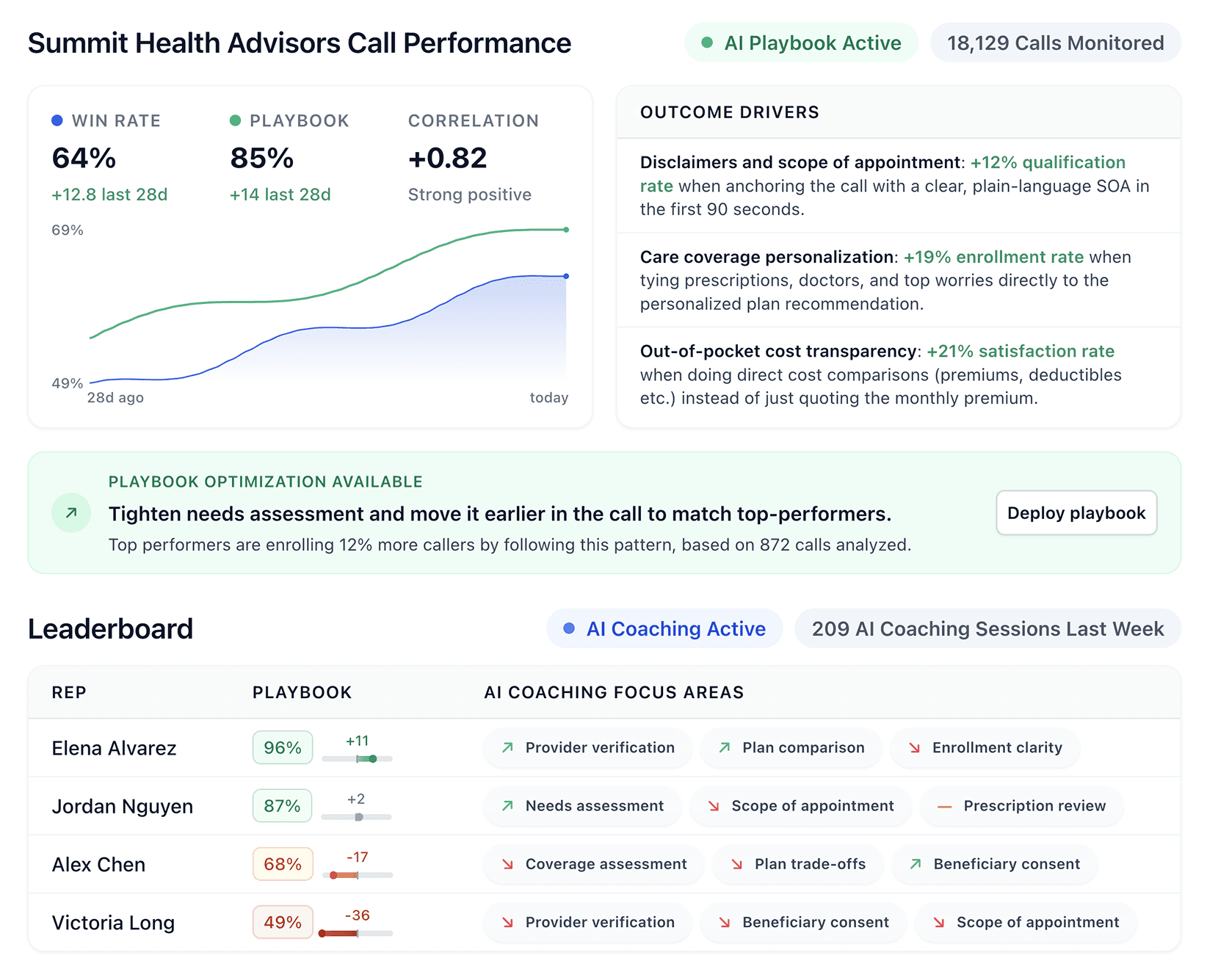
Alpharun cuts onboarding time by improving how call center training works. It also helps boost your call center training best practices through coaching new reps during live calls and automating QA across 100% of interactions.
Onboarding breaks down when managers are stuck reviewing calls, scoring performance, and running coaching sessions on top of daily operations. As teams grow, feedback slows down, coaching becomes inconsistent, and new reps take longer to ramp.
Alpharun replaces that manual workload with an automated system:
A custom playbook is built from your top performer calls and reflects what drives conversions on your team.
Every call is scored against that playbook to keep standards consistent from the first live interactions.
Sentence-level coaching runs during live calls and gives reps guidance in the moment.
Weekly insights show which reps need attention and help managers focus their time.
Key moments are flagged within each call so coaching sessions start with clear examples.
A SOC 2 Type 2 compliant framework supports compliance across regulated industries, including Medicare, healthcare, insurance, financial services, and mortgages.
New reps get clear guidance from their first calls, and managers can focus on coaching conversations rather than reviewing recordings.
Your team doesn’t have to choose between fast onboarding and thorough coaching. Take a look at how Alpharun gets your team there.
Frequently asked questions
What is the goal of call center training?
The goal of call center training is to improve how agents handle real conversations so they can drive better outcomes. It focuses on building skills like communication, objection handling, compliance, and closing so reps can perform consistently on live calls.
How can AI improve call center training?
AI improves call center training by analyzing calls at scale and delivering feedback faster. It can score every interaction, surface patterns across reps, and provide targeted coaching tied to specific moments in calls.
How do you measure whether call center training is working?
You measure call center training by tracking changes in key metrics like conversion rate, call quality scores, and compliance pass rate. Improvement in these areas shows that reps are applying what they learned in real conversations.
How long should call center onboarding take?
Call center onboarding typically takes three to six months, depending on the product's complexity and compliance requirements. Reps should reach a point where they can handle calls confidently while meeting performance and compliance standards.
How many calls should managers review per rep per week?
Managers should review at least three to five calls per rep per week to spot patterns and guide coaching. Higher-volume teams often combine this with automated QA to gain visibility across more calls.