
If you’ve ever deployed a voice agent that sounded great in testing and embarrassed you in production, you already know what this article is about.
These are the 9 AI voice agents that actually performed when real callers got involved in 2026.
9 best AI voice agents in 2026: quick comparison
💻 Tool | ⚡ Strengths | 🎯 Best for | 💰 Starting price | ⚠️ Key limitation |
Vapi | Full stack control, model-agnostic, bring your own LLM and TTS | Developers building custom voice AI infrastructure | $0.05/min + model costs | No developer resources, no go |
Bland | Proprietary models, self-hosted data, batch calling at volume | Enterprise high-volume outbound with strict data governance | $0.14/min | Steep learning curve and no public enterprise pricing |
Retell AI | Post-call sentiment, fast setup, wide integrations | Inbound support teams needing call visibility | $0.07/min (pay-as-you-go) | SIP trunking setup thin on documentation |
Synthflow | No-code builder, CRM sync, HIPAA and SOC 2 compliance | Non-technical teams running structured call flows | Custom (enterprise pricing) | Phone numbers limited to US, Canada, and Australia |
ElevenLabs | 10,000+ voices, 70+ languages, white-label ready | Brands where voice realism drives the experience | From $6/month | No production monitoring built in |
PolyAI | 75% call containment, 130+ integrations, multi-channel context | Large enterprise contact centers with complex conversations | Contact sales | Six-figure contracts, weeks of implementation |
Voiceflow | Real-time co-editing, model-agnostic, free tier available | Cross-functional teams building and iterating together | Custom, usage-based pricing | Not a full telephony stack. Needs external providers for phone calls. |
Sierra | Multi-model LLM architecture, brand tone control, Live Assist | Enterprise consumer brands with strict tone and policy requirements | Contact sales (~$150K+/year) | No public pricing, scalability at high volume unproven |
Cognigy | 100+ languages, plug-and-play Avaya and Genesys integration | Large contact centers layering AI onto existing infrastructure | Contact sales | Enterprise only, not built for fast or self-serve deployment |
Disclaimer: Prices are subject to change without notice. Always visit the official company websites for the most up-to-date pricing information.
How I tested these AI voice agents
These platforms were not evaluated on their demo performance, because demos are designed to hide the problems. Every tool ran through the same outbound qualification script, then got taken somewhere the script didn’t cover.
Voice quality and latency: Timed the gap between the caller finishing and the agent responding. A second of silence on a real call is longer than it sounds on paper.
Interruption handling: Mid-sentence topic changes, deliberate confusion, callers who talked over the agent. This is where most platforms quietly fell short.
Off-script behavior: Unexpected questions, tangents, edge cases. The situations that happen on every real call and never appear in a vendor demo.
Setup time: Blank account to live agent, no help, no shortcuts. The variance here was significant.
Integration accuracy: Test calls made, CRM audited after. Data either landed correctly or it didn’t.
G2 reviews and community forums were cross-referenced against every finding. Complaints that showed up repeatedly from teams running these in production carried more weight than anything from a vendor.
1. Vapi: best for developers building custom voice AI
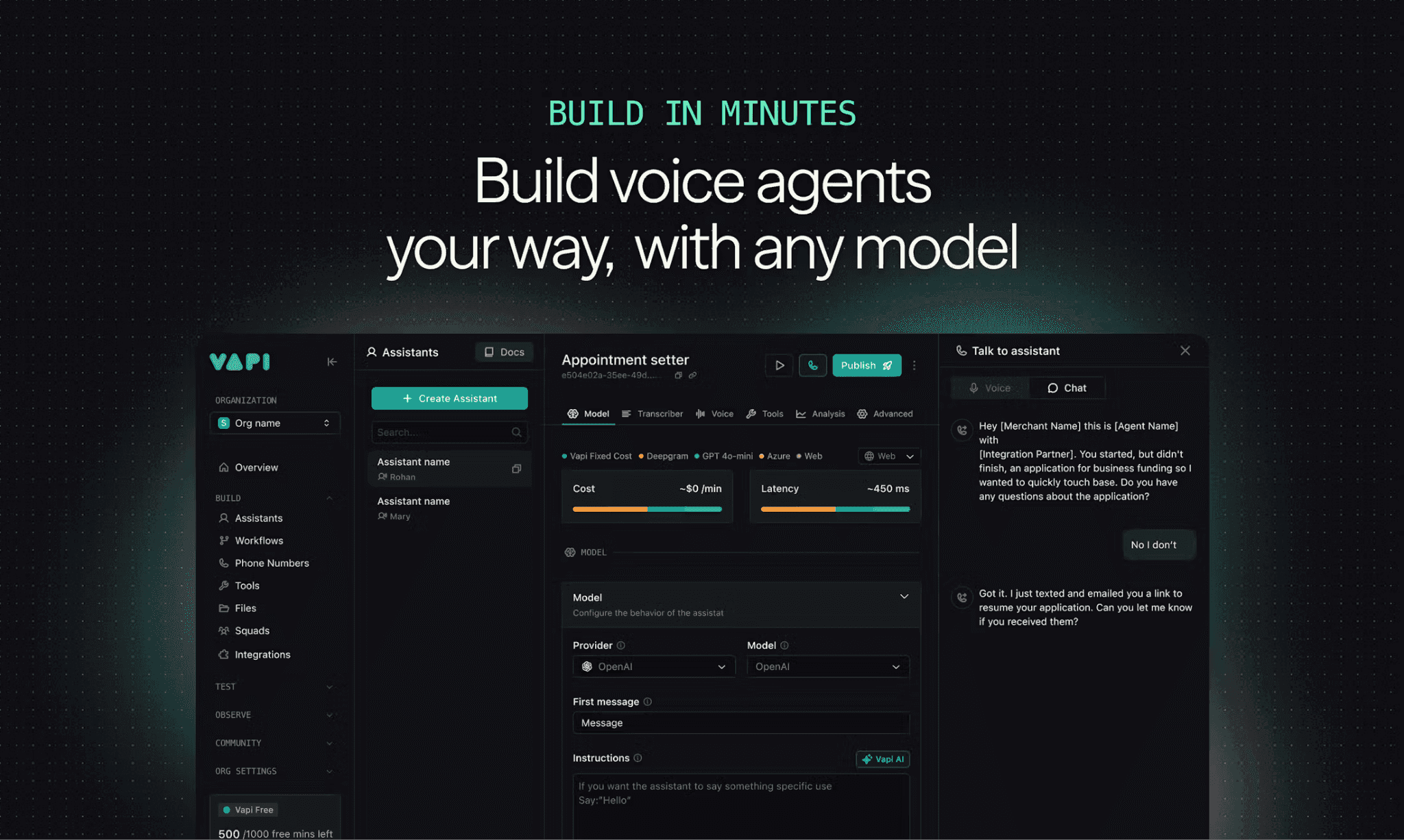
What it does: Vapi is a developer-first platform that lets engineering teams build voice agents by choosing their own speech-to-text, language model, and text-to-speech providers and wiring them together through Vapi’s API.
Best for: Engineering teams that want full control over every layer of the voice stack and are willing to manage that complexity.
Vapi is the only platform on this list where you own the entire stack. Most tools lock you into their LLM and voice provider, but Vapi lets you swap providers with a single config change, giving engineering teams a level of control that doesn’t exist anywhere else here.
Getting started is straightforward. A basic inbound support agent was live in under an hour, and swapping in ElevenLabs for the TTS layer was one config field. The platform stays out of your way when the task is simple.
The complexity catches up once you move past standard use cases. Production-grade agents require error handling, JSON parsing logic, and retry systems to stop calls from dropping mid-sentence, and none of that comes pre-built.
Key features
Model-agnostic architecture: Choose and swap LLMs, STT, and TTS providers independently. OpenAI, Claude, ElevenLabs, Deepgram, with no vendor lock-in across any layer.
Assistants and Squads: Assistants handle single-agent flows. Squads coordinate multiple specialized agents for complex routing scenarios.
Automated testing: Run simulated calls before deployment to catch failure modes before they hit live traffic.
Pros and cons
✅ Pros | ❌ Cons |
Complete control over every layer with zero vendor lock-in | Difficult for anyone without developer resources |
Low barrier to entry with real test calls before committing to a plan | Total cost per minute adds up fast once you factor in separate LLM, STT, and TTS providers |
Turn-taking and interruption handling feel natural when the stack is configured correctly | Building production-grade agents requires error handling, retry logic, and ongoing maintenance |
What users say
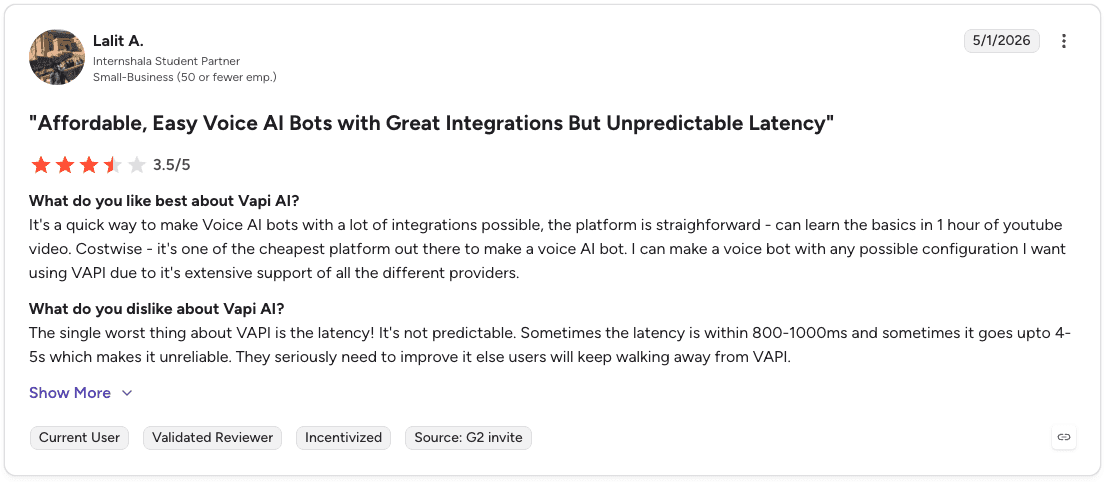
Pro: “It’s a quick way to make Voice AI bots with a lot of integrations possible, the platform is straightforward.” — Lalit A., Internshala Student Partner, G2 Review (May 1, 2026)

Con: “They could improve the dashboard. It’s very difficult. I have to be a developer if I want to understand all the options.” — Bappy R., G2 Review (Jan 29, 2026)
Pricing
Vapi offers usage-based pricing starting at $0.05/minute for voice hosting, with model costs (STT, LLM, TTS) passed through at cost or brought via your own API keys.
For larger deployments, Vapi provides custom enterprise pricing with volume discounts, advanced security, dedicated support, and enterprise-grade SLAs.
Bottom line
Vapi is the right fit for engineering teams building custom voice products with specific integration needs. If you don’t have developer resources, the setup cost in time and complexity will outweigh what you get.
2. Bland: best for enterprise high-volume outbound calling

What it does: Bland is an enterprise voice AI platform that runs proprietary speech and reasoning models on its own infrastructure, built for organizations that need millions of calls handled without data leaving the platform.
Best for: Large enterprises running high-volume outbound campaigns with strict data governance requirements.
Unlike most platforms on this list, Bland runs its own speech and reasoning models on dedicated servers rather than routing through OpenAI or Google.
That choice has two practical consequences: lower latency at high call volumes and full data containment for compliance-heavy environments.
In testing, the agent held context through deliberately confusing inputs on an outbound lead callback flow. The Conversational Pathways builder has a learning curve, but once the logic was mapped, calls ran cleanly and webhooks fired consistently.
Getting to that point takes patience. The first few weeks feel like learning a new mental model, and frequent product updates occasionally mean revisiting configurations you thought were already locked in.
Key features
Conversational Pathways: Design multi-turn dialog flows mixing scripted and generative responses, with variable extraction for custom routing logic.
Self-hosted infrastructure: Models and compute run on dedicated servers. Data stays fully contained with no third-party model exposure.
Batch calling: Dispatch thousands of outbound calls at once for appointment reminders, lead follow-ups, and notification campaigns.
Pros and cons
✅ Pros | ❌ Cons |
Latency feels natural even on difficult calls at volume | Steep learning curve for complex use cases |
Data never leaves the platform, critical for compliance-heavy industries | No public pricing adds procurement friction |
Webhook and batch calling setup is straightforward once the mental model clicks | Frequent product updates mean revisiting configurations periodically |
What users say

Pro: “Bland AI offers high performance and low latency, making it one of the fastest voice AI platforms I’ve used.” — Cameron O., G2 Review (Apr 23, 2026)

Con: “Their one-prompt approach to outbound calling could be better supported.” — Brennan S., G2 Review (Feb 23, 2026)
Pricing
Bland uses simple all-in per-minute pricing starting at $0.14/minute, with lower rates and higher limits available on team and volume plans.
Enterprise plans offer custom pricing with unlimited concurrency, dedicated infrastructure, enhanced security controls, and deployment flexibility.
Bottom line
Bland is the right fit for enterprises running high-volume calling with strict data governance needs. Teams without dedicated engineering resources or smaller operations that need quick deployment should look at Retell or Synthflow instead.
3. Retell AI: best for inbound support with post-call visibility

What it does: Retell is a voice AI platform built around the full call lifecycle: building the agent, running the call, and analyzing what happened afterward. with post-call sentiment scores, failed handoff flags, and automatic issue triage.
Best for: Support and sales teams that want a voice agent running fast without sacrificing visibility into call performance.
Retell earns its place on this list for one reason most platforms overlook: visibility into what actually happened on the call. Every conversation is automatically transcribed, summarized, and evaluated for sentiment the moment it ends.
In testing for a support use case, the agent was live and taking calls faster than expected. The knowledge base pulled accurate answers without manual scripting, and the conversation flow held up through deliberately awkward inputs.
The friction shows up during telephony setup. SIP trunking documentation lacks detail for anyone without prior experience, and the setup process isn’t well guided for beginners.
Key features
Knowledge base integration: Upload documents and website content so the agent pulls accurate answers without manual scripting.
Post-call analysis: Flags failed handoffs, low sentiment scores, and issue patterns across all calls automatically.
Broad integrations: Connects with Twilio, HubSpot, Salesforce, Make, n8n, and GoHighLevel out of the box.
Pros and cons
✅ Pros | ❌ Cons |
Post-call data is actionable: sentiment scores, handoff flags, and issue triage are built in | Costs climb at high call volumes without careful monitoring |
Fast to get a working agent into production with no heavy configuration | Edge cases in complex flows still need significant prompt tuning before going live |
Interruption handling feels natural on live calls | Customer support responsiveness is a recurring complaint in user reviews |
What users say

Pro: “The platform makes it easy to create scalable customer service, collections, roadside assistance, and operational workflows with low latency and natural conversations.” — Verified User in Automotive, G2 Review (May 27, 2026)

Con: “Advanced workflows and prompt tuning can still require a lot of testing and experimentation.” — Verified User in Information Technology and Services, G2 Review (May 26, 2026)
Pricing
Retell offers pay-as-you-go pricing starting at $0.07-$0.31 per minute for AI voice agents and $0.002+ per message for AI chat agents, with no long-term commitments.
Enterprise plans provide custom pricing with dedicated infrastructure, enhanced security and compliance, SSO, and priority support.
Bottom line
Retell is a strong pick for teams that need a voice agent up fast without sacrificing visibility into what happens after the call ends. Teams needing infrastructure-level customization will find Vapi or Bland a better fit.
4. Synthflow: best for no-code voice agent deployment
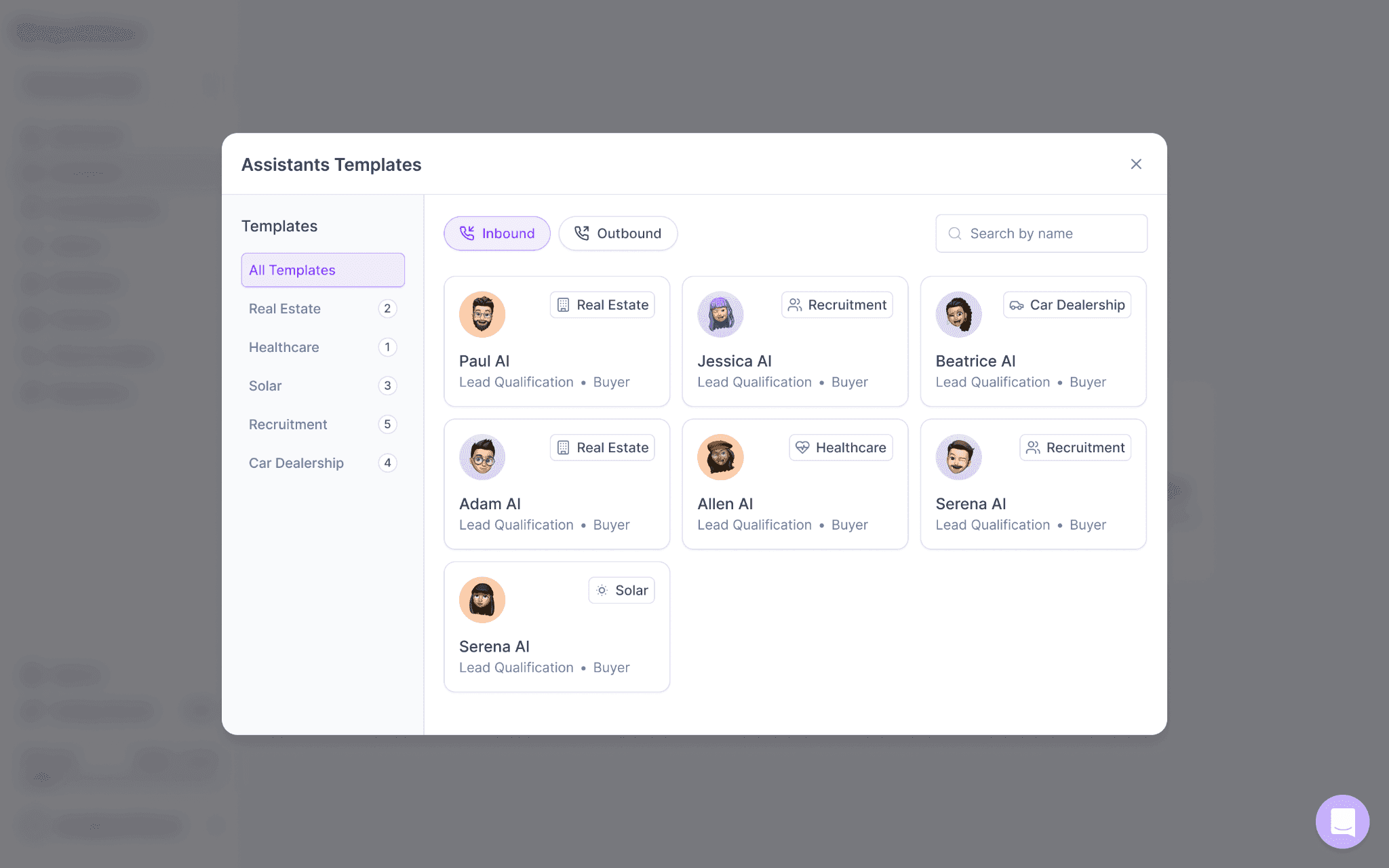
What it does: Synthflow is a no-code voice AI platform built around the full agent lifecycle: building, testing, deploying, and monitoring, without writing a single line of code.
Best for: Non-technical teams that need production-ready voice agents running fast for structured call types like appointment booking and FAQ handling.
Synthflow is aimed squarely at non-technical teams, and the workflow builder delivers on that promise. Getting a demo appointment agent running, with calendar integration and fallback responses configured, was a smooth process with no engineering involvement needed.
Structured call types performed well throughout testing. Appointment booking and FAQ flows ran cleanly and reliably, which is the use case Synthflow is genuinely built for.
Where it falls short is phone number coverage. Numbers are limited to the US, Canada, and Australia out of the box, which is a real barrier for any team trying to reach customers in other regions before the conversation even starts.
Key features
Post-call workflows: Automatically sync call outcomes, contact details, and notes to CRMs like HubSpot and Salesforce after every call ends.
Simulations and custom evaluations: Test agents against simulated conversations before going live to catch failure points early.
Compliance coverage: GDPR, SOC 2, and HIPAA support included, with guaranteed uptime SLA on Enterprise plans.
Pros and cons
✅ Pros | ❌ Cons |
Works without technical expertise, genuinely fast to deploy | Off-script handling breaks down in ways that make callers realize they’re talking to a bot |
Full lifecycle tooling from build to monitor in one platform | Full workflow features are locked behind the Enterprise plan |
Verifies callers, updates records, and escalates issues automatically | No-code approach can make debugging harder once flows get complex |
What users say

Pro: “Synthflow makes it very easy to build and manage AI voice agents without heavy technical setup.” — Jose Manuel G., G2 Review (Jan 12, 2026)
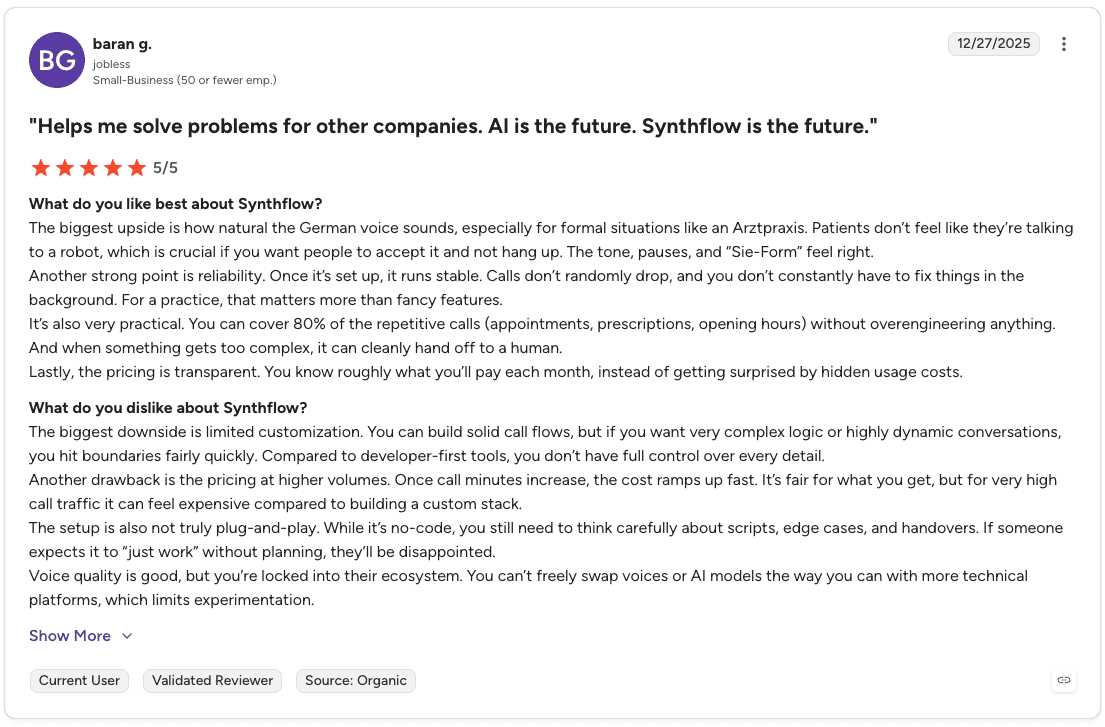
Con: “The biggest downside is limited customization.” — baran g., G2 Review (Dec 27, 2025)
Pricing
Synthflow offers custom pricing tailored to call volume and use case, with enterprise plans designed for organizations handling high volumes of inbound calls.
Bottom line
Synthflow is a solid pick for non-technical teams that need voice agents running fast across standard business use cases. Teams dealing with complex or unpredictable conversations will hit limitations quickly.
5. ElevenLabs: best for realistic and expressive AI voice quality

What it does: ElevenLabs builds AI voice synthesis and conversational agents, producing voice output that consistently passes as human in live calls, across 70+ languages with tone, pacing, and emotional nuance intact.
Best for: Brands where voice quality is non-negotiable and callers should not know they’re speaking to an AI.
Getting voice AI to sound human is harder than it looks. ElevenLabs handles tone, pacing, and natural pauses better than any other platform on this list.
The white-label setup is straightforward enough that agencies can deploy branded agents for multiple clients without rebuilding from scratch each time. Each client gets a customized voice, behavior, and experience.
Where ElevenLabs could improve is onboarding. There are a lot of sections to explore, and without a guided walkthrough, casual users can lose their bearings quickly. An in-platform tour showing what each area does and when to use it would make the experience significantly smoother.
Key features
Extensive voice library: 10,000+ human-like voices covering narration, customer support, branded audio, and character use cases.
Multilingual speech: 70+ languages with native-level clarity, tone, and emotional nuance, not only translation.
Conversational AI agents: Full inbound and outbound voice agent support with multi-agent workflow capability.
Pros and cons
✅ Pros | ❌ Cons |
Voice quality is the best on this list. Callers frequently can’t tell they’re talking to AI. | No built-in production monitoring means failures surface through user complaints, not dashboards |
70+ languages with genuine tonal nuance, going beyond literal translation. | Credit-based pricing is hard to forecast at volume |
White-label setup lets agencies deploy branded agents for multiple clients without rebuilding per client | Not a full telephony stack. Complex call routing requires pairing with another platform. |
What users say

Pro: “I really like ElevenLabs for its standout voice quality, which provides rich, emotional, and realistic voices.” — Gediminas P., G2 Review (Feb 27, 2026)
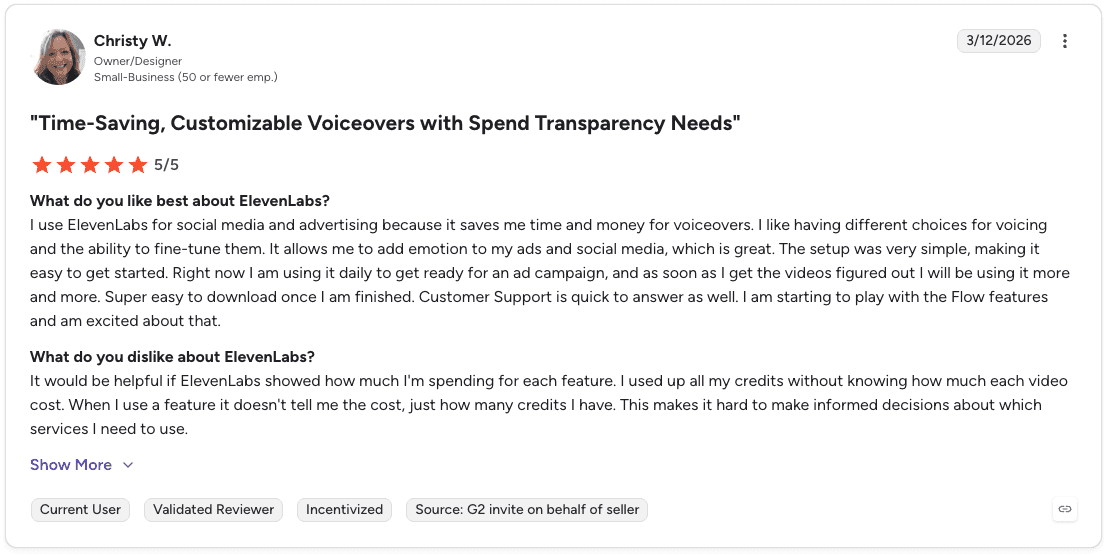
Con: “It would be helpful if ElevenLabs showed how much I’m spending for each feature.” — Christy W., G2 Review (Mar 12, 2026)
Pricing
ElevenLabs offers flexible pricing ranging from a free plan to paid tiers starting at $6/month, with higher plans unlocking voice cloning, commercial usage, API access, and premium audio quality.
Advanced plans scale up to $99/month+, with enterprise options available for larger teams and production workloads.
Bottom line
ElevenLabs is the right choice when voice quality drives the decision and callers should not detect AI. Teams needing deep telephony control or complex call routing logic will need to pair it with another platform.
6. PolyAI: best for large enterprise contact centers
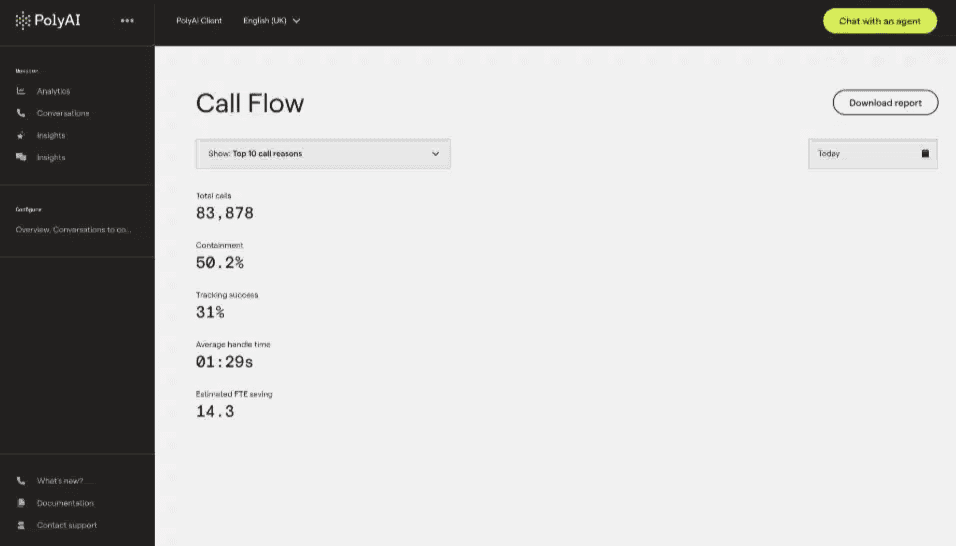
What it does: PolyAI is an enterprise voice AI platform built for large contact centers in banking, healthcare, and retail, handling the full conversation stack from routing and verification to bookings, payments, and orders through voice.
Best for: Large enterprises running high-volume contact centers where conversations go off-script regularly and context needs to stay intact across channels.
PolyAI sits at the heavier end of the voice AI market. When callers change topics mid-call, speak with heavy accents, or phrase things in ways a scripted system would usually struggle with, the agent handles it without losing context.
You can build the agent once and deploy it across voice, chat, and SMS without reworking the logic each time. Context carries across channels automatically.
Getting there takes real effort. Setup runs for several weeks, requires cross-functional coordination, and the platform expects organizations with dedicated CX resources. Contract sizes typically start in six figures annually.
Key features
130+ integrations: Pre-built connections across telephony, CRM, productivity, and vertical systems through Agent Studio.
Compliance certifications: ISO 27001, SOC 2 Type 2, PCI DSS, and GDPR certified with 99.9% SLA uptime claimed on phone lines.
Multi-industry deployment: Covers consumer services, financial services, healthcare, hotels, insurance, restaurants, retail, telecom, travel, and utilities.
Pros and cons
✅ Pros | ❌ Cons |
Handles complex, multi-turn conversations with strong contextual awareness across accent and phrasing variations | No public pricing. Contract sizes typically start in six figures annually. |
Build once, deploy across voice, chat, and SMS without rebuilding logic per channel | Implementation takes weeks and requires dedicated CX resources |
Reported 75% of calls resolved without human agents in production environments | Not suitable for smaller teams or anyone needing fast, self-serve deployment |
What users say
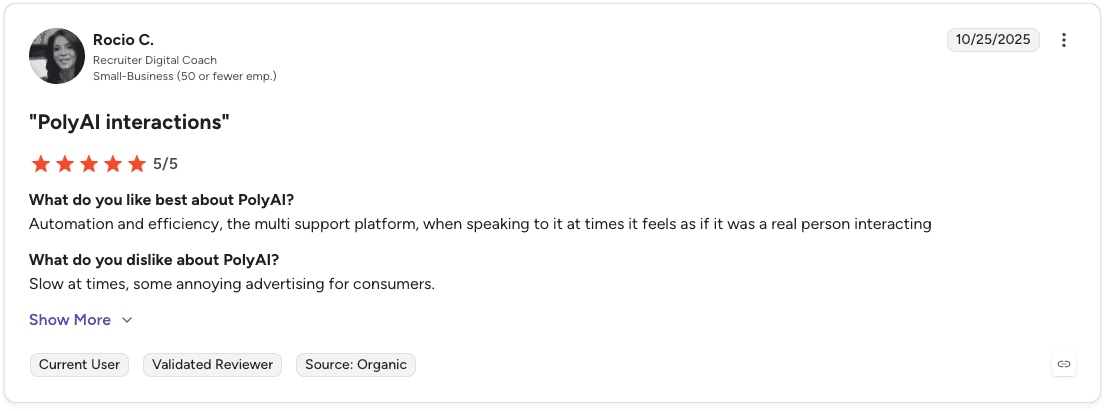
Pro: “Automation and efficiency, the multi support platform, when speaking to it at times it feels as if it was a real person interacting.” — Rocio C., G2 Review (Oct 25, 2025)
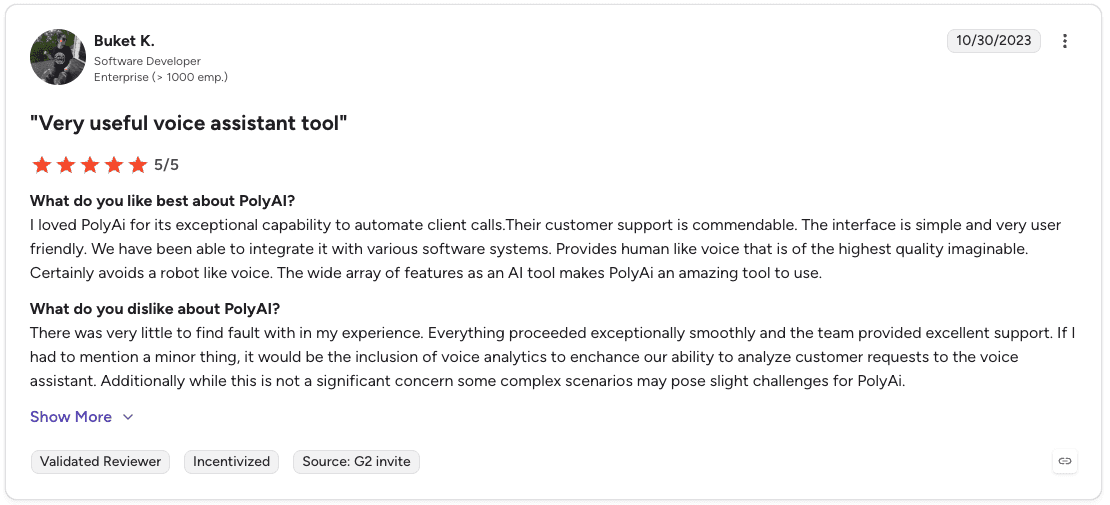
Con: “If I had to mention a minor thing, it would be the inclusion of voice analytics to enhance our ability to analyze customer requests to the voice assistant.” — Buket K., G2 Review (Oct 30, 2023)
Pricing
PolyAI uses a per-minute pricing model for voice agents, with costs tailored to call volume and enterprise requirements.
Bottom line
PolyAI is the right fit for large enterprises running high-volume contact centers where conversation quality and compliance are non-negotiable. Smaller teams or anyone needing fast, self-serve deployment should look elsewhere.
7. Voiceflow: best for teams building voice agents collaboratively

What it does: Voiceflow is a visual platform for designing, building, and deploying voice and chat agents collaboratively, with real-time co-editing, role-based permissions, and model-agnostic architecture that lets product, design, and engineering work from the same canvas.
Best for: Cross-functional product and CX teams that need to build, test, and iterate on voice agents together without heavy engineering involvement.
Voiceflow is where product managers, designers, and engineers can build without stepping on each other.
The visual builder made mapping out branching logic for a support agent straightforward, and explaining the flow to a non-technical stakeholder was easy because everything was visible on screen.
Once the logic grew past a certain complexity level, small changes required tracing back through multiple steps to make sure nothing broke downstream. Large flows get hard to manage.
Voiceflow is a design and orchestration layer, not a full telephony stack. You still need to wire in calling infrastructure and evaluation tools for production-grade phone agents.
Key features
Model-agnostic architecture: Swap between GPT, Claude, Gemini, or bring your own model without rebuilding the agent from scratch.
Collaboration tools: Real-time co-editing, role-based permissions, and commenting built directly into the workspace.
Observability suite: Tracks transcripts, evaluations, latency, resolution rate, and CSAT from a single analytics dashboard.
Pros and cons
✅ Pros | ❌ Cons |
Collaboration features genuinely work for cross-functional teams, not only a checkbox feature | Large flows get difficult to manage and debug as complexity grows |
Model flexibility means no vendor lock-in as the AI market changes | Small edits in complex flows often need multiple steps checked. |
Free tier available with transparent usage-based billing | Costs climb quickly at higher usage or with larger teams of editors |
What users say

Pro: “The visual builder really helped me map everything clearly.” — Muzammil M., G2 Review (Feb 25, 2026)

Con: “One thing that’s still missing is the ability to handle more advanced conversation management.” — Amaury B., G2 Review (Oct 21, 2025)
Pricing
Voiceflow pricing is provided through custom plans, with a free trial available and billing based on platform usage.
Bottom line
Voiceflow suits product and CX teams that need to build and iterate on voice agents together without heavy engineering involvement. Solo builders or teams needing deep telephony control will find other platforms a better fit.
8. Sierra: best for enterprise brands with strict brand tone requirements
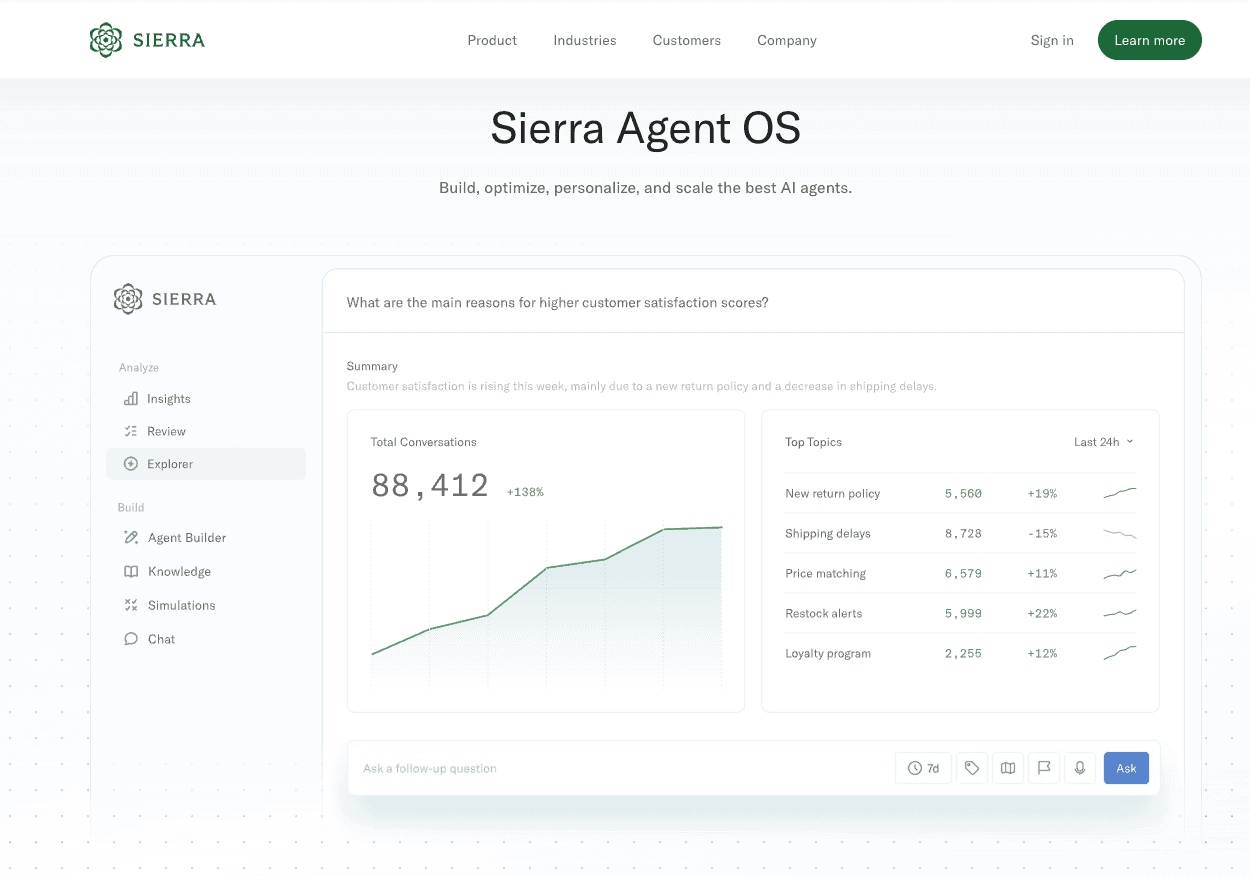
What it does: Sierra is an enterprise voice AI platform built for consumer-facing brands where every customer conversation carries brand weight, running on a multi-model architecture across multiple LLMs to improve reliability and reduce hallucinations.
Best for: Enterprise consumer brands in telecom, financial services, and similar verticals where consistent brand tone and policy adherence directly affect customer perception.
Sierra runs across multiple LLMs simultaneously rather than relying on a single provider. That multi-model setup improves reliability and reduces the risk of hallucinations in sensitive interactions.
The cross-functional setup means product, CX, and engineering all work from the same interface. Fewer handoffs and less back-and-forth when something needs changing.
Pricing clarity is a real friction point. Getting cost information requires going through a sales process, and scalability at very high volumes adds another layer of uncertainty before committing.
Key features
Agent Studio: Build customer journeys, configure knowledge bases, and set brand guardrails without engineering involvement.
Multi-model architecture: Runs across multiple LLMs simultaneously for reliability, fallback handling, and reduced hallucination risk.
Live Assist: Real-time AI guidance for human agents during live interactions to improve resolution rates.
Pros and cons
✅ Pros | ❌ Cons |
Brand tone consistency across voice and chat: vocabulary, pacing, and style match the company’s identity | No public pricing. Enterprise contract required just to understand cost. |
Multi-model setup improves reliability in sensitive customer conversations | Scalability at very high volumes is still largely unproven |
Cross-functional platform works for CX, product, and engineering from the same interface | Reported bugs and rough edges compared to more focused voice platforms |
What users say

Pro: “Its strong focus on safe, supervised AI agents that can take real business actions while protecting brand integrity.” — Verified User in Accounting, G2 Review (Oct 2, 2025)

Con: “Sierra AI may struggle to maintain context in longer conversations, leading to repetitive or irrelevant responses.” — Olga W., G2 Review (Jun 18, 2024)
Pricing
Sierra uses outcome-based pricing, ensuring you only pay for the value delivered by its AI agents. Pricing is customized to each organization and available through a consultation with the Sierra team.
Bottom line
Sierra is built for consumer brands where getting the tone wrong in a customer conversation has real consequences. Teams looking for quick deployment or transparent pricing will find the sales-heavy process frustrating.
9. Cognigy: best for large-scale contact center automation

What it does: Cognigy is an enterprise contact center AI platform that layers onto existing telephony infrastructure, plugging into Avaya, Genesys, and NICE rather than replacing it, with an AI copilot feeding agents real-time context as calls come in.
Best for: Large contact centers already running major telephony platforms that want AI layered on top without ripping out existing infrastructure.
Cognigy’s Agent Copilot sits inside your existing contact center and feeds agents real-time context mid-call. Since NICE acquired Cognigy in 2025, the platform now sits within a broader enterprise CX portfolio, which matters for teams evaluating long-term vendor stability.
A customer calling back about a previous issue means the agent sees full conversation history, CRM notes, and sentiment analysis before saying a word.
After the call ends, Cognigy transcribes everything automatically, pulls out action items, and updates the CRM. The AI-to-human handover capability is a standout, particularly for contact centers where most calls can be handled autonomously but some genuinely need a human.
Key features
Voice Gateway: Plug-and-play integration with Avaya, Genesys, NICE, and other major telephony providers without custom SIP configuration.
Multilingual support: 100+ languages with real-time voice translation built into the platform.
NLU360 insights: Tracks intent success rates, automation rates, and missed opportunities across every interaction for continuous improvement.
Pros and cons
✅ Pros | ❌ Cons |
Deep telephony integrations remove custom infrastructure work for enterprises already on Avaya, Genesys, or NICE | Not built for smaller teams or anyone needing fast self-serve deployment |
AI-to-human handover works in complex contact center scenarios without losing conversation context | Setup and deployment require collaboration between IT, ops, and CX teams |
100+ languages with real-time translation built in, not bolted on | No standard pricing published. All plans require enterprise sales engagement. |
What users say

Pro: “Cognigy feels very solid if focused on contact centres, especially voice and CX.” — Reddit user Redheadish (r/AI_Agents)

Con: “Cognigy’s voice AI is solid but their pricing model gets crazy expensive once you scale past a certain point.” — Reddit user expl0rer123 (r/AI_Agents)
Pricing
Cognigy does not publish standard pricing. All plans are scoped through their sales team based on call volume, deployment complexity, and integration requirements.
Bottom line
Cognigy is the right fit for large contact centers with dedicated technical resources and genuine volume requirements. Smaller teams or anyone who needs to move fast should look at Retell or Synthflow first.
Which AI voice agent should you choose?
The right platform depends on your team size, technical resources, and what the call actually needs to do.
Choose Vapi if you:
Have an engineering team willing to manage stack complexity in exchange for complete control.
Need to swap LLM, STT, or TTS providers independently based on cost or quality.
Choose Bland if you:
Run enterprise-scale outbound campaigns where data governance is non-negotiable.
Need proprietary models and self-hosted infrastructure, not third-party routing.
Choose Retell AI if you:
Need a voice agent running in hours with real post-call visibility built in.
Want sentiment scores, failed handoff flags, and issue triage without building them yourself.
Choose Synthflow if you:
Don’t have technical resources and need structured call flows deployed fast.
Handle predictable call types like appointment booking and FAQ handling.
Choose ElevenLabs if you:
Need callers to be unable to tell they’re talking to AI.
Already have telephony infrastructure and need voice quality layered on top.
Choose PolyAI if you:
Run a large enterprise contact center with complex, multi-turn conversations.
Need voice, chat, and SMS context carrying across channels automatically.
Choose Voiceflow if you:
Have a cross-functional team (product, design, engineering) that needs to build together.
Want model flexibility without being locked into one LLM provider.
Choose Sierra if you:
Are a consumer-facing enterprise where brand tone in customer conversations directly affects perception.
Have budget for a six-figure annual contract and a structured implementation process.
Choose Cognigy if you:
Already run Genesys, Avaya, or NICE and want AI layered on without replacing infrastructure.
Need 100+ language support with real-time translation at contact center volume.
Skip AI voice agents entirely if:
Your call volume is low enough that a human receptionist or basic call forwarding covers it.
You need complex sales conversations. AI voice agents qualify and route. They don’t close.
Final verdict
Retell AI is the strongest starting point for most teams. Fast setup, transparent pricing, and post-call analytics make it the most practical option across support, sales, and scheduling use cases.
For developers who need full stack control, Vapi. For enterprise outbound at volume with data governance requirements, Bland. For voice quality above everything else, ElevenLabs.
The tools that claim to do everything tend to do nothing particularly well. Pick the platform that matches the calls you actually need to run, test it on real traffic, and listen to what happens.
AI voice agents solve one part of the workflow
AI voice agents can handle qualification, routing, scheduling, and other repetitive conversations at scale. The challenge for many sales organizations is making sure the human side of the process is just as consistent once a rep joins the call.
For teams looking to improve rep execution after the handoff, Alpharun adds a coaching and QA layer across every conversation:
Custom playbooks built from your highest-performing calls.
Sentence-level post-call coaching delivered immediately after each conversation.
100% call scoring across sales and compliance criteria.
Rep and team performance tracking to identify coaching priorities.
Compliance monitoring for regulated industries like Medicare and insurance.
AI voice agents help create efficiency at the top of the funnel. Coaching and QA platforms help teams improve the conversations that follow.
Your AI voice agent can qualify the lead. Book a demo to see how Alpharun helps reps close it.
Frequently asked questions
What is the best AI voice agent in 2026?
Retell AI is one of the strongest AI voice agents for most businesses in 2026 because it balances performance, pricing transparency, and ease of deployment. Enterprise teams may prefer platforms like Cognigy, Sierra, or Bland depending on their requirements.
How do AI voice agents work?
AI voice agents convert speech to text, use an AI model to understand intent and generate a response, then convert that response back into speech. The process happens in near real time during the call.
How much do AI voice agents cost?
AI voice agent pricing ranges from usage-based models that charge per minute to enterprise contracts with custom pricing. Costs depend on call volume, integrations, compliance requirements, and the level of customization needed.
Can AI voice agents handle both inbound and outbound calls?
Yes, most AI voice agents support both inbound and outbound calling. Some platforms are stronger for customer support and inbound routing, while others are designed for high-volume outbound campaigns.
What is the difference between an AI voice agent and an IVR?
The main difference between an AI voice agent and an IVR is that AI voice agents understand natural language and hold conversations, while IVRs rely on predefined menus and keypad inputs. AI voice agents provide a more flexible and human-like caller experience.


