

A prospect pushes back and the rep pauses, unsure what to say next. This blog shows how AI works in call centers, with real examples of how it guides conversations, improves performance, and drives more sales.
How AI works in call center environments
AI works in call centers by listening to every conversation, analyzing what happens in real time, and turning those interactions into clear actions for reps and managers.
It guides calls as they happen and uses call data afterward to improve performance across the entire team.
According to McKinsey, nearly two-thirds of respondents say their organizations haven’t begun scaling AI across the enterprise, indicating how early most teams are in applying it to real operations.
What happens during a live call
AI listens to the conversation as it unfolds, picking up on what the caller is saying, how they are saying it, and where the conversation is heading. It recognizes intent, surfaces objections, and notices when the rep starts to lose control of the call.
As those moments happen, AI steps in with guidance on the screen, giving the rep a clear next move while the conversation is still active. This keeps the call moving forward and helps the rep respond with confidence instead of hesitation.
What happens after the call
Once the call ends, AI evaluates the entire interaction and scores it against your sales process and compliance requirements. Managers no longer need to rely on a small sample of calls to understand performance.
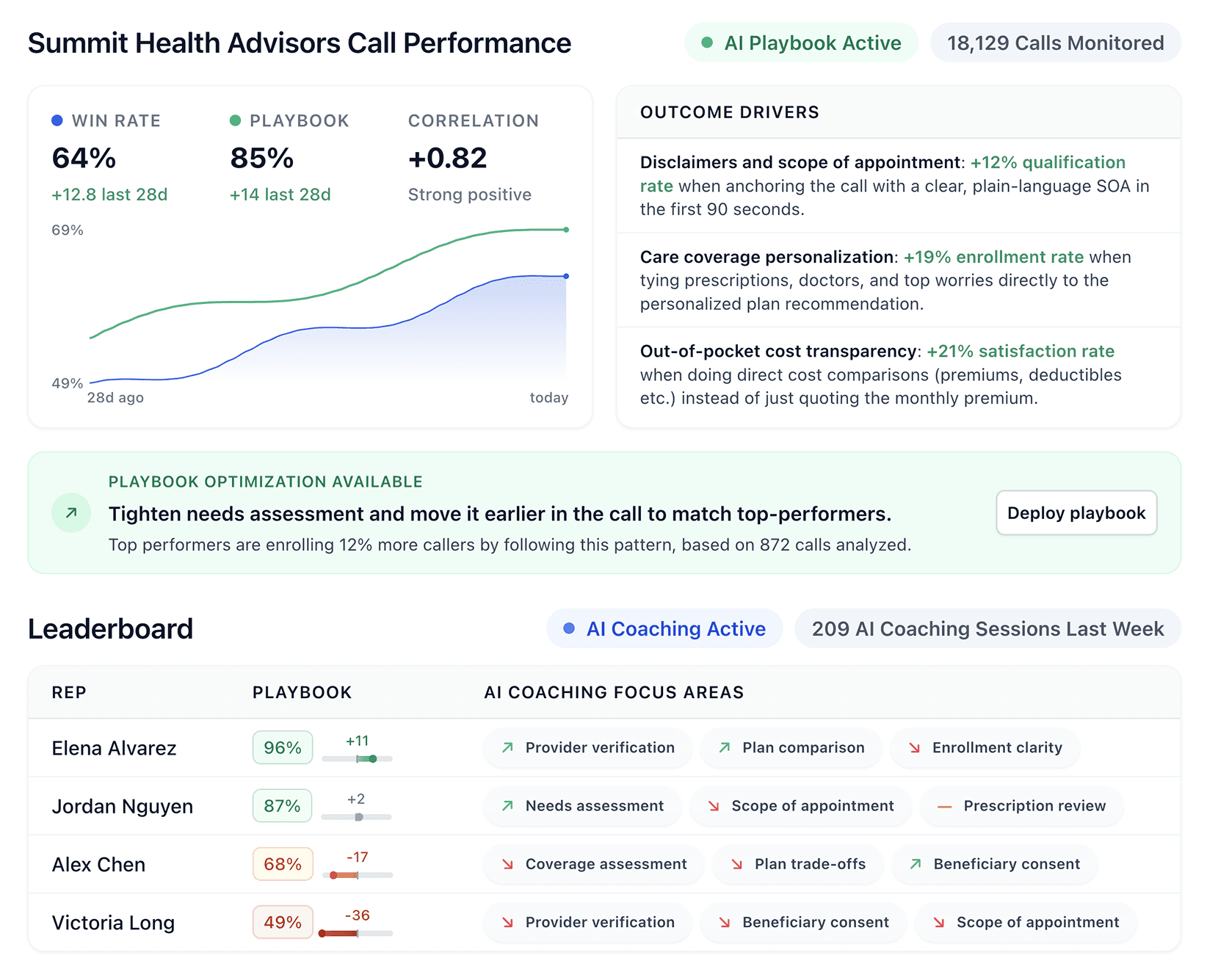
Over time, patterns begin to emerge across hundreds or thousands of conversations. These insights show which behaviors lead to better outcomes, and they’re delivered directly to reps and managers as focused coaching notes that are easy to act on.
Where the data comes from
AI pulls from a few core sources that already exist within your call center setup:
Call recordings captured by your dialer
Transcripts that convert conversations into searchable text
Outcomes such as closed deals, booked appointments, and compliance flags
All of this information connects automatically, giving teams a clear view of what is happening on every call and how it impacts performance.
Why most call centers struggle to improve rep performance
Most call centers struggle to improve rep performance because coaching relies on a small, inconsistent sample of calls instead of a clear view of what actually drives results.
Picture a manager at a 60-rep Medicare call center reviewing five or six calls each week. Those few recordings represent only a small slice of the 600 daily conversations, so the feedback often feels disconnected from what reps actually experience.
What this leads to:
Feedback feels uneven across the team
New hires hear different guidance depending on the manager
There is no clear standard for what a strong call sounds like
Over time, the behaviors that lead to higher close rates remain buried within individual conversations rather than being shared across the team.
AI brings structure to this process by analyzing every call and turning real conversations into patterns that reps and managers can actually use.
How AI works in call centers: 12 examples from real call floors
AI shows up in call centers through real, practical moments during calls, after calls, and across your entire operation, shaping how reps respond, how managers coach, and how performance improves over time.
1. Real-time prompts when a rep gets stuck
A caller says, “I need to think about it,” and the rep hesitates. AI recognizes that moment and surfaces a prompt within seconds, suggesting a follow-up, like asking what is holding them back today, which helps the rep stay engaged and keep the conversation moving forward.
Manager coaching note: Review flagged hesitation moments weekly to identify which objections your team struggles with most.
QA item: Track how often reps respond to hesitation prompts versus going silent.
2. Smart routing based on likelihood to close
Incoming calls are evaluated before they reach a rep, allowing high-intent callers to be directed to stronger closers while more complex conversations go to experienced agents. This creates a better match between the caller’s needs and the rep’s strengths.
Manager angle: Stronger alignment between caller intent and rep skill improves close rates without overloading top performers.
QA item: Measure conversion rates by route type to confirm routing effectiveness.
3. Automatic QA across every single call
Manual QA covers only a small portion of calls, leaving most interactions unseen. AI evaluates every call against your standards, checking disclosures, qualification steps, and restricted language with consistency across the entire team.
Manager pain solved: Coaching decisions are based on complete data instead of limited samples.
QA item: Pass or fail compliance tracking by rep and team, updated daily.
4. Post-call feedback tied to exact moments
General feedback often leaves reps unsure how to improve. AI highlights specific moments within the call, such as when a question about copays was missed, and provides clear guidance on how to handle that situation next time.
This level of precision helps reps understand exactly where they lost momentum and gives managers a more focused starting point for coaching.
QA item: Track missed opportunity rate per rep, broken down by call stage.
5. Call scoring based on your actual sales process
Instead of relying on generic scoring systems, AI builds a scorecard based on how your team actually sells, evaluating each stage from the introduction through the close attempt with weights tied to real outcomes.
Manager angle: Every rep is measured against a consistent and relevant standard.
QA item: Custom scorecards that evolve alongside your process.
6. Objection handling suggestions during the call
When a caller raises a concern about cost, AI surfaces a structured response that guides the rep to explain value and ask about the caller’s current situation, helping the conversation stay productive.
This reduces hesitation and gives reps a clear direction when the call becomes challenging.
QA item: Track how objection handling affects outcomes by objection type.
7. Automatic call summaries and next steps
After the call, AI generates a complete summary that includes what was discussed, the agreed-upon next steps, and any follow-up required, creating a consistent record without adding extra work for reps.
Manager angle: Teams save hours each week while maintaining accurate records that support compliance and reporting.
QA item: Flag calls where the disposition does not match the conversation.
8. Identifying what actually drives conversions
Performance differences between reps become clearer when AI analyzes large volumes of calls, revealing patterns in phrasing, sequencing, and questioning that lead to successful outcomes.
Managers can then use these insights to refine scripts and guide the entire team toward more effective behaviors.
Manager workflow: Update training and scripts based on observed patterns in real conversations.
9. Compliance monitoring for regulated sales
Every call is evaluated for required disclosures and approved language, ensuring compliance standards are consistently met. When something is missed, it is flagged immediately so it can be corrected before it becomes a larger issue.
For teams handling Medicare or insurance conversations, maintaining strong data and process standards is essential, and SOC 2 Type 2 compliance is relevant as part of a secure, reliable system.
QA item: Compliance score by rep, updated after each call and broken down by rule type.
10. AI agents handling repetitive steps
AI agents take on repetitive tasks such as scheduling callbacks, qualifying after-hours callers, and gathering initial information, allowing reps to focus on conversations that require attention and judgment.
Repetitive tasks get handled automatically, which frees your team to spend more time on the calls that drive revenue.
Speed angle: The pipeline continues moving even when reps are handling active calls.
11. Weekly performance breakdowns for managers
Managers receive regular summaries that show performance trends, compliance scores, and coaching progress across the team, which removes the need to manually review large volumes of calls.
Reps also receive short, focused coaching notes tied to their calls, so feedback stays timely and easier to act on.
Manager pain solved: Less time reviewing calls and more time focused on targeted coaching.
12. Seamless integration with your dialer
AI coaching tools connect to the systems your team already uses, such as dialers and call center platforms, so reps can keep working in a familiar environment while new insights run in the background.
Setup usually involves connecting call data, recordings, and transcripts, after which teams can start seeing coaching insights and performance trends without changing their day-to-day workflows.
Outcome: Faster adoption and quicker access to insights without interrupting how your team already works.
Signs your AI setup is actually working
You’ll know it’s working when you start seeing clear shifts on the floor and in how your team handles calls day to day.
New reps ramp faster with timelines dropping from three to four months down to six to eight weeks.
Call quality becomes more consistent across the team, rather than concentrated in a few strong performers.
Compliance mistakes drop, and flagged calls become less frequent.
Managers spend less time on recordings and more time coaching the right reps.
Average performers start closing more, and the spread between mid-tier reps and top closers tightens over time.
These signals show that the system is shaping behavior on real calls and driving results where it matters.
What to look for in AI for B2C call centers
Most teams waste months testing tools that look good in demos but never change what happens on the floor. The difference comes down to whether the system can influence live calls and scale across hundreds of conversations a day.
Features that actually move revenue
AI needs to work inside the call and across your entire QA process, or it won’t move numbers.
Real-time guidance during live calls to help reps recover and keep deals moving.
QA across 100% of calls so coaching reflects what is actually happening on the floor.
Coaching tied to your own conversations, based on how your team sells today.
Fast onboarding so managers can start using it within days.
Direct integration with platforms like Five9 and Genesys to avoid extra setup.
Why many AI tools fall short
Many tools were built around slower sales environments where reps handle fewer calls and decisions stretch over days or weeks. A high-volume B2C floor runs differently. Reps move fast, callers decide on the phone, and compliance sits in every interaction.
Tools designed for pipeline reporting or delayed feedback struggle to keep up with that pace, leaving managers still relying on manual reviews and inconsistent coaching.
What high-performing teams use instead
Teams that improve performance at scale rely on systems that fit how the floor actually runs.
Analyze every call so coaching reflects real performance, not a small sample.
Deliver feedback right after the call while details are still fresh.
Build playbooks from real conversations tied to outcomes like booked calls or closed deals.
Roll out quickly without adding overhead to managers already stretched for time.
When those pieces are in place, coaching stays close to the call itself, making it easier for reps to apply it right away.
How Alpharun fits into your call center stack
Most teams already have a dialer in place, but coaching and QA still sit outside the workflow, which slows everything down. Alpharun connects directly to your existing setup and starts working with the data you already have.
It pulls call recordings and transcripts from platforms like Five9 and Genesys, then analyzes large volumes of your team’s calls to identify which behaviors lead to better outcomes.
From there, it builds a playbook based on how your team actually sells, so coaching reflects what is happening on your floor.
What Alpharun puts into your workflow:
Sentence-level coaching that shows reps exactly where and how to improve
QA across every call, aligned to your compliance and sales process
Weekly performance breakdowns that highlight trends across reps
Short coaching notes sent directly to reps to keep feedback timely
Meets SOC 2 Type 2, HIPAA, and GDPR standards with encrypted data handling
This keeps coaching close to the call itself and gives managers a clearer view of where to focus their time.
If you're exploring how AI works in call centers, the best way is to see it live on your own calls. Book a demo with Alpharun to see how it fits your organization.
Frequently asked questions
How does AI work in a call center during a live call?
AI works in a call center during a live call by listening in real time, detecting intent and objections, and prompting the rep with suggested responses on their screen as the conversation unfolds.
Does AI replace call center reps?
No, AI doesn’t replace call center reps. AI handles repetitive tasks like scheduling and lead qualification, while reps focus on conversations that require judgment and closing.
What’s the difference between post-call AI coaching and real-time coaching?
The main difference between post-call and real-time coaching is timing. Post-call coaching reviews what happened after the call, while real-time coaching guides reps during the call when decisions are being made.
How long does it take to set up AI coaching in a call center?
AI coaching setup typically takes a few days to a few weeks, depending on the platform. Tools like Alpharun can integrate with dialers like Five9 and Genesys and start delivering insights in about a week.
Is AI coaching compliant for Medicare and insurance sales?
Yes, AI coaching can be compliant with Medicare and insurance sales requirements if the platform supports SOC 2 Type 2 standards and applies compliance rules to every call through QA scoring.