
A voice agent earns its cost when it books a demo at 9 p.m. on a Saturday. For a high-volume sales team, the test is whether the agent moved a real lead forward.
This list ranks AI voice agents for sales on the jobs an inside-sales or call-center team cares about, like answering a fresh lead fast, asking the right qualification questions, booking the meeting, and writing it all back to the CRM.
Yes, Alpharun is on this list, and this is our blog. Every tool here goes through the same sales criteria, with the honest cons kept in and each one's weak spots flagged, so you can make your own call.
The 11 best AI voice agents for sales: TL;DR
Alpharun: Best for high-volume inside-sales and call-center teams that want lead qualification plus coaching after every call on one platform.
Retell AI: Best for developers building custom outbound qualification agents.
Bland AI: Best for very high-volume outbound calling at scale.
Synthflow: Best for no-code inbound and outbound sales agents.
Vapi: Best for engineering teams that want low-level voice infrastructure.
PolyAI: Best for enterprise inbound voice at consumer brands.
Lindy: Best for teams that want an AI assistant to make one-off calls and handle the follow-up.
Voiceflow: Best for designing and prototyping conversational agents.
SquadStack: Best for a managed human-plus-AI outbound calling team.
11x: Best for an autonomous AI SDR, or "digital worker," motion.
ElevenLabs: Best for the most natural-sounding conversational voice.
How AI voice agents work on a sales call
An AI voice agent is software that holds a real phone conversation.
The loop runs fast: Vapi, for one, advertises sub-500ms latency. The agent picks up an inbound call or dials an outbound one, converts speech to text, reasons against a script or playbook with a language model, speaks back with a synthetic voice, and then takes an action: it qualifies the caller, books a meeting, routes a hot lead, or logs the result to your CRM.
A sales voice agent qualifies callers. It asks discovery questions, handles a few objections, and hands a warm, scored lead to a human.
And the human still does the hard parts. Complex objections, the close, and compliance-sensitive moments belong to a rep. The best setups give you the best of both worlds: the agent takes the repeatable calls, and your people spend their hours where judgment pays off.
How these AI voice agents for sales were ranked
Each tool was scored on whether it moves sales numbers for a high-volume consumer-selling team, like a Medicare brokerage answering after-hours eligibility calls or a life insurance floor reactivating aged leads.
What counted:
Speed to lead: How fast it answers an inbound lead or dials a fresh one, since a slow response can sink a conversion.
Lead qualification logic: Whether it asks the right discovery questions, scores the lead, and hands off cleanly.
Meeting booking: Whether it sets appointments on a live calendar without a human babysitting it.
CRM sync: Real two-way write-back to HubSpot and Salesforce.
Concurrency: How many calls it can run at once when a campaign spikes.
Rep coaching: Whether the platform also helps your human reps, with live prompts during the call or scoring and coaching after it.
Pricing comes from each vendor's official pricing page, and user feedback comes from linked public reviews.
AI voice agents for sales at a glance
Here is the quick version before the deep dives. The comparison is a recap, so skim it and jump to the tools that fit your motion.
Tool | Best for | Sales strength | Starting price |
|---|---|---|---|
Alpharun | High-volume B2C inside sales | Qualification plus coaching | |
Retell AI | Developers | Custom qualification flows | |
Bland AI | Outbound at scale | Concurrency | |
Synthflow | No-code teams | Fast builds | |
Vapi | Engineers | Voice infrastructure | |
PolyAI | Enterprise inbound | Containment | |
Lindy | One-off calls and follow-up | AI assistant for the whole team | |
Voiceflow | Builders and designers | Prototyping | |
SquadStack | Managed outbound | Done-for-you | |
11x | Autonomous SDR | Self-running outreach | |
ElevenLabs | Voice quality | Natural speech |
1. Alpharun: Best for lead qualification plus coaching after every call
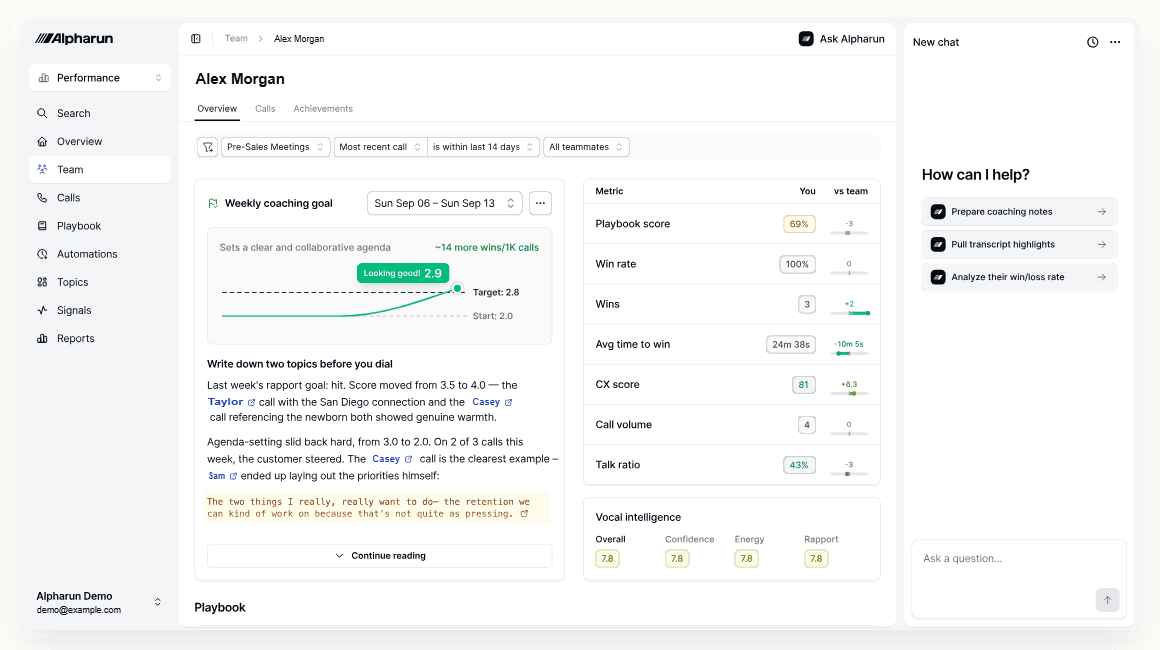
The Alpharun dashboard, showing a rep's weekly coaching goal, playbook and win-rate scores, and the Ask Alpharun chat panel.
What it does: Alpharun runs AI voice agents that cover off-hours calls, pre-qualify leads for eligibility, and route hot prospects to reps, then scores and coaches the human reps who take the handoff.
Best for: High-volume B2C inside-sales and call-center teams in regulated verticals like Medicare, life insurance, and consumer-direct mortgage.
The pitch is the best of both worlds: the voice agent handles the repeatable parts of the playbook that do not need a person, and the rest of the platform makes every human rep sell more like your top performer. Alpharun works with Medicare brokerages like Chapter, whose advisors handle hundreds of thousands of calls during the Annual Enrollment Period.
Alpharun grades every call at the sentence level against your playbook and sends reps short coaching notes right after the call. It scores the voice agent's calls against the same standards, so AI and human performance are measured the same way.
Key features:
Qualification and routing voice agents: Cover after-hours and overflow calls, pre-qualify for eligibility, and push hot leads to reps fast.
Sentence-level call scoring: Evaluates every call against your compliance rules and sales playbook.
Post-call rep coaching: Reps get specific feedback right after each call, tied to the exact moment it happened.
Five9 and Genesys integrations: Connects to your existing dialer, with AI playbook setup in about two weeks.
Sales fit: Its voice agents qualify leads, book appointments, and route calls; ask about CRM sync and call capacity on a demo.
Pros:
Qualification voice agents and post-call rep coaching on one platform
Scores every call against your own playbook and compliance rules
Integrates with Five9 and Genesys
Cons:
Overkill for a five-rep shop
No public pricing
Thin third-party review volume so far
What users say: Alpharun is newer than some tools here, so third-party review volume is still thin.
Pricing: Alpharun doesn't publish pricing, so you book a demo to get a quote.
Bottom line: If you run a high-volume consumer-sales floor and want qualification and rep coaching in one place, Alpharun is built for that. Book a demo to see it run against your own call types.
2. Retell AI: Best for developer-built outbound qualification agents
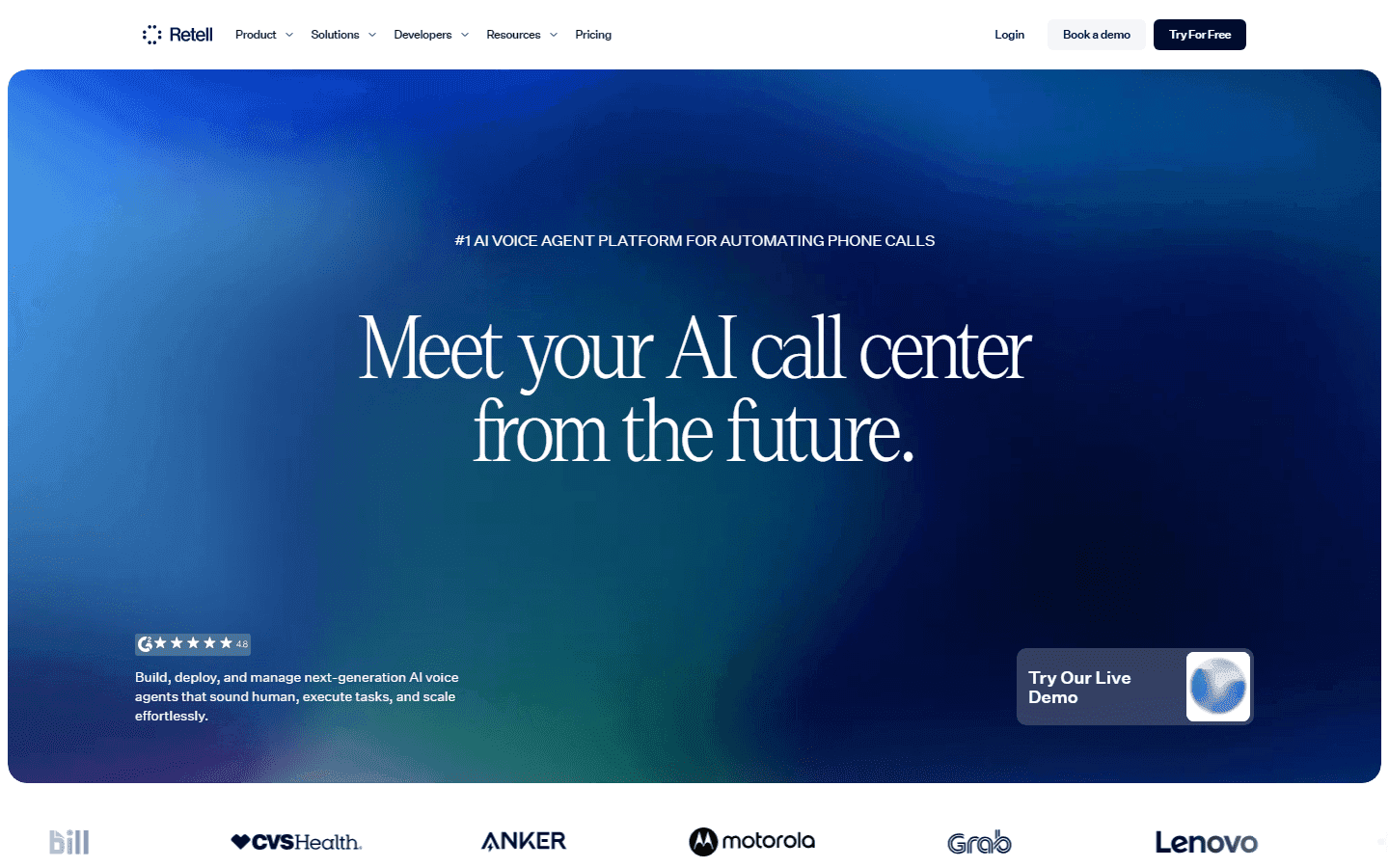
The Retell AI homepage, headlined "Meet your AI call center from the future."
What it does: Retell AI gives developers a platform to build custom voice agents for outbound qualification and lead generation.
Best for: Engineering-minded teams that want to design their own qualification logic and wire it into their stack.
Retell leans hard into sales workflows, with solid qualification branching and CRM integrations for HubSpot and Salesforce. Teams building a bespoke outbound motion get a lot of control here.
The honest con is that control costs effort. You need engineering time to build the agent and keep it running, and usage-based per-minute pricing climbs quickly once you are running thousands of calls a day.
Key features:
Custom qualification flows: Build branching discovery logic for outbound calls.
CRM integrations: Connect to HubSpot and Salesforce for lead write-back.
Developer tooling: APIs and testing to build and iterate on agents.
Sales fit: Native HubSpot and Salesforce integrations, with 20 calls at once included and more at $8 per extra call a month.
Pros:
Native HubSpot and Salesforce integrations
Detailed control over qualification branching
Pay per minute with no commitment
Cons:
Needs engineering time to build and keep running
Per-minute costs climb at thousands of calls a day
What users say: Retell holds a strong rating on G2; users like the flexibility and call quality, and the common complaint is the learning curve and the cost of scaling minutes.
Pricing: Usage-based, from $0.07 per minute, with no long-term contract.
Bottom line: Great for a team with engineers who want full control over the call logic.
3. Bland AI: Best for very high-volume outbound at scale
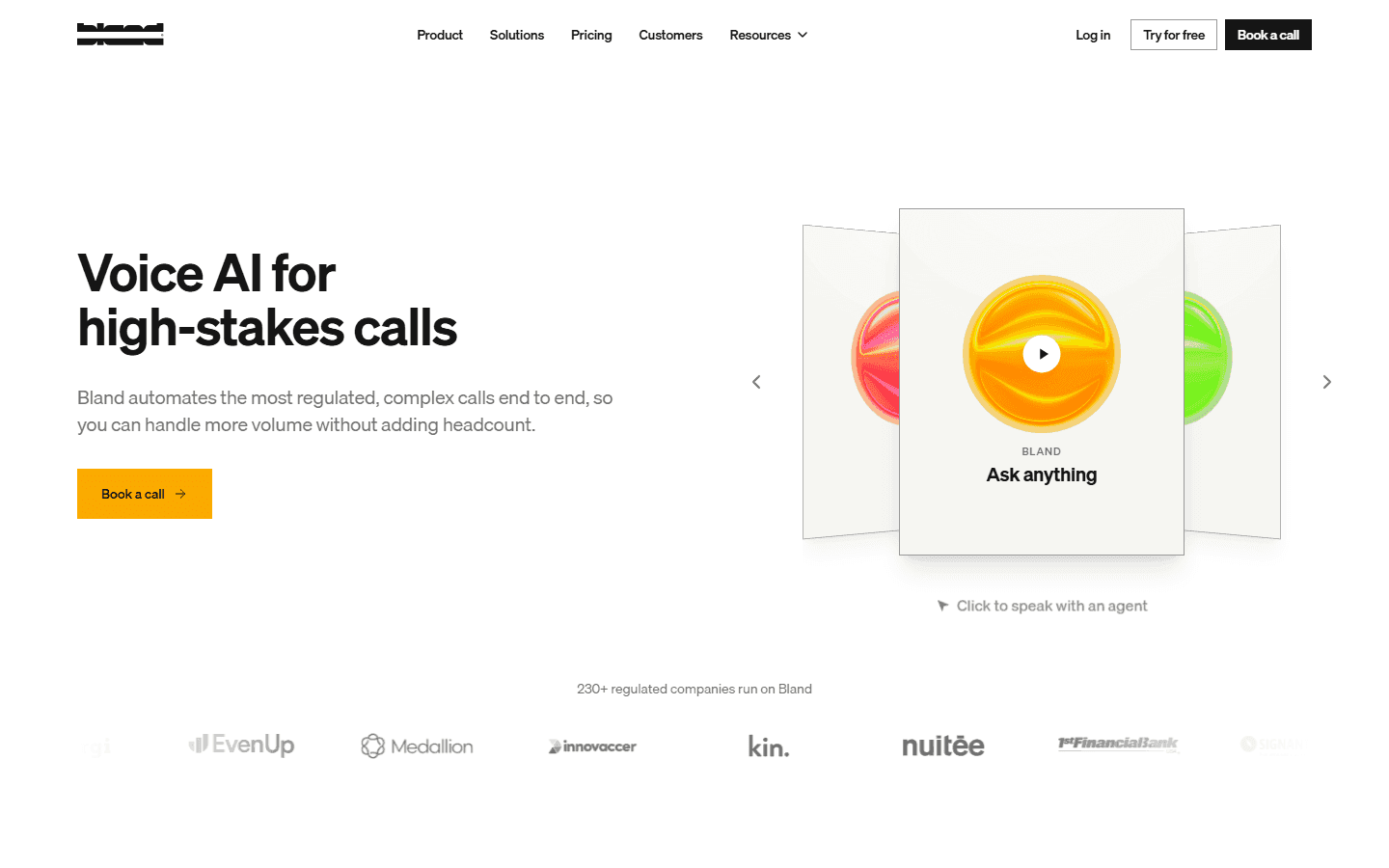
The Bland AI homepage, headlined "Voice AI for high-stakes calls," beside a click-to-talk agent demo.
What it does: Bland AI runs programmable outbound voice calls built for serious volume and concurrency.
Best for: Teams that need to place a very large number of outbound calls at once and have engineering support to configure them.
Bland's strength is scale, which helps speed-to-lead when a batch of leads lands at the same time.
The tradeoff is that it is a developer platform, so guardrails, qualification quality, and compliance checks are mostly on you to build and monitor. That is a real risk in regulated outbound.
Key features:
High concurrency: Run large outbound campaigns in parallel.
Programmable calls: Script and control call behavior through the API.
Branching pathways: Route the conversation based on what the caller says.
Sales fit: 10 calls at once on the free plan, 50 on Build, and concurrency sized to your volume on Enterprise.
Pros:
Runs a very large number of calls at once, with unlimited calls on Enterprise
Programmable calls and branching pathways through the API
Lower per-minute rate on the Build plan ($299 a month)
Cons:
Guardrails, qualification quality, and compliance checks are mostly on you to build
Weaker as a turnkey sales product
What users say: on G2, users praise the raw concurrency and API; critics note it takes work to make calls sound consistent and stay compliant.
Pricing: $0.14 per minute on the free Start plan, or $0.12 per minute on Build, which adds a $299 monthly platform fee and raises the number of calls you can run at once. Enterprise is custom.
Bottom line: A strong engine for high-volume outbound, weaker as a turnkey sales product.
4. Synthflow: Best for no-code inbound and outbound sales agents
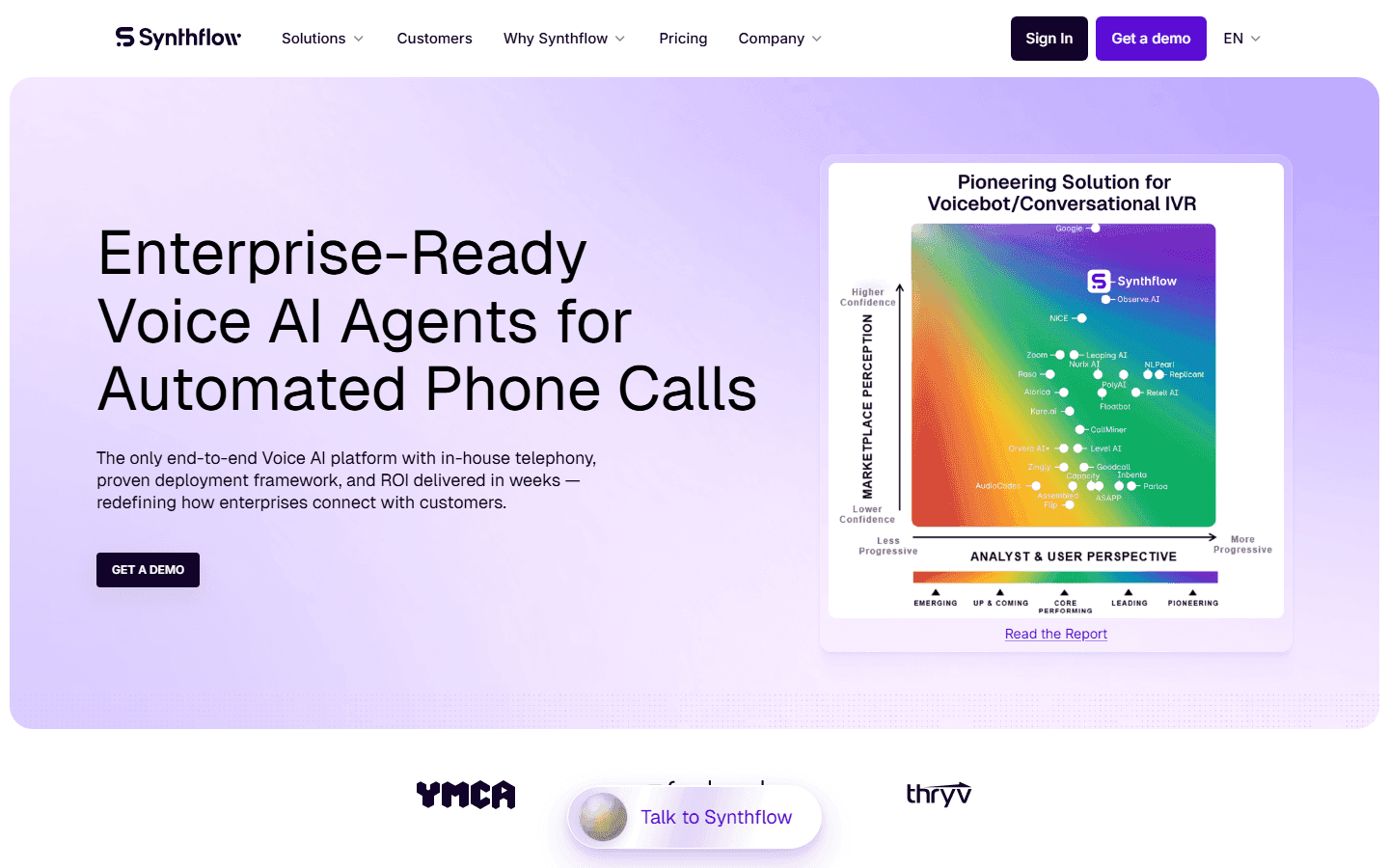
The Synthflow homepage, headlined "Enterprise-Ready Voice AI Agents for Automated Phone Calls," beside an analyst chart of conversational IVR vendors.
What it does: Synthflow lets you build inbound and outbound voice agents with a no-code visual builder.
Best for: Teams that want working voice agents without writing code.
You can stand up a qualification or booking agent quickly, connect it to your CRM and calendar, and go live without writing code. For a team that wants to move fast, that speed is the appeal.
The limit is depth. A no-code builder trades some flexibility for ease, so very custom qualification logic or complex routing can hit a ceiling.
Key features:
No-code builder: Assemble inbound and outbound agents visually.
CRM and calendar connections: Sync leads and book meetings automatically.
Prebuilt templates: Start from common sales-call patterns.
Sales fit: Sends call outcomes, transcripts, and recordings to HubSpot, with Salesforce and Cal.com among its integrations.
Pros:
No-code builder for inbound and outbound agents
Sends call outcomes, transcripts, and recordings to HubSpot
Prebuilt templates for common sales-call patterns
Cons:
Very custom qualification logic or complex routing can hit a ceiling
Sold on annual enterprise contracts
What users say: on G2, reviewers highlight the fast setup and templates; the recurring gripe is hitting limits on more advanced customization.
Pricing: Synthflow has moved to enterprise pricing with annual contracts, so you need to request a quote.
Bottom line: Well suited to teams that want a no-code agent live fast and can support an enterprise contract.
5. Vapi: Best for low-level voice infrastructure
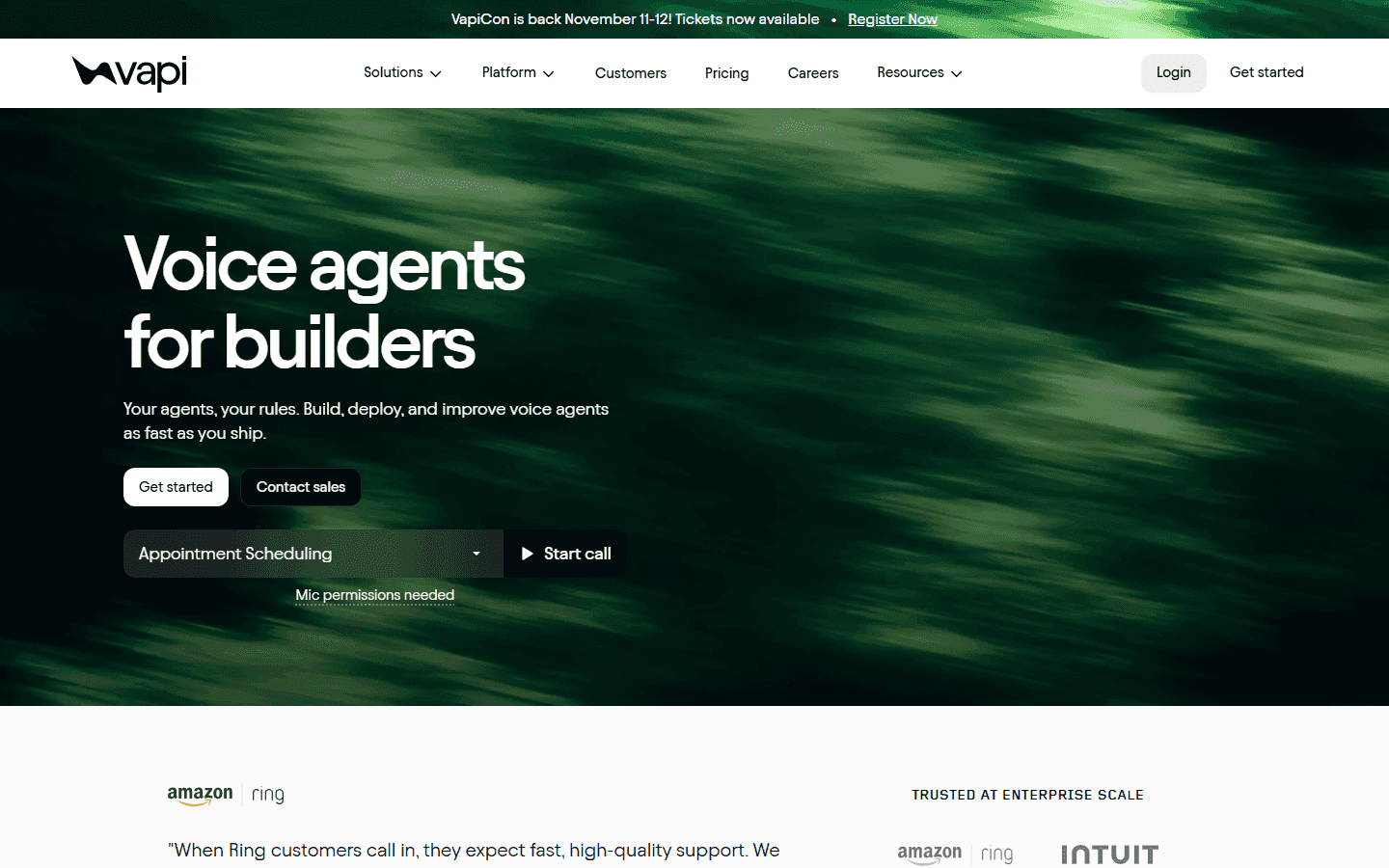
The Vapi homepage, headlined "Voice agents for builders," with a Start call demo for appointment scheduling.
What it does: Vapi is a developer platform for building, testing, and deploying voice agents with fine control over models and telephony.
Best for: Engineering teams that want to assemble their own voice stack and swap components.
Vapi gives you low-level orchestration: pick your speech-to-text, your language model, and your voice, and wire the call flow yourself. For builders, that flexibility is the draw.
Vapi's docs include a lead qualification assistant you can start from, and you still build and connect the rest of the sales logic yourself.
Key features:
Model choice: Pick your speech-to-text, language model, and voice.
Low-level orchestration: Control call routing and logic yourself.
Testing tools: Simulate and debug agents before they go live.
Sales fit: Four calls at once on usage-only billing, 10 on the $29/month Core package, and 30 on Pro.
Pros:
Pick your own speech-to-text, language model, and voice
A lead qualification assistant in the docs to start from
Testing tools to simulate and debug agents before launch
Cons:
You build and connect the rest of the sales logic yourself
Model and telephony costs come on top of the platform fee
What users say: on G2, developers value the control and documentation; the critique is that non-engineers cannot get far without help.
Pricing: Usage-based, at $0.05 per minute for Vapi's platform, plus your own model and telephony costs.
Bottom line: Excellent infrastructure for teams that want to build voice from the ground up. Everything above the plumbing is your job.
6. PolyAI: Best for enterprise inbound voice

The PolyAI homepage, headlined "The Frontier of Agentic Dialog."
What it does: PolyAI builds enterprise-grade inbound voice assistants that handle customer calls with natural conversation and high containment.
Best for: Large consumer brands that need to automate heavy inbound call volume.
PolyAI handles messy inbound conversations well and resolves a large share of calls without a human. For an enterprise contact center drowning in inbound, that containment is valuable.
The fit for sales is narrower. PolyAI leans toward inbound service and customer experience, with enterprise pricing and implementation timelines, so an outbound-sales-first team may find it heavier than it needs.
Key features:
Natural inbound handling: Resolve messy customer calls without a human.
High containment: Deflect a large share of inbound volume.
Enterprise integrations: Connect to existing contact-center systems.
Sales fit: Connects to Salesforce for customer records, with HubSpot available in its builder.
Pros:
Handles messy inbound conversations without a human
High containment on heavy inbound volume
Connects to Salesforce for customer records
Cons:
Leans toward inbound service over outbound sales
Enterprise pricing and implementation timelines
What users say: PolyAI has a small but strong set of reviews on G2; reviewers cite strong naturalness and containment, while critics mention cost and a longer implementation cycle.
Pricing: Custom, per-minute enterprise pricing; you contact sales for a quote.
Bottom line: A strong inbound-voice platform for enterprises, less of a match for an outbound sales motion.
7. Lindy: Best for one-off calls and follow-up from an AI assistant
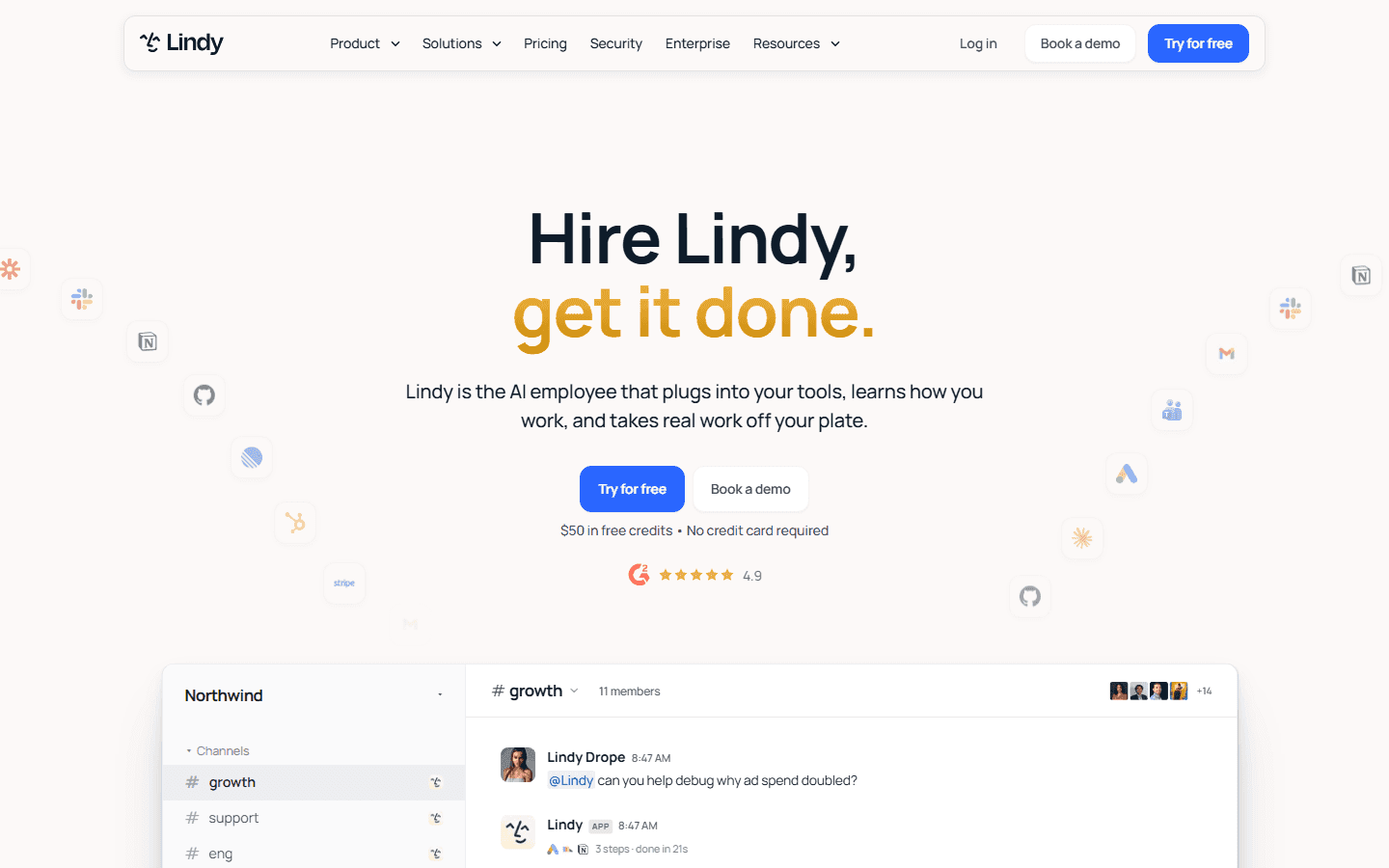
The Lindy homepage, headlined "Hire Lindy, get it done," above a Slack-style workspace where Lindy answers a teammate.
What it does: Lindy is an AI assistant for your whole team that can also make and take phone calls, with outbound calls capped at a daily limit.
Best for: Teams that already run automations and want voice to be one more connected step.
Lindy shines when voice is a piece of a bigger flow: an agent qualifies a lead, then triggers follow-up emails, CRM updates, and scheduling automatically. That glue is genuinely useful.
The flip side is focus. Voice is one capability inside a general agent platform, so a team that only wants a best-in-class sales dialer may find it broader than necessary.
Key features:
Voice as a workflow step: Trigger follow-up emails, CRM updates, and scheduling after a call.
Broad integrations: Connect voice to the rest of your stack.
Agent templates: Start from prebuilt automations.
Pros:
Triggers follow-up emails, CRM updates, and scheduling after a call
Connects voice to the rest of your stack
Prebuilt agent templates
Cons:
Outbound calls are capped at a daily limit
Voice is one capability inside a general agent platform
What users say: on G2, users like the flexibility and integrations; the common note is that it takes setup to get value, and voice is not the core.
Pricing: $49.99 per user per month for 5,000 credits each, after a free start with $50 in credits that last seven days.
Bottom line: A good fit for automation-heavy teams. Less ideal if voice qualification is your only need.
8. Voiceflow: Best for designing and prototyping agents

The Voiceflow homepage, headlined "AI agents customers love. ROI you can prove."
What it does: Voiceflow is a collaborative platform for designing, prototyping, and shipping conversational agents, including voice.
Best for: Teams that want to design and test conversation flows before they build for production.
Voiceflow's canvas makes it easy for a team to map out a conversation, test it, and iterate together. For designing the experience, it is one of the cleaner tools around.
Voiceflow can also deploy what you design: it provisions a US or Canadian number or connects your Twilio number, so the same agent takes inbound calls and makes outbound ones.
Key features:
Design canvas: Map and prototype conversation flows visually.
Team collaboration: Build and review agents together before production.
Multi-channel: Design for voice and chat in one place.
Sales fit: Salesforce and HubSpot appear in its integrations list.
Pros:
Design canvas for mapping and prototyping conversation flows
Team collaboration on agents before production
Voice and chat designed in one place
Cons:
Numbers it provisions are US or Canadian only
Businesses have to request pricing
What users say: on G2, reviewers praise the design experience and collaboration; critics say moving from prototype to a production sales motion takes extra work.
Pricing: Businesses request pricing, while agencies and partners get a free trial and usage-based billing.
Bottom line: Great for designing and prototyping agents, with phone deployment built in.
9. SquadStack: Best for a managed human-plus-AI calling team
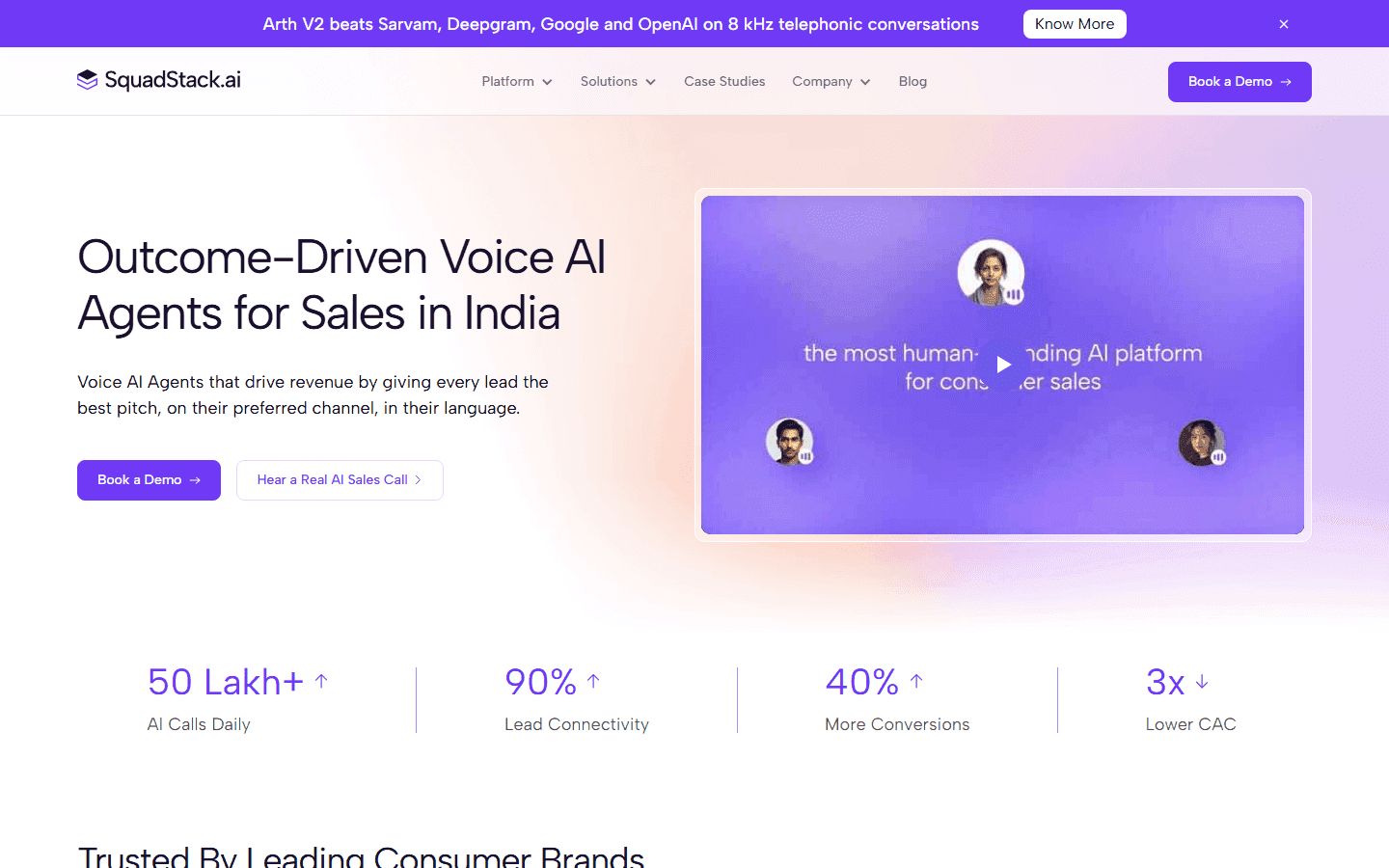
The SquadStack homepage, headlined "Outcome-Driven Voice AI Agents for Sales in India."
What it does: SquadStack runs an AI voice agent for sales teams in India, backed by a trained human team for handoffs and complex calls, delivered as a managed service.
Best for: Teams that would rather outsource outbound calling than build and staff it in-house.
SquadStack handles the people, the tech, and the QA, so you get outbound capacity without hiring a floor. For a team that wants outcomes without operational overhead, that is appealing.
The tradeoff is control. A managed, outsourced model means less hands-on say over scripts and process than running your own agent, and it is a different cost structure than a self-serve tool.
Key features:
AI voice agent plus human pod: Hindi and English voice agents, with trained advisors taking handoffs and complex calls.
Built-in QA: Quality controls applied across calls.
Done-for-you operations: People, tech, and reporting handled for you.
Pros:
Hindi and English voice agents backed by trained advisors for handoffs
People, tech, and reporting handled for you
Built-in QA across calls
Cons:
Less hands-on say over scripts and process
Built for sales teams in India
What users say: public reviews are limited, but on G2, clients like the hands-off capacity and quality controls; the critique is less direct control and variable fit by use case.
Pricing: Custom per-minute pricing with no seat fees, plus a one-time setup fee for each use case; you get a quote.
Bottom line: A solid choice for teams that want outbound calling delivered as a managed service.
10. 11x: Best for an autonomous AI SDR motion

The 11x homepage, headlined "Social agents that drive revenue," with the channel word rotating between Email, Social, and SMS.
What it does: 11x sells AI "digital workers": Alice runs outbound email and social outreach, and Julian, its voice agent, qualifies inbound leads by phone, chat, and SMS.
Best for: Teams that want an always-on, self-running SDR for prospecting and outreach.
The appeal is autonomy: 11x can extend your pipeline capacity without adding headcount.
The catch is the usual autonomy tradeoff: you give up some control over exactly how each call goes, and the product leans B2B outbound, which is a looser fit for a consumer-sales floor than a purpose-built qualification agent.
Key features:
Autonomous outreach: Runs the outbound motion end-to-end.
Multi-channel digital workers: Voice alongside other outreach channels.
CRM sync: Logs activity back to your pipeline.
Sales fit: Native HubSpot and Salesforce sync that writes call status, outcome, and transcript back to the fields you choose.
Pros:
Extends pipeline capacity without adding headcount
Native HubSpot and Salesforce sync that writes call results back
Julian qualifies inbound leads by phone, chat, and SMS
Cons:
Less control over exactly how each call goes
Leans B2B outbound, a looser fit for a consumer-sales floor
From $3,750 per month, billed annually only
What users say: on G2, reviewers like the autonomous outreach and time saved; critics flag ramp time and wanting more control over the agent's decisions.
Pricing: From $3,750 per month, billed annually only, with custom enterprise tiers.
Bottom line: Interesting for an autonomous SDR experiment, less tailored to high-volume B2C qualification.
11. ElevenLabs: Best for the most natural-sounding voice

The ElevenAgents page from ElevenLabs, headlined "Conversational agents that feel human."
What it does: ElevenLabs provides conversational AI with some of the most natural, low-latency synthetic voices available, in 90-plus languages.
Best for: Teams where voice quality and multilingual reach are the top priorities.
The voices are the standout: expressive, fast, and convincing, which matters when a stiff robotic agent gets hung up on fast. ElevenLabs also sells agent assist for human reps, with real-time objection-handling prompts and next-best-action suggestions.
The work is in the assembly. ElevenLabs gives you an excellent voice layer and platform, but the sales-specific qualification logic and workflow are yours to build on top.
Key features:
Natural low-latency voices: Expressive speech in more than 90 languages.
Conversational AI platform: Build agents on top of the voice layer.
Agent-assist options: Live and post-call support features.
Sales fit: Four calls at once on the free plan, rising to 40 on Business, with CRM record sync.
Pros:
Expressive, low-latency voices in more than 90 languages
Agent assist with real-time objection-handling prompts for human reps
Up to 40 calls at once on Business
Cons:
Sales qualification logic and workflow are yours to build
$0.08 for every minute beyond a plan's included minutes
What users say: on G2, reviewers rave about voice quality and latency; the common note is that you assemble the sales use case yourself, and usage costs add up at volume.
Pricing: Usage-based, at $0.08 per extra minute beyond each plan's included call minutes, and higher tiers add more included minutes at the same rate.
Bottom line: The best voice on the list, with the sales workflow left as a build-it-yourself project.
AI voice agent sales use cases
A voice agent earns its keep on a few specific jobs. Here is where to point one, and where to keep a human in the chair.
Outbound lead qualification
Point the agent at fresh or aged leads to confirm fit before a rep spends time. For a Medicare brokerage, that means calling back people who asked to be contacted, inside legal calling hours, and running an eligibility and election-period check before the call reaches an advisor. This is classic outbound call center work, scaled.
Inbound lead response
Speed to lead wins deals, and leads do not arrive on a schedule. An agent can answer every inbound call instantly, day or night, qualify the caller, and route hot ones to a rep. If no human is free, it works like an always-on AI answering service that still moves the sale forward.
Appointment setting
Booking is repetitive and perfect for automation. A voice agent can confirm interest, check a live calendar, and set the meeting, which is the core of an AI appointment setter. Your reps start the day with a booked calendar.
Follow-up and reactivation
Most teams sit on a pile of aged leads that nobody has time to call. An agent can work that list, reopen conversations, and surface the few that are ready to talk again. The human steps in once there is real intent and handles the close.
How much do AI voice agents cost?
Pricing splits into a few models, and the sticker number can mislead you. Per-minute usage pricing looks cheap until you are running thousands of calls a day and the minutes stack up.
Here is how vendors tend to charge:
Per-minute usage: Common with developer platforms like Retell, Bland, and Vapi. Great for testing, expensive at high volume.
Monthly plans plus minutes: Common with ElevenLabs, whose plans include a set number of call minutes and bill extra minutes on top.
Managed or custom: Used by platforms like Alpharun, Synthflow, PolyAI, 11x, and SquadStack, priced on volume, seats, or outcomes.
The real cost drivers are concurrency, total minutes, the integrations you need, and whether humans stay in the loop. When you compare, model your actual monthly call volume and what each booked meeting costs. A tool that costs more per seat can cost less per booked meeting.
Staying compliant on AI voice sales calls
Compliance is where a cheap outbound bot gets you in trouble. Automated outbound calls are governed by the TCPA, and in February 2024, the FCC ruled that AI-generated voices in calls count as "artificial" under those rules. The full picture lives in the rules that govern automated outbound dialing, and it is worth reading before you launch a campaign.
A few practical guardrails:
Get consent before AI-voice outbound calls: Prior express written consent is required for AI-voice marketing calls. The FCC's stricter one-to-one consent rule was struck down in court in January 2025, before it took effect.
Respect calling hours: Federal rules bar sales calls before 8 a.m. or after 9 p.m. in the called person's local time, and some states set tighter windows.
Disclose the AI and the recording: Federal rules require an automated call to name your business at the start; some states (California, for one) require you to say the voice is artificial, and states like California require every party's consent to record.
Regulated verticals add their own layer. Medicare sales carry CMS and TPMO rules, and insurance adds its own disclosure requirements, so the agent's script has to be built for that from day one. None of this is legal advice, so loop in your compliance team before you dial.
Which AI voice agent should you choose?
The right pick depends on your motion and who is building it.
Choose Alpharun if you run a high-volume B2C inside-sales or call-center floor and want lead qualification plus coaching after every call for your human reps on one platform.
Choose Retell, Vapi, or Bland if you have engineering muscle and want to build a custom agent, with Bland leaning to raw outbound scale.
Choose Synthflow if you want a no-code builder and can sign an enterprise contract.
Choose PolyAI if you are an enterprise automating heavy inbound call volume.
Choose 11x if you want an autonomous SDR running your outbound outreach.
Choose Lindy if you want an AI assistant that makes one-off calls and handles the follow-up.
Skip voice agents entirely if you have fewer than 20 reps, no repeatable call flow, and no compliance pressure, since the setup will cost more than it returns.
For a broader view, our roundup of AI voice agent platforms weighs these tools on jobs beyond sales, since a few of them are strongest in inbound service or general automation.
Final verdict
For a high-volume B2C inside-sales or call-center team, Alpharun is our pick among AI voice agents for sales because it pairs qualification and routing with the rep coaching that lifts a whole floor's numbers.
Builders who want full control should look at Retell or Vapi, and enterprises automating inbound should look at PolyAI. There is no single winner for everyone, so match the tool to your motion.
If your team sells by phone at volume, book a demo with Alpharun to see how qualification and coaching work together on your own calls.
Frequently asked questions
What is the best AI calling agent for sales?
For high-volume B2C inside-sales teams, Alpharun is our pick among AI calling agents for sales because it qualifies leads and coaches reps after every call on one platform. Developer teams building custom agents tend to prefer Retell AI or Vapi.
Can AI agents do sales?
Yes, AI agents can do the repeatable parts of sales well, including qualifying leads, answering inbound calls, booking meetings, and reactivating aged leads. They do not replace reps on complex objections or the close, where human judgment still wins. The strongest teams run agents and coach humans together.
Which AI is best for salespeople?
Alpharun suits high-volume consumer-sales floors, Synthflow suits no-code teams with an enterprise budget, and PolyAI suits enterprise inbound. Match the tool to your call motion and your team size.
Can AI voice agents cold call?
Yes, but consent and calling rules apply. The FCC treats AI voices as "artificial" under the TCPA, so an AI-voice sales call needs the person's prior express written consent. See our guide to AI cold calling for how teams do it within the rules.
How much does an AI voice agent cost?
AI voice agent pricing ranges from per-minute usage fees on developer platforms to monthly plans with included minutes to custom enterprise pricing. The true cost depends on your call volume, concurrency, and integrations, so model your real monthly minutes before you compare per-minute rates.


