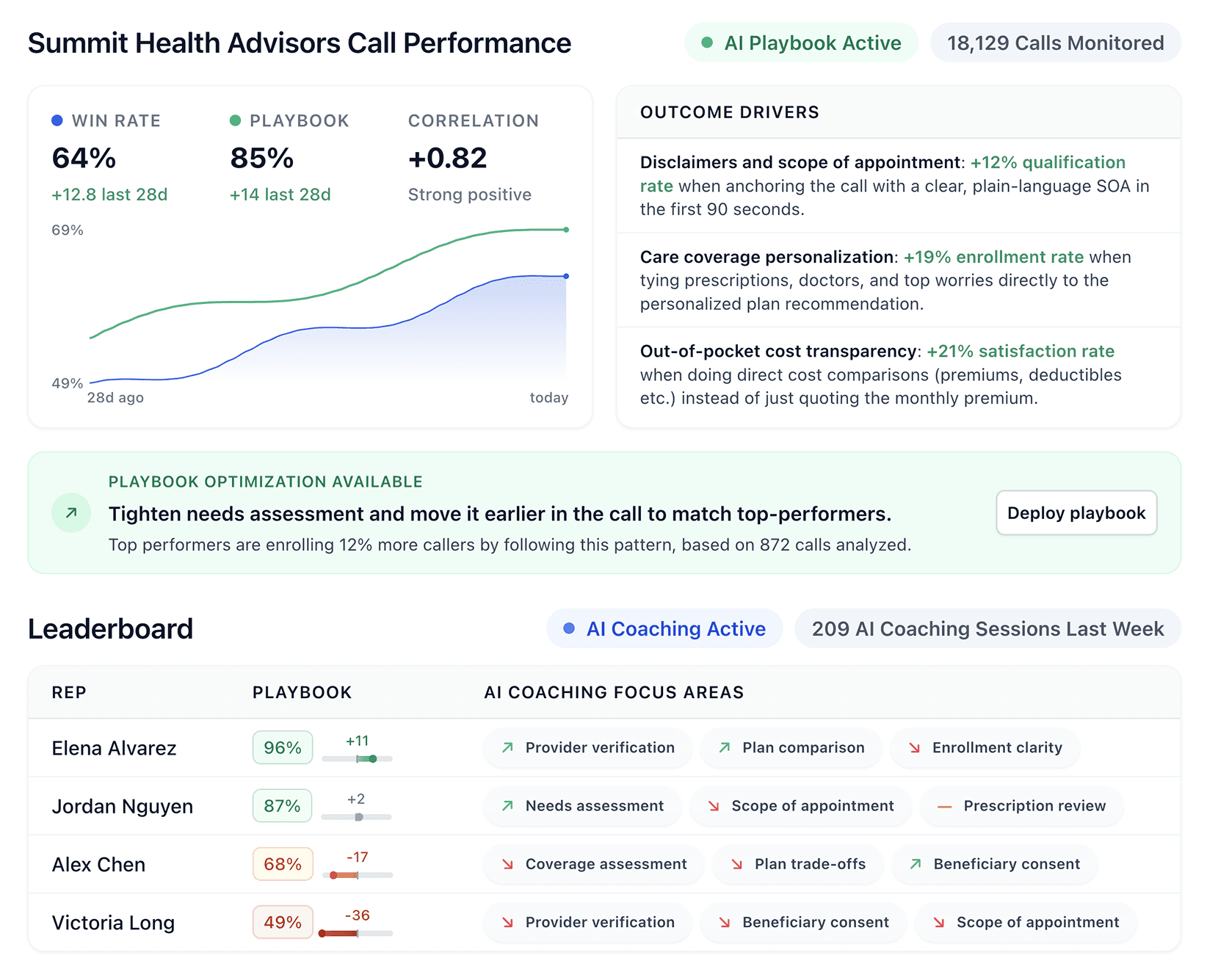


An AI appointment setter is software that handles the scheduling and qualification work that does not require a human rep, so your team can spend more of their time on the conversations that close.
For high-volume B2C sales floors in Medicare, insurance, and home services, that distinction matters more than most buyers realize before they commit to a platform.
What is an AI appointment setter?
An AI appointment setter is an automated system that engages prospects, qualifies their interest, and books meetings directly into a sales rep's calendar.
It handles the work that happens between a lead expressing interest and a sales conversation taking place. Instead of letting inquiries sit unanswered, the AI responds right away, asks qualifying questions, and helps prospects schedule a time to connect with the right representative.
It can handle tasks such as:
Responding to inbound inquiries after business hours
Following up with form submissions while interest is still high
Confirming and rescheduling appointments
Qualifying prospects based on predefined criteria
Routing leads to the appropriate sales representative
Booking meetings directly into a calendar
Modern AI appointment setters use natural language processing (NLP) to have conversations that feel natural and relevant. Prospects can ask questions, provide information, and move through the scheduling process without feeling like they are interacting with a rigid automated system.
For example, a prospect who fills out a Medicare plan comparison form at 9 p.m. does not have to wait until the next business day for a response. The AI can immediately start a conversation, gather key details, confirm availability, and schedule a meeting with an advisor for the following morning.
AI appointment setters help give every lead prompt attention. By handling scheduling and routine follow-ups, they free sales reps to focus on meaningful conversations with qualified prospects.
How an AI appointment setter works on a B2C sales floor
The exact workflow depends on the platform, but most AI appointment setters follow the same process. Their job is simple: engage leads quickly, determine whether they're a good fit, and get qualified prospects onto a rep's calendar.
🏁 Stage | ❓ What happens | 🎯 Outcome |
Lead engagement | AI responds to forms, quote requests, replies, and after-hours calls. | Prospects get an immediate response while interest is high. |
Lead qualification | AI asks a few questions to determine fit and gather key details. | Reps spend more time with qualified prospects. |
Appointment scheduling | AI presents available slots and books the appointment. | Prospects schedule without back-and-forth. |
Rep handoff | Qualification responses and details pass to the rep. | Reps start with context instead of from scratch. |
After-hours lead capture | AI engages prospects outside business hours. | Opportunities are qualified before the next workday. |
Lead engagement
The process starts when a prospect takes action.
They might request a quote, complete a website form, respond to a text message, or call after business hours. Instead of waiting for a sales rep to become available, the AI responds immediately.
Many B2C buyers contact multiple companies before making a decision. Reaching out while interest is still high can increase the likelihood of turning an inquiry into a booked appointment.
Lead qualification
Not every lead is ready to speak with a sales rep.
The AI asks a small number of qualifying questions to determine whether the prospect is a good fit and what type of conversation they need.
For a Medicare agency, that might include confirming eligibility, current coverage, or enrollment timelines.
For a home services company, the AI might ask about the service needed, property type, and location.
For a lending team, it might confirm loan type, estimated credit range, and purchase timeline.
By gathering this information upfront, the AI helps sales reps spend more time with qualified prospects and less time sorting through unqualified inquiries.
Appointment scheduling
Once a prospect qualifies, the AI moves directly into scheduling.
It can present available time slots, coordinate around the prospect's availability, and book the appointment without requiring multiple emails or phone calls.
The prospect receives a confirmation right away, while the sales rep gets a calendar booking with important context attached.
Rep handoff
When the scheduled conversation begins, the rep is not starting from scratch.
They can see what prompted the inquiry, how the prospect answered qualification questions, and what they expect from the conversation. This helps the discussion start in the right place instead of spending time covering information the prospect has already provided.
After-hours lead capture
Many B2C businesses generate leads outside normal working hours.
A Medicare brokerage may receive inquiries late at night during the Annual Enrollment Period. A roofing company might get quote requests after a storm. A personal injury law firm could receive website inquiries over the weekend.
Without an AI appointment setter, those leads often sit untouched for hours.
With one in place, prospects can get answers, complete qualification, and schedule a call while their interest is still high. By the time the sales team starts work the next day, qualified appointments are already waiting on the calendar.
Why AI appointment setters matter for high-volume B2C inside sales
Most discussions about AI appointment setters focus on B2B sales teams.
In those environments, the goal is often to automate prospecting, qualify leads, and book discovery calls before a sales rep gets involved.
High-volume B2C sales floors have a different challenge than most B2B teams.
The problem is not finding prospects. In many cases, the leads are already there. They've requested a quote, filled out a form, responded to an ad, or asked for more information.
The challenge is responding before that interest fades.
On a busy day, reps are already handling scheduled appointments, follow-ups, and live conversations. New inquiries keep coming in, but there are only so many calls a person can take at once. Even qualified leads can end up waiting longer than intended.
AI appointment setters help every inquiry get immediate attention. Instead of sitting unanswered, prospects can get a response, answer a few qualifying questions, and schedule a conversation while they're still engaged.
The impact is often most noticeable outside business hours.
A homeowner researching insurance options at 7 p.m. or a Medicare shopper comparing plans late at night may not be actively looking the next morning. An immediate response gives them a clear next step before they lose interest or contact another provider.
For high-volume B2C teams, AI appointment setters help address three common challenges:
Long response times during busy periods
Missed opportunities when reps are already at capacity
After-hours inquiries that would otherwise wait until the next business day
When interest is highest, prospects get a response, a conversation, and a clear path to the next step.
The tasks an AI appointment setter should handle (and the ones it should not)
AI appointment setters work best when the job is narrow and clear.
On a B2C sales floor, that means responding to new inquiries, collecting basic information, scheduling appointments, and handling routine follow-up. These are important tasks, but they don't always require a sales rep's time and attention.
1. Engaging inbound leads right away
Every form fill, after-hours inquiry, and overflow call deserves a fast response.
When reps are busy or unavailable, the AI can start the conversation immediately. It can acknowledge the inquiry, ask a few basic questions, and guide the prospect toward the next step.
2. Asking basic qualification questions
Some questions do not need a trained rep. The AI can confirm whether a prospect meets basic criteria, such as:
Service area
Eligibility
Current coverage type
Job type or request type
Preferred appointment time
A Medicare agency might ask about current coverage and enrollment timing. A home services company might ask about location, property type, and the issue the prospect needs help with.
3. Confirming appointments and sending reminders
Appointment confirmations and reminders are necessary, but they can eat up a lot of rep time.
The AI can confirm the booking, send reminder messages, and reduce missed appointments without pulling reps away from live conversations.
4. Re-engaging leads that did not book
Some prospects start the booking process and drop off. Others miss a scheduled call. In both cases, the AI can follow up automatically and give the prospect another chance to schedule.
This keeps follow-up consistent without asking reps to manually chase every unfinished booking.
5. Tasks that still need a human
Scheduling an appointment is one thing. Recommending a Medicare plan, addressing concerns about coverage, or discussing regulated topics requires a trained professional who can evaluate the prospect's unique situation.
6. Discovery and needs assessment
A rep should handle any conversation that requires judgment.
For example, an AI can confirm that someone is interested in Medicare Advantage. A licensed agent should evaluate doctors, medications, budget, and plan fit.
The same applies to insurance, financial services, and other regulated or advice-based sales conversations.
7. Objection handling
Prospects often raise concerns that require empathy and judgment.
A person should handle real objections, especially when the prospect is confused, hesitant, or worried about making the wrong decision.
AI responses can feel scripted in these moments. That can hurt trust when the conversation needs a human touch.
8. Regulated sales conversations
Some industries have strict rules about who can say what, when they can say it, and how information must be presented.
Medicare, insurance, and financial services teams should review their compliance requirements before automating any part of the conversation.
The safest use case is simple: Let the AI qualify, schedule, confirm, and remind. Let trained reps handle judgment, advice, objections, and regulated conversations.
What to look for in an AI appointment setter for a high-volume B2C sales floor
A platform also has to fit the way your team operates. Here's what to evaluate:
Speed of engagement
Response time should be one of the first things you evaluate.
When a prospect requests a quote or fills out a form, they're actively engaged. An AI appointment setter should reach out almost immediately, not several minutes later after leads have been queued for processing.
Ask vendors how quickly their system responds across different channels and whether response times remain consistent during peak volume periods.
Qualification flexibility
Every B2C sales floor has its own definition of a qualified lead.
The platform should allow your team to customize qualification questions, routing rules, and appointment logic. If the qualification process cannot be adapted to your sales workflow, the appointments generated may not be particularly useful.
CRM and dialer integrations
The handoff between AI and sales rep should feel invisible from the rep's perspective.
By the time a call is scheduled, qualification responses, appointment details, and conversation history should already be available inside the CRM and dialer. Reps should not have to piece together information from multiple systems before every conversation.
For teams using platforms such as Five9 or Genesys, integration capabilities deserve close attention during the evaluation process.
Compliance support
For regulated industries, compliance deserves as much attention as functionality.
An AI may be engaging prospects before a licensed agent joins the conversation, which makes it important to understand exactly what information the system collects, how consent is handled, and what records are retained.
Organizations operating in Medicare, insurance, lending, or financial services should review these requirements carefully before deploying any automation.
Handoff quality
A booked appointment only creates value if the rep has enough context to continue the conversation effectively.
The strongest platforms provide a concise summary of the interaction, including qualification responses, appointment details, and the reason the prospect scheduled the call.
That context helps reps pick up where the AI left off rather than asking prospects to repeat information they've already provided.
After-hours coverage
Many vendors advertise 24/7 availability, it's worth looking at what that means in practice.
Some systems respond immediately regardless of when a lead comes in. Others collect inquiries overnight and process them later.
If after-hours lead capture is a priority, ask how the platform handles evenings, weekends, and holidays, along with the average response time for leads that arrive outside business hours.
Where AI appointment setters break down
AI appointment setters can improve response times and reduce administrative work, but results depend heavily on how the workflow is designed.
Most failures happen when teams either ask the AI to do too much or create processes that add friction for prospects and reps. Understanding these common pitfalls can help you avoid problems before they affect conversion rates.
Over-qualifying and losing good leads
Teams often assume that asking more qualification questions will produce better appointments, but the opposite can happen. Every additional question creates another point where a prospect can abandon the process, especially when they were already ready to schedule a conversation.
Every qualification flow should gather the information required to determine eligibility, fit, and next steps. Once an appointment is booked, the rep can build on that foundation during the conversation.
Under-qualifying and wasting rep time
Problems can also arise when qualification standards are too loose. If nearly every inquiry ends up on a rep's calendar, sales teams spend valuable time speaking with prospects who do not meet basic eligibility requirements or have little intent to buy.
Effective appointment setting requires a balance between making it easy to book a conversation and ensuring reps spend their time with qualified opportunities.
Conversations that feel impersonal
While most prospects understand they're interacting with an automated system, engagement tends to drop when the conversation feels rigid, repetitive, or disconnected from their situation.
This becomes particularly important during the period between qualification and the scheduled call. A prospect who feels like they have been guided through a scripted workflow may arrive at the appointment less engaged than someone who experienced a more natural interaction.
Before deploying an AI appointment setter at scale, review actual conversations and evaluate them from the prospect's perspective. What sounds efficient internally may feel frustrating or impersonal to the person on the other side.
Compliance risks in regulated industries
Organizations in Medicare, insurance, lending, and financial services need to pay close attention to how AI interacts with prospects. Qualification conversations may be subject to rules around consent, disclosures, and recordkeeping.
Problems can arise when AI responses fall outside approved workflows or collect information before required permissions have been established. Even small mistakes can create compliance concerns.
For that reason, many organizations prioritize platforms that offer clear controls over conversation flows, consent management, and interaction records. Guidance from CMS, the FCC, and the CFPB can help teams understand the requirements that apply to their industry.
How AI appointment setting fits into a broader sales performance strategy
AI appointment setters help qualified prospects reach a sales rep faster, but the quality of the sales conversation still determines whether those opportunities turn into revenue.
That's why many organizations treat appointment setting as one part of a larger sales performance strategy. More appointments create more opportunities, but results improve most when scheduling, sales execution, and coaching work together.
On a high-volume B2C floor, responsibilities often break down like this:
AI appointment setters handle initial outreach, qualification, scheduling, reminders, and after-hours lead engagement.
Sales reps focus on discovery, relationship building, objection handling, and compliance-sensitive conversations.
Coaching and performance programs help reps improve over time so stronger conversations lead to better outcomes.
When each part of the process is doing its job, prospects receive faster responses, reps spend more time selling, and managers gain more opportunities to improve performance across the floor.
The most effective teams use AI to handle repetitive coordination work while keeping people focused on conversations, decisions, and customer interactions that benefit from human judgment and expertise.
How Alpharun combines AI appointment setting with sales coaching
Many sales teams end up solving appointment setting and rep performance separately. One tool helps fill the calendar, while another helps reps improve once the conversation starts.
Alpharun combines both within a single platform, allowing teams to manage lead engagement, appointment scheduling, and rep coaching in one place.
The AI agent handles qualification, scheduling, and routine follow-up so reps can focus on selling.
Once the conversation begins, Alpharun's coaching platform helps reps perform at a higher level through features such as:
Post-call coaching that delivers feedback immediately after each conversation.
Automated call scoring based on your team's custom playbook, eliminating the need for managers to manually review every recording.
Personalized coaching recommendations that highlight specific opportunities for improvement after each conversation.
Performance insights based on top-performing conversations so teams can identify the behaviors, questions, and techniques associated with stronger outcomes.
Visibility into team and individual rep performance through reporting that helps managers spot trends, coaching opportunities, and areas for improvement.
For sales leaders, this creates a more complete view of performance. Rather than looking only at booked appointments or only at call outcomes, teams can understand how lead engagement, appointment quality, and rep execution work together to drive results.
Book a demo to see how Alpharun helps high-volume sales teams improve both appointment conversion and sales performance.
Frequently asked questions
How does an AI appointment setter handle after-hours leads?
An AI appointment setter handles after-hours leads by engaging them immediately when they inquire, regardless of whether reps are available. It asks qualifying questions, confirms availability, and books the prospect into a rep's calendar for the next business day rather than leaving the lead to go cold overnight.
Does an AI appointment setter replace sales reps?
No, an AI appointment setter does not replace sales reps. It handles the repetitive coordination tasks between lead generation and a productive rep conversation: initial engagement, basic qualification, scheduling, and confirmation. Discovery, objection handling, and closing still require a trained human rep.
What is the ROI of an AI appointment setter for a high-volume sales floor?
The ROI of an AI appointment setter comes primarily from faster speed-to-lead and after-hours coverage. On a floor where reps handle 60 to 80 calls per day, an AI that engages every form fill within 60 seconds and books after-hours inquiries automatically can produce a measurable lift in booked appointments without adding headcount.
What should I look for when evaluating an AI appointment setter?
The most important factors are engagement speed, qualification customization, CRM and dialer integration, and compliance posture.
For Medicare and insurance floors specifically, confirm how the platform handles Permission to Contact requirements and whether the qualification conversation stays within approved regulatory language before deploying at scale.
How does an AI appointment setter work with a sales coaching platform?
An AI appointment setter and a sales coaching platform work together by covering different parts of the sales process. The coaching platform helps reps convert those prospects.
The two work together when appointment context flows into the coaching system, helping score and inform coaching on the rep's actual call.