We compared the 9 best AI roleplay tools for sales training in 2026, from Hyperbound to Alpharun, on realism, coaching depth, and call center fit.

Your reps get a few hours of manager coaching a week. Then they learn everything else on live leads, which is an expensive way to practice a cold open.
That gap is what the best AI roleplay for sales training is supposed to close: unlimited reps against a realistic buyer before anyone touches a real deal. Most roleplay tools do the drilling part well. The teams that actually move close rates and enrollment numbers also pay attention to what happens on the real calls afterward.
We compared nine platforms on the things that decide whether practice sticks: how realistic the buyer feels, how specific the feedback is, whether it fits a high-volume call center, and whether any of it shows up in live performance. Here's where each tool fits and how to pick one for your team.
9 best AI roleplay tools for sales training: TL;DR
Alpharun: Best for call centers and regulated inside-sales teams that want role-plays built from their own calls.
Hyperbound: Best for B2B SDR teams practicing cold calls and discovery.
Second Nature: Best for mid-market teams that want roleplay tied to structured training and certifications.
Quantified: Best for regulated field teams practicing approved messaging with video avatars.
Mindtickle: Best for enterprises that want roleplay inside a full enablement suite.
Yoodli: Best for individual reps and small teams on a budget.
Allego: Best for teams consolidating roleplay into an existing enablement platform.
PitchMonster: Best for SMB and outbound teams that want gamified practice.
UneeQ: Best for teams that sell face-to-face or on video.
What to look for in an AI roleplay tool for sales training
Feature pages all sound the same. These are the criteria that actually separate a tool your reps use daily from one that collects dust after week two.
Conversation realism: The AI buyer should interrupt, push back, and go off-script the way a real prospect does. If it only reacts to keywords, reps learn to game the bot, and that skill evaporates on a live call. (For the wider category, see our guide to sales simulation.)
Feedback depth: "You scored 72%" tells a rep nothing. Look for feedback tied to a specific moment: where they lost the buyer, which objection they fumbled, what a top rep would have said instead.
Practice-to-live transfer: Does the tool connect practice to real calls, or does it stop at the simulation? A high score in the sandbox is only useful if it predicts what happens on a live one.
Customization: You should be able to build the buyers your reps actually face, down to the vertical, objection set, and personality. Generic "Budget Bob" scenarios don't prepare anyone for an AEP call.
Compliance fit: Regulated teams need practice that drills the required script language, so reps rehearse disclosures, consent, and qualification steps right alongside the pitch. Can the tool check that reps actually hit them?
Manager visibility and integrations: Managers need to see who's practicing and where reps are struggling, and the tool should plug into your stack (Five9, Genesys, your CRM or LMS) so the data lands where they already work.
Roleplay simulation vs. coaching on real calls: Which moves the needle?
Picture a Medicare advisor three weeks into the job, on a live enrollment call, when the senior on the other end asks a question about drug coverage that wasn't in any script. That moment is when training either shows up or doesn't.
Simulation is genuinely useful for getting reps to that moment. It gives them unlimited reps, no burned leads, and a safe place to fumble an objection for the first time. Research on deliberate practice shows expertise comes from focused work on your weak spots with immediate feedback, and roleplay bots deliver both at a scale no manager can.
The ceiling is that an AI buyer isn't your buyer. Practice scores measure how well a rep handles the simulation, which is a decent proxy for readiness and a weak proxy for live performance.
That's why the strongest programs pair practice with coaching on real recorded calls. Without reinforcement, memory for newly learned material drops sharply within the first day (the forgetting curve is well documented), so grading real conversations keeps the lessons alive where they count.
Call center coaching software closes that loop by scoring the real calls, which is where the practice was supposed to pay off.
For high-volume regulated teams, the bottleneck is coverage: no manager can listen to every real call, so coaching stays stuck on the handful they spot-check.
9 best AI roleplay tools for sales training: Quick comparison
Tool | Best for | Practice format | Pricing |
|---|---|---|---|
Alpharun | Call center and regulated inside-sales teams | Voice roleplay + real-call coaching | Custom |
Hyperbound | B2B SDR cold-call and discovery practice | Voice roleplay | |
Second Nature | Scalable roleplay with built-in training | Voice and video-avatar roleplay | |
Quantified | Regulated, enterprise avatar practice | Video avatar roleplay | |
Mindtickle | Roleplay inside a full enablement suite | Voice roleplay | |
Yoodli | Individuals and small teams on a budget | Voice roleplay | |
Allego | Enablement consolidation | AI avatar roleplay | |
PitchMonster | Gamified SMB practice | Voice, avatar and screen-share roleplay | |
UneeQ | Face-to-face and video-selling practice | Digital-human roleplay |
The 9 best AI roleplay tools for sales training
1. Alpharun: Best for call center and regulated inside-sales teams

Alpharun's homepage, with the headline "Turn every agent into your best agent" above a preview of its coaching dashboard.
What it is: Alpharun is an AI sales performance platform that builds a bespoke playbook from your team's best calls, then grades and coaches every real call at the sentence level. Its real-time coaching means immediate post-call feedback, so reps get specific notes right after they hang up.
Alpharun is our own platform, and it's the one tool here that builds its AI role-plays from your team's real calls: agents rehearse the objections and gaps found in their own conversations, get feedback, and retry before the next customer call.
Best for: B2C call centers and inside-sales teams of 50+ reps in regulated verticals like Medicare, life and health insurance, and mortgage.
Standout features: A custom playbook trained on your winning calls, plus sentence-level scoring that covers compliance steps like TPMO disclaimers and Scope of Appointment. Reps get weekly coaching, managers get digests, and AI playbook setup with Five9, Genesys, and major contact-center platforms takes about two weeks on average.
Alpharun works with Medicare brokerages like AskChapter across hundreds of thousands of calls.
Pricing: Custom. Book a demo for a quote.
Honest limit: Its role-plays are built from your playbook and call recordings, so it fits teams with real call volume better than reps practicing on their own.
2. Hyperbound: Best for B2B SDR cold-call and discovery practice

Hyperbound's homepage, with an AI sales coaching headline beside a sample MEDDPICC scorecard showing what a rep could do differently next time.
What it is: Hyperbound builds voice-based AI buyer personas from your ICP for cold-call, discovery, and warm-call practice. The company says it builds its AI buyer personas from more than 2 million hours of real B2B sales conversations.
Best for: B2B SDR and AE teams that want CRM-connected practice tied to real pipeline.
Standout features: ICP-based personas, real-call scoring on the separately licensed Perform plan, and, per Hyperbound, a first bot you can build in under 10 minutes.
Pricing: A free tier with 45 prebuilt roleplays; paid Practice and Perform plans are quoted per user.
Honest limit: It's voice-only, so it won't help with video or in-person selling, and it leans B2B.
3. Second Nature: Best for scalable roleplay with built-in training

Second Nature's homepage, with its AI role-play headline above a video avatar discovery call demo.
What it is: Second Nature runs two-way voice roleplay through an AI persona called Jenny, paired with built-in course authoring and certifications, and it connects to your existing LMS.
Best for: Mid-market and larger teams that want roleplay tied to structured training tracks.
Standout features: Dynamic avatars, 30+ language support, certification workflows, and gamification to keep reps practicing.
Pricing: Custom. Second Nature doesn't publish rates; book a demo for a quote.
Honest limit: Its new video avatars work only in English, single-persona roleplays for now, and some users find the AI a little robotic.
4. Quantified: Best for regulated, enterprise avatar practice

Quantified's homepage, with the headline "AI Sales Coaching That Wins" beside a video avatar inviting visitors to start a conversation.
What it is: Quantified offers lifelike AI video avatars for roleplay, with a strong focus on message adherence and compliance in industries like life sciences and financial services.
Best for: Enterprise teams in compliance-heavy verticals that need audit-ready practice.
Standout features: Behavioral scoring on clarity, pace, confidence, and tone across 1,400+ dimensions, ComplianceGuard messaging checks, and screen-share practice for demos. Quantified says 94% of users prefer it to alternatives, by its own count.
Pricing: Custom, quoted per organization.
Honest limit: There's no self-serve plan or trial; every deal is sales-led and quoted per organization.
5. Mindtickle: Best for roleplay inside a full enablement suite
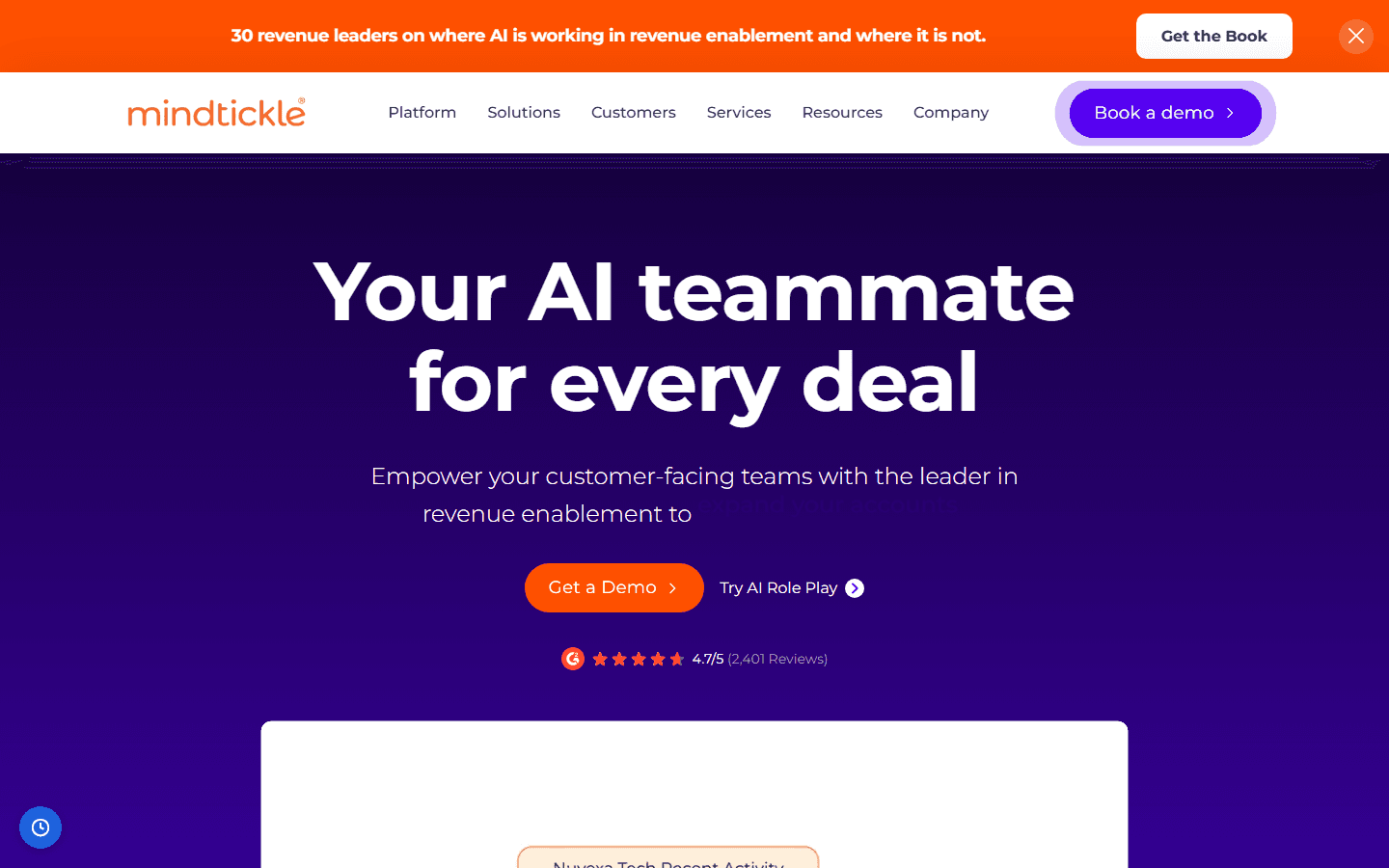
Mindtickle's homepage, with the headline "Your AI teammate for every deal" and buttons to book a demo or try AI role play.
What it is: Mindtickle bundles AI roleplay into a broader revenue-enablement platform that also covers training, content, coaching, and conversation intelligence.
Best for: Enterprises that want practice data connected to learning paths, certifications, and quota attainment.
Standout features: Copilot scenario generation, a Readiness Index that ties practice to performance, and Salesforce integration.
Pricing: Custom, based on company size and team structure.
Honest limit: Roleplay is one module among many, so it can be overkill if practice is all you need, and two-way AI roleplay isn't in the standard packages, so it has to be added to your order.
6. Yoodli: Best for individuals and small teams on a budget

Yoodli's homepage, with the headline "Interactive AI Roleplays for employee programs" beside a sample roleplay chat.
What it is: Yoodli started as a speech-coaching tool and grew into a roleplay tool. It's strong on communication mechanics like filler words, pacing, and clarity.
Best for: Solo reps and small teams that want cheap, fast practice and presentation polish.
Standout features: Instant post-session feedback on pacing, filler words, and clarity, multi-persona roleplays, and SOC 2 Type II and GDPR compliance.
Pricing: A free plan (five lifetime sessions), with individual plans from $11 a month billed annually; team plans are custom-quoted.
Honest limit: It's communication-focused, so its sales-specific scenarios run shallower than purpose-built tools.
7. Allego: Best for enablement consolidation

Allego's homepage, with the headline "Loved By Customers" beside its overview video.
What it is: Allego is a revenue-enablement platform that upgraded its AI roleplay in mid-2025 with the Live Dialog Simulator, an unscripted video-avatar engine, alongside learning, content, and digital sales rooms.
Best for: Teams already invested in a broad enablement stack that want roleplay in the same place.
Standout features: Async coaching, AI lesson authoring, and conversation intelligence.
Pricing: Custom, quoted per user per month and billed annually.
Honest limit: The unscripted Live Dialog Simulator only arrived in mid-2025, so it has less of a track record than dedicated roleplay tools, and the full suite may be more than a practice-only team needs.
8. PitchMonster: Best for gamified SMB practice
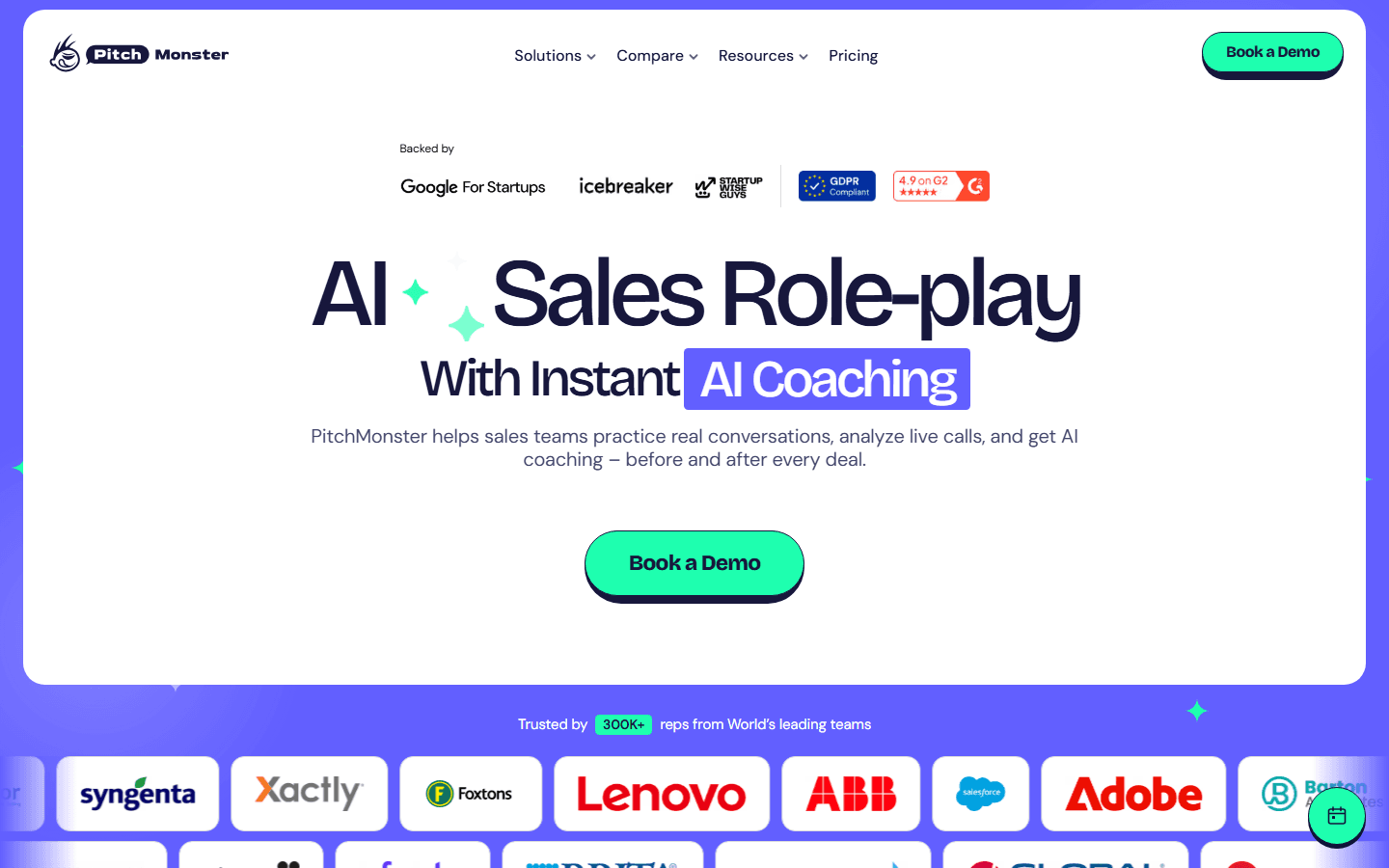
PitchMonster's homepage, with the headline "AI Sales Role-play With Instant AI Coaching" above its customer logos.
What it is: PitchMonster is a gamified roleplay and objection-handling tool built around engagement, with leaderboards and prebuilt scenarios.
Best for: SMB and outbound teams that want practice to feel like a competition.
Standout features: A library of ready-made scenarios plus custom scenarios built from your calls and objections, customizable AI buyer personas, and post-session coaching feedback.
Pricing: Quote-based, per seat, with standard 12-month contracts and a free trial through the demo.
Honest limit: Every plan is quote-based on a 12-month contract, so there's no low-commitment way to try it beyond the demo trial.
9. UneeQ: Best for face-to-face and video-selling practice

UneeQ's homepage, with a digital human behind the headline "Practice your team's toughest in-person conversations."
What it is: UneeQ's Immersive Training Platform lets reps practice face-to-face with lifelike digital humans that respond in real time, no headset required.
Best for: Teams that sell on video or in person and need reps to read facial expressions and hold eye contact.
Standout features: True visual face-to-face roleplay, sub-second response latency, and browser-based scenario setup.
Pricing: Per seat, per month, with every feature included; book a demo for a quote or start a 30-day free trial.
Honest limit: The Immersive Training Platform launched in late 2025 and its client list skews enterprise, so it's best when visual presence is central to how you sell.
Example AI roleplay scenarios for sales training
The best scenarios mirror the calls your reps actually take. Five that work for most inside-sales and call center teams:
Cold open: The buyer picks up distracted, and the rep has a few seconds to earn the next minute.
Objection handling: The buyer pushes back on price, timing, or needing to check with a spouse, and the rep has to keep the conversation moving.
Discovery: The buyer gives short answers, and the rep has to ask follow-ups that uncover the real need.
Compliance disclosure: The rep delivers required language, like a Medicare TPMO disclaimer, word for word without losing the buyer.
Renewal or win-back: A past customer is shopping with a competitor, and the rep has to find out why before making an offer.
Build each one from your own call recordings where you can, so the objections and buyer types match what reps hear on the phone.
How to choose the right AI roleplay tool for your team
Match the tool to how your team actually sells and to the numbers it's measured on.
By sales motion: Phone and inside-sales teams do best with voice tools like Hyperbound or Second Nature, or real-call coaching for live performance. Video and in-person sellers want UneeQ. Teams consolidating tools lean toward Mindtickle or Allego.
By team size and budget: Solo reps and small teams start with Yoodli, SMBs get traction with PitchMonster, regulated call centers fit Alpharun, and regulated field teams fit Quantified.
By goal: If you're ramping new hires, practice earns its keep, and role-plays built from your own calls keep that practice close to the real thing. If you're chasing sustained live-call performance and compliance, weight real-call coaching more heavily. For the wider category beyond roleplay, our roundup of sales training software covers tools that handle content and enablement too.
By how you measure it: Pick a tool whose scores map to metrics you already track, like enrollment conversion, quote-to-app, or QA pass rate. Then run a sales performance evaluation a quarter in to check whether practice is showing up in live results.
Final verdict
For call centers and regulated inside-sales teams, Alpharun is our pick: it builds role-plays from your own calls, then scores every real call against the same playbook, so practice and live performance are measured the same way.
Hyperbound is the stronger choice for B2B SDR teams drilling cold calls, and Second Nature or Mindtickle fit teams that want roleplay inside structured training. Solo reps and small teams can start on Yoodli's free plan before committing to a platform.
How Alpharun fits into sales training
Roleplay tools get reps ready for their first real conversations. That's real value, especially for a brand-new hire.
The lasting lift, though, happens on live calls, where the buyer is real, and the compliance stakes are too. Manager coaching bandwidth is the constraint: nobody can listen to every call, so most feedback comes from a thin sample. A broader sales enablement program helps, but the coverage problem stays.
Alpharun sits on top of your existing call center stack and coaches on the calls your team already makes. You keep your human reps doing what they do best, and it handles the repetitive review work that used to eat up a manager's week.
With Alpharun, sales and call center teams can:
Build a playbook from your best calls: It turns what top reps actually do into a repeatable framework for everyone else
Score every call at the sentence level: Consistent evaluation across reps, teams, and time, including compliance steps
Coach reps right after the call: Specific, tactical feedback on the exact moment that needs work, while it's still fresh
Flag compliance gaps automatically: Missed disclosures, incomplete Scope of Appointment, and script drift get caught early
Point managers at the right calls: Digests show exactly where coaching time will pay off
Connect to Five9, Genesys, and major platforms: AI playbook setup takes about two weeks on average
The shift is from guessing what works to knowing, with every rep operating a little more like your top 10%.
Book a demo to see how Alpharun turns your real calls into coaching your team can use.
Frequently asked questions
What is AI roleplay for sales training?
AI roleplay for sales training uses AI to simulate realistic buyer conversations so reps can practice pitches, discovery, and objection handling without risking live deals. The AI plays the prospect, adapts to what the rep says, and scores the session with feedback afterward.
Does AI sales roleplay actually improve performance?
Yes, when practice is consistent and paired with feedback, skill comes from focused repetition and immediate correction. Reinforcement is the deciding factor: research on the forgetting curve shows memory fades fast without review, so teams that practice regularly and coach on real calls hold onto the gains.
What's the difference between AI roleplay and coaching on real calls?
AI roleplay is simulated practice against an AI buyer, while call coaching grades the actual conversations reps have with customers. Roleplay builds skills before the call; real-call coaching reinforces them after, and the strongest programs use both.
Which AI roleplay tool is best for call center or insurance teams?
Alpharun is the best fit for call center and insurance teams because it runs role-plays built from your real calls and grades every real call for disclosures and script adherence. Quantified suits regulated field teams that practice against an approved messaging library.
How much do AI sales roleplay tools cost?
AI sales roleplay tools range from free plans to custom quotes. Yoodli's individual Pro plan costs about $11 a month billed, Hyperbound has a free tier with paid plans quoted per user, and most enterprise options, like Second Nature, Quantified, and PitchMonster, are priced by custom quote.

