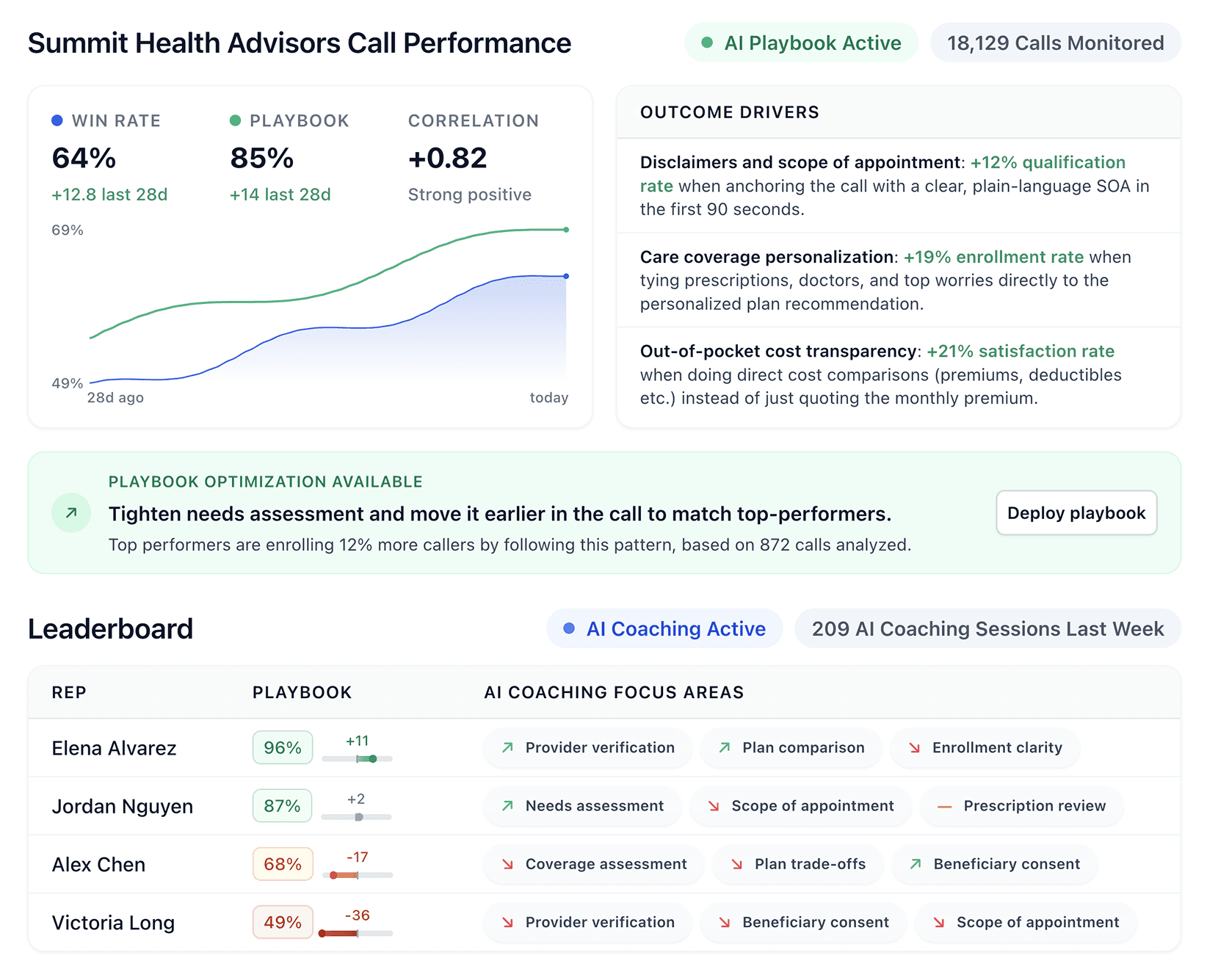


Your reps are losing live calls to objections they've never practiced, on prospects they've never been prepared for, using responses they're making up in real time.
Here's how to build a sales simulation from your actual calls so reps can handle common objections and conversations with more confidence on live calls.
What is a sales simulation?
A sales simulation is a structured training exercise that lets sales reps practice realistic conversations before they happen with live prospects.
Teams use sales simulations to rehearse discovery calls, objection handling, compliance requirements, and closing scenarios using situations that mirror real customer interactions.
The 4 types of simulations that work for inside sales teams
Not every simulation serves the same purpose, and running the wrong type at the wrong time is how teams waste practice reps on skills that don't move the needle. Here's how to think about them:
1. Discovery simulations
These practice the opening minutes of a call. The goal is to help reps build rapport quickly, ask the right qualifying questions, and establish the right tone before they ever try to move toward a close.
For a home services team, this might mean practicing how to move from a warranty question into a service agreement conversation without it feeling like a bait-and-switch.
For an insurance team, it could mean handling a prospect who is comparing quotes from multiple providers and looking for the lowest price.
2. Objection handling simulations
These are often the highest-value simulations a team can run. Start with the five objections reps hear most frequently and build dedicated practice scenarios around each one.
Use real language from customer conversations whenever possible. Simulations are far more effective when they reflect how prospects actually speak rather than how training materials say they should.
Run each one multiple times. The first time a rep hears a hard objection, their response will be inconsistent. By the fifth time, they've developed a real response. By the tenth time, it's automatic.
3. Compliance simulations
For Medicare, insurance, and other regulated industries, compliance is a performance issue just as much as a legal one. A rep who stumbles through the required disclosure, reads it too fast, or loses the buyer's attention during it is losing calls they should be closing.
Compliance simulations give reps an opportunity to practice required disclosures in realistic sales scenarios. Over time, those conversations become more natural, helping reps maintain confidence, consistency, and compliance throughout the call.
4. Recovery simulations
Recovery simulations focus on calls that were close to converting but ultimately broke down.
A prospect may start disengaging halfway through the conversation, hesitate when asked for insurance information, or raise concerns when pricing is discussed.
Using real examples from lost calls helps reps practice these moments repeatedly, making it easier to recognize warning signs and respond before the opportunity slips away.
How to build sales simulations your reps will learn from
The answer is specificity. The closer a simulation is to the real calls your reps handle, the more directly it prepares them for those calls.
1. Build scenarios from real customer objections
Pull your most common objection types from actual call recordings. For an insurance team, that might be:
"I need to talk to my spouse first."
"I already have coverage through my job."
"The other company quoted me less."
"I don't want to give out my personal information."
Each of those requires a different response. Each one has a version that loses the call and a version that keeps it alive.
Your simulation scenarios should be built from the exact language real prospects use on your calls. The closer the wording is to real customer conversations, the more useful the practice becomes.
A rep who has practiced the "I need to talk to my spouse" objection thirty times before they hear it live will handle it differently than a rep who heard it explained once during onboarding.
2. Use recordings from your actual top performers
Your best reps are already solving these problems on every shift. Find the call where your top performer got a skeptical prospect to commit. Find the call where someone nearly lost the deal at the compliance disclosure and recovered it.
Find the call where the energy was perfectly calibrated from the opener to the close, those recordings are your simulation scripts.
When reps hear what good sounds like in your specific context, they have something concrete to model. Real call recordings show how top performers handle conversations from the opener to the close, giving reps a clear example they can follow.
Key takeaway: Every team already has the raw material for great simulations. The question is whether you're using it.
3. Run simulations at the moment of highest impact
Some simulation sessions have a greater impact than others. These are the two points in the training process where simulations deliver the most value.
Pre-floor preparation: Before a new rep ever takes a live call, they should have practiced the core scenarios enough that nothing on the floor is completely new. The first five objections they hear shouldn't be surprises, their opener shouldn't feel foreign.
Most reps will still face a learning curve on day one. The difference is that they have already practiced the core objections, openings, and conversations they are likely to hear on live calls.
Post-call debrief practice: When a rep loses a call in a specific way, the best time to practice that scenario is within 24 hours. The situation is fresh, the emotional weight is real, and they're motivated to fix it.
Running a simulation that recreates the exact situation they just failed at is far more effective than adding it to a queue for next month's training.
4. Score simulations the same way you score real calls
If your real calls get scored on compliance disclosure, qualification steps, and objection handling, your simulations should be scored on the same criteria. This serves two purposes.
First, it creates continuity. Reps learn that the same standard applies whether it's a practice call or a live one. The playbook isn't something that gets checked during training and forgotten on the floor.
Second, it gives you usable data. If a rep scores well on discovery but consistently breaks down at the close during simulations, you know where to focus coaching before they take that weakness into live calls.
5. Make the feedback impossible to misinterpret
Most post-simulation feedback is too vague to act on. "Work on your tone" or "try to sound more confident" tells a rep what to fix but not how to fix it. That's not useful.
Effective simulation feedback ties every note to a specific moment in the call. Timestamp it. Show the rep exactly what they said, play them what a top performer said in the same situation, and let them hear the difference themselves.
Reps who can hear the contrast don't need convincing. They just need the next chance to practice it.
6. Build simulations around real compliance scenarios
Most teams treat compliance as a separate training track. Reps learn the required disclosures in one session and practice their sales skills in another. The problem is that on a live call, they happen at the same time.
A rep who knows the disclosure but hasn't practiced delivering it mid-conversation will stumble. They'll read it too fast, lose the buyer's attention, and spend the rest of the call trying to recover momentum they didn't need to lose.
Build compliance into every relevant simulation from the start. Compliance is part of the customer conversation, and reps need opportunities to practice delivering disclosures with confidence and consistency.
7. Rotate simulations when your market changes
A simulation built six months ago reflects objections from six months ago. If a competitor dropped their price, launched a new product, or changed their pitch, your reps are already hearing new objections on live calls. They just haven't practiced them yet.
Treat your simulation library the way you treat your playbook: review it quarterly at minimum, update it when something on the floor changes, and retire scenarios that no longer reflect what prospects are actually saying.
A stale simulation is worse than no simulation, because it builds confidence for conversations that don't happen anymore.
Why most sales simulations don't move the needle
Here's the honest version of why most role-play programs underperform.
They're built on generic scenarios
Someone on the training team writes a hypothetical prospect, attaches a few common objections, and calls it a simulation.
Your reps aren't speaking with hypothetical prospects. They're speaking with homeowners comparing service providers, insurance shoppers evaluating coverage options, and customers who already have concerns before the conversation begins.
The simulation needs to reflect those real-world conversations closely enough to prepare reps for what they'll hear on live calls.
They don't use your best calls
Every team has recordings where a rep handled a tough objection perfectly, created urgency without being pushy, or recovered a conversation that was about to fall apart. Those calls are your most valuable training asset. Most teams never use them.
Feedback is too general
Telling a rep to "be more confident on the close" is the training equivalent of telling someone to "just be better." Reps improve when they hear exactly what they said, at the moment it cost them the call, with a clear example of what they could have said instead.
There's no repetition built in
A rep does one simulation during onboarding, gets some notes, and then gets on the phone. One practice session doesn't build muscle memory. Repetition does.
How often should simulations happen?
Most teams would benefit from running simulations more frequently than they do today.
Reps who practice three or more times per week against active competitors show 25-30% higher win rates. That level of improvement comes from regular repetition, feedback, and refinement rather than infrequent training sessions.
The practical model for most call center teams looks like this:
During onboarding: 3 to 5 sessions covering core scenarios before any live calls
First 30 days on the floor: Weekly simulation focused on the objections or situations where the rep is struggling
Ongoing: Monthly or bi-weekly simulations tied to playbook updates, seasonal demand shifts, changes in customer behavior, or new competitive dynamics.
Simulations should evolve along with your playbook. If a competitor changes their pricing and your reps are now hearing "the other company quoted me less" more frequently, that needs a dedicated simulation before it costs you a month of quota.
Where simulations break down on large teams
Simulation-based training becomes harder to sustain as teams grow.
A manager may be able to run a few practice sessions per rep each week, but maintaining that level of coaching across a team of 50 or more people quickly becomes difficult. As workloads increase, practice sessions become less frequent, even though consistent repetition is what helps reps improve.
The challenge becomes even greater when the reps who need the most coaching are often the least likely to seek it out.
How AI helps with sales training strategy
AI makes it easier for teams to deliver consistent practice and coaching at scale.
The scenarios still need to come from real conversations, common objections, and actual compliance requirements. What changes is how often reps can practice and how quickly they receive feedback.
Instead of waiting for a manager to facilitate every session, reps can work through simulations on their own schedule, receive feedback tied to the team's playbook, and identify areas for improvement before their next live conversation.
Managers continue to lead coaching and development, but they gain a clearer view of where reps are struggling and which skills need the most attention. That makes coaching conversations more focused, consistent, and actionable.
Simulations vs. call shadowing: What each one does
Sales simulations and call shadowing serve different purposes within a training program. One gives reps a chance to practice, while the other helps them observe how experienced team members handle real conversations.
🗣️ Sales Simulations | 🔍 Call Shadowing | |
What it does | Lets reps practice responding in realistic scenarios | Lets reps observe how experienced reps handle live calls |
Best for | Building specific skills and objection responses | Understanding tone, pacing, and real call dynamics |
Repetition | High. The same scenario can be practiced repeatedly. | Low. Every call is different. |
Feedback | Immediate and tied to specific actions. | Depends on manager or rep availability. |
Risk | No customer impact because no live calls are involved. | Low because reps are observing rather than participating. |
When to use | Before floor time and after performance gaps are identified. | During onboarding and for learning call flow, tone, and communication style. |
The strongest training programs combine both approaches. Call shadowing helps reps understand how successful conversations sound in the real world, while simulations give them a safe environment to practice those skills until they become second nature.
How Alpharun builds simulations from your actual calls
Every call your reps lose is a simulation you haven't built yet. Alpharun builds it for you, from your actual recordings, scored against your actual playbook, delivered to every rep on your floor.
Built for high-volume B2C inside sales teams with 50+ reps in Medicare, insurance, home services, and similar verticals. With Alpharun, teams can:
Custom playbooks: Built from the conversations, behaviors, and compliance standards that already drive results for your team.
Sentence-level coaching: Highlights where conversations broke down and shows how top performers handled similar moments.
100% call scoring: Scores every call against the same standards used throughout training and coaching.
Compliance-focused coaching: Helps teams reinforce required disclosures and processes as part of everyday coaching.
Stop losing calls to objections your reps have already heard. Book a demo and see what Alpharun builds from your recordings.
Frequently asked questions
What is a sales simulation?
A sales simulation is a structured practice scenario that mirrors a real sales conversation. It allows reps to practice objection handling, compliance delivery, discovery, and closing techniques before speaking with live prospects. The most effective sales simulations are built from real call recordings and scored against actual QA criteria.
How are sales simulations different from role-playing?
The main difference between sales simulations and role-playing is consistency.
Role-playing is often informal and depends on the person running it, while sales simulations use standardized scenarios, scoring criteria, and feedback. Sales simulations can also be delivered through AI-powered coaching platforms without requiring a manager or peer to participate.
How often should inside sales reps practice simulations?
Inside sales reps should practice simulations at least once per week, with newer reps often benefiting from more frequent sessions. Teams that make simulations part of their regular coaching process tend to reinforce skills more effectively than teams that rely solely on onboarding or periodic training events.
Do sales simulations work for compliance-heavy industries like Medicare?
Yes. Sales simulations can be highly effective for Medicare, insurance, and other compliance-heavy industries because they allow reps to practice required disclosures, qualification steps, and approved language before live customer interactions. Compliance criteria can also be included in the scoring process.
What makes a sales simulation effective for call centers?
Effective call center simulations are built from real customer conversations and scored against actual performance standards. The strongest simulations reflect how prospects speak in real calls and provide feedback tied to specific moments in the conversation, helping reps improve skills they use every day.