Find the best software for training new sales reps in 2026, from AI roleplay and certification tools to coaching, knowledge, and motivation platforms.

Training new sales reps is where most teams either build confident sellers or create bad habits that follow them into every call.
After researching and testing the leading platforms, these are the 7 best software for training new sales reps in 2026, compared by what they actually improve, where they fit in onboarding, and who they’re really built for.
7 best software for training new sales reps: Quick comparison
💻 Tool | 🎯 Best for | 💰 Starting price | ✅ Choose if... | ⚠️ Skip if... |
Mindtickle | Full-platform enablement from day one | Custom pricing | You want onboarding, AI roleplay, readiness tracking, and call analysis in one system | You only need one piece of the stack |
Allego | Video-based coaching and rep-recorded pitches | Custom pricing | You have distributed teams where asynchronous feedback is more practical than live sessions | You need live AI roleplay or formal certification programs |
Hyperbound | Deep AI roleplay before reps go live | Free plan available; advanced features custom pricing | You want new reps practicing hundreds of realistic conversations before speaking to a real prospect | You need published pricing before evaluating |
Second Nature AI | Structured certification before first call | Custom pricing | You need a formal gate new reps must pass before going live | You lack dedicated L&D resources to build and maintain scenarios |
Spekit | In-the-moment knowledge access during ramp | Custom pricing | Your new reps struggle to find the right information inside their CRM at the right moment | Your primary need is roleplay or structured practice |
Gong | Training built from real customer conversations | Custom pricing | You run a B2B team and want new reps practicing against your actual call data | You run a high-volume B2C inside sales floor |
Ambition | Keeping new reps engaged and motivated during ramp | From $45/user/month | You struggle with early attrition and need to build consistent daily habits during ramp | You need a tool that develops selling skills directly |
How these training tools were researched
We looked at each platform through the lens of a sales team onboarding new reps.
That meant reviewing feature docs, pricing pages, and verified user reviews from G2 and Capterra. When free trials or demos were available, we also tested the core sales rep onboarding checklist workflows ourselves.
We focused on five areas:
Onboarding fit: Does the tool actually help new reps ramp, or is it better for reps who already know the job?
Skill development depth: Does it build real sales skills, or mostly track activity and performance?
Ease of use: Could a rep who started last Monday get value from it by Friday?
Integrations: Does it connect cleanly with the CRM and the rest of the sales stack?
Customization: Can teams adapt it to their own sales process, ICP, and common objections?
The goal was to separate tools that genuinely help new reps improve from tools that work better once reps are already ramped.
1. Mindtickle: Best for full-platform enablement from day one
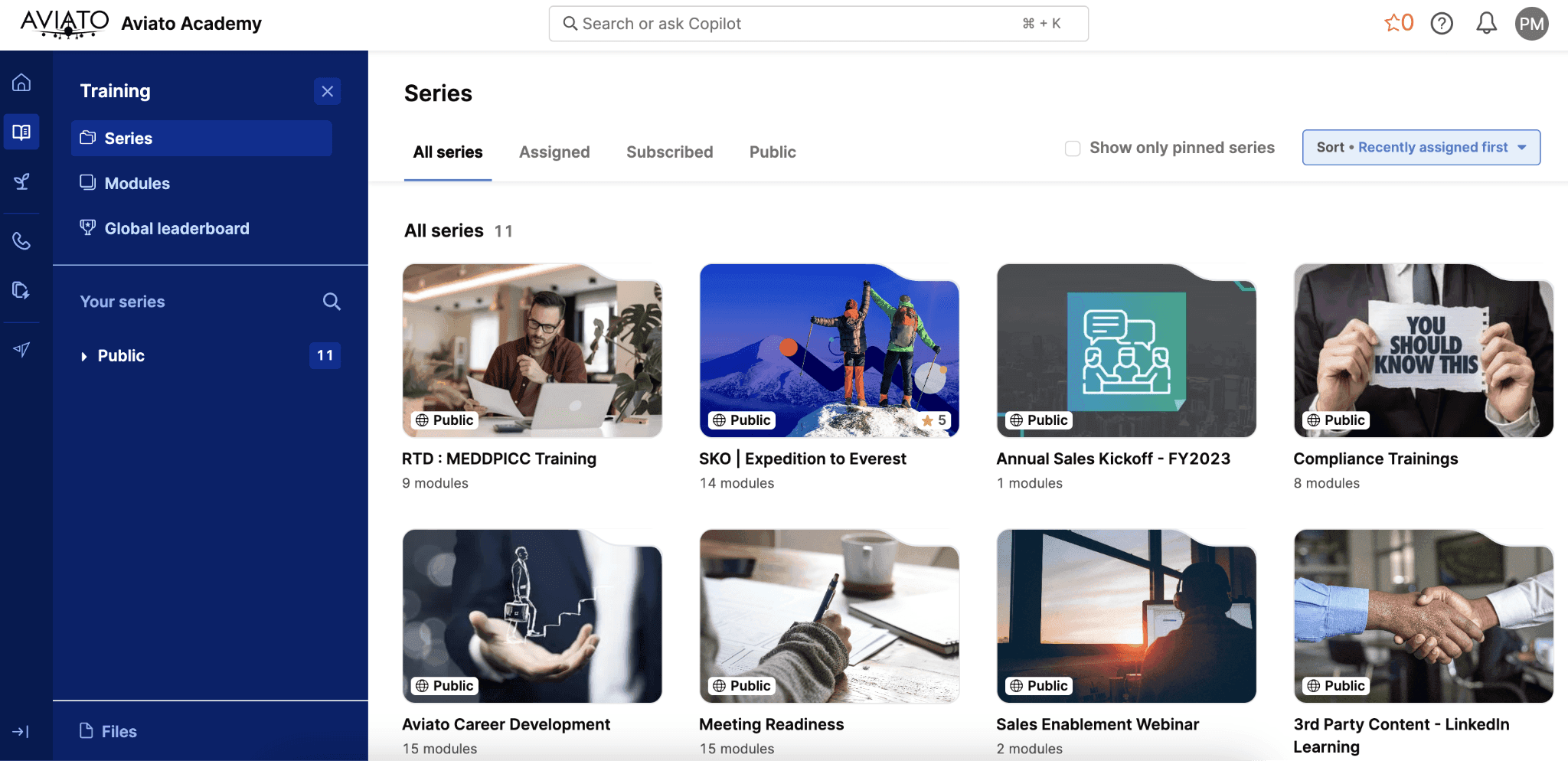
What it does: AI-powered revenue enablement platform that brings together structured onboarding, AI-driven roleplay, content management, conversation intelligence, and readiness tracking in one system.
Best for: Enterprise revenue teams that want to manage the full training lifecycle from new hire onboarding through to ongoing performance development without switching tools.
Mindtickle is the most complete platform on this list for new rep development. When a rep joins, they can move through structured onboarding modules, practice sales conversations with an AI buyer, get scored on their readiness, and then have their real calls analyzed once they go live.
The Readiness Index tracks progress automatically so managers can see where each rep stands without manually checking in.
For larger organizations running complex onboarding programs, that single-platform approach saves a significant amount of coordination time. The tradeoff is scope: teams that only need roleplay or only need call analysis will find Mindtickle more platform than they require.
Key features
Structured onboarding programs: Role-based learning paths, certifications, and micro-learning modules that move new reps through onboarding in a defined sequence.
AI roleplay and coaching: Practice sales conversations with an AI buyer and receive automated feedback tied to specific moments in the conversation.
Readiness Index: Tracks each rep's progress automatically using activity and performance data, so managers can see who is ready to go live without manual check-ins.
Conversation intelligence: Records, transcribes, and analyzes real calls once reps go live, surfacing coaching opportunities from actual conversations.
Pros and cons
✅ Pros | ❌ Cons |
Covers the full training lifecycle from onboarding through ongoing performance in one platform. | Enterprise pricing can carry add-on fees for SSO, integrations, or implementation on top of the base license |
Readiness Index gives managers automatic visibility into new rep progress. | Feature breadth can feel overwhelming for teams that only need one piece of the stack. |
Trusted by large enterprise customers including Cisco. | No published pricing; requires a sales process to get a quote. |
What users say
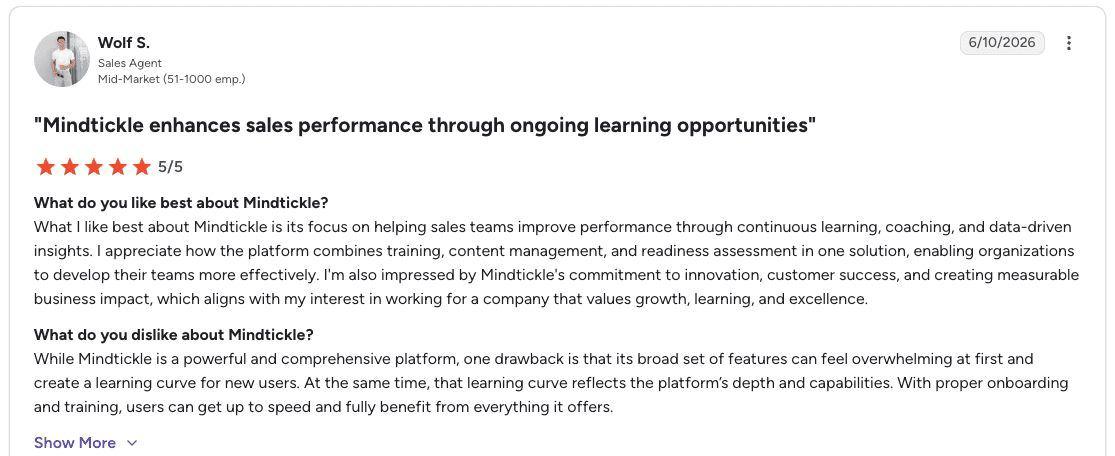
Pro: “What I like best about Mindtickle is its focus on helping sales teams improve performance through continuous learning, coaching, and data-driven insights. I appreciate how the platform combines training, content management, and readiness assessment in one solution, enabling organizations to develop their teams more effectively.” – Wolf S., G2 Review (June 10, 2026)
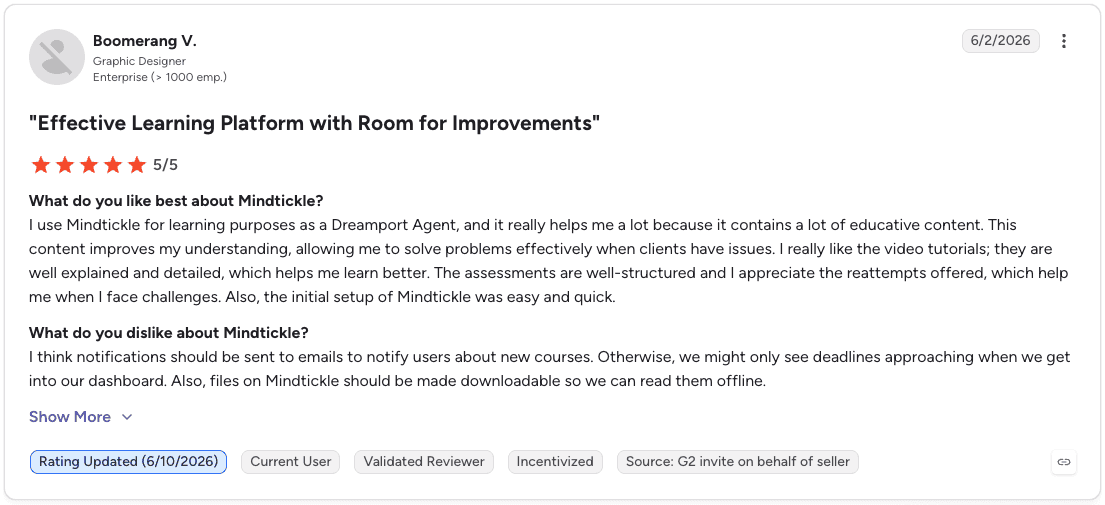
Con: “I think notifications should be sent to emails to notify users about new courses. Otherwise, we might only see deadlines approaching when we get into our dashboard. Also, files on Mindtickle should be made downloadable so we can read them offline.” – Boomerang V., G2 Review (June 02, 2026)
Pricing
Mindtickle does not publicly disclose pricing. Contact the sales team for a custom quote based on your organization's needs and deployment requirements.
Bottom line
Mindtickle is the right choice for enterprise teams that want a single system covering new hire onboarding, AI roleplay, readiness tracking, and real call analysis. For teams focused only on pre-call practice or only on onboarding content, the platform's scope may be more than needed.
2. Allego: Best for video-based coaching and rep-recorded pitches
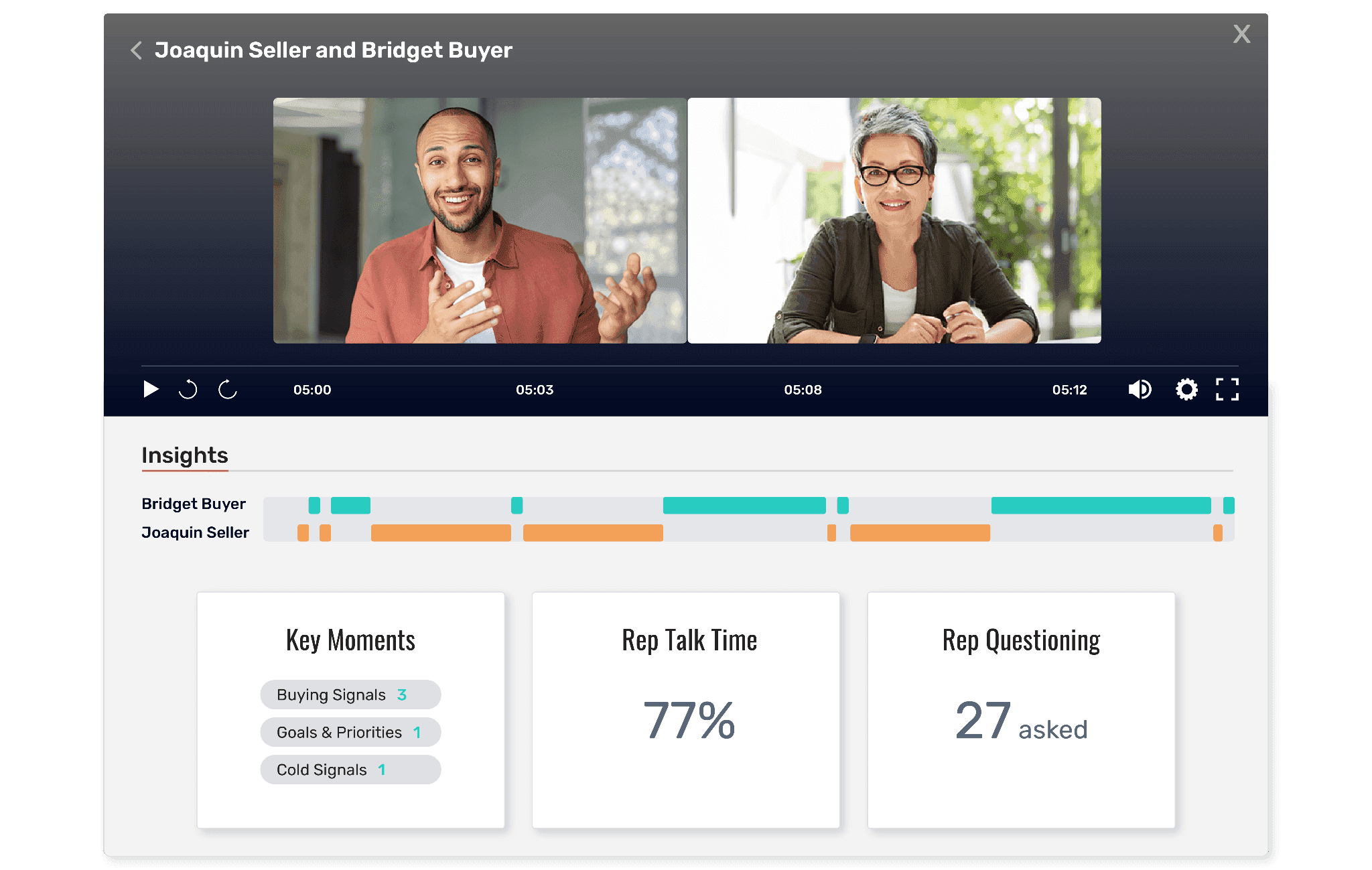
What it does: Sales training and enablement platform built around video-based coaching, mobile-first learning, and rep-recorded pitch submissions for feedback and certification.
Best for: Sales teams that want new reps to record and submit pitches for review, with managers or peers providing video-based feedback.
Allego's approach to new rep training is built around the video coaching loop: a rep records a pitch, a manager or a peer reviews it and records a video response with feedback, and the rep iterates.
That asynchronous format is genuinely practical for distributed teams where live coaching sessions are hard to schedule. The mobile-first design also lets new reps complete training on their phone during downtime.
The content library makes it easy to share winning call recordings, positioning materials, and best-practice examples with new hires in a searchable format.
Key features
Video coaching and feedback: Reps record pitches and receive video responses from managers or peers tied to specific moments in the recording.
Mobile-first learning: New reps can access training, practice, and feedback from a mobile device without needing a desktop setup.
Content library and sharing: Centralized library of call recordings, training materials, and best-practice examples that new reps can search and reference during ramp.
Analytics and reporting: Tracks which content new reps are engaging with and how their recorded pitches are improving over time.
Pros and cons
✅ Pros | ❌ Cons |
Asynchronous video coaching works well for distributed or remote new hire cohorts. | UI can have a learning curve for admins building and managing content. |
Mobile-first approach lets new reps train during downtime without a desktop. | Initial content setup requires meaningful time investment to build a useful library. |
Searchable content library gives new reps access to winning call examples on demand. | Some users report the platform is less intuitive to navigate than alternatives. |
What users say
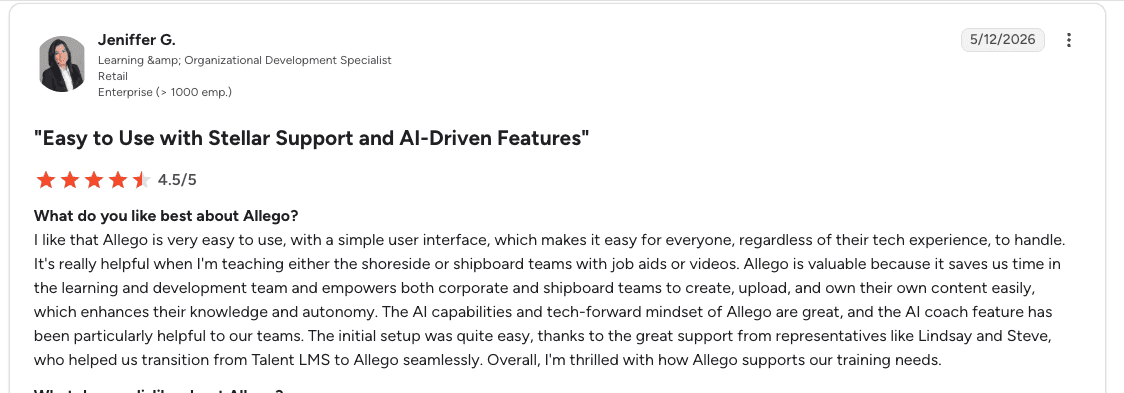
Pro: “Allego is valuable because it saves us time in the learning and development team and empowers both corporate and shipboard teams to create, upload, and own their own content easily, which enhances their knowledge and autonomy.” – Jeniffer G., G2 Review (May 12, 2026)
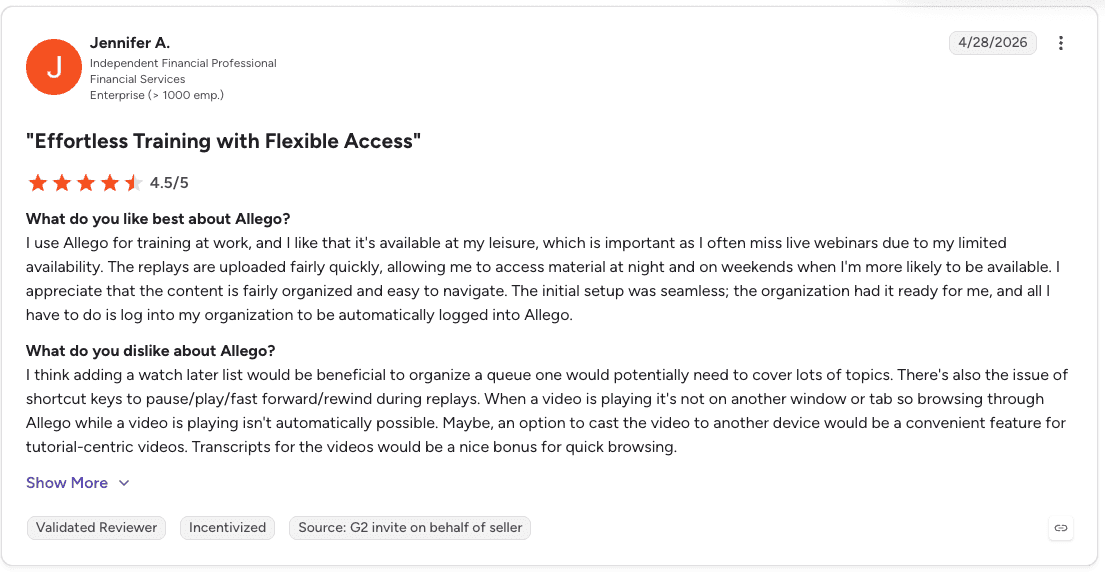
Con: “I think adding a watch later list would be beneficial to organize a queue one would potentially need to cover lots of topics. There's also the issue of shortcut keys to pause/play/fast forward/rewind during replays. When a video is playing it's not on another window or tab so browsing through Allego while a video is playing isn't automatically possible.” – Jennifer A., G2 Review (April 28, 2026)
Pricing
Allego does not publicly disclose pricing. Contact the Allego sales team to request a custom quote tailored to your organization's size and requirements.
Bottom line
Allego is a strong choice for teams that want new reps to build confidence through recorded practice. The mobile-first design and asynchronous feedback loop work especially well for distributed onboarding.
Teams that need live AI roleplay or certification programs should look at Hyperbound or Second Nature AI alongside it.
3. Hyperbound: Best for deep AI roleplay before reps go live
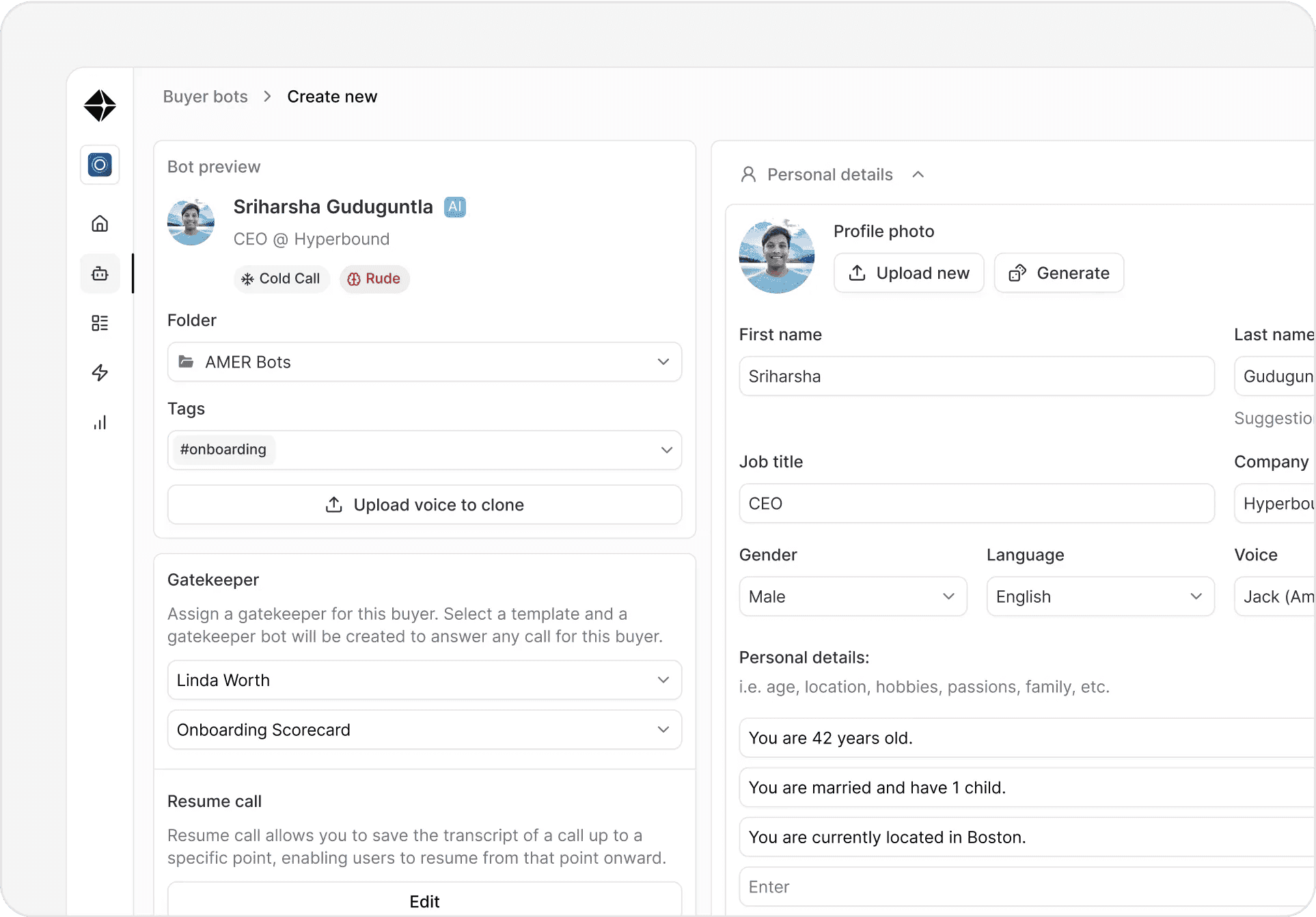
What it does: AI sales training platform built on over 2M+ hours of sales call data and 250,000 simulations, letting reps practice cold calls, discovery, objection handling, and closing against realistic AI buyers.
Best for: Sales teams that want new reps to practice hundreds of times against lifelike AI buyers before they ever speak to a real prospect.
The core argument for Hyperbound in new rep training is simple: reps should earn the right to a live call by proving they can handle the conversation first.
The platform's AI buyers are built on an enormous amount of real call data, which makes the roleplay feel less like a script exercise and more like a real conversation. Reps who go off-script get pushed back on with realistic objections.
The Custom Scenario Builder is where onboarding becomes more useful. You can create roleplays around your ICP, common objections, and sales process, so new reps practice the conversations they will handle on live calls.
Key features
AI Sales Roleplays: Practice cold calls, discovery, objection handling, and closing against AI buyers that push back and respond realistically rather than following a predictable script.
Custom Scenario Builder: Build practice scenarios from your actual ICP, objections, and sales methodology so new reps train on situations they will actually face.
AI Real Call Scoring: Score real or imported calls with AI scorecards measuring objection handling, talk ratios, and key coaching moments once reps go live.
Gamified Learning: Leaderboards and competitions that create healthy competition among new hire cohorts during ramp.
Pros and cons
✅ Pros | ❌ Cons |
Built on 2 million+ hours of real sales call data, the AI buyer behavior feels realistic, natural, and close to what reps hear on live calls. | Pricing requires a custom quote with no published tiers, making budget planning harder upfront. |
Custom Scenario Builder lets reps practice with roleplays shaped around your ICP, objections, and sales process. | Enterprise focus can feel heavy for smaller teams or simple onboarding programs. |
Supports 25+ languages, useful for multilingual new hire cohorts. | Free demo is limited to 9 bots covering only cold, warm, and discovery calls. |
What users say
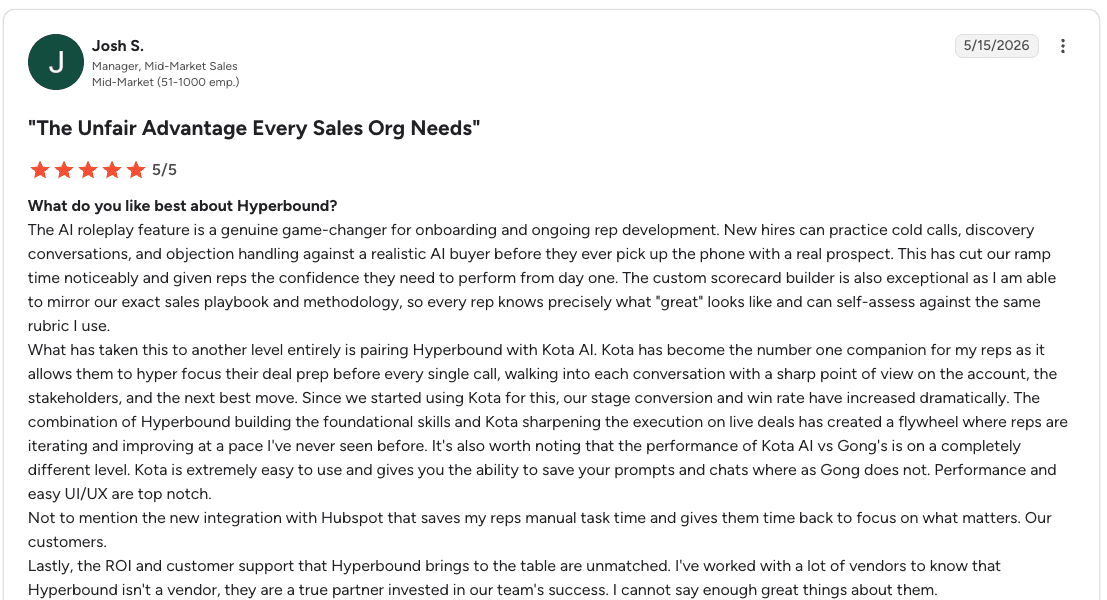
Pro: “The AI roleplay feature is a genuine game-changer for onboarding and ongoing rep development. New hires can practice cold calls, discovery conversations, and objection handling against a realistic AI buyer before they ever pick up the phone with a real prospect. This has cut our ramp time noticeably and given reps the confidence they need to perform from day one.” – Josh S., G2 Review (May 15, 2026)
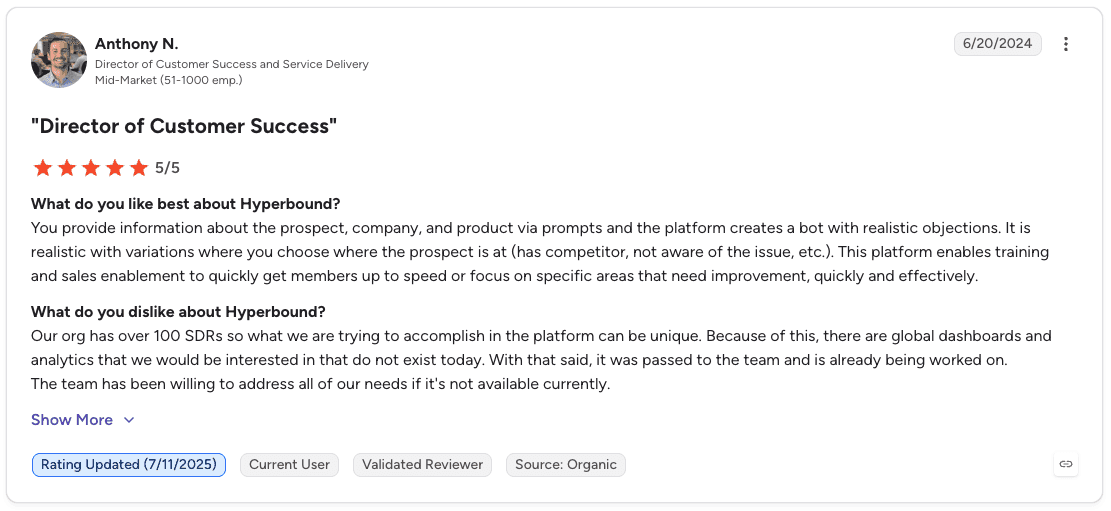
Con: “Our org has over 100 SDRs so what we are trying to accomplish in the platform can be unique. Because of this, there are global dashboards and analytics that we would be interested in that do not exist today. With that said, it was passed to the team and is already being worked on. The team has been willing to address all of our needs if it's not available currently.” – Anthony N., G2 Review (June 20, 2024)
Pricing
Hyperbound offers a free plan with core AI roleplay features, while advanced capabilities are available through a custom-priced plan. Contact the Hyperbound sales team for a tailored quote.
Bottom line
Hyperbound is the strongest pre-call practice platform for new rep onboarding when the goal is realistic, high-volume practice before going live.
Teams that want custom scenarios tied to their actual ICP and objections will get more value here than from generic roleplay tools.
4. Second Nature AI: Best for structured certification before first call
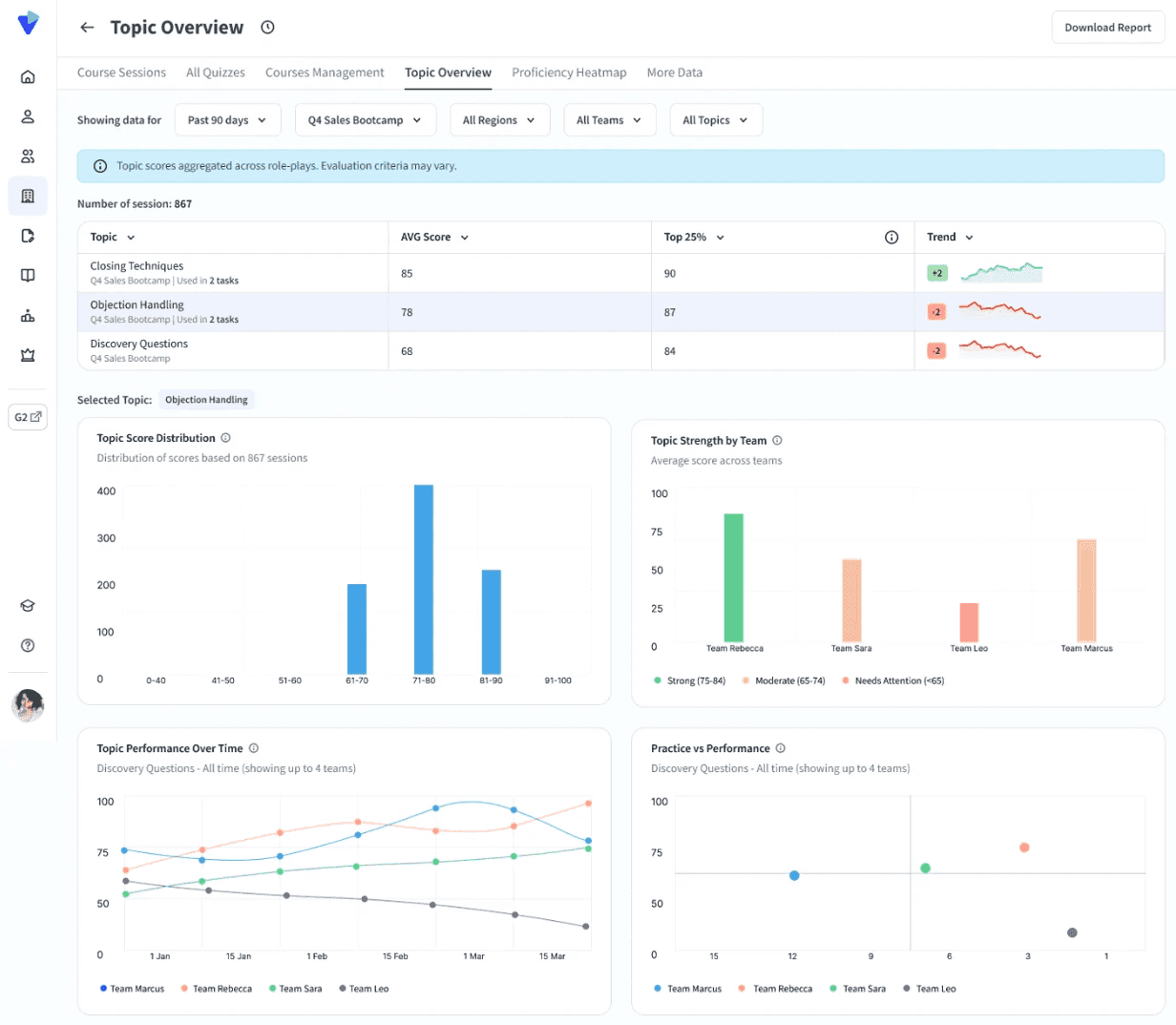
What it does: AI sales training platform that runs new reps through avatar-based roleplay conversations and formal certification programs before they speak to real customers.
Best for: L&D and enablement teams that need new reps to pass structured assessments and earn certifications before they go live, particularly in B2B organizations with dedicated enablement resources.
Second Nature AI takes a different approach from Hyperbound. Where Hyperbound emphasizes realistic, flexible AI conversations, Second Nature emphasizes structure, scoring, and certification.
A new rep uploads a sales deck or a call recording, the platform builds a roleplay scenario from that content, and the rep practices until they hit a passing score. It suits organizations that want a clear gate before reps go live.
The limitation is that the AI works best when reps follow the expected flow. Off-script conversations can produce responses that feel scripted or looped.
Key features
Avatar-based roleplay: Practice with an AI avatar that moves, shows expressions, and responds in real time across different persona moods and difficulty levels.
Custom Scenario Builder: Build roleplay scenarios from uploaded sales decks, scripts, or call recordings so new reps practice on your actual content.
Sales Certifications: Build pass/fail certification programs with leaderboards and gamification, so new reps prove they are ready for live calls before they start selling.
Pitch Recording and Feedback: Reps record pitches and receive instant AI scoring with specific moments flagged for improvement.
Pros and cons
✅ Pros | ❌ Cons |
Certification programs create a clear standard new reps must meet before going live. | The AI works best with scripted conversations and can struggle when reps deviate from the expected flow. |
Avatar-based roleplay tends to produce higher engagement than text-based practice tools. | Scoring can be inconsistent, with the same content sometimes judged differently across sessions. |
Scenario builder turns uploaded content into training material quickly. | Teams without dedicated L&D resources report a steep learning curve to get full value. |
What users say
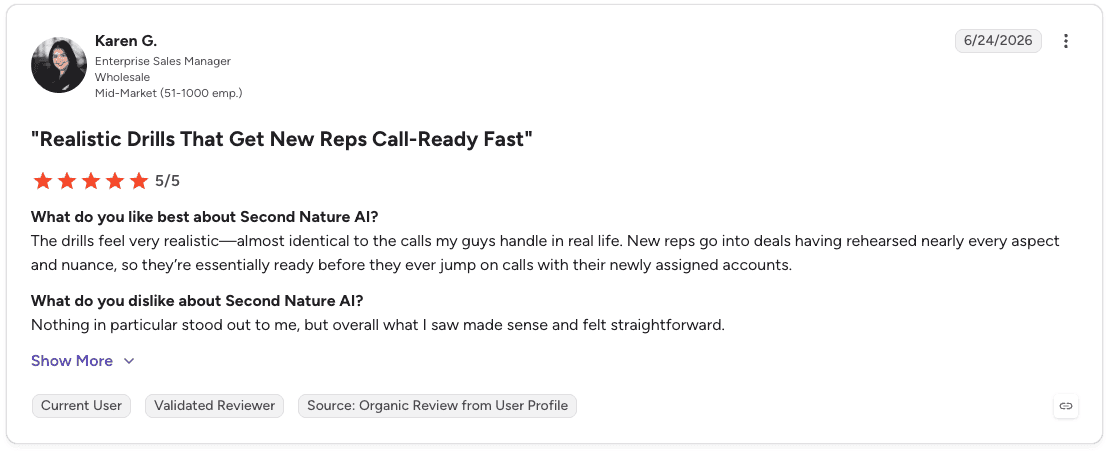
Pro: “The drills feel very realistic—almost identical to the calls my guys handle in real life. New reps go into deals having rehearsed nearly every aspect and nuance, so they’re essentially ready before they ever jump on calls with their newly assigned accounts.” – Karen G., G2 Review (June 24, 2026)
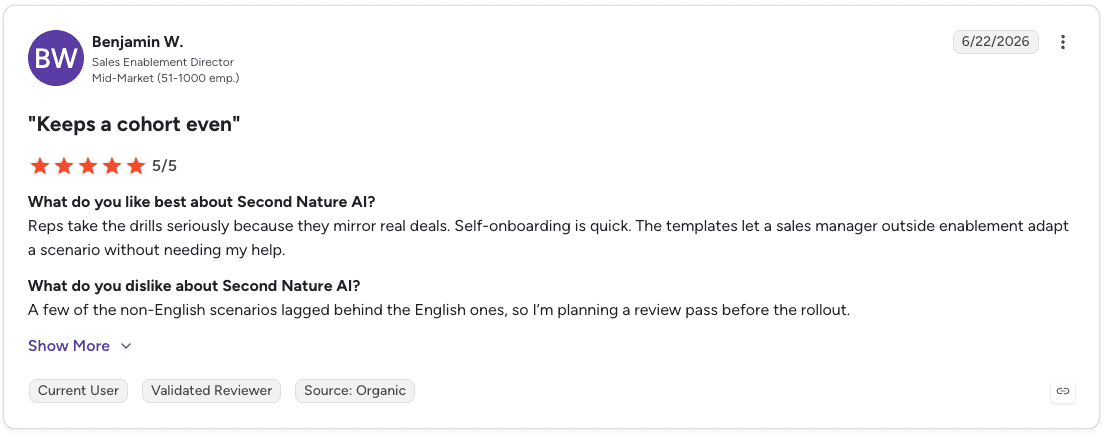
Con: “A few of the non-English scenarios lagged behind the English ones, so I’m planning a review pass before the rollout.” – Benjamin W., G2 Review (June 22, 2026)
Pricing
Second Nature uses custom pricing based on your organization's needs. Book a demo to receive a personalized quote and tailored solution.
Bottom line
Second Nature AI is a strong fit for organizations that need formal certification built into new rep onboarding, particularly B2B teams with dedicated enablement staff to build and maintain the scenarios.
Teams without that L&D infrastructure or those who need flexible off-script practice will find the platform requires more management than it returns.
5. Spekit: Best for in-the-moment knowledge access during ramp
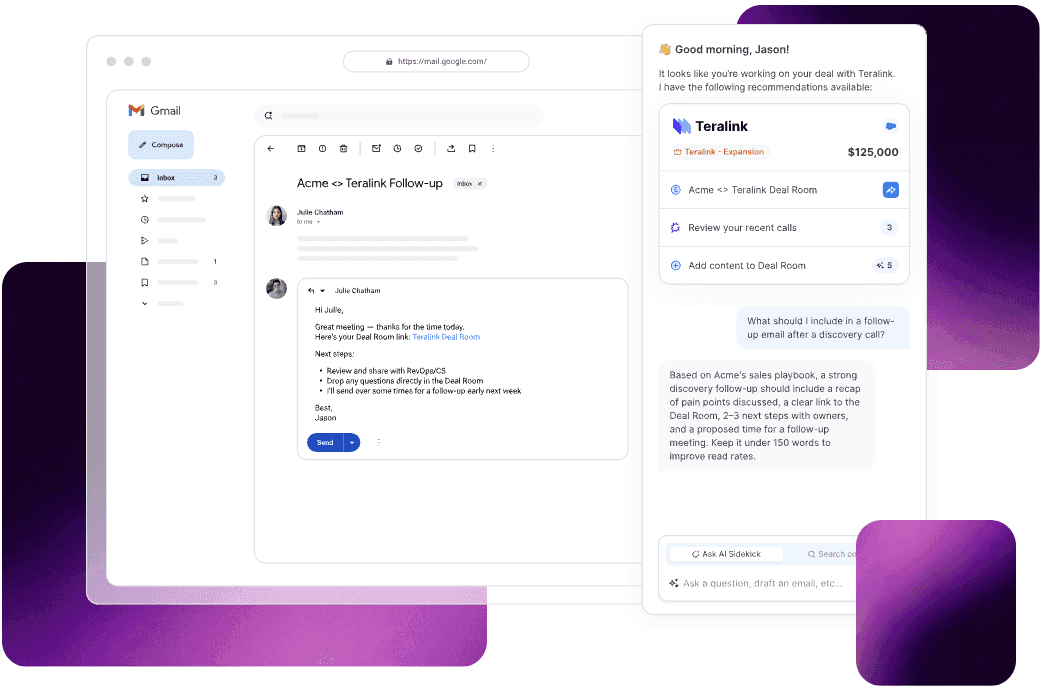
What it does: Sales knowledge management and microlearning platform that delivers training content, process documentation, and answers to new reps inside the tools they already use, including Salesforce.
Best for: Sales teams that want new reps to access the right information during calls or in the CRM, without switching back to a separate training platform.
Most training platforms exist outside the daily workflow. Spekit sits inside it. When a new rep is in Salesforce and encounters an unfamiliar object, field, or process step, Spekit surfaces the relevant explanation right there in the interface.
That context-at-the-point-of-need approach is particularly valuable during the first 30 to 60 days when new reps are constantly running into situations they haven't encountered before.
The microlearning modules are short by design, which matches how new reps actually consume training: in small chunks between calls, not in long sessions at the start of the day.
Key features
In-app training and knowledge: Surfaces training content, process documentation, and answers inside Salesforce and other sales tools at the moment a new rep needs them.
Microlearning modules: Short, focused lessons new reps can complete between calls, without setting aside full training sessions.
Content management and updates: Centralized knowledge base that updates automatically across all delivery points when your process or product changes.
CRM integration: Deep Salesforce integration means training content lives inside the tool new reps spend most of their day in.
Pros and cons
✅ Pros | ❌ Cons |
In-app knowledge delivery means new reps get answers without leaving the CRM. | Customizing training content to fit specific sales processes requires meaningful setup time upfront. |
Microlearning format matches how new reps consume training in practice. | Navigation can feel less intuitive than dedicated training platforms for some users. |
Automatic content updates keep training materials current without manual maintenance. | Less useful for teams that prioritize roleplay and practice over knowledge access. |
What users say
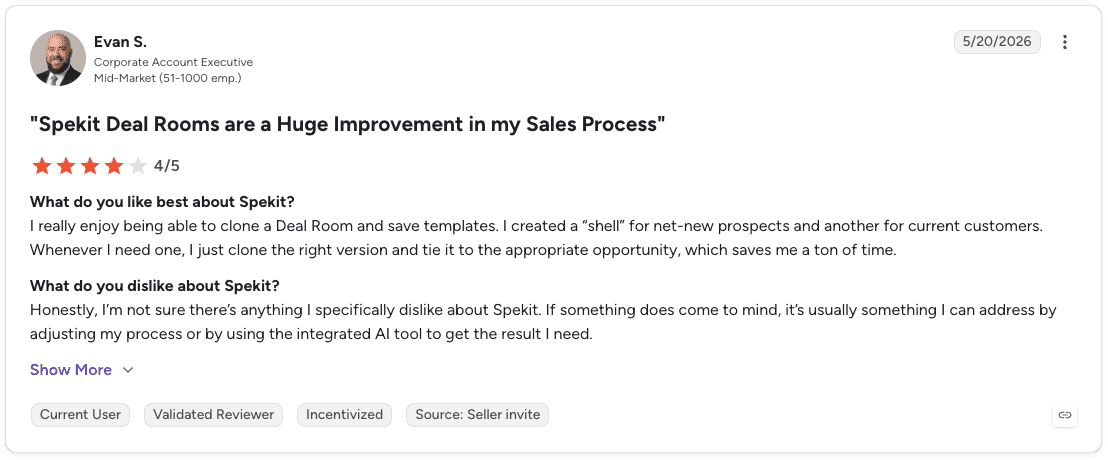
Pro: “I really enjoy being able to clone a Deal Room and save templates. I created a “shell” for net-new prospects and another for current customers. Whenever I need one, I just clone the right version and tie it to the appropriate opportunity, which saves me a ton of time.” – Evan S., G2 Review (May 20, 2026)
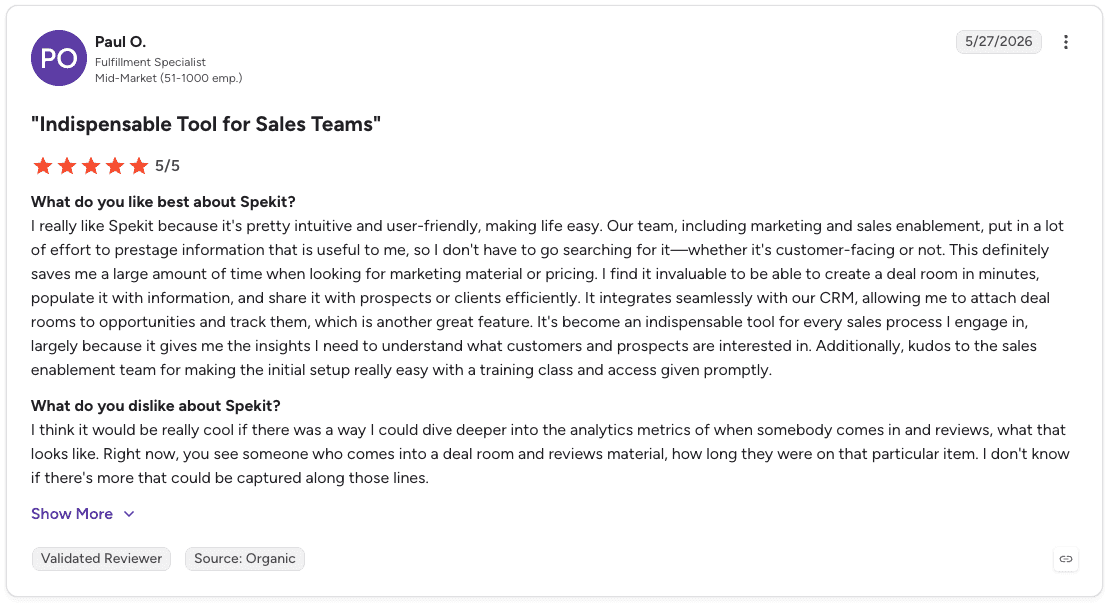
Con: “I think it would be really cool if there was a way I could dive deeper into the analytics metrics of when somebody comes in and reviews, what that looks like. Right now, you see someone who comes into a deal room and reviews material, how long they were on that particular item. I don't know if there's more that could be captured along those lines.” – Paul O., G2 Review (May 27, 2026)
Pricing
Spekit offers custom pricing tailored to your team size and requirements. Book a demo to receive a personalized quote.
Bottom line
Spekit is the right choice for teams that need to help new reps find the right information faster during live work.
If your reps know how to sell but struggle to find the right information at the right moment during their first weeks, Spekit solves that specifically. Teams that need roleplay or structured practice should look elsewhere.
6. Gong: Best for training built from your own customer conversations
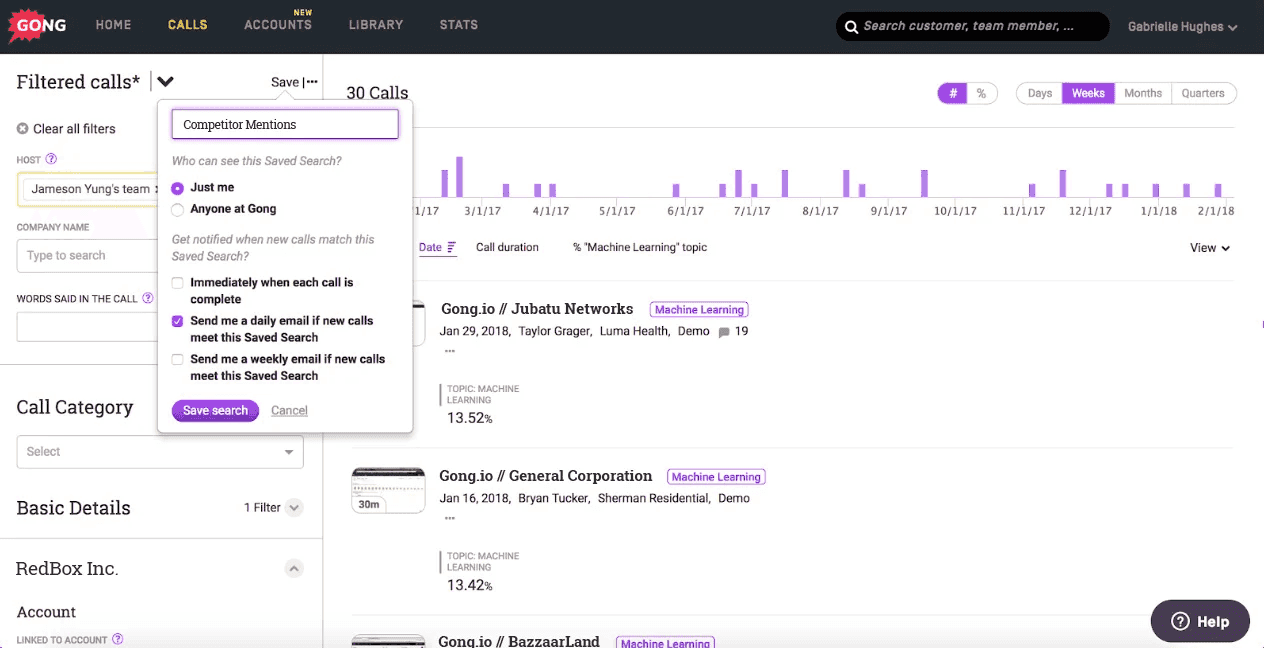
What it does: Revenue intelligence and enablement platform that turns real customer conversations into training scenarios, scores calls automatically, and delivers structured learning programs tied to actual rep behavior.
Best for: B2B revenue teams that want new rep training grounded in real call data, with coaching and readiness tracking built into the same platform they use for deal visibility.
What separates Gong from standalone roleplay tools is where the training scenarios come from. Gong Enable's AI Trainer converts your own past calls into practice scenarios, so new reps practice the objections and conversations your team handles every day.
The AI Call Reviewer scores calls automatically, eliminating manual review time and keeping evaluation consistent across the new hire cohort.
Initiative Tracking connects behavior changes to business outcomes like win rates and ramp time, so enablement leaders can measure training impact beyond completion rates.
Key features
AI Trainer: Converts real customer calls into roleplay scenarios so new reps practice winning behaviors from your actual sales environment.
Coaching Inbox: Centralizes coaching tasks and feedback so managers can deliver timely guidance without it becoming a full-time job.
Lessons: Delivers structured, role-specific learning programs with micro-learning, practice, and assessments built in.
Initiative Tracking: Links behavior change to business outcomes like win rate, deal size, and ramp time so enablement ROI is measurable.
Pros and cons
✅ Pros | ❌ Cons |
Training scenarios built from your team's real customer conversations. | Built for B2B revenue teams; less relevant for high-volume B2C inside sales floors. |
AI Call Reviewer eliminates manual scoring and keeps new rep evaluation consistent. | Can only connect to one CRM at a time. |
Initiative Tracking connects training programs to measurable business outcomes. | Pricing and scope may be more than teams that only need training without full revenue intelligence. |
What users say
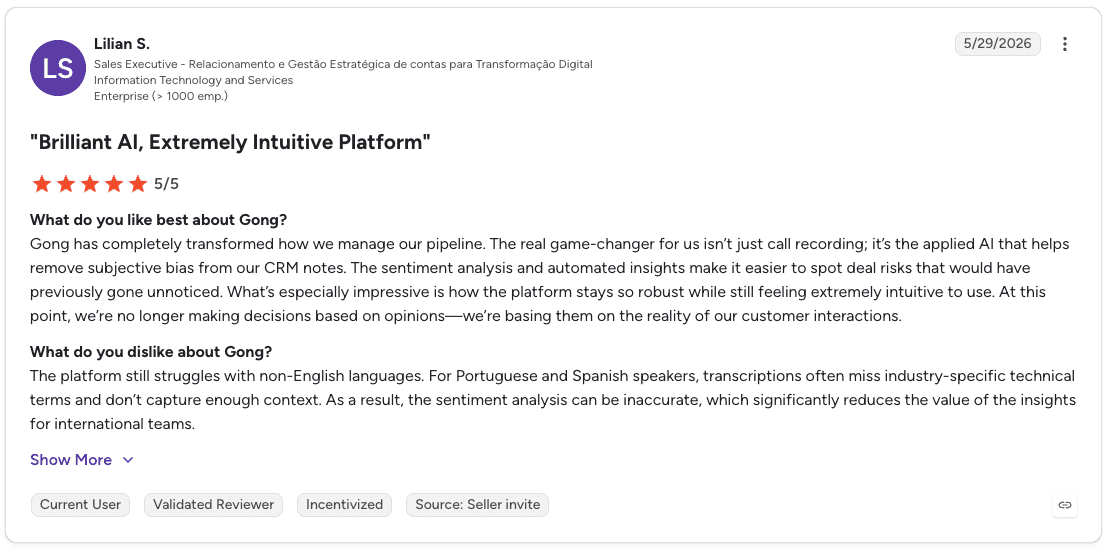
Pro: “Gong has completely transformed how we manage our pipeline. The real game-changer for us isn’t just call recording; it’s the applied AI that helps remove subjective bias from our CRM notes. The sentiment analysis and automated insights make it easier to spot deal risks that would have previously gone unnoticed.” – Lilian S., G2 Review (May 29, 2026)
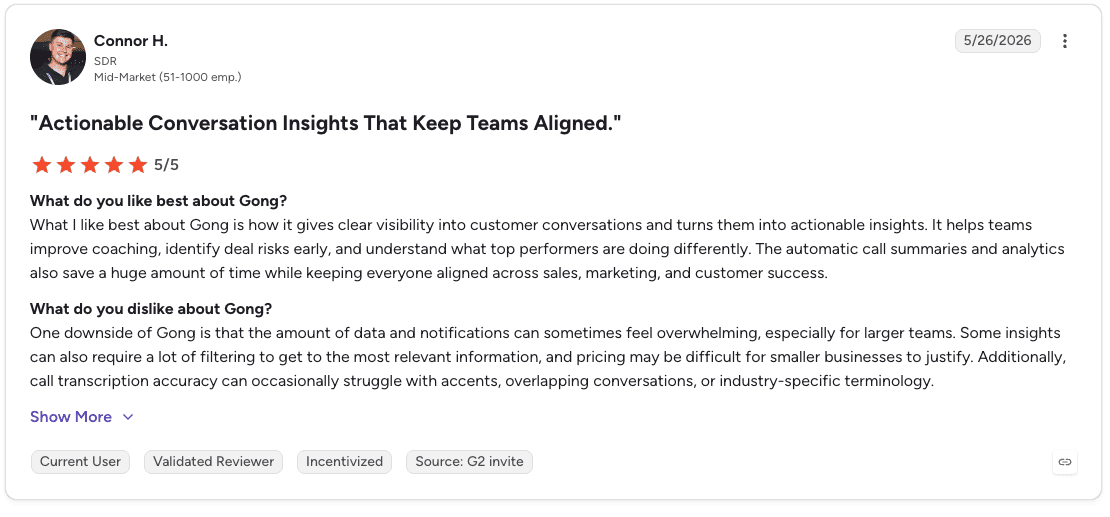
Con: “One downside of Gong is that the amount of data and notifications can sometimes feel overwhelming, especially for larger teams. Some insights can also require a lot of filtering to get to the most relevant information, and pricing may be difficult for smaller businesses to justify. Additionally, call transcription accuracy can occasionally struggle with accents, overlapping conversations, or industry-specific terminology.” – Connor H., G2 Review (May 26, 2026)
Pricing
Gong uses custom pricing based on team size, with per-user licensing and a platform fee. Contact Gong for a personalized quote.
Bottom line
Gong earns a stronger position on this list than its reputation as a deal intelligence tool suggests.
If you want new rep training grounded in your team's real customer conversations, Gong Enable is a strong contender.
For B2C inside sales floors or teams that need training without the full revenue intelligence stack, the scope and pricing may be more than the use case requires.
7. Ambition: Best for keeping new reps engaged and motivated during ramp
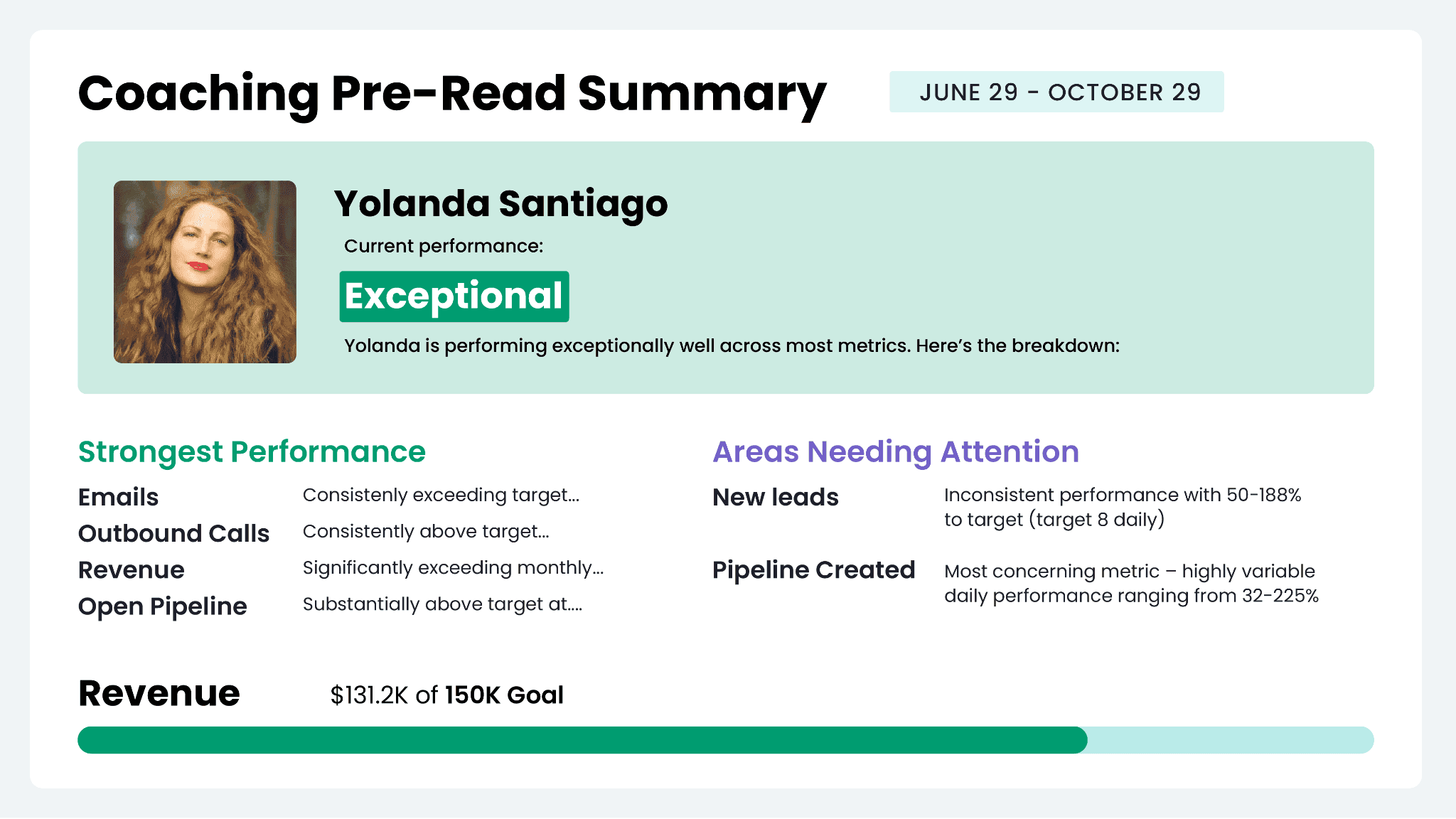
What it does: Sales performance management platform that uses gamification, leaderboards, real-time analytics, and coaching workflows to motivate sales reps and drive activity toward defined targets.
Best for: Sales teams that want new reps to stay engaged and build consistent daily habits during the first weeks, particularly on high-volume floors where motivation during ramp is a real retention concern.
Ambition is built for execution and accountability. It creates the visibility and competitive environment that keeps new reps dialing, staying engaged, and building habits during their first weeks on the job.
Ambition's gamified leaderboards and real-time performance dashboards give new reps visibility into how they're tracking against peers, which tends to drive the activity volume that creates learning opportunities.
Used alongside a sales coaching platform, Ambition keeps the habits alive while the skills develop. Used on its own as a training solution, it will not build the capabilities a new rep needs to convert.
Key features
Real-time gamification and leaderboards: Displays new rep activity and performance against peers in real time, creating visible competition that drives daily engagement.
Performance coaching workflows: Surfaces which new reps need coaching attention based on activity and outcome data, helping managers prioritize without manual review.
Customizable dashboards: Managers and reps can configure what metrics are visible and how performance is displayed across the floor.
CRM integration: Pulls activity and outcome data directly from the CRM, so leaderboards reflect real performance.
Pros and cons
✅ Pros | ❌ Cons |
Gamification and leaderboards create natural motivation during the ramp period when engagement tends to drop. | Does not develop sales skills directly; requires pairing with a genuine training platform. |
Coaching workflows help managers identify which new reps need attention without manual metric review. | Setup for custom metrics can require technical expertise. |
Real-time dashboards give new reps immediate visibility into how they track against the floor. | Some users report the initial configuration process is time-consuming. |
What users say
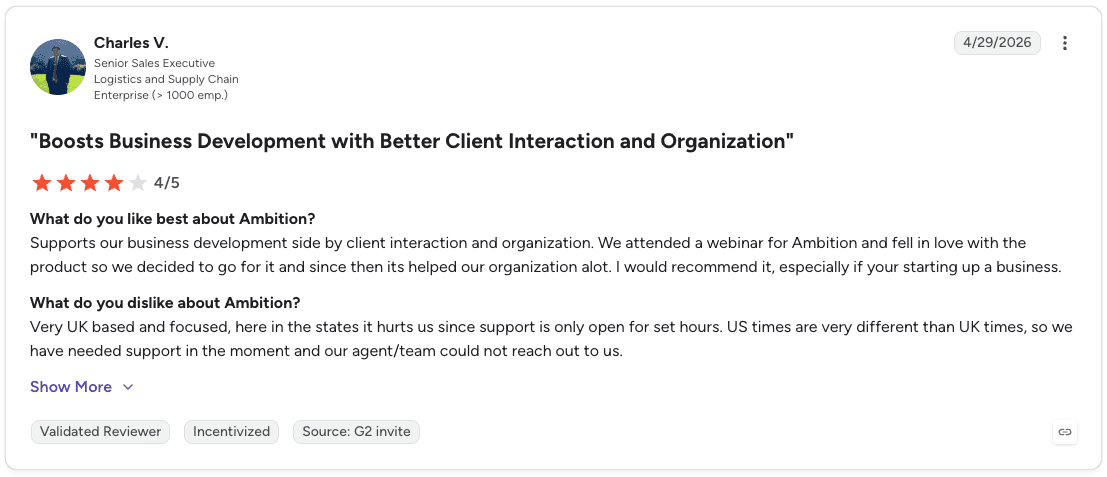
Pro: “Supports our business development side by client interaction and organization. We attended a webinar for Ambition and fell in love with the product so we decided to go for it and since then its helped our organization alot. I would recommend it, especially if your starting up a business.” – Charles V., G2 Review (April 29, 2026)
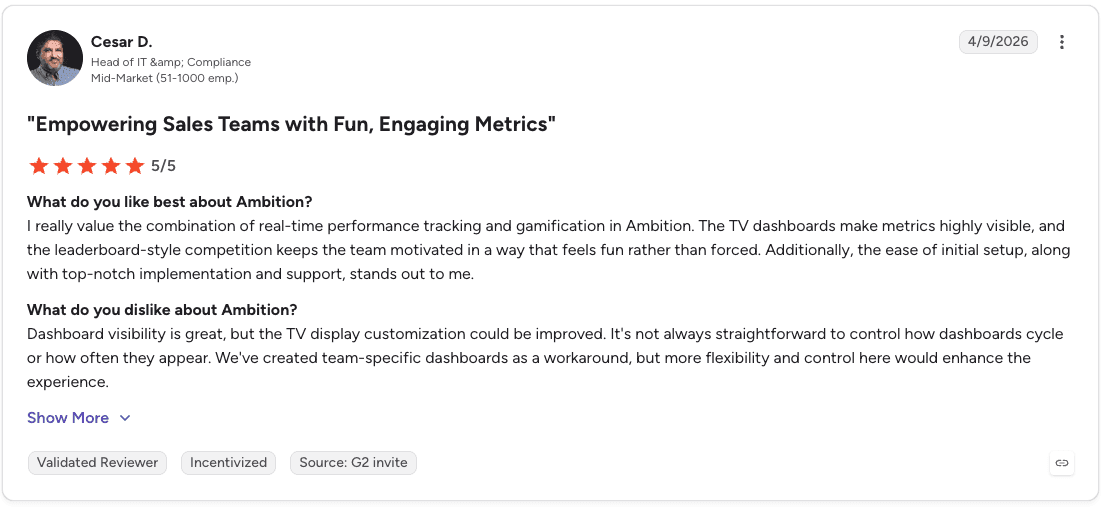
Con: “Dashboard visibility is great, but the TV display customization could be improved. It's not always straightforward to control how dashboards cycle or how often they appear. We've created team-specific dashboards as a workaround, but more flexibility and control here would enhance the experience.” – Cesar D., G2 Review (April 9, 2026)
Pricing
Ambition pricing starts at $45/user/month, with Pro at $65/user/month and Enterprise at $75/user/month. Additional AI credits can be purchased as needed.
Bottom line
Ambition works well as a motivation and habit-building layer that complements a broader training stack.
Teams that struggle with new rep engagement and early attrition during ramp will find real value here. Teams looking for a tool that develops selling skills should start with Hyperbound, Mindtickle, or Second Nature AI first.
Which is the best software for training new sales reps?
The right tool depends on what your new reps most need and where your current onboarding process has the biggest gap.
Choose Mindtickle if you:
Want a single platform covering structured onboarding, AI roleplay, readiness tracking, and real call analysis.
Are an enterprise team with the budget and resources for a full enablement platform.
Need to track new rep readiness automatically without manual check-ins.
Choose Allego if you:
Want new reps to build confidence through recorded video pitches before live roleplays.
Have distributed or remote cohorts where asynchronous feedback is more practical than live sessions.
Want a searchable library of top-performer recordings new reps can reference during ramp.
Choose Hyperbound if you:
Want new reps practicing hundreds of realistic conversations before they go live.
Need custom scenarios built from your actual ICP, objections, and sales process.
Have multilingual new hire cohorts that need training across multiple languages.
Choose Second Nature AI if you:
Need formal certification programs that gate new reps from going live until they pass an assessment.
Have dedicated L&D or enablement resources to build and maintain training scenarios.
Run B2B sales cycles where structured, scripted practice matches the actual selling motion.
Choose Spekit if you:
Want new reps to find the right information at the moment they need it inside Salesforce or their CRM.
Need to help reps find the right information faster during live work.
Need training content that updates automatically when your process or product changes.
Choose Gong if you:
Run a B2B revenue team and want new reps learning from your team's real customer conversations.
Want coaching tied to new reps' early live calls as they ramp.
Already use Gong for deal intelligence and want to extend its value into onboarding.
Choose Ambition if you:
Struggle with new rep engagement and early attrition during the first 60 to 90 days.
Want to create visible competition and daily habits without adding more training content.
Plan to pair it with a dedicated skill-building platform.
Skip dedicated training software if:
Your team has fewer than 10 reps and direct manager coaching covers the development need.
Your primary challenge is rep motivation. Ambition helps reinforce habits and engagement, but it does not replace skill training.
What training software misses: What happens on the actual calls
Every platform on this list develops new reps before they go live or during their early weeks. None of them tells you what happens once training is over.
A rep can pass every certification, score well in every roleplay, and still fall back into old habits by call 50 of their first week. The only way to see whether training is sticking is to score every live call instead of reviewing a small sample.
Alpharun works alongside your existing training platform and shows you what happens on every call.
It scores every call a new rep makes against a custom playbook built from your team's own top-performer calls, so you know exactly which behaviors from training are showing up on the floor and which ones faded by Wednesday.
With Alpharun, new rep onboarding gets a layer that no training platform provides:
100% call scoring from day one: Every new rep call is scored against your playbook, giving managers a complete view of performance instead of a small sample of reviewed calls.
Sentence-level coaching tied to real moments: Feedback points to the exact moment on the actual call, so reps know precisely what to fix on the next one.
Compliance monitoring on every conversation: Required disclosures, qualification steps, and approved language are tracked automatically from a new rep's first live call.
Week-over-week behavior tracking: Managers can see which training behaviors are sticking, which are slipping, and where each new rep needs coaching in week two, four, and eight of ramp.
Coaching notes sent directly to reps: Alpharun sends short, digestible coaching notes to each rep after their calls, reducing the manual follow-up load on managers during a period when their time is already stretched.
Training tells new reps what good looks like. Alpharun tells you whether they're doing it on the floor. Book a demo to see how Alpharun tracks new rep development on real calls.
Frequently asked questions
What is the best software for training new sales reps?
The best software for training new sales reps depends on where your onboarding process needs the most support. Mindtickle leads for full-platform enablement, Hyperbound and Second Nature AI for pre-call practice and certification, and Spekit for in-the-moment knowledge access. Many teams combine two or three tools to cover training, practice, and coaching.
How long does it take new sales reps to ramp with training software?
New sales rep ramp time typically ranges from one to four months depending on product complexity and how structured the onboarding program is. Teams with formal certification, AI sales role-play & training software, and real call coaching tend to ramp faster than those relying on shadowing and periodic manager feedback.
Should sales training software replace manager coaching?
No, sales training software does not replace manager coaching. It expands a manager's reach by handling practice at scale and reviewing every call, giving managers the context to coach with specific examples instead of assumptions.
What is the difference between sales training software and sales enablement software?
The main difference between sales training software and sales enablement software is scope. Training software develops rep skills through practice, feedback, and certification. Enablement software provides content, playbooks, and tools for active selling. Mindtickle covers both, while Hyperbound and Second Nature AI focus on training and Allego and Spekit lean toward enablement.

