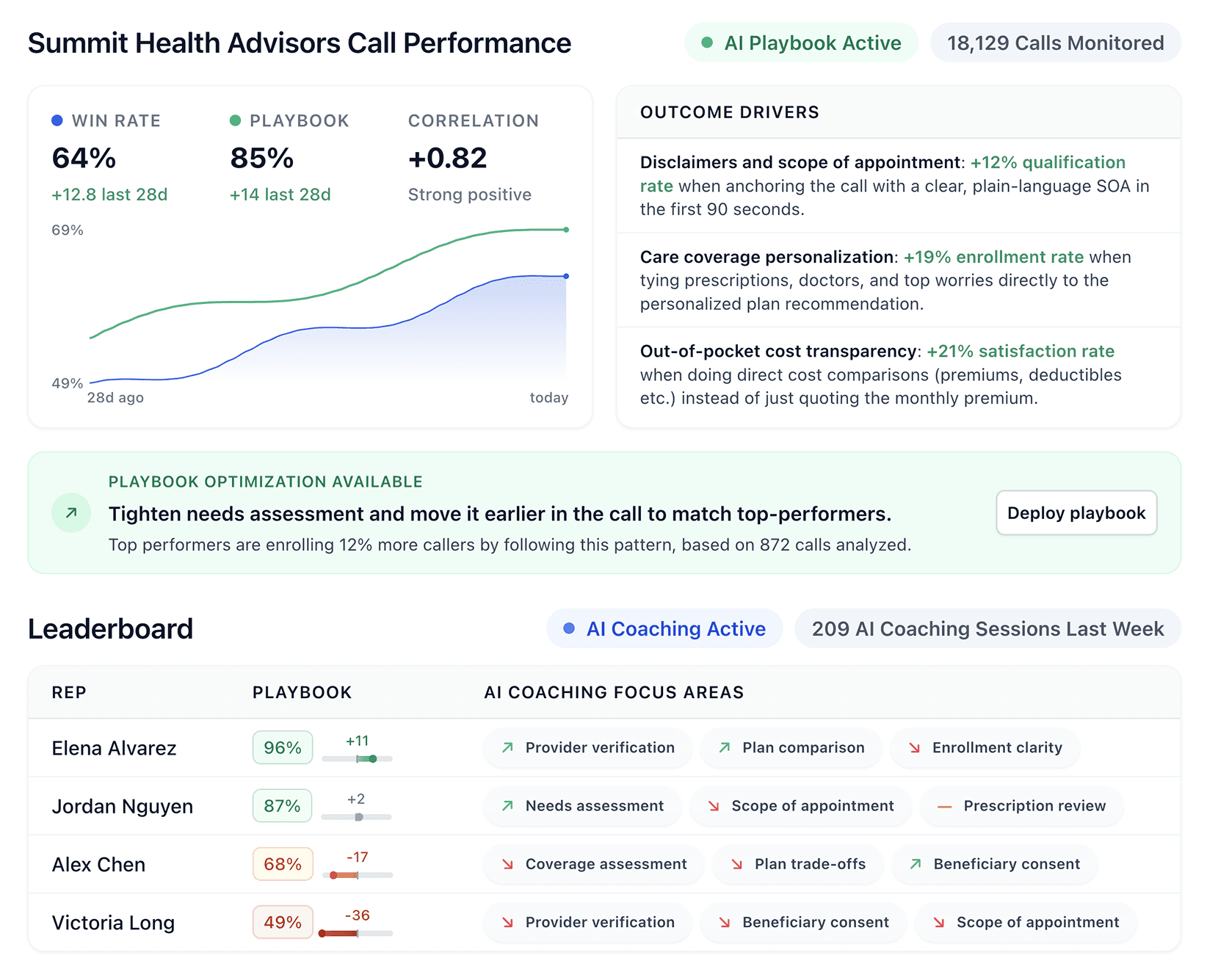


Open most sales dashboards and you'll find forty numbers elbowing for space. Win rate, dials, pipeline, handle time, NPS, a dozen more. It looks thorough.
Then someone asks the one question that matters: which reps are getting better and why? And the whole board goes quiet.
That's the problem most sales floors run into. Collecting metrics is easy, which is exactly why most teams collect too many. The part that pays the bills is knowing the handful worth acting on and what to do the moment one of them moves.
These are the 14 sales team performance metrics worth tracking, grouped by leading versus lagging so they add up to something you can read at a glance and act on the same day.
What are sales team performance metrics?
A sales team performance metric is any number that shows how well your team turns activity into revenue.
Calls made, deals won, average deal size, churn: each one measures a slice of how the team is doing.
People use metric and KPI as if they're the same word. They're close. Every KPI is a metric you've chosen to steer by, but only a handful of the metrics you can track deserve that status.
The honest test for any metric comes down to two questions:
If this number moved, would you do anything differently?
If the answer is no, it's noise. Keep it off the dashboard.
Leading vs. lagging sales metrics: What’s the difference?
The most useful way to sort sales metrics is by when they tell you something.
Lagging metrics report the result after it has happened: win rate, revenue, churn. They're your scoreboard. They tell you whether last quarter worked, but by the time they move, the work is already done.
Leading metrics measure the inputs that predict those results: calls made, lead response time, how well reps run discovery. They're the part you can still change today.
The split matters because of what you can do with each one. You coach the leading metrics, the lagging ones just tell you later whether the coaching worked.
A team that only watches the scoreboard spends every quarter reacting to a game that's already over, while a team watching its inputs can fix a soft quarter while the clock is still running.
It helps to pair them up, because almost every lagging result has a leading indicator sitting upstream of it.
📈 Leading indicator | 📊 Lagging result |
Discovery quality and qualification | Win rate |
Pipeline created | Revenue |
How the first few calls went | Churn rate |
Watch the leading indicator and you get a head start on the result. Watch only the result and you're reading the report of a decision you can no longer change.
The core sales team performance metrics
There are a lot of numbers you could track. These are the ones that earn their place, grouped by where they sit in the team's work.
Activity metrics: The effort going in
These count what reps put in. On their own, they prove almost nothing (a busy rep and a good rep can post identical numbers), but stand them next to outcomes, and they start to tell you who's working and how.
📊 Metric | 🔍 What it measures | ⚠️ Watch for |
Activity volume | Raw count of calls, emails, meetings, demos per rep | Low volume = no pipeline coming; high volume with no closes = quality problem |
Lead response and qualification | Speed to first contact + share of leads advanced to real opportunities | Slow response = routing problem; low qualification = poor leads or no selectivity |
1. Activity volume
The raw count of calls, emails, meetings, and demos a rep makes in a given period.
How to calculate:
Sum of logged activities per rep, per day or week.
Why it matters: It's the floor under everything else. A rep with no activity has no pipeline coming, and you want to catch that early.
How to read it: Read volume as a floor, and always next to a conversion number. A rep doing five calls a day has a problem worth a conversation. A rep doing 120 with nothing closing has a different problem, and more dials won't fix it.
2. Lead response and qualification
How fast a rep reaches a new lead, and how many of those leads they advance to a real opportunity.
How to calculate: Response time is the average gap between lead creation and first contact attempt; qualification rate is qualified leads ÷ total leads handled.
Why it matters: Speed wins conversations, and the first team to reach a prospect usually sets the agenda. Good qualification keeps reps from pouring hours into leads that were never going to buy.
How to read it: Slow response with healthy volume usually means leads are sitting in a queue, which is a routing problem more than a rep problem. A low qualification rate means reps are either getting poor leads or chasing anything with a pulse.
Pipeline metrics: How deals move
Once a deal is real, these tell you whether it's moving or just sitting in the CRM looking hopeful.
Metric 📊 | What it measures 💡 | Watch for ⚠️ |
Pipeline created | Volume and dollar value of new opportunities entering the funnel | Thin coverage means a prospecting problem — visible in activity numbers first |
Conversion rate | Share of leads or opportunities moving stage to stage | Single-stage drop = specific skill gap; decline across all stages = lead quality issue |
Sales cycle length | Average time from first contact to closed deal | Creeping cycle usually means missing next steps letting deals drift |
3. Pipeline created (number and value of opportunities)
The volume and dollar value of new opportunities entering the funnel.
How to calculate: Count and summed value of opportunities created in a period. Pair it with pipeline coverage, the ratio of open pipeline to quota.
Why it matters: Today's pipeline is next quarter's revenue, and no amount of closing skill fixes an empty funnel.
How to read it: The more of your number already sitting in qualified pipeline, the safer the quarter. When coverage looks thin, the fix is upstream in prospecting, and you'll see it in activity and lead numbers first.
4. Conversion rate
The share of leads or opportunities that move from one stage to the next, and eventually to a closed deal.
How to calculate:
Deals advanced ÷ deals entered, measured per stage and end to end.
Why it matters: It shows where deals live and die, and a single end-to-end number hides which stage is leaking.
How to read it: Track it stage by stage. A drop at one specific stage points to a specific skill, like discovery before the demo or handling pushback near the close. A smooth decline across every stage usually points to lead quality upstream.
5. Sales cycle length
The average time from first contact to closed deal.
How to calculate:
Average of (close date minus first-contact date) across won deals
Why it matters: Shorter cycles let each rep work more deals with the same hours, so cycle length is a quiet lever on capacity.
How to read it: A creeping cycle is an early warning that something in the sales cycle is breaking down, often a missing next step that lets deals drift. Segment by deal size before you worry, since bigger deals naturally take longer.
Outcome metrics: The results you're judged on
These are the numbers that end up on the board in the QBR. They're also the ones you can do the least about directly, since each is the sum of a hundred smaller things that already happened.
Metric 📊 | What it measures 💡 | Watch for ⚠️ |
Quota attainment | Share of reps hitting target and by how much | One or two reps carrying the team hides a coaching problem behind a healthy average |
Win rate | Share of worked deals that close | A healthy team average can mask one star carrying four underperformers |
Average deal size | Mean revenue per closed deal | Rising win rate with shrinking deals means reps are picking off small, easy ones |
Revenue per rep | Total revenue divided by ramped headcount | Judge against tenure before judging the rep; a three-month hire will trail a two-year vet |
Revenue growth rate | How fast revenue is climbing over time | Growth on thin new pipeline is borrowed from the future |
Customer lifetime value | Total expected revenue over the full customer relationship | Read next to acquisition cost; a small deal at signing can be your most valuable if the customer stays |
Churn and retention rate | Share of customers who leave or stay over a period | Early churn usually traces back to how the sale was made, not the success team |
Customer acquisition cost | What it costs to win a customer | Rising CAC against flat CLV is a margin problem coming even when top-line revenue looks fine |
New-rep ramp time | How long a new hire takes to reach full productivity | Long or widening ramp points at onboarding and coaching, not the individual |
6. Quota attainment
The share of reps hitting the target, and by how much.
How to calculate:
Reps at or above quota ÷ total reps; also track average attainment as a percentage
Why it matters: It's the headline number for any sales org and the cleanest read on whether the team is built to hit its number.
How to read it: Look at the distribution behind the team total. When one or two reps carry attainment while the rest miss, you have a coaching and hiring problem hiding behind a healthy-looking average.
7. Win rate
The share of worked deals that close.
How to calculate:
Deals won ÷ total deals worked (won plus lost)
Why it matters: It's the most direct read on selling effectiveness once a deal is real.
How to read it: Always track it per rep. A healthy 60% team win rate can be one star at 90% quietly carrying four reps at 35%. And when win rate is low on leads you know were good, the problem is usually upstream in discovery or fit, so look there before you blame the close.
8. Average deal size
The mean revenue per closed deal.
How to calculate:
Total closed revenue ÷ number of won deals
Why it matters: It shows whether the team is trading up or down, and it changes how much each point of win rate is worth.
How to read it: Rising deal size usually means sharper qualification or stronger value framing. Falling deal size can mean reps are discounting to get to yes, so read it next to win rate. Climbing win rate with shrinking deals sometimes means reps are picking off the small, easy ones.
9. Revenue per rep
Total revenue divided by headcount.
How to calculate:
Total team revenue ÷ number of ramped reps, for a fair read.
Why it matters: A blunt but honest read on how productive the team is, and a useful input when planning headcount.
How to read it: Judge it against tenure before you judge anyone. A rep three months in will trail a two-year veteran, and that's expected. It's most useful as a trend per rep over time.
10. Revenue growth rate
How fast revenue is climbing over time.
How to calculate:
(current-period revenue minus prior-period revenue) ÷ prior-period revenue, tracked month over month, quarter over quarter, or year over year
Why it matters: It tells you whether the engine is accelerating or coasting, smoothing out the noise of any single deal.
How to read it: Compare like periods so seasonality doesn't fool you, and read it next to pipeline created. Growth on thin new pipeline is borrowed from the future.
11. Customer lifetime value (CLV)
The total revenue you expect from a customer over the whole relationship.
How to calculate:
Average revenue per period multiplied by average retention length, refined by margin for a truer figure
Why it matters: It tells you what a closed deal is really worth, which sets how much you can afford to spend winning one.
How to read it: Read it next to acquisition cost. A deal that looks small at signing can be the most valuable one you booked if the customer stays for years.
12. Churn and retention rate
The share of customers who leave (churn) or stay (retention) over a period.
How to calculate:
Churn = customers lost ÷ customers at the start of the period; retention is the inverse
Why it matters: On any team selling renewable products, retention is where revenue quietly compounds or bleeds, and it often traces back to how the sale was made.
How to read it: A spike in early churn usually points back to the sales conversation, where customers were oversold or rushed. That makes churn a lagging score on sales quality as much as a success-team metric.
13. Customer acquisition cost (CAC)
What it costs to win a customer.
How to calculate:
Total sales and marketing spend ÷ new customers acquired in the same period
Why it matters: It tells you whether growth is efficient or bought, and it keeps revenue honest about profitability.
How to read it: Read it next to CLV to see how efficiently the team turns spend into revenue. Rising CAC against flat CLV is a margin problem coming, even while top-line revenue looks fine.
14. New-rep ramp time
How long a new hire takes to reach full productivity.
How to calculate:
Average time from start date to the month a rep first hits full quota, or a defined productivity bar
Why it matters: Every week a rep is below quota is a week they cost more than they bring in, so ramp is a direct drag on the economics of growth.
How to read it: A long or widening ramp points at onboarding and coaching more than the individual. If your tenured reps are strong but every new hire takes a year to find their feet, the problem is sitting in your onboarding, and that's fixable.
What every slipping metric is telling you about rep behavior
The win rate dropped four points last month. Okay, now what? The number lives on a dashboard. The cause lives on the calls.
Most outcome metrics trace back to a specific, coachable behavior. Once you connect the two, a metric stops being a report card and starts being a coaching plan.
🔢 Metric that slipped | 🎯 Behavior behind it | ⚡ What to coach |
|---|---|---|
Win rate down | Reps skipping discovery | Uncover the real need before pitching |
Cycle getting longer | No clear next step set | Lock a specific next step on every call |
Conversion stalling | Pitching before qualifying | Qualify hard, walk away from bad fits |
Deal size shrinking | Leading with price too early | Build the value case before the number |
None of that shows up on a standard dashboard. You only see it by looking at what reps do on calls.
Take the first row. Win rate slips from 48% to 44% over a month. The dashboard tells you it happened, maybe that it's concentrated in inbound deals. It can't tell you that three reps started jumping into a pitch before they understood the prospect's situation, so their quotes kept missing.
You find that by listening to the calls, or by scoring them against a consistent standard so the pattern surfaces without anyone sitting through 200 recordings.
Once you can see it, the fix is specific and teachable: slow down, run real discovery, confirm the need before quoting. Then you check the win rate the next month to see whether the coaching landed.
That loop, number to behavior to coaching to number, is the whole game. A metric you can trace to a behavior is a metric you can move.
Why high activity doesn't equal high performance
High activity doesn't equal high performance because a rep can hit 100 dials a day, log every one, and close nothing. Volume tells you a rep is busy. Whether they're any good is a different question.
Picture two reps with identical dial counts. One books four meetings off 50 calls, the other books none. On an activity dashboard they look identical. On an effectiveness dashboard they're in different leagues.
Salesforce's State of Sales research found reps spend just 28% of their week actually selling, with the rest lost to admin and data entry. Piling on more activity targets without fixing quality just fills that window with low-value calls.
Pair every activity number with an effectiveness number:
Dials alongside connect rate
Call volume alongside conversion per call
Emails sent alongside meetings booked
The hardest thing to measure, and the most telling, is conversation quality. Whether reps ask good discovery questions, listen more than they pitch, and work through objections cleanly. It used to be invisible. When calls are scored, it becomes a number you can track and improve like any other.
Scored consistently, conversation quality breaks into leading indicators you can actually move:
Share of calls with a real discovery phase
Talk-to-listen ratio
How often reps set a clear next step
Whether required disclosures were read on regulated calls
Each of those sits upstream of an outcome metric further down the line.
Why team averages hide your real problems
Team averages hide real problems because they smooth over the spread, and the spread is where the actual issues live.
Take a 55% team win rate, for example. Break it apart and you might find your top three reps closing at 75% while four others sit near 30%, quietly dragging the number down. The average looked fine the whole time, but the team had a real problem buried inside it.
Every team metric is worth segmenting: By rep first, then by product, region, lead source, or call type. A dip in conversion isn't a team issue if it's really two reps who started last month and haven't found their footing yet.
Once you can see the spread, the response gets targeted. The reps at 30% need different coaching from the ones at 75%, and a team-wide training session helps neither group. Pull the laggards' recent calls, find the breakdown they share, and coach that one thing specifically.
Segmenting by rep is the first cut, but the same principle applies across every other dimension you can split.
Conversion might look healthy on inbound and collapse on outbound, or win rate might hold on one product and sink on a newer one. The team number folds all of that into a single line that hides where the work actually is.
Read the spread before you read the mean. When a number looks off, the next click should be the rep-level view, where you can drill into each rep's performance and see who's moving it.
Read metrics in combination
A single metric on its own can point you the wrong way. The real signal is usually in how two or three move together.
Win rate up, deal size down: Reps may be cherry-picking small, easy deals to protect their close rate.
Activity up, conversion flat: More effort is going in with nothing to show, so the issue is call quality, and more dials won't fix it.
Pipeline healthy, revenue soft: Deals are entering but stalling, so look at sales cycle length and stage conversion.
Quota attainment fine, churn rising: The team is closing deals it maybe shouldn't, and the cost lands after the sale.
Before you act on any one number, glance at the two or three around it. The combination tells you whether you're looking at a real problem or a healthy tradeoff.
How to track sales team performance metrics
Tracking metrics well comes down to three things: Capturing clean data, putting it somewhere people look, and reviewing it on a rhythm.
Capture is where most teams quietly fail. At low deal volume, reps can log calls and outcomes in the CRM by hand. At high call volume, manual logging falls apart: a rep running 80 calls a day isn't updating fields after each one, so the data lands late, thin, and skewed.
High-volume teams capture metrics straight from the calls themselves, so the numbers come from what happened on the call, with nothing lost to skipped fields.
Dashboards turn raw data into something a manager can read at a glance. A tight dashboard of the metrics you'll act on beats a sprawling one nobody opens. The analytics tools that pull this together range from CRM-native reports to dedicated platforms.
Cadence keeps metrics honest. Review leading metrics weekly, while you can still change the outcome, and lagging metrics monthly or quarterly to confirm the trend.
Before you add any metric to the board, run it through one question: if this number moved, what would I do differently? When the honest answer is nothing, leave it off. A shorter board you act on is worth more than a complete one you admire.
Common mistakes when tracking sales team performance metrics
A few patterns show up on teams that track a lot but improve little:
Tracking too many metrics: A dashboard with forty numbers buries the five that matter. Pick the few that tie to a decision.
Mistaking activity for effectiveness: Busy reps and good reps aren't always the same people. Measure both.
Acting on the team average: The mean hides the reps who need help. Segment before you draw a conclusion.
Watching only lagging metrics: If win rate and revenue are all you track, you learn about problems a quarter too late. Watch the leading inputs too.
Collecting data and never acting on it: The point of a metric is the decision it drives. If you score reps but never turn the scores into coaching, you've built a very precise report nobody uses.
Turn your metrics into your next coaching move
Here's the uncomfortable part. You can track all 14 of these perfectly and still not move a single one, because the number lives on your dashboard and the reason behind it lives on the calls.
Win rate dipped, cycle stretched, and conversion sagged. The dashboard shows you the dip in angry red, then taps out right when the real question (what do we do about it Monday morning?) shows up.
And it's not something you can do by hand. A manager who sets out to hear enough calls to spot the pattern across a 40-rep floor is doing it at midnight, and still catching maybe two percent of what happened.
Alpharun handles the part no manager has hours for, capturing and scoring every call against a playbook drawn from your own best reps so every number on the board traces straight back to the behavior driving it.
With Alpharun, teams can:
Capture and score every call automatically, so the numbers come from the calls themselves, with nothing lost to skipped CRM fields
Tie each outcome metric to the behaviors that move it
Track conversation quality, like discovery depth and objection handling, as real metrics
See each rep's performance under the team average, down to the sentence
Send reps personalized, post-call coaching aimed at the metric that needs to move
Give managers a weekly read on where coaching time will pay off most
Your reps still do the selling. Alpharun does the listening, the scoring, and the post-call coaching, so the dashboard you used to just stare at finally tells you what to coach next.
Book a demo with Alpharun to see how it turns your sales team performance metrics into coaching your reps can use on the very next call.
Frequently asked questions
What are sales team performance metrics?
Sales team performance metrics are the numbers that show how well a team converts activity into revenue. They fall into three groups: activity metrics (calls, lead response), pipeline metrics (opportunities, cycle length), and outcome metrics (win rate, revenue, churn).
What's the difference between a sales metric and a sales KPI?
A sales metric is any number you can measure. A KPI is a metric you've chosen as a key indicator of success and actively steer by. Every KPI is a metric, but only the ones you manage to count as KPIs.
What are examples of leading and lagging sales metrics?
Leading metrics measure inputs you can still change, like calls made, lead response time, and discovery quality. Lagging metrics report results after the fact, like win rate, revenue, and churn rate.
What is the most important sales team performance metric?
Quota attainment is the headline metric most teams judge themselves on, but it only improves when you act on the leading behaviors that feed it. The teams that move it consistently track discovery quality and rep-level conversion weekly rather than waiting for the quarter-end number to tell them something went wrong.
How do you track sales metrics for a high-volume team?
High-volume teams capture metrics directly from the calls themselves and review a tight dashboard on a regular cadence, since manual CRM entry breaks down at hundreds of calls a day. Sales coaching software can score calls and surface the behaviors behind the numbers.