
It's 9:02 a.m. on October 16, the second day of Medicare's enrollment window, and your queue is already 40 deep. Two of your best closers called in sick, the callback option is switched off, and a new rep is reading a disclosure off a sticky note.
Your product is good. Your script is good. You're still leaking enrollments by the hour, and nobody on the floor can tell you exactly where.
When the team is clearly working hard but the numbers won't move, the cause is almost always operational. These 15 call center operations best practices are the parts you actually control: how you forecast, staff, route, score, measure, and connect the tools underneath it all.
They apply just as well to guided-service phone teams, such as patient financial counselors and care navigators, whose calls guide patients through bills, coverage, and the next step in their care.
One note first. This is the operations playbook, so it stays at the operations level. For the day-to-day people side (coaching cadence, motivation, one-on-ones), read How to Manage a Call Center: Proven Tactics for Sales Leaders. This guide covers the machine.
Call center operations best practices at a glance
Strong operations come from getting five areas right and keeping them connected. Everything below is organized into these groups.
Area | Focus | What it drives |
|---|---|---|
Planning and staffing | Forecasting, staffing model, schedule adherence | Right coverage, fewer missed and abandoned calls |
Routing and workflows | Skills-based routing, callbacks, written SOPs, and SLAs | Faster speed to lead, consistent process |
Quality assurance | Playbook scoring, calibration, a tight feedback loop | Consistent calls, compliance, and conversion together |
Metrics and KPIs | Operational and sales-outcome KPIs, review cadence | Visibility into what moves revenue |
Technology and continuity | Connected stack, automation, redundancy | Less manual work, no outage leakage |
Planning and staffing (workforce management)
Coverage is where most floors win or lose the day before a single call connects. When the forecast and the schedule are right, everything downstream gets easier.
1. Forecast call volume before you build the schedule
Most floors staff to a daily headcount. Volume doesn't arrive evenly across the day, so a flat headcount leaves you overstaffed at 11 a.m. and drowning at 4 p.m.
Build your forecast from historical volume by half-hour interval, then layer in the seasonal spikes you already know are coming. In Medicare, the biggest one is the Annual Enrollment Period, which runs from October 15 to December 7 and is the busiest stretch of the year for most Medicare floors.
A good forecast feeds everything else: your staffing model, your schedule, and your speed to lead. A wrong forecast leaves every other best practice working against a bad baseline. For the hiring and retention side of staffing up, our call center staffing best practices guide goes deeper.
2. Build your staffing model to a service-level target
Pick a service-level target and staff to it. The most common one is the 80/20 rule, and it's worth a callout.
The 80/20 rule: answer 80% of inbound calls within 20 seconds. New York State lists answering 80% of calls within 20 to 30 seconds as a common service-level benchmark. It's an arbitrary standard, but it's a useful one because it forces a staffing decision.
Then turn the forecast into headcount one interval at a time. Multiply forecast calls by average handle time to get the workload, use an Erlang C calculator to find how many agents hit your service-level target, and add shrinkage (breaks, training, coaching, and absence) on top so the people you schedule match the people actually on the phones.
Here's the honest tradeoff: you can't max out agent occupancy and hit an aggressive service level at the same time. Understaffing drives abandonment up. Overstaffing means paying for idle time. The staffing model is where you choose your spot on that line, and for a sales floor, speed to answer is speed to lead.
Our guide on call center optimization walks through tuning that balance on a high-volume floor.
3. Track schedule adherence, and let agents see their own schedules
A perfect schedule means nothing if people aren't at the activity they were scheduled for. Schedule adherence is the quiet metric that decides whether your forecast actually holds.
The math is unforgiving at scale. A 5% adherence gap across 150 agents is real coverage gone, and it shows up as abandoned calls during the exact peaks you staffed for.
Give agents self-serve visibility into their own schedules, shift swaps, and time-off requests. When people can plan their lives around their shifts, adherence goes up and last-minute leakage goes down. This is core workforce optimization, and it's one of the cheaper fixes on this list.
Routing and workflows
Once the calls arrive, the question is whether they reach the right rep on a repeatable path. These three practices keep the flow clean.
4. Route calls by skill and lead value
"Next available agent" is the lowest-effort routing rule and the most expensive one. It sends a complex Medicare Advantage question to a rep three days out of training while a top closer handles a password reset.
Skills-based routing matches the caller's intent, language, or vertical to the best-fit rep. On a guided-service team, that might mean sending a billing question to a patient financial counselor and a question about a referral or follow-up appointment to a care navigator.
For a sales floor, add a value layer: route your hottest or highest-intent leads to your strongest closers. Fewer transfers, higher conversion, and new reps ramp on the calls they can actually handle.
5. Offer a callback instead of making leads wait
Long holds are where paid leads go to die. A caller who hangs up at minute four is an enrollment you lost and a lead you already paid for.
A virtual hold or callback option keeps the caller's place in line and calls them back when an agent frees up. Pair it with an honest estimated wait time. It's a small feature that directly protects revenue during your busiest hours.
6. Write your call flow into SOPs and SLAs
Tribal knowledge stops scaling once the floor outgrows what one manager can hear in a week. Past that point, the process has to live on paper.
Standard operating procedures (SOPs) define how work gets done: the call flow, escalation paths, and how calls get dispositioned. Service level agreements (SLAs) define the targets: answer speed, resolution or enrollment time, and callback windows. Keep both current as rules and products change.
In regulated verticals, this is also your audit trail. When a compliance review lands, "here's our documented process and here's proof we follow it" is the whole ballgame. A reusable call center workflow template is the fastest way to start.
Quality assurance
QA is where operations meets revenue, because the same call carries both your compliance risk and your conversion. The trick is seeing enough of those calls.
7. Score every call against your sales playbook
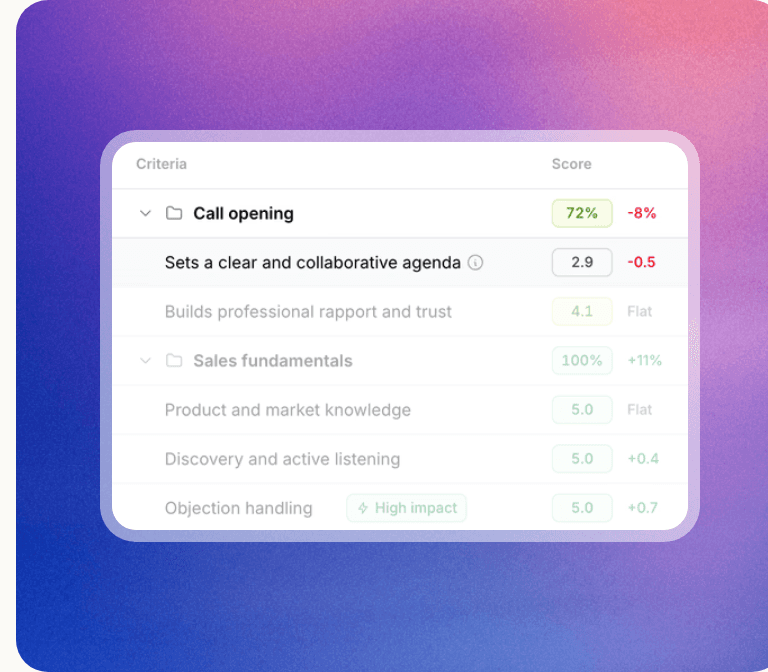
Alpharun's call scorecard, breaking a rep's call opening and sales fundamentals into scored criteria.
Picture a rep on hour three of a shift. In most QA programs, a supervisor will listen to maybe a handful of that rep's calls this week, grade them against a generic scorecard, and move on. The rest of the week runs ungraded.
Build your scorecard from your own playbook. List the must-say compliance items as pass/fail, then score the skill behaviors (discovery, objection handling, the next step) on a simple scale. If people are reviewing by hand, set a per-rep weekly sample your supervisors can actually hit, pull it at random, and add every call tied to a complaint or a lost sale.
That's the real limit of manual QA: it sees a thin slice of what's happening and grades it against criteria that don't reflect how your best reps actually sell. AI-based scoring changes that by grading 100% of calls.
What you score against decides whether that coverage is useful. Tools like Alpharun build a custom playbook from your own top-performer calls, then score every call against it: did the rep deliver the recording disclosure, run real discovery before pitching, handle the objection, and close a qualifying lead while staying compliant?
For a guided-service team, such as patient financial counselors or care navigators, the playbook checks different moments: whether the rep confirmed who they were speaking with, explained the bill or coverage in plain language, and set a clear next step.
Alpharun works with Medicare brokerages like Chapter, whose advisors handle hundreds of thousands of calls during the Annual Enrollment Period.
Managers still own the coaching. Their job gets easier because they walk in with every call already scored and the key moments flagged, so the conversation starts from evidence. Our call center quality assurance best practices guide covers the full program.
8. Calibrate so a score means the same thing to everyone
A QA score is only useful if it's consistent. When two supervisors grade the same call three points apart, reps stop trusting the number, and so do you.
Calibration fixes that. Have your reviewers (and your automated scoring) grade the same set of calls, then align on the standard until the scores converge. Write the criteria down explicitly so "good discovery" means the same thing on Tuesday as it did on Monday. Consistent, fair evaluations across reps, teams, and time are the whole point of automated call scoring.
9. Close the loop from QA to coaching
QA data that nobody acts on is just a spreadsheet. The loop is simple: a finding leads to targeted feedback, then you re-score to confirm the behavior actually changed.
Keep the QA review (did the rep follow the steps) separate from the development conversation (how does the rep get better). When both happen in one meeting, compliance eats the whole session, and skill-building gets nothing.
Operations owns the loop mechanism: the scoring, the flagging, the re-check. The human side of that coaching, the cadence, the one-on-ones, and the motivation, lives in our guide on how to manage a call center. Run the loop here, lead the people there.
Metrics and KPIs
The floors that grow revenue track more than the standard support metrics, so this section covers both.
10. Track the KPIs that actually move revenue
Start with the six operational KPIs every floor should watch, each with its formula.
KPI | Formula | What it tells you |
|---|---|---|
Average handle time (AHT) | (talk + hold + after-call work) ÷ calls | How long a call takes end to end |
First call resolution (FCR) | (resolved on first contact ÷ total calls) × 100 | Whether reps solve it the first time |
Abandonment rate | (abandoned calls ÷ total inbound) × 100 | How many callers hang up before reaching a rep |
Service level | (calls answered within threshold ÷ total) × 100 | Whether you're hitting your 80/20 target |
Occupancy | (handle time ÷ (handle time + available time)) × 100 | How much of paid time is spent on calls |
CSAT | (satisfied responses ÷ total responses) × 100 | How callers felt about the interaction |
Here's where sales floors go further. AHT measures speed, so pair it with numbers that measure whether the call worked, like these sales-outcome KPIs that tie to revenue:
Enrollment or quote-to-enroll conversion: The share of qualified calls that become enrollments
Enrollments per talk hour: Output that respects both speed and quality
Speed to lead: How fast a new lead gets a first call attempt
Vertical-specific outcomes: Placement rate and Issued AP in life insurance, app-to-lock in mortgage
A quick honest caveat: AHT is easy to game. A rep can shave handle time by rushing discovery and tank conversion in the process, and a dashboard that only watches AHT will applaud it. Watch both numbers together. For AHT specifically, our guide on how to reduce average handle time goes deep, and call center agent performance metrics covers the rep-level set.
11. Set a weekly and monthly review cadence
A metric nobody reviews is decoration. Build the rhythm into the calendar and give each number an owner.
Weekly is operational: service level, abandonment, adherence, and per-rep outcome trends. Monthly is strategic: conversion trends, ramp progress, and whether your staffing model still fits the volume you're seeing. The cadence is what turns contact center performance management from a dashboard into a decision.
12. Watch performance variance across reps
Team averages hide the spread between your reps. On most sales floors, a handful of reps at the top carry an outsized share of the revenue while the rest cluster well below them, and the average sits politely in the middle, telling you nothing.
The biggest operational lever is moving the middle of your floor closer to how your top performers already work. Hiring more star reps helps too, but it's slower and more expensive than lifting the reps you already have. Both moves depend on two things: QA sees every call, and the playbook that defines "good" is explicit.
So track how conversion spreads across your reps, find where the middle clusters, and point coaching at the specific behaviors separating them from the top.
Technology and continuity
The last group is the plumbing. Disconnected tools and fragile infrastructure quietly tax every other practice on this list.
13. Connect your phone system, CRM, WFM, and analytics
When your dialer, CRM, workforce management, and analytics live in separate tabs, your managers spend their day copying data between them. Every manual pull is a delayed coaching session and a blind spot.
Connect the stack so data flows on its own. A screen pop that surfaces the caller's history cuts handle time. A unified record means nobody repeats themselves.
Platforms like Five9 and Genesys anchor a lot of these stacks, and fast integration with them is what keeps the data moving. A cloud contact center setup makes that connection far easier than legacy on-premises hardware.
14. Automate the repetitive work
A lot of what eats up agent and manager time doesn't need a human. McKinsey found that non-selling activities still consume about two-thirds of the average sales team's time, so there's plenty to hand off. Call summaries, dispositioning, after-call work, survey sends, and QA scoring are all automatable, and automating them buys back hours for the actual conversations.
The best-of-both-worlds framework works here: your human team performs at its best, and AI handles the repetitive parts of the playbook that don't require a person, like covering off-hours calls, pre-qualifying callers, and routing hot leads.
Voice automation has a real place in that mix, as one piece of the stack among many. There are plenty of practical AI use cases in the contact center that start with the boring, high-volume tasks.
15. Build a redundancy plan for outages
Power cuts, internet drops, and weather events happen, and a dead phone line during peak season is revenue you don't get back. An outage during the Annual Enrollment Period can cost enrollments you can't recover.
Build a cloud failover plan: automatic rerouting to mobile apps or backup systems, voicemail with transcription so nothing gets lost, and a documented procedure your team has actually practiced. In regulated verticals, the continuity plan belongs in your SOPs too, so write it down and test it before you need it.
How Alpharun supports call center operations
Most of what's on this list breaks down for the same reason: it's manual. QA samples a few calls, coaching waits for a manager with a free hour, and the middle of your floor stays stuck because nobody can see every call, every day.
Alpharun sits on top of your existing call center and turns that oversight into a system. It learns what good looks like from your own best calls, then applies that standard to everyone.
With Alpharun, call center teams can:
Build a custom playbook from your top performers' real calls
Score 100% of calls against that playbook for both compliance and sales effectiveness
Surface sentence-level coaching tied to the exact moment a call turned
Give managers weekly insights on which reps need attention and where
Track performance variance and move the middle of your floor toward your top performers
Integrate with major contact center systems like Five9 and Genesys
Support regulated verticals with audit-ready scoring and SOC 2 Type 2 security across Medicare, life insurance, and mortgage
When every call gets scored and every rep gets specific feedback, you can see which practice on this list is slipping and fix it that week. Book a demo to see how Alpharun scores your calls against your own playbook.
Frequently asked questions
What is the 80/20 rule in a call center?
The 80/20 rule means answering 80% of inbound calls within 20 seconds. It's a common service-level target that forces a staffing decision: staff to hit it, and you keep abandonment low while knowing exactly how much idle time you're paying for.
What's the difference between call center operations and call center management?
Call center operations covers the systems that run the floor: forecasting, staffing, routing, QA, metrics, and the tech stack. Call center management covers leading the people: coaching, motivation, and development. The two overlap, but operations is the machine and management is the team running it.
Which call center KPIs matter most for sales teams?
Sales teams should pair operational KPIs with outcome KPIs. Track service level, abandonment, and AHT for efficiency, then add conversion rate, enrollments per talk hour, and speed to lead to confirm that efficiency is actually producing revenue.
How many calls should QA review?
QA should review every call where software can score it, and a random weekly sample per rep plus every complaint or lost-sale call where people review by hand. AI-based QA can score 100% of calls, which covers the calls a manual sample misses and lets managers focus their time on the ones that need real coaching.
How do you improve call center operations?
Improve call center operations by forecasting volume accurately, routing by skill, documenting SOPs and SLAs, scoring every call against a playbook, tracking the right KPIs on a set cadence, and connecting your tool stack. Individual performance follows once the system is fixed.


