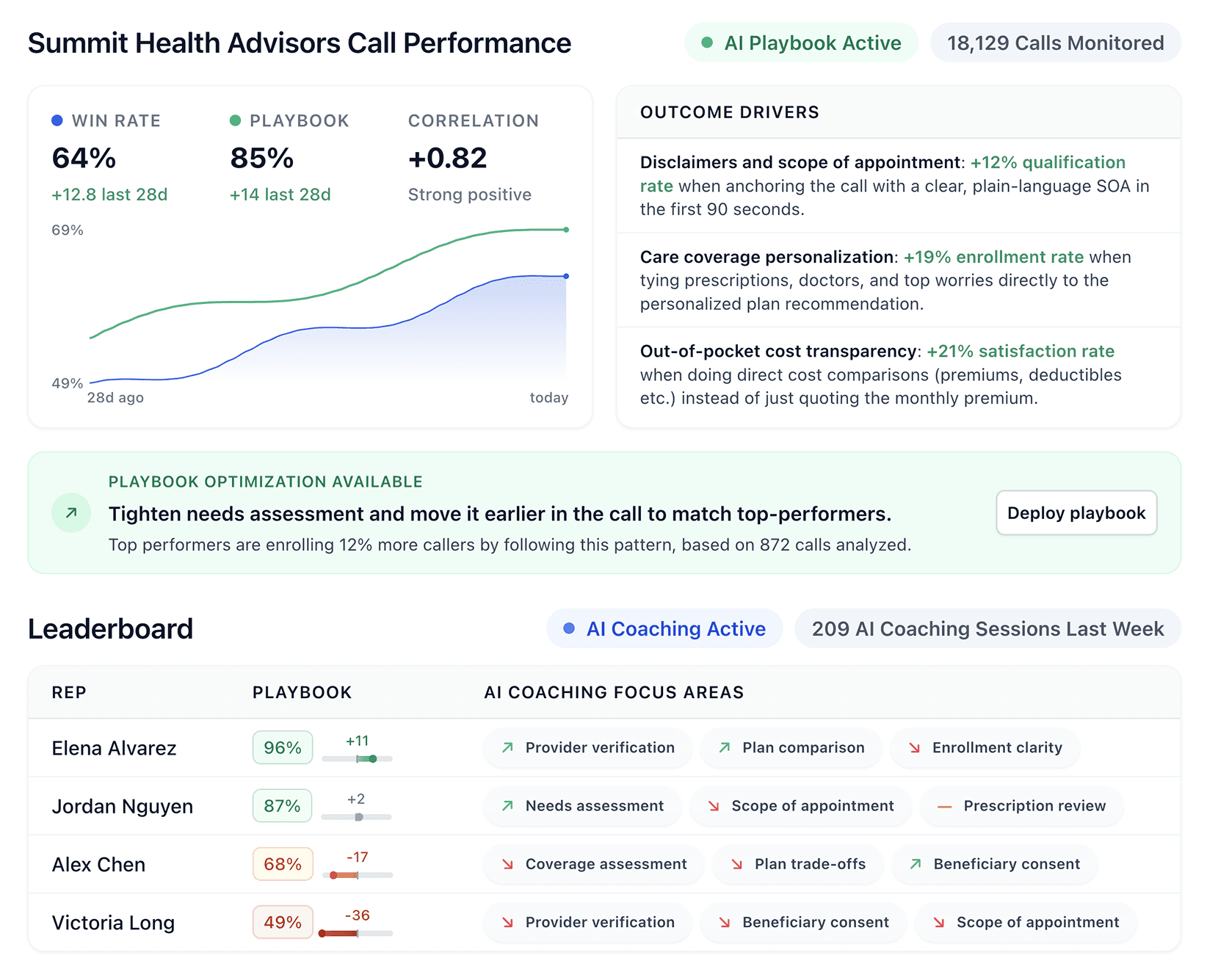


Call center optimization on a sales floor is not the same problem as call center optimization for a support team.
On a support floor, the goal is faster resolution. On a sales floor, the goal is more conversions, fewer compliance misses, and reps who improve over time rather than plateau after month two. The levers are different, and so is the approach.
What call center optimization actually means for sales teams
Most definitions of call center optimization focus on reducing handle time, improving routing, and cutting costs. Those matter. But for a high-volume B2C sales operation, the real optimization target is performance consistency.
You have reps converting at 38% and reps converting at 19% on the same leads, with the same product, working the same hours.
That variance is the problem call center optimization should solve on a sales floor. The goal is not just to make the floor run faster. It's to make every rep perform closer to what your best reps already demonstrate is possible.
4 areas where sales floor optimization has the biggest impact
Sales floor optimization comes down to improving the parts of the operation that directly influence conversion, rep development, and compliance.
🎯 Area | ❓Key question | 💡 Why it matters |
Rep performance and coaching | Are reps consistently using the behaviors that drive sales? | Small improvements across average performers often produce the largest revenue gains. |
Call structure and process consistency | Do reps follow the same proven sales process? | Consistency makes coaching, QA, and performance analysis more effective. |
Compliance and quality assurance | Are required steps happening on every call? | Strong compliance protects the business and supports customer trust. |
Ramp time and onboarding efficiency | How quickly do new hires become productive? | Faster ramp times reduce hiring costs and increase revenue capacity. |
1. Rep performance and coaching
This is where the largest revenue opportunity exists on most sales floors. The gap between top performers and average performers usually comes down to how they handle specific moments in a conversation.
Consider a Medicare prospect who says, "I already have coverage."
One rep immediately ends the conversation. Another asks a follow-up question about premiums, benefits, or provider access and uncovers a reason to continue the discussion. The difference can determine whether the call ends in 30 seconds or progresses toward an enrollment.
Improving rep performance starts with identifying those patterns across hundreds or thousands of conversations and coaching them consistently across the team.
2. Call structure and process consistency
Sales conversations follow predictable stages, and each stage contributes to conversion performance:
Discovery: Understanding the prospect's needs, challenges, and goals
Qualification: Determining whether the prospect is a good fit
Objection handling: Addressing concerns that could prevent a sale
Closing: Moving the prospect toward a decision or next step
When reps skip stages or follow different processes, managers struggle to pinpoint where opportunities are being lost.
For example:
If prospects consistently disengage during discovery, the issue may be poor questioning or weak qualification.
If conversations stall after pricing is introduced, objection handling may need attention.
If qualified prospects reach the end of the call without taking action, the closing process may be the bottleneck.
A consistent call structure makes these patterns easier to identify, measure, and improve.
3. Compliance and quality assurance
Compliance and sales performance often move together because both depend on how well reps execute critical parts of the conversation.
A Medicare prospect who receives a rushed TPMO disclaimer may question the credibility of the interaction before the sales conversation has even begun. A prospect who receives a clear, confident explanation is more likely to stay engaged.
Comprehensive QA helps managers identify these patterns early. Instead of discovering issues weeks later during an audit, teams can correct behaviors before they spread across the floor.
4. Ramp time and onboarding efficiency
Ramp time measures how quickly a new rep becomes productive, making it one of the clearest indicators of sales floor health.
On some teams, new hires learn primarily through shadowing, call listening, and trial and error. On others, they learn from documented playbooks, structured coaching, and examples from top-performing calls.
The difference becomes obvious when one cohort reaches quota in eight weeks while another requires four months. Across an entire hiring class, those additional weeks can represent a meaningful difference in revenue generation and manager capacity.
Common call center optimization mistakes on sales floors
The biggest barriers to sales floor performance are rarely obvious. Many teams have strong technology, experienced reps, and clear goals, yet a few common optimization mistakes continue to limit conversion rates and coaching effectiveness.
1. Optimizing for volume instead of conversion
More calls do not automatically produce more revenue.
A floor that increases call volume by 20% while maintaining the same conversion rate has simply created more activity. A floor that improves conversion from 20% to 25% often generates a larger revenue impact without adding a single rep.
Common examples include:
Increasing dial quotas without improving call quality
Measuring reps primarily on calls completed per day
Celebrating activity metrics while conversion rates remain flat
Call volume is an input, conversion is the outcome.
2. Treating coaching as an event instead of an operating system
Many managers coach when performance drops, a complaint surfaces, or a QA review uncovers an issue.
That creates long gaps between feedback and behavior change.
For example:
A rep mishandles an objection on Monday.
The call gets reviewed two weeks later.
Coaching happens at the end of the month.
The same mistake appears in dozens of calls during that period.
High-performing sales floors build coaching into the weekly operating rhythm. Feedback arrives consistently, while the conversation is still fresh enough to remember and apply.
3. Measuring the wrong metrics
Some metrics are easy to track but provide little insight into sales performance.
Average handle time is a common example. A shorter call is only valuable if it produces the same or better outcome.
A rep who spends an extra two minutes uncovering needs and addressing objections may generate significantly more revenue than a rep who rushes through the conversation.
Sales leaders should pay close attention to behaviors that influence outcomes, including:
Discovery completion rate
Objection handling effectiveness
Close attempt rate
Compliance adherence
Qualification accuracy
These metrics provide earlier signals about performance changes than revenue reports alone.
4. Over-investing in dialer technology while under-investing in coaching
Dialers, routing systems, and workflow automation help reps reach more prospects.
Revenue is ultimately determined by what happens after the prospect answers.
Many organizations spend months optimizing:
Dialer settings
Lead routing logic
Call distribution rules
Contact rates
While spending far less time improving:
Discovery conversations
Objection handling
Closing techniques
Rep coaching programs
A predictive dialer can place a rep in front of more prospects. The quality of the conversation still determines whether those opportunities turn into revenue.
The strongest sales floors invest in both. They build efficient systems for getting reps into conversations and equally strong systems for helping reps perform once they're there.
How to approach call center optimization on a sales floor
The fastest path to improvement is understanding what your best reps do differently and making those behaviors repeatable.
Managers already know some reps outperform others, some objections are harder to overcome, and some lead sources convert better. The challenge is turning those insights into a repeatable system that improves performance across the entire floor.
A practical optimization strategy usually follows five steps:
1. Start with the performance data you already have
Before changing scripts, processes, or technology, look at the variance in your current results.
Compare:
Close rates by rep
Close rates by lead source
Close rates by campaign
Conversion rates by call type
The patterns often reveal where the biggest opportunity exists.
A large performance gap between top performers and average performers usually points to untapped coaching opportunities. The goal is to identify the behaviors driving that gap and spread them across the floor.
2. Define what good performance actually looks like
Many sales floors talk about improving performance without defining the behaviors they want to see.
A strong standard answers questions like:
How should the call open?
Which discovery questions should every rep ask?
How should common objections be handled?
What should happen before a close attempt?
The most useful standards come from conversations that already produce results. Your highest-converting calls contain examples of what success looks like in your market, with your buyers, and with your product.
3. Build QA around the behaviors you want to reinforce
Once a standard exists, QA becomes much more valuable. Instead of asking whether a call felt good, managers can evaluate whether key behaviors occurred consistently throughout the conversation.
That creates visibility into questions such as:
Which reps consistently follow the process?
Where do conversations break down most often?
Which coaching themes appear across the floor?
The goal is to make performance measurable at the behavior level rather than waiting for revenue numbers to tell the story weeks later.
4. Close the feedback loop quickly
One of the biggest mistakes sales organizations make is allowing too much time between the call and the coaching conversation.
A rep who receives feedback the next day can usually remember the interaction, the objection, and their thought process. A rep receiving feedback two weeks later is often relying on memory.
The shorter the feedback loop, the faster behavior changes.
5. Measure improvement trends
Optimization is an ongoing process rather than a one-time project. Current performance tells you where a rep is today. Improvement trends show whether coaching, onboarding, and process changes are actually working.
Look for movement in:
Close rate progression
Discovery completion rates
Objection handling effectiveness
Ramp time for new hires
Compliance adherence
When those metrics improve consistently over time, the sales floor is moving in the right direction. When they remain flat, the process deserves as much attention as the people following it.
The role of AI in call center optimization for sales teams
AI doesn't replace the judgment a manager brings to coaching. What it does is make full-call coverage operationally possible on a 50-plus rep floor.
A manager reviewing calls manually can cover a small sample. AI can score every call, flag the specific moments where the rep deviated from the standard, and surface which reps and which behaviors need coaching attention that week.
That shifts the manager's time from finding problems to fixing them.
For regulated sales floors, AI also runs compliance monitoring across every call simultaneously. Missed disclosures, prohibited phrases, and qualification steps are flagged immediately rather than caught in a quarterly audit.
The most effective use of AI in call center optimization is as an infrastructure layer that makes consistent coaching and consistent compliance monitoring possible at the volume most high-volume floors operate at.
Call center optimization metrics that matter for sales floors
Revenue and close rate tell you what happened. The metrics below help explain why it happened and where managers should focus their coaching efforts.
📊Metric | 🔍 What it measures | 🎯 Why it matters for sales |
Conversion rate by rep | Percentage of calls that result in a closed sale | The primary output metric. Variance across reps reveals the coaching opportunity. |
Discovery completion rate | Whether required discovery questions were asked | Leading indicator of close rate. Reps who skip discovery lose deals at the close. |
Objection handling rate | How often reps respond to common objections vs. losing the call | Identifies the specific objections that need coaching attention. |
Compliance adherence | Whether required disclosures and steps happened | Critical for regulated floors. Also correlates with trust signals on the call. |
Ramp time by cohort | How long new hires take to reach quota | Measures whether onboarding and early coaching are producing results. |
Call structure adherence | Whether the call followed the defined stage sequence | Reveals where deals are most commonly breaking down structurally. |
The strongest sales organizations track these metrics together rather than relying on a single performance number.
When conversion rates decline, these metrics help managers identify the underlying cause. When conversion rates improve, they reveal which behaviors and coaching efforts are driving the improvement so they can be replicated across the rest of the floor.
How Alpharun supports call center optimization
Dialers, routing tools, and recording systems optimize how calls move through the floor. Alpharun focuses on the part that drives sales performance: what reps actually say once the call starts.
Alpharun helps sales floors optimize by:
Building custom playbooks from real calls: Alpharun analyzes your best-performing conversations and turns the behaviors behind them into a coaching standard.
Scoring every call against that standard: Managers see which reps are following the playbook, where calls break down, and which behaviors need attention.
Delivering moment-specific coaching: Reps receive feedback tied to exact points in their own calls, making coaching easier to understand and apply.
Tracking sales and compliance together: Medicare, insurance, and home services teams can monitor conversion behaviors and required call steps in one workflow.
Surfacing weekly coaching priorities: Managers know which reps, skills, and call stages need focus without spending hours digging through recordings.
Book a demo to see how Alpharun helps sales organizations improve performance without increasing QA and coaching headcount.
Frequently asked questions
What is call center optimization?
Call center optimization is the process of improving call center performance through better coaching, workflows, technology, and quality assurance. On sales floors, the focus is typically on increasing conversions, improving rep consistency, reducing ramp time, and maintaining compliance.
How do you optimize a sales call center?
Optimizing a sales call center starts with defining the behaviors that drive successful calls, then coaching reps against that standard consistently. The most effective programs combine call scoring, structured coaching, performance tracking, and fast feedback loops.
What metrics should a sales call center track?
The most important sales call center metrics are conversion rate, discovery completion rate, objection handling effectiveness, compliance adherence, call structure adherence, and ramp time. Together, these metrics show both sales outcomes and the behaviors driving them.
How does AI help with call center optimization?
AI helps call center optimization by analyzing every call instead of a small sample. Managers can identify coaching opportunities faster, monitor compliance at scale, and see which behaviors are most closely tied to conversion performance.
How can managers improve sales performance across a large call center team?
Managers improve sales performance by creating a consistent coaching process built around top-performer behaviors. Tracking leading indicators, reviewing calls regularly, and delivering feedback quickly helps improve performance across the entire floor.