

A single agent screen can hold a caller's full name, card number, Social Security number, and health history, all at once, all in plain view. Multiply that by hundreds of agents and thousands of calls a day, and you have one of the richest targets in your business.
These call center security best practices cover what protects that data, and where most of the risk hides.
Why call center security matters
Call center security matters because a single breach can cost millions and unwind years of customer trust in weeks. The global average data breach reached $4.44 million in 2025, and in the United States the average hit a record $10.22 million.
That number is the easy part to quantify. Harder to put on a spreadsheet are the customers who leave after a breach, the regulators who come asking questions, and the trust that takes years to rebuild.
Most teams treat security as something the phone-system vendor handles. The ones that stay out of the headlines treat it as a shared job across their people, their process, and their tools. Your encryption is only as good as the agent who reads a card number out loud on a recorded line.
The main security threats call centers face today
The failure point in a call center is rarely one dramatic exploit. It's the slow pile-up of small, weak controls until something gives.
Here's where the pressure usually comes from:
Social engineering and phishing: Attackers go straight for the human. An agent gets an urgent email or call from "IT" asking them to confirm a password, and the breach starts there.
Account-takeover fraud: Fraudsters arrive with stolen data and a convincing story, then talk their way past identity checks to take over a real customer's account.
Insider risk and plain negligence: An over-permissioned agent, a curious lookup, a screenshot sent to a personal email. Not always malicious, always costly.
Unsecured remote and hybrid setups: Home networks, personal devices, and shared Wi-Fi widen the attack surface every time an agent logs in from the couch.
Third-party exposure: Every integration, outsourcer, and tool you connect is another door, and you don't always hold the keys.
Knowing the threats is the easy part. The practices below are how you close the doors.
Call center security best practices
You don't need all ten in place by Friday. You do need to know which ones you're missing. Start with the table, then work down the list.
🔒 Practice | 🛡️ What it protects against |
|---|---|
Encrypt data in transit and at rest | Interception, stolen storage |
Least-privilege access (RBAC) | Insider misuse, role creep |
Multi-factor authentication | Account takeover, stolen passwords |
Secure remote agent setups | Endpoint and network attacks |
Govern call recordings | Exposed PII, retention violations |
Monitor compliance on every call | Missed disclosures, script drift |
Continuous monitoring and logging | Slow breach detection |
Agent security training | Phishing, social engineering |
Patching and regular audits | Known-vulnerability exploits |
Incident response plan | Slow, messy breach response |
1. Encrypt sensitive data in transit and at rest
Encryption is the floor every other control stands on. Encrypt call media and signaling in transit with TLS 1.3 and SRTP so a tapped line gives an attacker nothing but noise.
Then cover data at rest: Full-disk encryption on agent machines, field-level encryption for stored PII, and AES-256 on your databases. Tokenize card numbers so the raw data never sits in most of your systems, which also shrinks your PCI scope.
2. Enforce least-privilege access with role-based controls
Most agents need a sliver of your data to do their job. Give them exactly that sliver.
Role-based access control (RBAC) ties permissions to job function, so a new rep can't open records they have no reason to touch.
Add just-in-time access for sensitive actions, and sync permissions with your HR system so the moment someone leaves, their access does too. The goal is simple: When an account is compromised, the blast radius is small.
3. Require multi-factor authentication and strong identity controls
Passwords get reused, phished, and guessed. Multi-factor authentication closes most of that gap by requiring a second factor before anyone reaches sensitive systems.
Move toward single sign-on with SAML or OAuth so agents juggle fewer credentials, and support passkeys where you can. For high-risk actions, layer in adaptive checks that weigh device, location, and behavior before granting access.
4. Secure remote and hybrid agent environments
Remote work turned every agent's living room into part of your network. Lock down the endpoints before you trust them: managed devices, enforced disk encryption, and zero-trust access that checks device health at every login.
Segment your network so a compromised laptop can reach the help desk app and nothing else. Voice traffic, payment systems, and admin tools should live on separate segments, with a VPN or zero-trust layer in between.
5. Govern call recordings end to end
Recordings are an asset for coaching and a liability for security, often on the same file. The software you use to record calls should capture consent, then protect what it stores.
Mask or redact sensitive fields like card numbers and SSNs in both recordings and transcripts. Store recordings in encrypted, access-controlled storage, and set retention limits so you keep what regulations require and purge the rest on a schedule.
6. Monitor compliance on every call
This is where most security programs quietly fall short. A manager can review maybe three to five calls per rep per week, which on a high-volume floor is a rounding error against the thousands of calls happening every day.
Everything in those unreviewed calls is a blind spot: The skipped disclosure, the consent nobody confirmed, the script that drifted three weeks ago and never got corrected. Automated monitoring changes the coverage math.
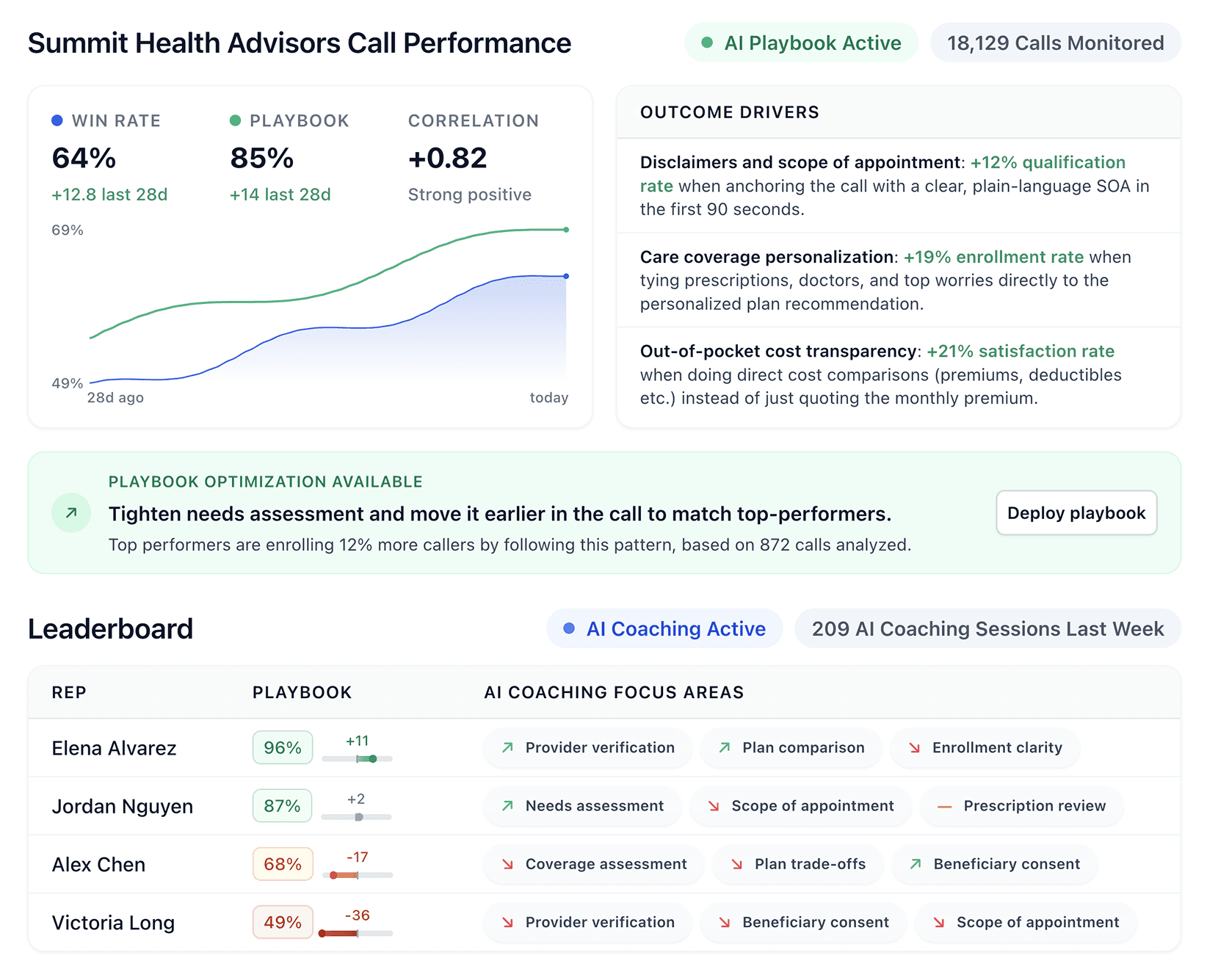
Tools like Alpharun score 100% of calls against your playbook and flag the exact moment a required disclosure went missing, so compliance problems surface on the call while you can still fix them.
Pair that monitoring with automated quality management, and your weekly spot check becomes full coverage. It's one of the higher-leverage call center quality assurance best practices a regulated team can put in place.
7. Build continuous monitoring, logging, and anomaly detection
You can't respond to what you can't see. Centralize your logs in a SIEM, and capture session metadata for every call: agent ID, timestamps, location, and what records were accessed.
Then baseline what normal looks like so the abnormal stands out. A spike in account lookups, repeated authentication failures, or logins at 3 a.m. should trigger an alert while there's still time to act.
8. Train agents to recognize and resist social engineering
Your strongest technical controls still route through a human under quota pressure. Picture it: an agent is mid-shift when someone calls claiming to be from internal IT, says there's an urgent system issue, and asks them to confirm their login "to keep their queue running." The trained agent pauses; the untrained one helps.
Build that pause through repetition. Run role-based security training and quarterly phishing simulations, bake verification steps into the agent workflow, and make escalation blame-free so people feel safe reporting a suspicious call the moment it happens.
9. Keep software patched and run regular security audits
Attackers love a known vulnerability that nobody got around to patching. Maintain an asset inventory so you know what's running, then patch high-severity issues on a tight SLA with staged rollouts that don't break your voice stack.
Schedule the reviews you'd rather skip: Quarterly control checks, an annual penetration test, and a SOC 2 or equivalent audit cadence. The NIST Cybersecurity Framework is a solid backbone if you're building this from scratch.
10. Build and rehearse an incident response plan
Prevention lowers your odds of a breach. It won't take them to zero, so write the plan before you need it: who contains the breach, who notifies customers and regulators, and how fast the clock starts.
Then rehearse it. A tabletop exercise twice a year turns a panic into a procedure, and the difference shows up in how fast you contain the next real incident.
How call center security and compliance work together
Call center security and compliance work together because one keeps data safe and the other proves you did, and in a call center the two meet on every recorded line.
Most teams answer to a familiar set of frameworks. PCI DSS governs card data, HIPAA covers health information, GDPR protects personal data, and TCPA sets the rules for consent and recording.
Regulated sales and service teams carry extra weight on top, from CMS disclosure requirements to GLBA privacy rules, depending on the industry. Healthcare breaches alone average $7.42 million, so the stakes climb fast in regulated work.
Here's the part the frameworks can't enforce for you: a policy means nothing if a rep skips the disclosure on call number 847. Compliance is won or lost one conversation at a time, which is exactly why per-call monitoring matters more than another binder of rules.
In regulated environments like healthcare call centers, catching a missed disclosure the day it happens is the difference between a coaching note and a fine.
How Alpharun fits
Strong call center security comes down to two things: solid controls and real visibility into what happens on calls. You can encrypt everything, lock down every login, and still get burned by what one agent says on one recorded line.
Alpharun sits on top of your existing call setup and handles the visibility side. Your human team performs at its best, while AI scores every call and surfaces the compliance gaps that used to depend on a manager catching them by luck.
With Alpharun, teams can:
Monitor 100% of calls against a custom playbook, well beyond the handful a manager can spot-check.
Flag missed disclosures, skipped consent, and script drift down to the sentence.
Coach reps on the exact moment a call went off-script, tied to the recording.
Score compliance and sales effectiveness together on the same call.
Give managers audit-ready visibility across reps and teams.
Support regulated industries with SOC 2 Type 2, HIPAA, and GDPR-compliant security.
When every call gets reviewed, compliance shifts from something you hope is happening to something you can prove.
Book a demo to see how Alpharun catches compliance gaps on the call, while there's still time to fix them.
Frequently asked questions
What data needs to be protected in a call center?
Call centers need to protect personally identifiable information (PII), payment card data, and health or financial records, along with the call recordings and transcripts that store them. Each category carries its own regulatory requirements, from PCI DSS for card data to HIPAA for health information.
What regulations apply to call center security?
The most common are PCI DSS for payment data, GDPR for personal data, HIPAA for health information, and TCPA for recording consent. Regulated industries add their own rules, such as CMS requirements for Medicare sales or GLBA for financial data.
Is VoIP secure for call centers?
VoIP is reasonably secure when calls are encrypted with TLS and SRTP and run on a segmented network. Unencrypted VoIP is vulnerable to interception, so encryption and network segmentation are what make it safe for handling sensitive customer data.
How do you prevent call center fraud?
Preventing call center fraud takes layered controls: multi-factor authentication, strong identity verification, agent training against social engineering, and anomaly detection. Per-call monitoring adds a backstop by flagging suspicious patterns across every conversation, with no gaps in coverage.
How can AI improve call center security and compliance?
AI improves call center security by reviewing 100% of calls, flagging compliance gaps like missed disclosures in near real time, and surfacing anomalies humans miss at scale. That coverage turns compliance from periodic spot checks into continuous monitoring.