
A rep finishes onboarding on a Friday, gets a thumbs-up and a login, and takes their first real call Monday morning. Thirty seconds in, the prospect asks a question that isn't in the script, and the rep freezes.
"Finished the training" and "ready to sell" are two different things, and the second one is the one that pays. This sales readiness checklist gives you eight checkpoints you can watch on a call and a manager sign-off built on the first three questions in ATD's sales rep performance checklist, to run per rep before you route them calls on their own.
What is sales readiness, and how is it different from onboarding?
Sales readiness is the point where a rep can hold a real sales conversation on their own and hit your standard on a live call. It's a pass/fail gate you clear right before go-live, graded on a scored practice call or a first call with a manager listening.
Onboarding is the whole program you build to get a rep there. Readiness is the single checkpoint inside it that answers one question: can this person sell yet? If you want the full ramp plan that surrounds this gate, our separate 17-step onboarding checklist covers that. For software that helps you run these checks, see our roundup of the best sales readiness tools.
Most teams treat readiness as a date on the calendar. New SDRs take about three months on average to ramp, per The Bridge Group's 2025 research, so every rep you push live before they're ready stretches an already expensive ramp even longer. Treating readiness as a bar the rep has to clear catches the freeze-on-call-one problem before a prospect does.
How to use this sales readiness checklist
Print or copy one per rep. Run it the week before you hand them their own unsupervised calls.
Every checkpoint is pass or fail. "Mostly there" counts as not ready because prospects don't grade on a curve. When a rep misses a checkpoint, name the specific area to re-run and re-check it before the start date.
This works whether your team sells Medicare plans, life insurance, mortgages, or consumer loans. The eight areas stay the same across verticals; only the scripts, disclosures, and compliance steps change.
The sales readiness checklist: 8 checkpoints
Each checkpoint below is a behavior you can watch a rep perform. Score what actually shows up on a call, then move to the manager sign-off.
1. Buyer personas
The rep can tell you who they're selling to and what that person actually worries about before they pick up the phone.
Can name the target buyer's top two or three priorities
Knows the objection that buyer raises most often
Can tell a hot lead from someone who's just browsing
A rep who can describe the buyer opens the call on that person's problem instead of a feature list.
2. Product knowledge
The rep can explain what you sell in terms of the buyer's problem, in their own words, without reading off a sheet.
Gives a 60-second "here's the problem, here's how we solve it" from memory
Knows the two or three plans or products they'll quote most
Answers your top five product questions without reaching for a doc
If your enablement training landed, this one is quick. If it didn't, you'd hear it in the hesitation.
3. Competitive differentiation
The rep can say why a buyer picks you over the obvious alternative, honestly, without trashing the competitor.
Knows the main competitors in your market
Gives one true reason a buyer chooses you
Handles "I'm already with someone" without going quiet
Buyers can smell a rep who's never heard the competitor's name. Confidence here is half the battle on a comparison call.
4. Pre-call planning
The rep preps the call ahead of time and walks in with a plan, so the prospect doesn't have to carry the conversation.
Knows the objective for this call type before dialing
Has the lead's details and notes open and ready
Knows where to find the collateral a call might need
Pre-call planning is boring, and it's the cheapest point gain on this list. Thirty seconds of prep changes the first 30 seconds of the call.
5. Talk track and script
The rep can run your script like a conversation, loosely enough to recover when the prospect goes off-menu.
Delivers the opener naturally, in their own cadence
Hits the required disclosures where your vertical needs them
Can leave the talk track and find their way back
Scripts exist so reps don't miss the important parts. A rep who's ready sounds like a person using one, with enough ease to improvise when a call calls for it.
6. Objection handling
The rep has a real answer for your most common objections and knows the difference between a stall and a genuine no.
Handles your five most common objections without panic
Can tell a brush-off from a real concern
Keeps the rebuttal compliant while handling the pushback
Objections are where new reps either hold the line or hand back control. This is worth watching live before you trust it.
7. CRM and systems
The rep can actually run your stack while talking to a human, which nobody checks until it goes wrong on a real call.
Logs and dispositions a call correctly
Can pull up the lead and take notes mid-conversation
Knows the dialer and transfer flow cold
A rep fumbling the CRM sounds distracted to the prospect, even when their pitch is fine. The tools have to be muscle memory before go-live.
8. Reviewed first live call or demo
The rep has done at least one full run, either a scored demo or a first live call with a manager listening, graded against your standard.
Completed a role-play or demo scored against your rubric
A manager listened to the full recording and scored each part of the call
Weak spots were re-coached before go-live
This is the checkpoint teams skip when they're short on time, and it's the closest preview you'll get of the rep's first week.
Copy-ready sales readiness checklist:
Rep: ________
Manager: ________
Go-live date: ________
1. Buyer personas
Can name the target buyer's top two or three priorities
Knows the objection that buyer raises most often
Can tell a hot lead from someone who's just browsing
2. Product knowledge
Gives a 60-second "here's the problem, here's how we solve it" from memory
Knows the two or three plans or products they'll quote most
Answers your top five product questions without reaching for a doc
3. Competitive differentiation
Knows the main competitors in your market
Gives one true reason a buyer chooses you
Handles "I'm already with someone" without going quiet
4. Pre-call planning
Knows the objective for this call type before dialing
Has the lead's details and notes open and ready
Knows where to find the collateral a call might need
5. Talk track and script
Delivers the opener naturally, in their own cadence
Hits the required disclosures where your vertical needs them
Can leave the talk track and find their way back
6. Objection handling
Handles your five most common objections without panic
Can tell a brush-off from a real concern
Keeps the rebuttal compliant while handling the pushback
7. CRM and systems
Logs and dispositions a call correctly
Can pull up the lead and take notes mid-conversation
Knows the dialer and transfer flow cold
8. Reviewed first live call or demo
Completed a role-play or demo scored against your rubric
A manager listened to the full recording and scored each part of the call
Weak spots were re-coached before go-live
Manager sign-off
Does the rep know what's expected?
Can they actually meet it?
Do they know how to meet it?
Manager sign-off: ________
Manager sign-off: 3 questions before you send a rep live
The checklist tells you what the rep can do. This part is on you. Before you route that first real call, answer three questions honestly. They're the first three questions in ATD's sales rep performance checklist, and they're the same ones a frontline manager uses to coach a rep who's stuck.
Does the rep know what's expected? Can they repeat your standard back to you in their own words? Telling them once doesn't count.
Can they actually meet it? You've watched them clear the checklist with your own eyes, on a scored practice call or a supervised live one.
Do they know how to meet it? The training and coaching landed, so when a call gets hard they have a move ready.
If any answer is "not yet," point to the exact checkpoint and run it again. A sign-off lowers the risk enough to let them talk to a real buyer.
The coaching checkpoint: Role-play first, then review the first real calls
This is how to run checkpoint 8 well and what to do in the rep's first week after go-live.
Before live calls, the rep passes a role-play scored against your rubric by someone who knows what good sounds like. After they go live, you review their first calls with them fast, while the habits are still forming.
The trouble is bandwidth. When a rep does 10-plus calls a day, no manager can listen to all of them, so most teams spot-check a handful and miss the pattern until a number slips. Reviewing a new class's first calls before the habits set means scoring those early calls against your rubric faster than a manager can by hand.
How Alpharun fits into your readiness process
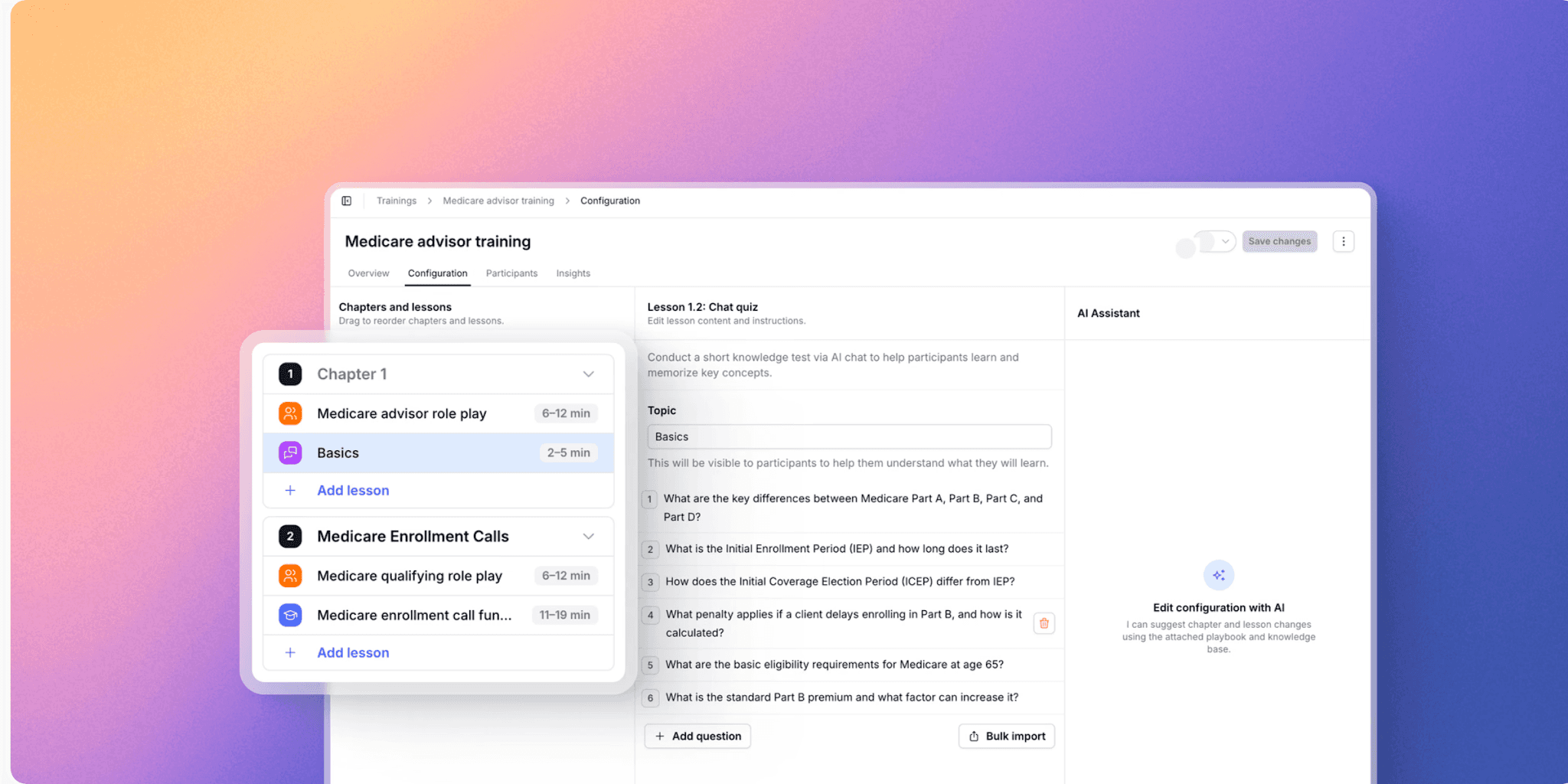
Alpharun's training builder, laying out a Medicare advisor course with role-play lessons and a knowledge quiz.
A checklist tells you who's ready. Knowing it at volume is harder, when a new class of reps goes live the same week and every one of them does dozens of calls a day.
A manager can't do that by hand. You can't listen to every call, score every role-play, and still coach the reps who need you. Something gets dropped, and it's usually the quiet struggler who looked fine on paper.
Alpharun sits on top of your existing call system and scores every call against your playbook, so you can see each rep's readiness instead of guessing at it. It gives each rep specific feedback right after the call, tied to the exact moments that moved the conversation.
With Alpharun, sales teams can:
Score every rep's calls against your own playbook, built from your best reps' calls
Run role-play practice and grade it before a rep ever goes live
See exactly where a new rep is ready or not, down to the sentence
Send each rep short, specific coaching notes after their calls, so the manager isn't the only source of feedback
Catch compliance misses like a skipped Scope of Appointment (SOA) or disclosure on every call you run
Show managers which reps cleared the bar and which need another week before go-live
It leaves the judgment to you and gives you the coverage to use it well. Alpharun works with Medicare brokerages like Chapter, whose advisors handle hundreds of thousands of calls during the Annual Enrollment Period.
Book a demo with Alpharun to see how every new rep's calls score against your playbook, so your sales readiness checklist rests on real calls.
Frequently asked questions
What is sales readiness?
Sales readiness is the point where a rep can run a real sales conversation on their own and hit your standard. It's measured as a pass/fail gate across skills like discovery, objection handling, and compliance, usually confirmed on a scored practice call before the rep goes live.
What is the 30-60-90 rule in sales?
The 30-60-90 rule is a staged plan for a new rep's first three months: learn the product and process in the first 30 days, apply it on supported calls by day 60, and produce on your own by day 90. It gives both the rep and the manager clear milestones at each stage of the ramp.
What are the 7 golden rules of sales?
The seven golden rules of sales are commonly cited as: listen more than you talk, understand the buyer's real problem, qualify early, sell the value behind the feature, handle objections honestly, ask for the close, and follow up every time. They work as a shorthand for the habits that separate steady closers from inconsistent ones.
What is the 10-3-1 rule in sales?
The 10-3-1 rule is a prospecting ratio: roughly 10 prospects produce three qualified leads, which produce one sale. It's used to reverse-engineer activity targets, so a rep who needs one deal a day knows they need about 10 quality leads to work.
How is sales readiness different from onboarding?
Onboarding is the full program that brings a rep onto the team. Sales readiness is the go-live gate inside it that confirms the rep can actually sell before their first live call. A rep can be deep into onboarding and ramp and still not be ready to sell.


