

Most cold calling scripts fail for the same reason: they're written from the rep's perspective instead of the prospect's.
These 17 sales scripts for cold calling are built around what actually keeps a prospect on the line, organized by call type and industry so you can find the one that fits your situation and use it today.
What makes a cold calling script work
Before getting to the scripts, two things are worth understanding about why most scripts fail and what separates the ones that don't.
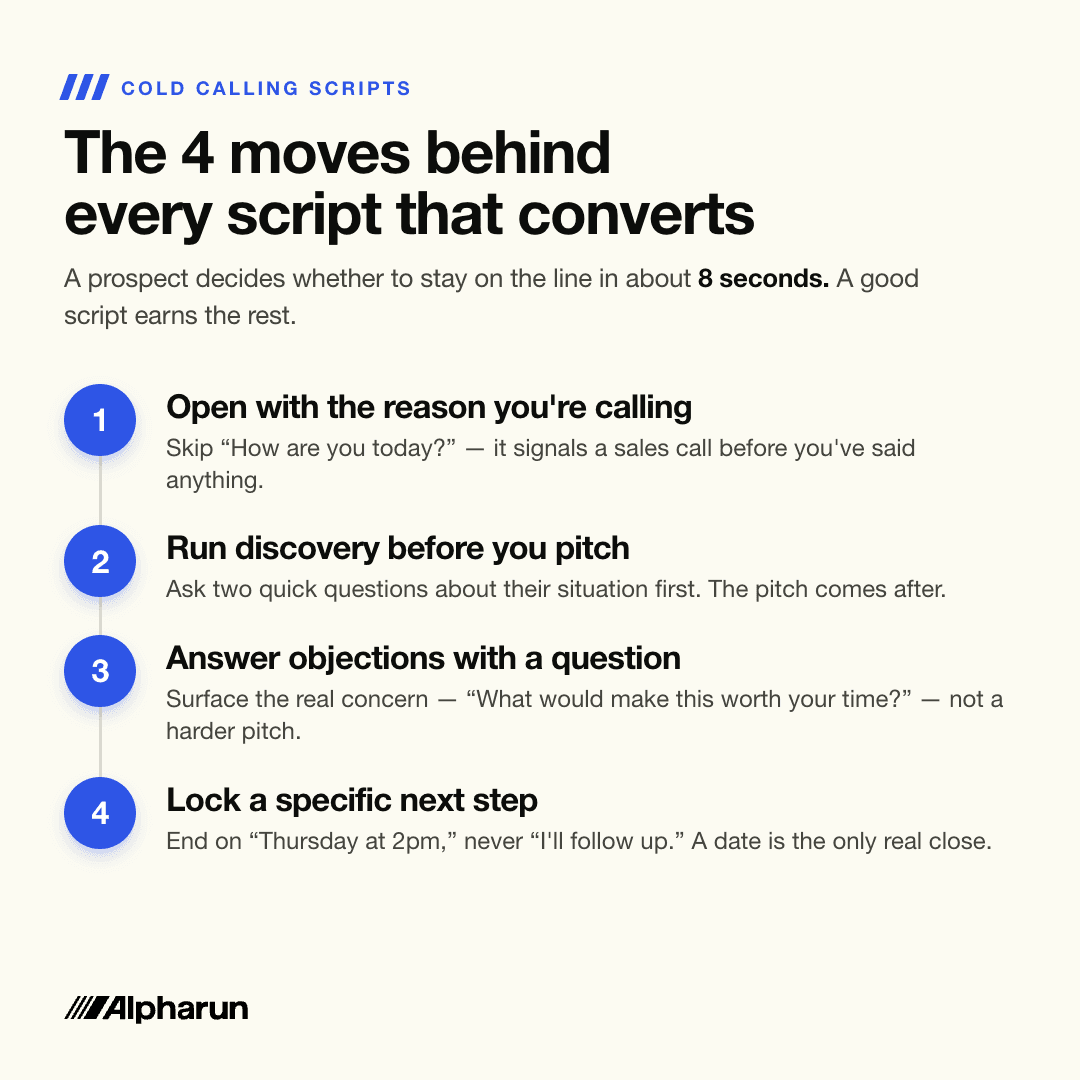
The prospect decides in the first eight seconds. Before you've finished your opener, the person on the other end has already started deciding whether to stay on the call or end it. That decision isn't based on your product. It's based on whether you sound like every other sales call they've taken or like someone worth talking to.
The strongest sales reps treat scripts as a guide. They understand the structure behind the conversation and adapt in real time based on what the prospect says. The script provides a starting point and direction. Active listening determines where the conversation goes from there.
With that said, here are 17 sales scripts for cold calling organized by scenario and industry.
Opening scripts
1. The honest opener (any industry)
Use this when you're cold calling and want to cut through the guard immediately. Works on any vertical.
Script:
"Hi [Name], I'm probably catching you at a bad time. I'll be quick. I work with [industry] teams on [one-sentence problem you solve]. Are you the right person to talk to about that, or should I be reaching someone else?"
Why it works: You've already conceded it might be a bad time, so the prospect's defenses drop. You've stated your purpose in one sentence. And you've asked a question that invites a real answer rather than a reflex no.
What to avoid: Don't say "how are you today?" before this. That phrase signals a sales call to anyone who's ever taken one, and it delays the reason you're calling.
2. The permission-based opener (regulated industries)
Use this on Medicare, insurance, and financial services calls where the prospect is likely sales-fatigued and has heard dozens of similar openers this week.
Script:
"Hi [Name], this is [Your Name] with [Company]. I haven't spoken with you before, and I want to be upfront about why I'm calling before I say anything else. Do you have 60 seconds?"
Why it works: The transparency disarms the prospect. They expect a pitch. You're asking permission before delivering one. In regulated industries where trust is everything, this opener earns more goodwill in the first sentence than most reps earn in the first three minutes.
Follow-up if they say yes:
"I work with [Medicare beneficiaries / homeowners / families] in [area] who are paying more than they should for [coverage / service]. I can usually find out in a few questions whether that's the case for you. Mind if I ask two quick ones?"
3. The referral opener
Use this when a current customer, colleague, or mutual connection gave you the prospect's name.
Script:
"Hi [Name], I'm [Your Name] with [Company]. [Referral Name] mentioned you might be looking at [coverage / service / solution] and thought it was worth a call. Is now an okay time to spend a couple minutes on that?"
Why it works: The familiar name shifts the dynamic from cold call to warm introduction before the prospect has said a word. According to your prospect's instincts, this is no longer a stranger calling. It's someone connected to someone they trust.
What to avoid: Don't exaggerate the referral. If the connection is loose ("your name came up in conversation"), say so. Overstating the relationship gets exposed within 30 seconds and destroys the advantage the referral gave you.
4. The specific trigger opener
Use this when a prospect has taken a recent action, like requesting a quote, downloading a resource, filling out a form, or calling in previously.
Script:
"Hi [Name], this is [Your Name] with [Company]. You reached out to us [yesterday / earlier this week] about [specific thing]. I wanted to call while it was still fresh rather than send another email. Do you have a couple minutes?"
Why it works: You're responding to something the prospect initiated, which makes this less of a cold call and more of a follow-up. The phrase "while it was still fresh" signals urgency without pressure.
What to avoid: Don't wait. Speed-to-lead matters more than most reps realize. A call within five minutes of a form submission converts at dramatically higher rates than a call made two days later.
Medicare sales scripts for cold calling
5. The Annual Enrollment Period outbound script
Use this during the AEP window (October 15 through December 7) when prospects are actively comparing Medicare plans.
Script:
"Hi [Name], this is [Your Name] calling from [Agency]. We're reaching out to Medicare beneficiaries in [area] during the Annual Enrollment Period because this is the one window each year when you can make changes to your coverage without penalty.
I'm not here to sell you anything today. I'd like to ask you three questions about your current plan to see if it's still the right fit for your situation. Is that okay?"
Why it works: The AEP framing establishes legitimate urgency. The "not here to sell" line disarms the pitch reflex. And the three-question setup creates a low-commitment path forward that most prospects will accept.
Common objection and response:
"I already have a plan."
"That's great. Most people I speak with do. The question is whether it still covers your doctors and your medications at the same cost as last year. Plans change their formularies and networks every year. It usually takes me about three minutes to check. Would that be useful?"
6. The plan comparison script
Use this when calling Medicare leads who have requested a comparison or who are enrolled in a plan but haven't reviewed it recently.
Script:
"Hi [Name], this is [Your Name] with [Agency]. I'm calling because many Medicare beneficiaries in [area] haven't reviewed their plan in two or three years, and in that time the plan may have changed its network or drug coverage without them realizing it.
I'd like to do a quick review to make sure you're still getting the coverage you're paying for. It takes about five minutes. Is now a good time?"
What to listen for: If the prospect mentions a specific doctor or medication, write it down immediately. That detail becomes the anchor for your comparison.
A prospect who hears "Based on what you told me about your cardiologist, Plan B covers that at a $15 specialist copay versus your current $45" is far more likely to engage than one hearing generic plan features.
7. The D-SNP and dual eligibility script
Use this when calling leads who may qualify for a Dual Special Needs Plan based on income or Medicaid eligibility.
Script:
"Hi [Name], I'm [Your Name] with [Agency]. I'm reaching out because you may qualify for a Medicare plan that includes additional benefits like dental, vision, and a monthly allowance for over-the-counter items, at no additional cost to you. It takes about three minutes to check your eligibility. Would you like me to look into that for you?"
Important compliance note: You must have Permission to Contact (PTC) documented before making this call. Do not make benefit claims that are not tied to a specific plan available in the prospect's area. Verify eligibility before discussing specific benefits.
Insurance sales scripts for cold calling
8. The home and auto comparison script
Use this when calling prospects who have requested a quote or whose policy is approaching renewal.
Script:
"Hi [Name], this is [Your Name] with [Agency]. I'm calling because most homeowners in [area] are paying more for their home and auto coverage than they need to, and they don't find out until they actually compare. I can usually tell within a few questions whether there's savings available for you. Mind if I ask two quick ones?"
Discovery questions to follow with:
"When does your current policy renew?"
"Roughly what are you paying per month combined for home and auto?"
The renewal date tells you urgency. The current payment tells you the size of the potential saving. Both shape how you frame the rest of the call.
9. The life insurance needs assessment script
Use this for outbound calls to prospects who have requested information about term or whole life coverage.
Script:
"Hi [Name], this is [Your Name] with [Agency]. I'm following up on your request for information about life insurance.
I know a lot of people research this when something prompts it, whether that's a new baby, a mortgage, or just realizing the coverage they have through work might not be enough. Can I ask what's going on for you right now that got you looking?"
Why this works: The question puts the prospect at the center of the conversation immediately. It also surfaces the emotional driver behind the inquiry, which is far more useful for the rest of the call than any demographic information.
A prospect whose answer is "my dad just passed and I realized I hadn't thought about this" needs a different conversation than one whose answer is "my HR department said my employer coverage ends if I leave."
10. The commercial insurance script
Use this when calling small business owners or operators about commercial liability, workers' comp, or business property coverage.
Script:
"Hi [Name], I'm [Your Name] with [Agency]. I work with business owners in [industry] who want to make sure their coverage actually fits their operation, not just their industry average.
Most of the owners I speak with have either been with the same carrier for years without reviewing it, or they bought coverage quickly without realizing what was and wasn't included. Does either of those sound familiar?"
Why it works: The two scenarios in the last sentence almost always resonate with one. The prospect self-selects into the one that fits, and that answer shapes where you take the discovery.
Home services sales scripts for cold calling
11. The pest control outbound script
Use this when calling homeowners in areas with seasonal pest activity, or when following up on a neighborhood treatment notification.
Script:
"Hi [Name], this is [Your Name] with [Company]. We've been treating a few homes in your neighborhood for [ant / rodent / termite] activity, and we're calling homeowners nearby because once it's active in the area, it tends to spread.
I'm not calling to pressure you into anything. I'd like to offer you a free inspection so you know whether it's something to be concerned about. Would that be useful?"
Why it works: The neighborhood context creates social proof and localized urgency without fabricating a manufactured crisis. The free inspection is a low-commitment ask that most homeowners will accept.
12. The home improvement consultation script
Use this when calling prospects who have requested information about a renovation project, solar installation, or home services estimate.
Script:
"Hi [Name], this is [Your Name] with [Company]. You reached out to us about [project type], and I wanted to call before sending anything over because a quick conversation usually saves both of us time. Can I ask you two questions about what you're looking for?"
Discovery questions:
"What's driving the timing for this project right now?"
"Have you gotten other estimates, or are you still in the early stages?"
The first question surfaces urgency and budget signals. The second tells you whether you're competing or educating.
13. The HVAC service script
Use this when calling homeowners ahead of seasonal demand, or following up on service records showing equipment age.
Script:
"Hi [Name], this is [Your Name] with [Company]. We serviced your [furnace / AC] about [X years] ago, and I'm calling because units that age typically start showing efficiency drops that show up on your energy bill before they show up as a breakdown.\
I'm not calling to sell you a replacement. I'd like to offer you a seasonal check to see where things stand. Would that be worth scheduling?"
Why it works: The call is framed as a service call, not a sales call. The energy bill reference makes the value concrete. And the explicit "not calling to sell you a replacement" line earns trust before the ask.
Objection-handling scripts
14. The "I'm not interested" response
This is the most common early-call objection and the one most reps handle worst by either apologizing and hanging up or doubling down on the pitch.
Script:
"Fair enough. Before I let you go, can I ask one quick question? What would make this worth your time in the future, if anything? Even knowing that would help me know whether to reach back out or leave you alone."
Why it works: It respects the objection rather than fighting it. The question surfaces whether there's a real fit that just has bad timing, or whether the prospect is a genuine dead end. Either answer is useful.
15. The "I already have coverage / a provider" response
Common in Medicare, insurance, and home services calls. Most reps treat this as a closed door. It isn't.
Script:
"That's good to hear. I'm not trying to talk you out of it. Can I ask one thing: when did you last compare what you're paying to what else is available? A lot of people haven't looked in two or three years, and things change. If you're already getting the best value, nothing lost. If you're not, you'd want to know. Would a quick comparison be worth it?"
What to avoid: Don't say "but" after "That's good to hear." The word "but" signals that you didn't actually hear them, which breaks the trust the first sentence built.
16. The "I need to think about it" close
This is what reps hear when a prospect hasn't said no but hasn't said yes either. The call is about to end with nothing committed.
Script:
"Completely understandable. Before we hang up, can I ask what specifically you'd want to think through? Sometimes I can answer it right now, and if I can't, I'll know better what to send you before we talk again."
Why it works: "I need to think about it" is rarely about thinking. It's usually about one unresolved concern the prospect hasn't named. This question surfaces it. If the answer is "the price," you now know what the objection actually is.
If the answer is "I need to talk to my spouse," you know to ask when that conversation will happen and when to call back.
17. The voicemail script
Use this when the prospect doesn't pick up. Most reps either hang up or leave a rambling message. Neither builds any advantage for the callback.
Script:
"Hi [Name], this is [Your Name] with [Company]. I'm calling about [one-sentence reason]. If you have three minutes to connect, I can be reached at [number]. I'll try you again [day], but feel free to call me anytime."
Keep it under 20 seconds. The only goals of a voicemail are to get your name and number heard clearly and to give the prospect a single, specific reason to call back. Anything beyond that works against you.
Common cold calling mistakes and how to fix them
Small mistakes early in a cold call can make the rest of the conversation much harder. Here are five of the most common issues sales reps run into and how to fix them:
1. Starting with "How are you today?"
This phrase signals a sales call before you've said another word. Every prospect has heard it in the same context. Replace it with getting directly to the reason you're calling or asking a permission-based question.
2. Pitching before qualifying
A rep who leads with product features before understanding the prospect's situation is solving a problem the prospect hasn't confirmed they have. Discovery comes before the pitch, and it comes before you assume you know what they need.
3. Reading the script word for word
Prospects can usually tell when a script is being read word for word. The conversation feels less natural, responses become less relevant, and valuable buying signals can get overlooked.
Strong reps learn the structure of the script, then focus on listening and responding to the prospect in front of them.
4. Not defining a next step before hanging up
A call that ends with "I'll send you some information" is not a successful cold call unless that information has a defined follow-up appointment attached to it.
Before the call ends, there should be an agreed next step with a date and time. "I'll reach out next week" is not a next step. "I'll call you Thursday at 2pm" is.
5. Treating every objection as a reason to pitch harder
Most objections are not objections to the product. They're objections to the timing, the unfamiliarity, or an unresolved concern.
A rep who responds to "I'm not interested" with another version of the pitch has misread the situation. The right response is a question that surfaces what's actually going on.
Build cold calling scripts from what already converts
The best cold calling scripts are usually hiding in conversations your team has already had.
Every sales floor has reps who consistently navigate objections, keep prospects engaged, and move conversations toward the next step. The challenge is identifying those patterns and turning them into a repeatable system the rest of the team can follow.
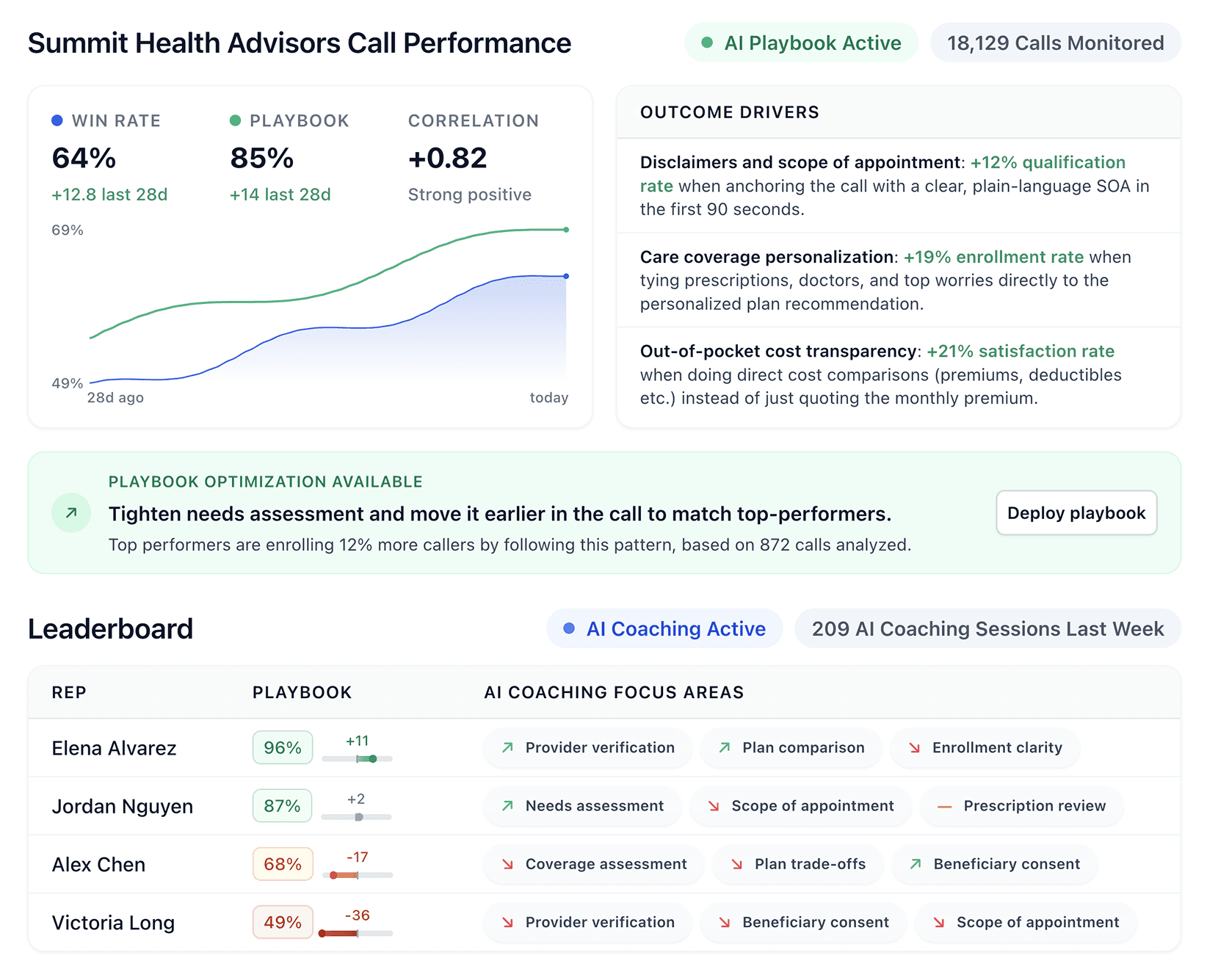
Alpharun fits alongside your existing dialer, CRM, and call recording tools by helping teams understand what top performers are doing differently and build stronger scripts around those behaviors.
With Alpharun, teams can:
Identify winning talk tracks from top-performing calls and turn them into repeatable script frameworks.
Build custom playbooks from real conversations rather than relying on generic cold calling templates.
See where prospects disengage most often so script improvements focus on the moments that matter.
Analyze objection-handling patterns to understand which responses lead to longer conversations and higher conversion rates.
Coach reps on script execution using examples pulled directly from their own calls.
Track script adherence across every call to understand which parts of the process are being followed consistently.
Monitor compliance language automatically for Medicare, insurance, and other regulated sales environments.
Instead of rewriting scripts based on assumptions, teams can improve them using evidence from the conversations already producing results.
See which talk tracks, questions, and objection responses are actually driving conversions on your floor. Book a demo with Alpharun today.
Frequently asked questions
What are the best sales scripts for cold calling?
The best sales scripts for cold calling provide structure while leaving room for a natural conversation. High-performing scripts include an opener, discovery questions, objection responses, and a clear next-step ask tailored to the prospect and industry.
Do sales scripts for cold calling actually work?
Yes, sales scripts can improve cold calling performance when they're used as a framework rather than read word for word. They help reps stay consistent, handle common objections, and guide conversations toward the next step.
How long should a cold calling script be?
A cold calling script should be concise and easy to reference during a conversation. Most effective scripts cover the opener, discovery questions, key objection responses, and the close on a single page.
What is the best opening line for a cold call?
The best cold call opening line clearly explains why you're calling and gives the prospect a reason to stay engaged. Permission-based openers often work well because they lower resistance and create a more natural conversation.
How do you handle rejection on a cold call?
Handling rejection starts with understanding the reason behind the response. A follow-up question can help determine whether the issue is timing, interest, budget, or something else, giving the rep more context for the next step.