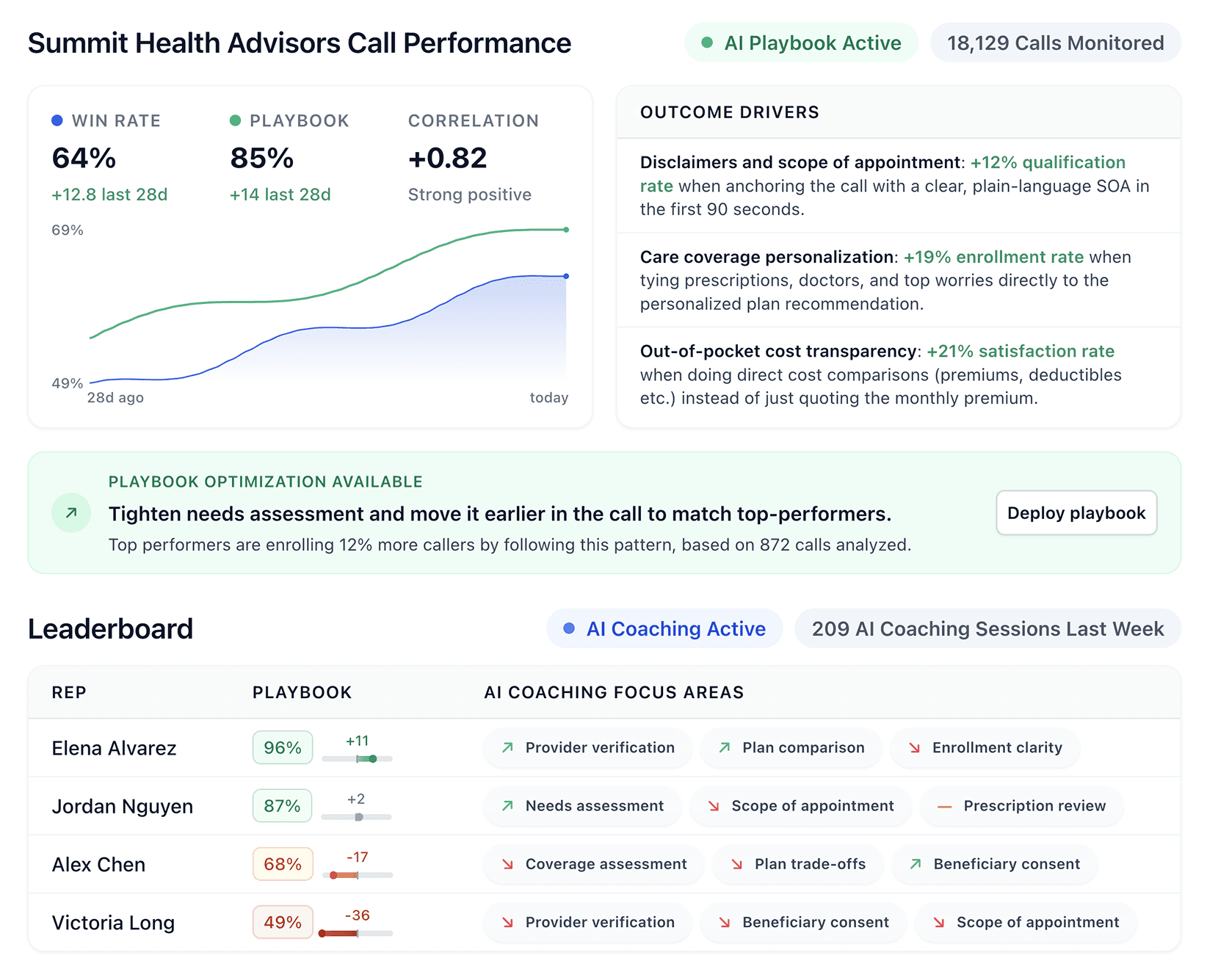


A sales training strategy is the system a sales organization uses to identify winning behaviors, coach them consistently, and reinforce them across the team over time.
The difference between top-performing sales teams and everyone else usually isn't more training. It's a better system for turning successful behaviors into repeatable habits across the sales floor.
Here's a four-step framework for building a sales training strategy that works, based on real conversations, measurable coaching, and continuous reinforcement.
How to build a sales training strategy in 4 steps
The call centers with the strongest rep performance share a few things in common, and none of them involve a better PowerPoint deck.
1. Start with what your best reps are doing
Many training programs rely on industry frameworks, third-party coaching materials, or broad sales methodologies. The problem is that those resources are rarely built around your team's playbook, objection patterns, or top-performing calls.
Your top 10% of reps are already running a winning playbook. The problem is that knowledge lives in their heads, not in your training program.
A real training strategy starts by pulling apart those calls: what language do they use during discovery? How do they handle the "I need to think about it" objection? At what point in the call does the enrollment happen?
That analysis becomes the foundation for your playbook, built from the winning behaviors already driving results on your sales floor.
Key takeaway: The highest-performing teams codify what works from real call data before they ever write a coaching guide.
2. Score every call across the sales floor
Most managers don't have enough visibility to coach consistently across every rep and every conversation. A manager reviewing 5 calls out of 500 is making decisions based on a 1% sample. With that level of visibility, important coaching opportunities can easily be missed.
The impact extends beyond performance metrics. Replacing a rep before they reach full productivity can cost organizations between 1.5x and 2x that employee's annual salary.
Effective call center training strategies build in systematic call scoring so managers know exactly where each rep stands across the full range of calls.
Which reps are struggling with compliance disclosures? Who's consistently losing deals at the qualification stage? Where are the patterns that signal someone's about to miss quota?
With visibility across every conversation, managers can identify recurring patterns faster and focus coaching where it will have the greatest impact.
Key takeaway: Scoring at volume is what separates a coaching culture from a coaching illusion.
3. Tie coaching to specific moments in conversations
"Be more confident on the close" is not coaching.
"Here's the exact moment at 2:14 where the buyer's tone changed and you talked through it instead of pausing" is coaching.
The reps who improve fastest get feedback tied to specific call moments. They hear what they said, they hear what their top-performing peers said in the same situation, and they understand exactly what to do differently next time.
That level of specificity requires both the data and the time investment from managers to deliver it consistently.
Building this into your training strategy means moving from quarterly reviews to continuous, call-level feedback. The cadence matters as much as the content.
Key takeaway: The fastest improvement comes from coaching tied to specific moments in real conversations.
4. Keep the playbook active in everyday conversations
Many training programs lose momentum after onboarding because reinforcement disappears over time.
New hires get the most training attention. Experienced reps get the least, even though a 10% lift in a veteran's close rate generates far more revenue than any onboarding optimization.
Effective training depends on consistent reinforcement. As market conditions change, objections evolve, and competitors adjust their positioning, sales playbooks need to evolve as well.
Regular coaching helps reps apply those updates in real conversations, keeping the playbook relevant long after onboarding is complete.
As teams grow, consistency depends on making successful behaviors visible and repeatable across the sales floor. Every rep should understand what strong performance looks like based on the conversations they're having today, the objections they're hearing, and how buyers are responding.
Key takeaway: Training only works when winning behaviors are reinforced consistently long after onboarding ends.
What separates a training strategy from a training event
📞 Training Event | 📈 Training Strategy |
Happens during onboarding | Runs continuously |
Based on generic frameworks | Built from your best calls |
Feedback is periodic and general | Feedback is specific and call-level |
Managers review calls they have time for | Every call gets scored |
Playbook is static | Playbook updates from real performance data |
High performers stay high performers | High performers raise the floor for everyone |
The companies that consistently hit quota have systems for identifying what their top performers do well and reinforcing those behaviors across the sales floor.
The role of AI in modern sales training strategy
Traditional coaching programs are limited by manager bandwidth. No matter how experienced a manager is, there are only so many calls they can review and coach each week.
Expanding coaching visibility
AI helps teams analyze every conversation instead of relying on a small sample of calls.
Calls can be scored against the sales playbook automatically, skill gaps can be identified across the team, and coaching recommendations can be generated for individual reps.
Managers still lead the coaching process, but they do so with a more complete picture of performance across the sales floor.
Helping managers focus where it matters most
The value of AI is not replacing managers. The value comes from helping them prioritize their time more effectively.
Instead of searching for coaching opportunities, managers can focus on the conversations, behaviors, and reps that will have the greatest impact on performance.
Supporting compliance at scale
For industries with strict compliance requirements, AI can also help strengthen compliance processes.
Call analysis can verify that required disclosures are delivered, qualification steps are completed, and approved language is being used consistently.
This gives teams broader coverage than manual reviews alone and helps reduce the burden of reviewing calls one by one.
Putting it together: How to audit your current training strategy
Before building or revamping a training program, it helps to be honest about where you stand. A few diagnostic questions worth asking:
What percentage of calls do managers review each week? If it's under 10%, you're coaching blind.
Is your training playbook built from your best calls or from external frameworks? Build it from external frameworks and you'll get generic results. Coaching from your own best calls is what moves the number.
How long does it take a new rep to reach full productivity? With average SDR ramp time at 3.2 months and average tenure at 1.5 years, you're working with roughly 15 months of productive selling per rep. Every month added to ramp eats directly into that window.
When did you last update your training materials? If it's been more than a quarter, the playbook may not reflect how your best reps are selling right now.
Can your managers tell you the top three coaching needs for each rep on their team? If not, the visibility problem is the strategy problem.
Most inside sales call centers find that their training strategy looks better on paper than it does on the floor. Managers are stretched thin, playbooks become outdated, and the behaviors driving success are rarely reinforced consistently across the team.
The organizations that solve this challenge build systems that define what good performance looks like, measure it consistently, and help every rep move closer to that standard over time.
How Alpharun builds your sales training strategy from the inside out
Alpharun is built for high-volume B2C inside sales teams with 50+ reps in Medicare, insurance, home services, and similar verticals. The whole platform starts with your own call data, so your training strategy reflects what wins on your floor, not what worked for someone else's team.
Custom playbooks: Built from your best reps' actual call flows, phrases, and objection-handling patterns. No borrowed frameworks, no guesswork.
Sentence-level coaching: Reps hear exactly what to fix and exactly where it happened on the call. "Be more confident" doesn't cut it here.
100% call coverage: Every call gets scored against your playbook. No more coaching the 1% and hoping it spreads.
Compliance as a coaching signal: Tracks whether reps are following the process, so managers know where training needs to go next, not just whether a disclosure got read.
Your human team gets sharper with every call. Your managers finally have the visibility to coach what matters. That's what a training strategy looks like when the data and the people are working together.
You're already recording every call. Book a demo with Alpharun and see what's inside them.
Frequently asked questions
What is a sales training strategy?
A sales training strategy is the system a sales org uses to build rep skills, reinforce winning behaviors, and close the gap between top performers and everyone else. It's the ongoing process of identifying what good looks like, coaching it consistently, and updating it as your market changes.
How often should sales training happen?
Sales training should happen continuously, not quarterly. The teams that hit quota treat coaching as a weekly rhythm because skills erode fast without reinforcement and reps revert to old habits within weeks of any standalone training session.
What's the difference between sales training and sales coaching?
The main difference between sales training and sales coaching is that training builds the playbook and coaching applies it to real calls. Training without coaching leaves reps knowing what to do but not doing it. Coaching without training means every manager is improvising their own standard.
How do you measure whether a sales training strategy is working?
Track ramp time, quota attainment, and call scores over time. If ramp is getting shorter, more reps are hitting quota, and call scores are improving, the strategy is working. If those numbers aren't moving, the training isn't sticking.
Why do most sales training programs fail?
Most sales training programs fail for three reasons: they're built on generic frameworks instead of the team's own winning calls, managers don't have the visibility to coach consistently, and reinforcement stops after onboarding. A program that doesn't address all three will keep producing the same results.