
The hardest part of sitting beside a rep on a live call is staying quiet when the urge to "help" hits. When a coach cuts in, the rep freezes, the customer hears it, and the call falls apart. Handled well, a sit-in shows you exactly what an agent does on a call, screen and all.
This ready-to-copy side-by-side coaching call center template covers the whole session: prep, live observation, a same-day debrief, and a follow-up that shows whether the change held. If you want the broader call center coaching template that covers every coaching format, start there. This guide sticks to the sit-in.
The side-by-side coaching call center template
Here's the template. Copy it into a doc, a sheet, or a printed form (Word, PDF, whatever your team actually opens) and fill in one block per phase of the session.
Block | What goes in it | Your notes |
|---|---|---|
Session overview | Agent name, date, call type, and the one focus skill | |
Observed behaviors | What happened, with timestamps and exact quotes | |
Agreed coaching actions | The one or two specific changes you both commit to | |
Follow-up and sign-off | Check-in date, Did it hold? (Y/N), agent + coach initials |
Fill in the overview before the call, jot down behaviors during it, and write the actions and follow-up together in the debrief. Four blocks, one page. A form that runs past one page has usually turned into a scorecard.
What side-by-side coaching is (and when to use it)
Side-by-side coaching means a coach sits next to an agent for a block of live calls, listening in on a shared headset and watching the agent's screen, then debriefs as soon as the calls end.
Of all the coaching methods a floor uses, it's the only one where the coach sees what the agent does on screen while the call happens. The agent agreed to it in advance and knows what you're there to work on, which is what keeps it from feeling like a surprise audit.
Reach for a sit-in when you're onboarding a new rep, rolling out a new script, or chasing a sudden drop in one behavior. You get the screen view and instant feedback, which is exactly what a green rep needs.
A sit-in also ties up one coach for one rep, call by call. When you only need to sample calls across the floor, remote listening takes far less coach time, but the coach can't see the screen or talk the call through with the agent face to face.
Use sit-ins to build one rep's skill and remote listening to check how the whole floor is doing. For reps who work from home, our remote sales coaching guide has seven practices for coaching from a distance.
Before the session: Prepare and agree the focus
A sit-in goes sideways when the rep feels ambushed, so prep is what keeps it developmental.
Agree on one focus before the call. Pick a single skill or call type (discovery, objection handling, the recording disclosure) and tell the rep that's what you'll both be watching.
Fill the overview block while you're at it: who, when, what call type, which skill. Walk in knowing the one or two behaviors you're there to watch.
Give the rep a heads-up the day before so they can self-reflect going in.
Keep the session off your QA scorecard. Scoring and coaching in the same breath makes reps defensive, which is why a repeatable agent coaching routine treats the two as separate jobs.
During the call: The live observation form
The rep picks up, leads with the opener you rehearsed, and 40 seconds in, the customer says, "I already have coverage." This is the moment you're there to capture, and how you capture it decides whether the debrief lands.
Run a simple observation form down the call. The middle column is your prompt sheet, and the notes column fills in as the call runs.
Call moment | What to watch for | Notes / exact quote |
|---|---|---|
Opening | ☐ Sets the agenda and reads any required disclosure | |
Discovery | ☐ Asks real questions before any pitch | |
Objection handling | ☐ Stays calm and answers the concern before talking price | |
Compliance lines | ☐ Required script lines delivered (on a Medicare call: the recording notice, the TPMO disclaimer before any benefits talk, and the Scope of Appointment (SOA) recorded before the plan discussion) | |
Close / next step | ☐ Makes a clear ask and books the next step |
On a Medicare call, that compliance row carries real stakes. CMS rules require every marketing and sales call to be recorded, and agents who sell for more than one Medicare Advantage organization must read the TPMO disclaimer before discussing any benefits. A missed line puts the plan at risk of CMS sanctions.
Write down exact quotes and timestamps as they happen. "At 3:42, you quoted the plan before confirming eligibility" gives the rep something to fix. "Your discovery needs work" gives them nothing.
The cardinal rule: note, don't interrupt. Let the rep own the call. Biting your tongue is hard, but mid-call corrections rattle reps and tip off the customer. Save every note for the debrief.
Watch the screen, too. A rep hunting through three tabs for a plan detail tells you something the audio never will.
This is also where a sit-in differs from a scored quality monitoring form: you're there to develop the rep, and the scoring can wait.
After the call: The same-day debrief
Debrief the same day, while the call is fresh for both of you. Wait a week and the moment is gone.
Let the rep talk first. Ask how they thought it went before you say a word. Their self-assessment shows you where their head is, and a rep who names their own miss is far more likely to fix it than one who gets told.
Then work through GROW, one behavior at a time:
Goal: What were you trying to do on that call?
Reality: What actually happened at 3:42?
Options: What could you try next time a customer opens with "I already have coverage"?
Will: Which option will you commit to?
Say the rep rushed past that objection straight into price. You ask what they were going for, replay the clip, and let them land on the fix: one discovery question before responding. Write that down as the agreed action. Keep the agreed actions to one or two behaviors.
If you want ready-made scripts for the tougher moments, our call center coaching examples break them down by scenario.
Following up: Did the coached behavior actually hold?
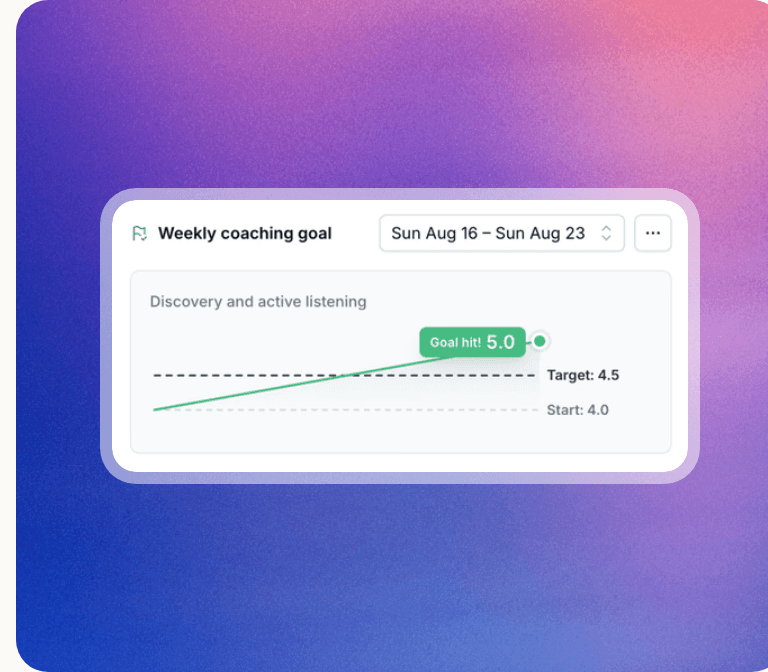
Alpharun's weekly coaching goal view, tracking one rep's discovery skills from a 4.0 start past a 4.5 target.
What matters after a sit-in is whether the behavior shows up on the rep's next calls.
Set a dated follow-up in the last block. A two-minute check-in a few days later beats a formal review three weeks out. "How's the discovery-first thing going?" keeps it alive.
A sit-in covers only the calls you watched. No manager can hand-review more than a slice of a busy team's calls, so the behavior you coached can quietly slip on the dozens nobody is listening to. Spot-checking a couple of the rep's next recordings by hand is the manual fix, and it beats guessing.
Scoring every call is what closes that gap for real. Alpharun grades each call against your own playbook, so you can see whether the coached behavior is repeated across the rep's next calls. Tie the follow-up to real agent performance metrics so you can watch the number actually move.
How Alpharun turns one sit-in into coaching that scales
A sit-in is the richest coaching data you'll get all week, and you get it one call at a time.
You coach one call well, then the next 50 happen without you, and the behavior either holds or fades where you can't see it. At a Medicare brokerage like Chapter, whose advisors handle hundreds of thousands of calls during the Annual Enrollment Period, almost every call happens without a coach listening.
Alpharun sits on top of your existing call setup and closes the loop. It builds a playbook from your best calls, then grades every call against it, so each sit-in becomes the first step in a rep's coaching.
With Alpharun, call center teams can:
Score every call against your own playbook
See whether a coached behavior held across a rep's next calls, down to the sentence
Surface the exact moments (a fumbled objection, a missed disclosure) worth sitting in on next
Catch script and compliance drift, like a skipped recording disclosure or a missing SOA, automatically
Send reps short coaching notes directly, plus a weekly digest for managers
Turn your strongest conversations into a shared standard the whole team coaches toward
The sit-in keeps its value, and Alpharun shows you whether what you coached holds up on the calls you never get to watch.
Book a demo to see how Alpharun scores your calls against your playbook and tracks whether coaching actually sticks.
Frequently asked questions
What is side-by-side coaching in a call center?
Side-by-side coaching is a planned session where a coach sits next to an agent during live calls, watches the screen, listens in, and debriefs right after. It targets one skill the agent agreed to work on.
How do you run a side-by-side coaching session?
You run a side-by-side coaching session in four moves: agree on one focus with the rep, observe live calls without interrupting, debrief the same day using GROW, and set a dated follow-up. Keeping it to one or two behaviors is what makes the change stick.
What's the difference between side-by-side coaching and remote listening?
Side-by-side coaching is hands-on, with the coach beside the rep, seeing the screen and debriefing instantly. Remote listening samples calls from a distance, which takes less coach time but loses the screen view and the face-to-face debrief. A sit-in builds one rep's skills, and remote listening shows how the whole floor is doing.
How often should you run side-by-side coaching?
Run sit-ins often with new reps, then taper them as the reps gain confidence. Tenured reps need one when there's a specific skill to work on, such as a new script or a drop in one behavior. Each session needs one clear focus and a dated follow-up.
Is side-by-side coaching the same as double jacking?
No. Double jacking is how the coach hears the call during a sit-in: a second headset plugged into the agent's line with a Y-cable. Side-by-side coaching is the whole session, from agreeing on the focus to the follow-up.


