
If you search "Allego pricing," you'll find two different companies with the same name. One sells electric-vehicle charging by the kilowatt-hour across Europe. The other is the sales enablement and training platform that call centers, banks, and life-science teams use to coach their reps. This guide is about the second one.
That second Allego doesn't publish a price. Vendr's deal data puts the median contract at about $49,600 a year, and third-party estimates gathered by Outdoo, an Allego competitor, put it at roughly $25 to $60 per user per month, a figure Allego hasn't confirmed. Its pricing page is a "Get Pricing" button.
This guide pieces together the real cost from Allego's own pricing page, the four product cards it lists there, and the third-party estimates that fill in the numbers Allego won't. By the end, you'll know what Allego really costs, what's included, and whether it's the right fit for your team.
How Allego pricing works
Allego pricing runs on a quote. You give Allego's sales team your seat count through the pricing page's quote form, and they come back with a number.
Underneath the quote, the model is consistent. Allego charges per user per month, billed annually upfront, and the rate depends on several factors, including how many seats you buy and how long you sign for.
Not every seat costs the same, either. Channel and partner-sales users get a lower list price, and non-revenue roles (think managers who review calls but don't sell) are priced well below a full seat.
One genuinely good part: Allego includes AI features and support in the seat price, with no usage-based fees, so a heavy month won't blow up your invoice.
The whole thing is sold as a consolidation play. Allego's pitch is that one platform replaces up to seven point tools (LMS/LXP, coaching, reinforcement, conversation intelligence, content management, digital sales rooms, and video selling), which is where the "save up to 50%" claim comes from. Whether that math works for you depends on how many of those seven you're paying for today.
Allego's four plans (and what's included)
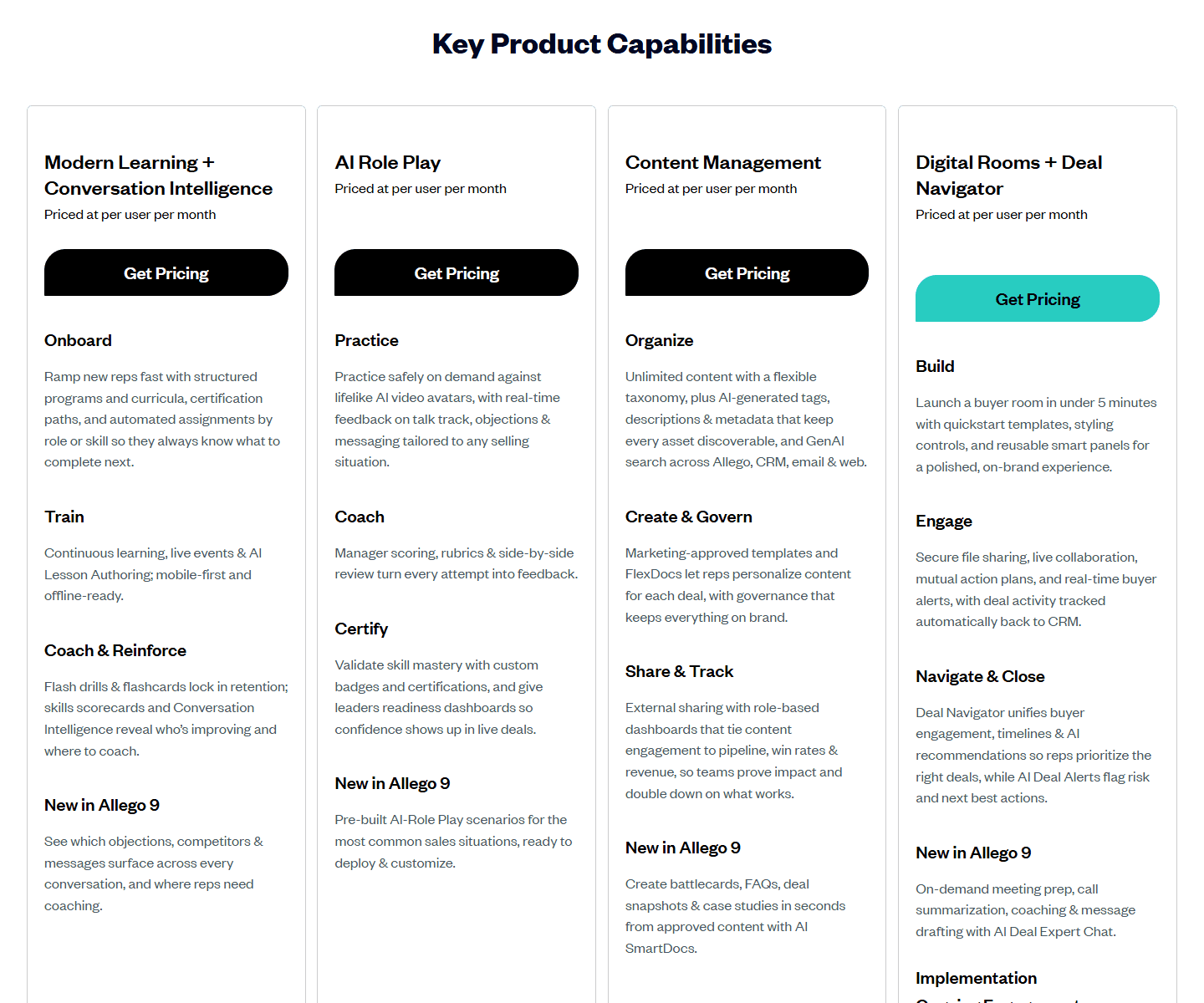
Allego's pricing page, showing its four product cards, each priced per user per month behind a "Get Pricing" button.
Allego's pricing page lists four product cards, each "priced at per user per month" with the number left blank behind a "Get Pricing" button. Here's what each one covers.
Plan | Best for | What's included |
|---|---|---|
Modern Learning + Conversation Intelligence | Teams focused on training and coaching | AI lesson authoring, flash drills and flashcards, conversation intelligence |
AI Role Play | Teams that want reps rehearsing before real calls | AI role-play practice, sold as its own card |
Content Management | Teams drowning in sales collateral | Unlimited content, GenAI search across Allego, CRM, email, and web, marketing-approved templates and FlexDocs, external sharing tied to pipeline |
Digital Rooms + Deal Navigator | Teams that want branded buyer spaces | Buyer rooms launched in under 5 minutes, secure file sharing, live collaboration, mutual action plans, real-time buyer alerts |
Every card is quoted the same way, per user per month, so get a price on the one capability you need first, then ask what adding a second card does to your per-seat rate.
Which card to start with: pick Modern Learning + Conversation Intelligence if coaching is the gap, AI Role Play if you mainly want reps practicing, Content Management if collateral is the mess, and Digital Rooms + Deal Navigator if buyer engagement is the priority.
What Allego actually costs
Allego won't quote a public number, so these figures come from third parties. Treat them as rough estimates.
Vendr pegs the median Allego contract at $49,600 per year, with deals ranging from $27,925 to $116,675 a year.
Outdoo, which sells a competing AI roleplay tool, collects third-party estimates that put Allego at roughly $25 to $60 per user per month, a figure Allego hasn't confirmed.
Allego says most deployments can be launched within four weeks.
Stack it all up, and a mid-sized rollout lands in the mid five figures a year, while a large enterprise deal clears six figures.
Contract terms and the costs people miss
Before you budget, check the contract terms too.
No free trial: Allego doesn't advertise a self-serve free trial, so the only way in is a scheduled demo. Budget time for a sales cycle before you ever see the product running on your own calls.
Three-year default: Allego's typical term is three years, paid annually upfront, with two- and one-year options available. For plenty of buyers, that multi-year lock-in is the single biggest hesitation.
Minimums you won't find on the page: Outdoo reports a $50,000 minimum annual commitment and a 100-user floor, which Outdoo pulled from a sales quote (Allego publishes no minimums of its own). Confirm it for your own deal, but it's a useful gut check: this isn't built for a 15-rep shop.
Included vs. extra: Premium Success Services (implementation, key integrations, and training) come with every deployment. Managed services, the hands-on help configuring integrations or building your content, cost more on top.
One lever worth knowing: Allego runs a Buyout Program that it says can cut your annual budget even if you're still under contract with another provider. The page doesn't say exactly what it pays for, so ask sales before you count on it.
Quote-only pricing is the norm in this category: Gong, Cresta, and AmplifAI all price on a custom quote too.
Is Allego worth it? Who the pricing fits
The real question is whether the pricing model fits your team.
It's a strong fit if you're an enterprise or mid-market B2B team in a regulated, consultative industry (financial services, life sciences, medical devices, and manufacturing), you're consolidating five to seven tools, and you need compliance built in.
Allego's trust page lists support for FINRA 17a-3 and 17a-4 recordkeeping, FDA 21 CFR Part 11 for learning records, and SOC 2 Type II certification. Allego's own customer stories also cite results like a 45% lift in win rates at RxBenefits.
It's a weaker fit if you want to start fast, can't commit to three years, or run a high-volume B2C inside-sales call center. Call centers live on different economics than enterprise field sales: short cycles, huge call volume, and ramp measured in weeks.
A seven-tool enterprise suite is a heavy way to answer one question, "coach my reps on their actual calls," and tools built for conversation-intelligence coaching at the call level often fit that job better. (Alpharun is one of them, and our guide to sales training platforms for call centers covers the rest.)
The cons reviewers raise most: search inside large content libraries can get clunky, admins face a steeper learning curve than end users, and integrations beyond Salesforce could go deeper, according to ZoomInfo's roundup of Allego reviews.
Allego alternatives, compared by pricing model
If Allego's price or commitment gives you pause, here's how the main alternatives stack up, by what they're best at and how they price. For a wider view, see our picks for sales readiness tools, where Allego sits alongside Mindtickle, Seismic, and Second Nature, plus our running list of sales coaching software.
Tool | Best for | Pricing model |
|---|---|---|
Alpharun | High-volume B2C inside-sales and call-center coaching | |
Mindtickle | Large enterprise readiness programs | |
Seismic | Content-heavy enablement at scale | |
Second Nature | Roleplay-first practice |
Alpharun, best for high-volume B2C call centers
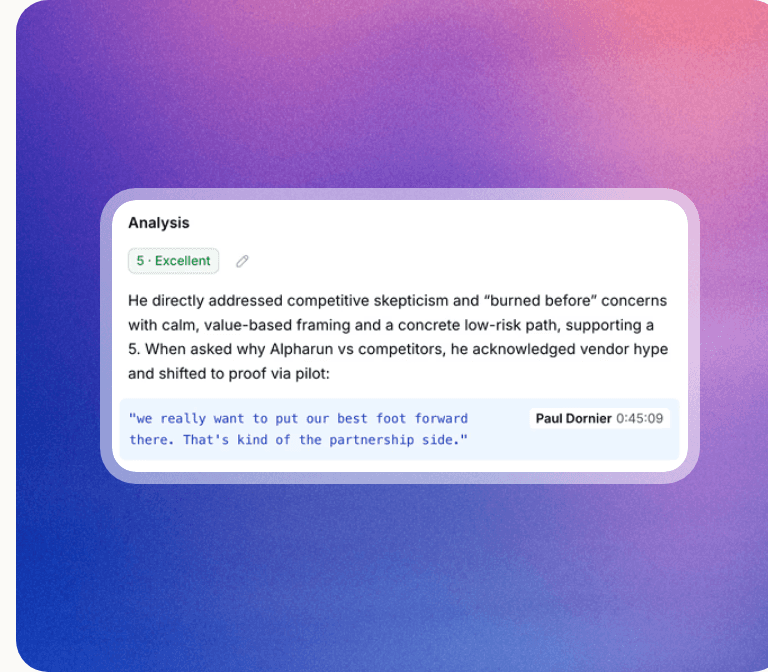
Alpharun's call analysis, rating how a rep handled a skeptical buyer and quoting the line from the call.
Alpharun is a sales performance platform built for inside-sales and call-center teams: the Medicare brokerages, life insurance agencies, and consumer-direct mortgage lenders running 20 or more agents on repeatable calls. It's a focused coaching tool built around one job: coaching reps on their real calls.
Alpharun builds a custom playbook from your best calls, scores every call against it at the sentence level, and sends reps specific feedback on the moments where deals are won or lost. AI roleplay helps new reps ramp, and it plugs into Five9 and Genesys.
Alpharun works with Medicare brokerages like Chapter, whose advisors handle hundreds of thousands of calls during the Annual Enrollment Period.
Pricing is quote-based like Allego's, but the product is built for the call-center economics described above. Honest limit: Alpharun isn't a full content-management and digital-sales-room suite, so if you need those enterprise modules, it isn't a like-for-like swap. Best for: B2C inside-sales and call-center coaching.
Mindtickle, best for enterprise readiness
Mindtickle's homepage, headlined "Your AI teammate for every deal."
Mindtickle (7.8 out of 10 on TrustRadius from 52 ratings) is the heavyweight for structured readiness and certification programs across large enterprise sales orgs. Pricing is custom-quoted, the same demo-first motion as Allego. Best for: big, process-heavy readiness programs.
Seismic, best for content at scale
Seismic's homepage, headlined "Move from preparation to GTM performance."
Seismic (7.8 out of 10 on TrustRadius from 144 ratings) leans hardest into content management and analytics. If your bottleneck is collateral sprawl more than coaching, it's the natural comparison. Pricing is custom. Best for: content-heavy enablement teams.
Second Nature, best for roleplay practice
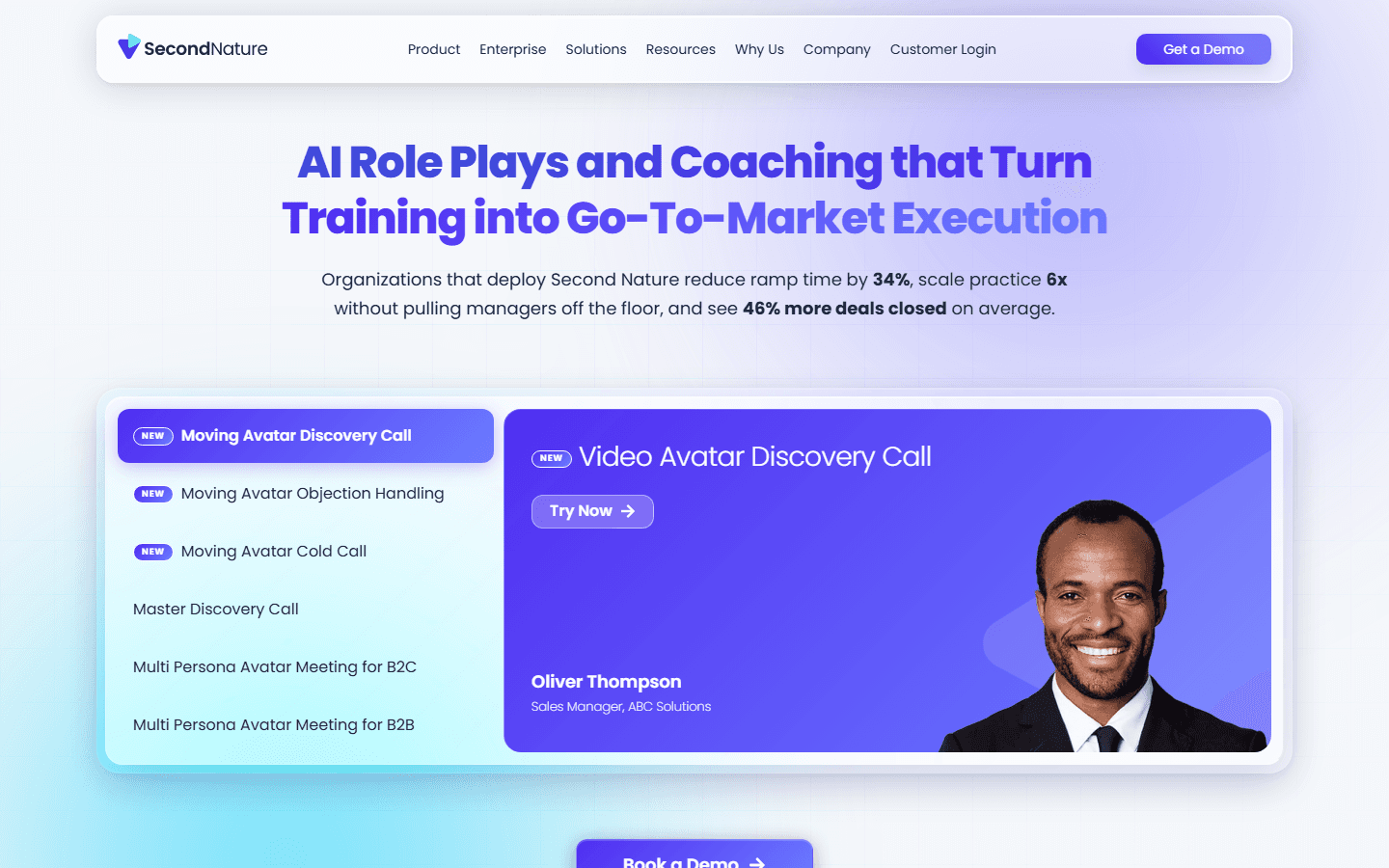
Second Nature's homepage, headlined "AI Role Plays and Coaching that Turn Training into Go-To-Market Execution."
Second Nature focuses on AI roleplay simulations so reps can practice before they're live. It's narrower than Allego and quote-priced as well; you can see how its pricing shakes out here. Best for: teams that want roleplay-first practice.
How Alpharun fits
Allego pricing is built for big, multi-year enablement programs. If that's you, the quote is worth getting.
If your problem is narrower, like getting every rep in a high-volume call center coached on their actual calls, a coaching tool built for that job covers it with less to buy.
Alpharun sits on top of your existing call setup (Five9, Genesys, or your own dialer) and turns your best calls into the standard everyone else is measured against. The promise is the best of both worlds: your human team performs at its peak, and AI handles the repetitive parts of the playbook that don't need a person.
With Alpharun, teams can:
Build a custom playbook from your top reps' real calls
Score every call against that playbook down to the sentence
Coach reps on the exact moments where wins and losses diverge
Run AI roleplay to ramp new hires faster
Send managers a weekly digest and reps their own coaching notes
Track performance across the whole floor, then drill into any single call
Integrate with Five9, Genesys, and other major contact-center platforms
When every call gets coached, the middle of your team starts to sell like your top 10%.
Book a demo with Alpharun to see how high-volume sales teams turn their best calls into the playbook for everyone.
Frequently asked questions
How much does Allego cost?
Allego costs about $49,600 a year at the median, according to Vendr, and third-party estimates put it at roughly $25 to $60 per user per month. Allego doesn't publish prices: it quotes per user per month, billed annually, based on seat count, contract length, and other factors.
Does Allego offer a free trial?
No. Allego doesn't advertise a self-serve free plan or free trial. The standard way to evaluate it is a scheduled demo with Allego's sales team.
Who are Allego's main competitors?
Allego's main alternatives include Alpharun (for call-center and inside-sales coaching), Mindtickle, Seismic, and Second Nature. Most of them price on a custom quote, just like Allego.
What's included in Allego's price?
Allego includes all AI features, customer support, and Premium Success Services (implementation, key integrations, and training) in its price. Managed services for extra integration or content work cost more on top.
Is Allego worth it?
Yes, for enterprise teams in regulated industries that want to replace several enablement tools with one platform. Leaner teams and high-volume B2C call centers often find the three-year default and a reported $50,000 annual minimum a poor fit, so they look at coaching-first alternatives instead.


