
"Hi, this is Sarah from BetterCoverage, calling about your life insurance coverage." Click. Gone before she finished the sentence.
Most reps "practice" cold calls by reading the script out loud once, then learning the hard way on a live prospect. That's an expensive practice. Cold call role play turns it into structured practice: reps rehearse the moments that actually decide the call (the gatekeeper, the first "not interested," the budget pushback) before a real buyer is on the line.
This guide gives you a repeatable practice loop, eight ready-to-run scenarios with the actual lines, a simple scorecard, and the one move most teams skip: turning real calls into the next role play. You can run your first one today, with a partner or an AI.
What cold call role play is (and why it beats reading a script)
Cold call role play is a practice method where one person plays the prospect and a rep rehearses a real scenario, start to finish, before using it on a live call.
Role play builds the reflex to recover when the prospect goes off-script, which they always do.
In high-volume inside sales, that reflex decides a lot of calls: a rep might run dozens a day, and the spread between your best and average performers is wide. The faster your middle reps learn to recover, the faster your whole team's numbers move.
It works because it rehearses the decisions behind the words. What do you say when the prospect talks over your opener? When they say they already have a provider? When they go quiet right after you mention price? Reps answer those well only after they've run them before.
This guide is written for B2C inside-sales and call-center teams: life insurance agents, mortgage loan officers, and the reps making consumer calls all day.
How to run a cold call role play: A 5-step practice loop
The teams that get the most out of role play run it as a loop. Here's the version that holds up on a busy floor.
1. Pick one skill to drill
Drill one piece of the call at a time, such as the opener, your discovery questions, or a single objection. One skill per session keeps the feedback specific and the rep from feeling buried.
2. Build a specific buyer persona
Give the buyer a name, a plan, a mood, and one objection they'll lead with: "Margaret, 52, already has life insurance through work and thinks it's plenty, and she's a little annoyed you called during lunch." A specific persona makes the rep run a real cold calling script against the kind of buyer they actually reach on the phone.
3. Run it once, straight through
Play the whole scenario without stopping to fix mistakes. Pausing every 10 seconds to coach kills the pressure that makes practice useful. Let it get a little messy.
4. Score it against a scorecard
Right after, score the call on a few fixed criteria (there's a scorecard below). Name what worked and the one moment it broke. Write it down. "That was pretty good" fades by the next call.
5. Repeat with exactly one change
Run it again, changing one thing. The managers who improve reps fastest change one behavior per round, then build from there.
8 cold call role play scenarios to practice (with scripts)
Here are eight you can run today, each with the setup, what the prospect actually says, and what a strong reply sounds like.
Scenario | What it drills | Prospect's first move |
|---|---|---|
1. The gatekeeper | Getting past a spouse or family member | "She's not interested, thanks." |
2. The first 15 seconds | A pattern-interrupt opener | "Who is this?" |
3. Early "I'm not interested" | Staying on the line without pushing | "I'm not interested." |
4. "I already have a plan" | Reframing against an existing provider | "I already have coverage." |
5. Budget pushback | Holding value before discounting | "That sounds expensive." |
6. "Just send me an email" | Turning a brush-off into a next step | "Just email me something." |
7. The skeptical prospect | Building trust fast | "How'd you get my number?" |
8. The referral ask | Asking without the awkwardness | (a call that went well) |
1. The gatekeeper
Setup: A spouse or adult child picks up for the person you're trying to reach.
Prospect: "She's not interested, thanks."
Strong rep reply: "Totally fair, and I don't want to be a bother. I'm calling because a lot of folks who bought life insurance years ago find their coverage no longer fits their family. Is she the best person to go over that, or are you helping her with it?"
The move: Respect the gatekeeper, give a reason they'd want passed along, then ask who owns the decision.
2. The first 15 seconds
Setup: The prospect answers, guarded. You have about one breath to earn the next 20 seconds.
Prospect: "Who is this?"
Strong rep reply: "Hey, it's Marcus. I'll be quick. I'm calling new homeowners because a mortgage changes how much life insurance a family needs. Did I catch you at an okay time for 30 seconds?"
The move: Name yourself, give a reason tied to them, and ask permission. If you need openers that land, study a few attention-getter examples and keep three in your pocket.
3. Early "I'm not interested"
Setup: It comes before you've said anything real, so treat it as a reflex and keep going.
Prospect: "I'm not interested."
Strong rep reply: "Makes sense, you don't know me yet. Most people I call say that in the first 10 seconds. Can I ask one question, and if it's not relevant, I'll let you go?"
The move: Agree, normalize it, and trade for one question. This is the drill where reps learn the difference between pushing and staying. Work through more common rebuttals once the pattern clicks.
4. "I already have a plan"
Setup: The prospect has an existing provider and no obvious reason to switch.
Prospect: "I already have coverage."
Strong rep reply: "Good, that means you're not starting from scratch. Quick question: when you picked it, did anyone check whether it still covers the mortgage? That's the thing that quietly changes."
The move: Validate the existing choice, then open one specific gap they probably haven't checked.
5. Budget pushback
Setup: Price comes up before value does.
Prospect: "That sounds expensive."
Strong rep reply: "I hear you, nobody wants another bill. Can I show you what's actually in it first? If it's not worth the number, I'll tell you myself."
The move: Acknowledge the cost, slow down, and earn the right to talk value before you defend price. Discounting on reflex just teaches prospects to keep pushing.
6. "Just send me an email"
Setup: A polite brush-off that usually means goodbye.
Prospect: "Just email me something."
Strong rep reply: "Happy to. So I don't send you a generic PDF you'll ignore, give me 10 seconds: are you more worried about the monthly cost or about how much your family would get? I'll send the one that fits."
The move: Say yes, then trade the email for a qualifying question and a reason to reply.
7. The skeptical prospect
Setup: The prospect is suspicious before you've earned anything.
Prospect: "How'd you get my number?"
Strong rep reply: "Fair question. You filled out a quote request a couple of weeks back on a comparison site, so you landed on my list. If that doesn't ring a bell, I'm glad to take you off it. Does that sound familiar?"
The move: Answer honestly, offer the exit, and let the honesty build the trust.
8. The referral ask
Setup: The call went well, and the prospect is happy. Most reps hang up here and leave money on the table.
Prospect: (warm, satisfied)
Strong rep reply: "Glad this helped. One quick thing: who else do you know who just bought a house or had a baby this year? I'd rather help someone you trust than cold-dial strangers."
The move: Anchor the ask to the good feeling you just created and make the referral about helping their people.
Two ways to practice: With a manager or peer, and with AI
Both modes work, and they're good at different things. A manager still catches things a bot can't.
With a manager or peer
Pick a buyer-player who'll actually stay in character and push back. The fastest way to ruin a role play is a partner who breaks character to be nice, so the rep never feels real pressure.
Keep feedback to one strength and one fix, both tied to the scorecard. One concrete change is easy to remember on the next call. If you're not sure what to ask in the debrief, these sales coaching questions give you a starting set.
With an AI role play tool or ChatGPT
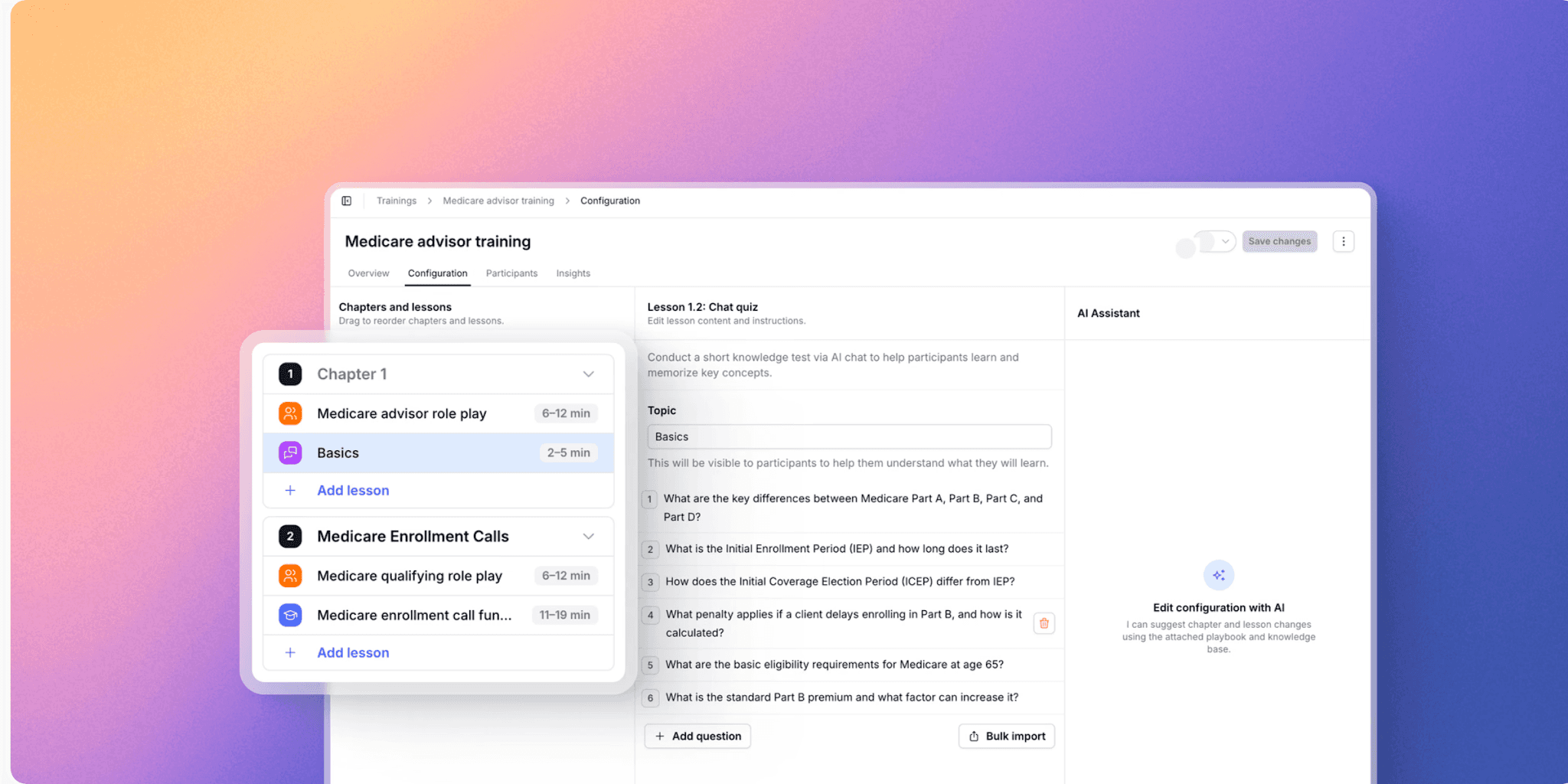
Alpharun's training builder, laying out a Medicare advisor course with role-play lessons and a knowledge quiz.
AI wins on volume. It runs reps at 2 a.m., never gets tired of the gatekeeper, and nobody feels embarrassed flubbing a line in front of a bot. Plenty of AI role-play tools are built for exactly this, and these Second Nature alternatives are a good place to compare them.
You can also just use ChatGPT. Try a prompt like: "You're a skeptical 45-year-old homeowner who just told a life insurance agent, 'I'm not interested.' Stay in character, push back twice, then let me try to recover. Score me at the end on opener, discovery, and objection handling."
The honest limit: AI is great for drilling objections at volume and weaker at reading tone than a human. Alpharun builds its AI role-plays from your reps' real calls, so each scenario targets a gap that actually showed up on the phone.
Score every practice call with a simple cold call scorecard
Five criteria are enough for a manager to score a call in under a minute, whether the rep practiced with a human or a bot. It's the same handful of things that make or break a live call. Our guide to nailing the essentials on every call covers them in more depth.
Criterion | What a strong call looks like | Score |
|---|---|---|
Opener | Keeps the prospect on the line past the first sentence | 0–2 |
Reason for calling | States a clear, specific reason the prospect cares about | 0–2 |
Discovery questions | Asks before pitching, and listens more than talks | 0–2 |
Objection handling | Acknowledges, reframes, then moves forward | 0–2 |
Next step booked | Ends with a specific, scheduled next step | 0–2 |
Score each line 0 (missed), 1 (okay), or 2 (strong). Adding up to a score of 10 is rare. Then agree on the single line to work on in the next session.
A quick note on calling rules
The best reps rehearse the compliance lines as carefully as the pitch. In regulated B2C calling (Medicare, life insurance, mortgage), the recording disclosure and any required disclaimer are part of the script worth drilling until they're automatic. Role-play the rep who reads them cleanly and still sounds human.
If you want the specifics, check the auto dialer and Telephone Consumer Protection Act (TCPA) rules that apply to your team, and scrub your call lists against the National Do Not Call Registry at least every 31 days.
Medicare is the exception: federal rules ban cold calls for Medicare Advantage and Part D plans, including calls to referrals, so Medicare advisors should practice these scenarios as return calls to people who asked to hear from them.
Turn your real calls into your next role play
Scripted scenarios get your reps ready for the objections you expect. Real calls also bring moments nobody scripted: the weird question, the off-tone pause, and the objection your best rep handles on instinct and your new hire fumbles.
You only catch those by listening to real calls. On a floor running thousands of calls a week, no manager has the hours to do that at scale.
That's the loop worth building: score real calls after they end, find the exact moment a rep struggled, and turn that moment into their next role play.
Alpharun is built for this.
With Alpharun, teams can:
Score every call automatically against the playbook you define, including compliance lines like recording disclosures
Pinpoint the exact moments that helped or hurt each call's score, down to the sentence
Turn recurring stumbles into targeted role play for the reps who need it
Send each rep short, specific coaching notes right after their calls without piling hours onto managers
Track whether objection handling actually improves call over call
Give managers one clear view of where the whole floor is winning and losing
It's the best-of-both-worlds setup: your reps still do the human work of talking to people, and Alpharun handles the listening and pattern-finding no manager could keep up with.
Alpharun works with Medicare brokerages like Chapter, whose advisors handle hundreds of thousands of calls during the Annual Enrollment Period, and it grades every one of those calls against Chapter's own playbook.
Book a demo with Alpharun to see how scoring your real calls turns into sharper cold call role plays, and sharper reps, this quarter.
Frequently asked questions
What are the 5 stages of cold calling?
The five stages of cold calling are the opener, qualification, the value pitch, objection handling, and the close or next step. Each stage is something you can role-play on its own, so pick one stage to focus each session on.
What is the 80/20 rule in cold calling?
The 80/20 rule in cold calling says roughly 80% of your results come from about 20% of your inputs, usually a handful of top reps and your best-fit lists. On the call itself, it's also a good reminder to let the prospect talk for most of discovery while you mostly listen.
Is B2B cold calling illegal?
B2B cold calling is legal in the United States, and most business-to-business calls fall outside the National Do Not Call Registry. Autodialed or prerecorded calls to cell phones still need consent under the TCPA. B2C calling is tighter: consumer numbers have to be checked against the registry, and Medicare plan sales calls can't be cold calls at all.
How often should reps practice cold call role play?
Reps should practice cold call role play in short, frequent sessions: 10 to 15 minutes a day will do more than one long monthly block. Drill one skill per session so the feedback stays specific and easy to act on the next day.
Can you use ChatGPT for cold call role play?
Yes, you can use ChatGPT for cold call role play by prompting it to act as a specific prospect and stay in character through your objections. It's great for high-volume objection reps, though a human partner still reads tone and nuance better than a bot.


