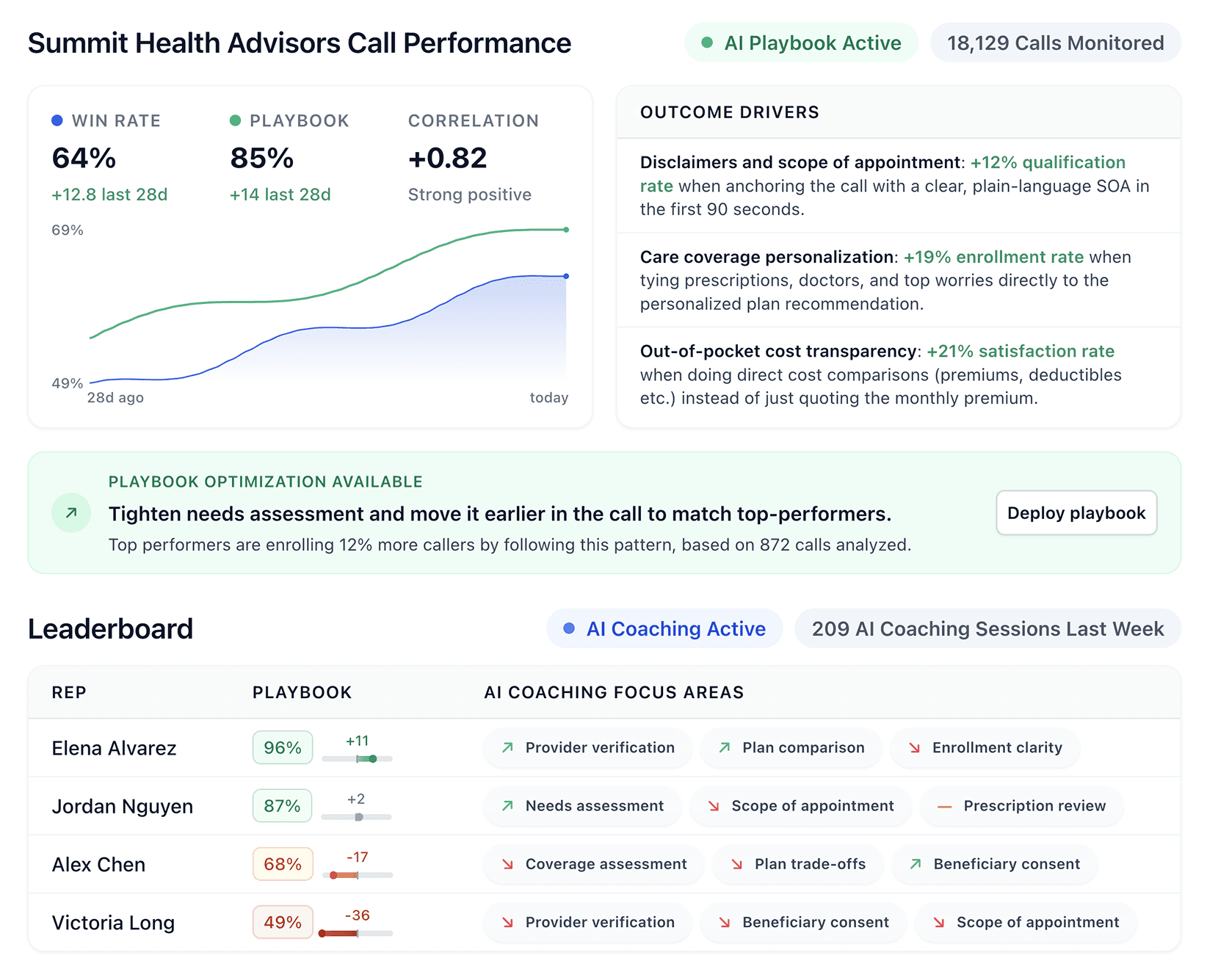


Ask a sales manager to name the competencies a great rep needs and you'll get a clean list in about ten seconds. Communication, discovery, objection handling, closing.
Then ask which of their reps is actually good at discovery, and which one just talks a lot and calls it rapport. The room goes quiet.
Knowing what a sales competency is turns out to be the easy part. Knowing who on your team has it, and being able to coach the ones who don't, is the hard part, and it's what separates a competency list from better numbers.
What is a sales competency?
A sales competency is an observable, repeatable capability that reliably drives a sales outcome. It's a bundle of knowledge, skill, and judgment you can watch a rep use on a call.
That word observable is doing a lot of work. If you can't see it happen on a call, you can't score it, and you can't coach it. Hold onto that, because it decides everything that follows.
It helps to separate three things people lump together:
A skill is a single ability, like asking a sharp follow-up question.
A competency bundles skills, knowledge, and judgment toward a job that has to get done, like running discovery.
A trait is wiring, like natural competitiveness. Useful, but hard to teach.
The good news for anyone who manages a team: competencies are learned. Reps aren't born knowing how to handle a price objection. They pick it up, usually by hearing how a stronger rep does it.
Why sales competencies matter
A defined set of competencies gives a new rep a target and gives a manager a map. "Get better at sales" becomes "get to proficient at discovery and objection handling," which is something you can coach toward and use to shorten the time it takes new reps to ramp.
Competencies turn "what my best rep happens to do" into a standard the whole floor can be held to, and the money is in that consistency.
RAIN Group's research on more than 1,000 sellers found top performers win 72% of their proposals compared with 47% for everyone else, with that top group making up just 18.7% of sellers. Most teams can name the competencies, far fewer can move them.
The 14 core sales competencies
There are a lot of these, so it helps to group them into four buckets: how you run the deal, what you know, how you work with people, and how you manage yourself.
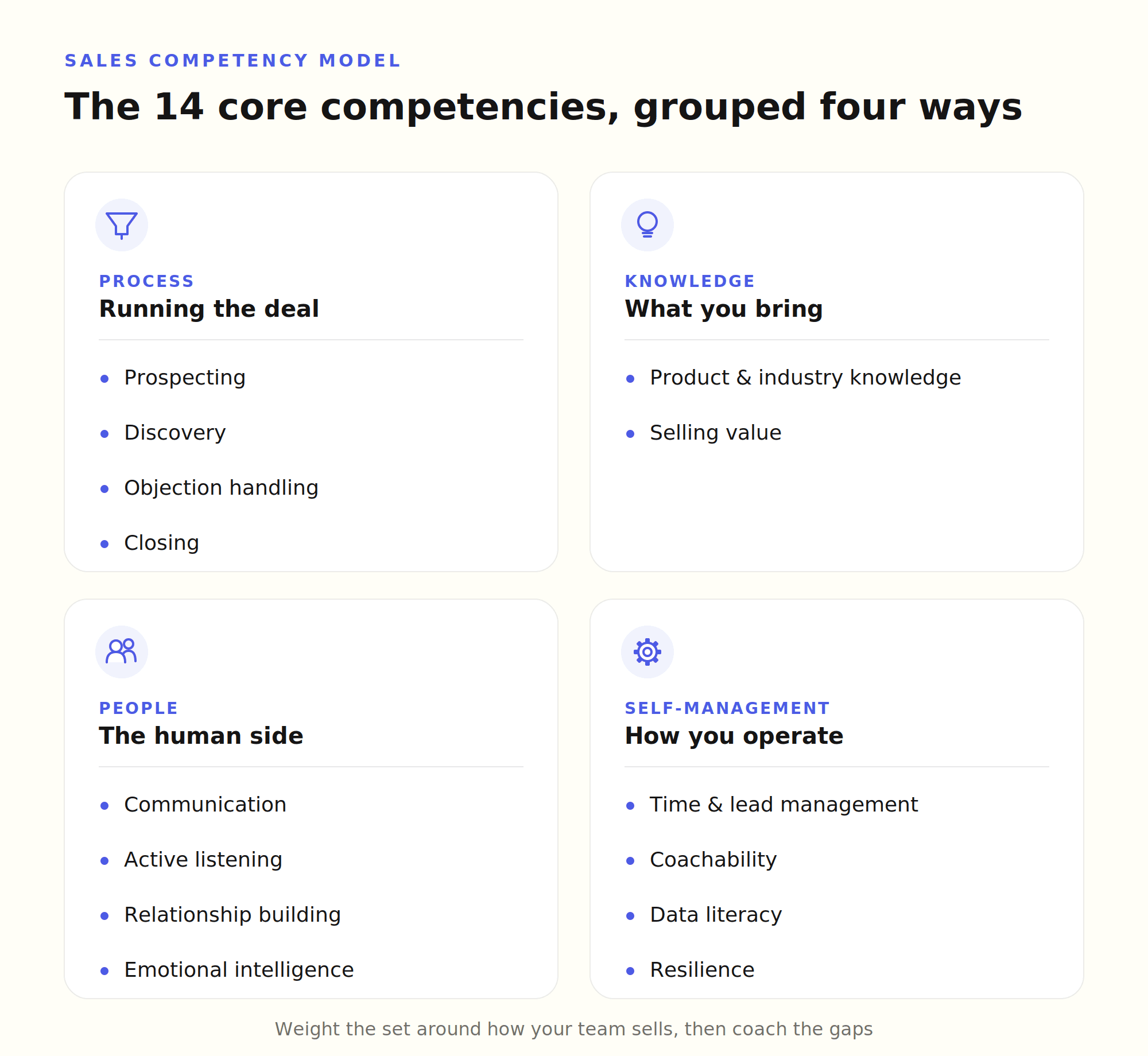
Process competencies: running the deal
These are the competencies that move a deal from first contact to signed.
1. Prospecting: Filling your own pipeline so you're never waiting on leads to land. On the floor, it looks like a rep who still has someone to call at 4 p.m.
2. Discovery: Uncovering the real need. Good discovery means the rep found the one constraint that decides the deal. Question count tells you almost nothing on its own.
3. Objection handling: Answering "it's too expensive" or "I need to think about it" in a way that moves the conversation forward.
4. Closing: Asking for the commitment and making the next step obvious. Plenty of strong calls die here because nobody actually asked.
Each of these maps to a stage of the sales cycle, so a weak competency tends to show up as deals stalling at the same point.
Knowledge competencies: What you bring
5. Product and industry knowledge: Knowing your product cold and knowing the buyer's world well enough to talk like an insider. A rep who fumbles a basic product question loses trust in one sentence.
6. Selling value: Tying the conversation to the buyer's outcome. The strongest reps make the buyer feel understood before they ever bring up a feature.
People competencies: The human side
7. Communication: Being clear and easy to follow, in plain language the buyer doesn't have to decode.
8. Active listening: Hearing what the buyer says, and what they avoid saying, then using it. Most reps are waiting to talk; strong reps are waiting to understand.
9. Relationship building: Creating enough trust that a stranger will take your advice on something that costs money.
10. Emotional intelligence: Reading tone and adjusting. When the buyer goes quiet, the rep who notices and slows down keeps the deal alive.
Self-management competencies: How you operate
11. Time and lead management: Spending your hours on the highest-value calls. In a high-volume role, this is whether a rep works the best leads first or just works the list top to bottom.
12. Coachability: Taking feedback and changing behavior the next day. This one predicts growth more than almost anything else on the list.
13. Data literacy: Reading your own numbers and knowing which one to fix. A rep who can see their conversion drop right after discovery can do something about it.
14. Resilience: Hearing "no" sixty times and dialing again. The job runs on it.
How to measure a sales competency
Most teams get stuck right here. A list tells you what good looks like, but it won't tell you which of your reps is doing it.
Measuring a competency means turning it into specific behaviors you can watch for on a call, then scoring those behaviors the same way every time.
📊 Level | 👂 What it sounds like on the call | ⚠️ What's missing |
|---|---|---|
Developing | Runs a question checklist, then moves on | Never follows up on the buyer's answers |
Proficient | Asks follow-ups, confirms the core need | Rarely surfaces budget or timeline |
Expert | Gets the buyer to say the real constraint out loud | This is the bar |
Once "good discovery" is written down like this, two managers scoring the same call mostly agree, which is the whole point.
The hard part is volume: A manager can listen to maybe three or four calls per rep per week, and at 60 to 100 calls a day that's a sliver of what actually happened, usually whatever happened to get flagged. You end up coaching off recency and luck.
Real measurement means scoring far more calls than a person can sit through, against the same standard every time. That's why teams lean on sales coaching software and call scoring to widen coverage.
It's also why the metrics you track should capture how well reps sell, beyond how much they dial.
How the competency mix changes with your sales motion
The competencies don't really change from team to team. The weighting does.
A high-volume inside sales team lives and dies on a handful of them: Prospecting cadence, call control, fast objection handling, and doing all of it the same way across hundreds of calls a week. Discovery still matters, but it gets compressed into about three minutes.
A complex enterprise deal flips the emphasis. Now it's account management, navigating five stakeholders, and selling value over a six-month cycle. The rep who's elite on a 90-second call might stall on a deal that takes nine months.
There's also a competency that's easy to overlook: Running a compliant call without killing the sale.
In regulated, high-volume work (insurance, lending, or financial services), a rep has to hit every required disclosure and still sound human and persuasive. That's a real, coachable skill, and on those teams it's table stakes.
So build your competency set around how your team sells. A model borrowed from a different motion will coach reps toward the wrong things.
How to build a sales competency model
You don't need a consulting engagement to build one. You need five steps and the discipline to keep using it.
Start from outcomes: Write down what the role has to produce: booked demos, closed policies, funded loans. The skills come after, derived from the outcome.
Pull the behaviors from your best calls: Listen to your top reps and write down what they do that the rest don't. This is the most reliable source you have, and it's the core idea behind data-driven sales coaching.
Set proficiency levels: For each competency, define what developing, proficient, and expert sound like, the way the discovery table above does.
Assess every rep against it: Score people honestly so you know where the team really stands.
Coach the weak spots, then re-score: Treat the model as a loop you keep running. The value shows up when you measure, coach, and measure again.
One more payoff: A clear model also tells you what to screen for when hiring, so interviews stop being a guessing game.
Be honest about the failure mode here. A model built in a workshop and saved to a shared drive does nothing. The teams that get value from one use it every week.
How to lift the reps stuck in the middle
Most teams pour coaching attention on two groups: The new hires who are struggling and the stars they want to keep happy, leaving the broad middle alone because they're "fine."
That middle is where the revenue hides, because a small lift across forty steady reps beats squeezing two stars who are already maxed out, and it's the logic behind most efforts to raise the performance of your whole floor.
The reason the middle plateaus usually isn't talent or training events. It's that nobody gives them specific feedback on their own calls often enough to change anything. A quarterly workshop teaches a concept, but it can't tell a rep that they rushed discovery on the call they ran at 2:15 today.
The fix is a tight loop:
Measure each rep's competencies against the defined standard
Give feedback tied to real moments in their own calls
Measure again to see whether it moved
RAIN's same study found that reps with an effective manager, regular coaching, and solid training are 63% more likely to be top performers. That loop is simple to describe and brutal to run by hand across a full team, which is the problem worth solving.
How Alpharun makes sales competency coaching consistent
Everything above comes down to two hard jobs: measuring competencies across every rep and every call, and reinforcing them often enough to move the middle. Managers can do this on a handful of calls, they can't do it on all of them.
Alpharun sits on top of your existing call setup and scores every call against a playbook built from your own best reps, so each competency becomes something you can see, grade, and coach consistently rather than whenever a manager happens to have time.
With Alpharun, teams can:
Score every call against a custom playbook drawn from the team's own top performers
Turn each competency into observable behaviors graded the same way every time
See exactly where each rep is strong or still developing, down to the sentence
Send reps specific coaching tied to real moments in their own calls
Surface team-wide competency trends so managers know where to spend their time
Alpharun handles the measurement and post-call coaching no manager has time to do by hand, so when every call gets scored against a real standard, coaching stops being a guess and the middle of your team finally has somewhere to go.
Book a demo to find out which competencies are holding your middle performers back.
Frequently asked questions
What is a sales competency?
A sales competency is an observable, coachable capability that reliably drives sales outcomes. It blends the knowledge, skill, and judgment a rep applies during a call, like discovery or objection handling.
What are the core sales competencies?
The core sales competencies include prospecting, discovery, product and industry knowledge, communication, active listening, objection handling, negotiation, closing, relationship building, emotional intelligence, time management, and coachability.
Most teams group them by process, knowledge, people, and self-management.
What's the difference between a sales skill and a sales competency?
A sales skill is a single ability, like asking a good follow-up question. A sales competency bundles several skills, plus knowledge and judgment, toward a job the role has to do, like running a full discovery.
How do you measure sales competencies?
You measure sales competencies by defining the observable behaviors behind each one, setting proficiency levels (developing, proficient, expert), and scoring those behaviors consistently across as many calls as possible.
How do you improve sales competencies across a team?
You improve sales competencies by building a model from your best calls, assessing each rep against it, and coaching the weak spots with frequent, specific feedback. Structured sales training and regular coaching speed it up.