Compare the 9 best call center software for the automotive industry in 2026, with honest pros, cons, pricing, and picks for dealers and auto call centers.

A customer calls your service drive at 6:47 p.m. to book a warranty repair. Nobody picks up. By morning, they've called the dealership two exits down the highway, and that repair order, plus the trade-in and the next lease, is gone.
That's the problem automotive teams are solving for. When calls to a dealership or service department go unanswered, every missed call is a sales lead, a service booking, or an F&I follow-up that walks away. The right call center software for the automotive industry is the difference between catching those calls and funding your competitor's month.
We compared the major call center and contact center platforms against what automotive teams actually deal with: DMS and CRM integrations, after-hours coverage, compliance, and the coaching it takes to get a busy BDC performing. We also checked pricing straight from vendor pages. Here's where each tool fits, where it falls short, and how to pick the one that solves your bottleneck.
9 best call center software for the automotive industry: TL;DR
Five9: Best for large auto-finance and auto-insurance call centers running high-volume blended campaigns.
Genesys Cloud CX: Best for multi-rooftop dealer groups routing sales, service, and parts calls from one system.
Talkdesk: Best for dealer groups that want built-in AI without a long enterprise rollout.
NICE CXone: Best for compliance-driven call centers that need every call recorded and scored.
Dialpad: Best for single and mid-size dealers that want AI transcription without enterprise complexity.
RingCentral: Best for dealers that want store phones and a contact center from one vendor.
JustCall: Best for small BDCs that do most of their follow-up by text.
VinSolutions: Best for dealers who want an automotive-native CRM at the center of their calling.
DriveCentric: Best for dealership sales teams that want AI agents following up on every lead.
What to look for in automotive call center software
A dealership BDC juggles sales leads, service scheduling, parts, and recall outreach, often across three rooftops and two DMS platforms. So before you shortlist anything, know what call center software actually has to do for a dealer.
Here's the checklist we used to evaluate every tool on this list:
DMS integration depth: The software should sync cleanly with your DMS and CRM, including CDK, Reynolds & Reynolds, and Tekion, and read lead data in ADF (the Auto-lead Data Format that dealers already run on).
CRM fit: Native or tight hooks into VinSolutions, DealerSocket, or DriveCentric so call notes and outcomes land where your reps already work.
Multichannel: Voice, SMS, WhatsApp, email, and web chat in one place. Car buyers text now, and a platform that ignores that loses them.
After-hours and missed-call capture: Overflow routing, callback queues, and voicemail-to-lead so the 6:47 p.m. call gets caught.
Appointment scheduling: Hooks into service schedulers like Xtime for booking service and test drives without a second tool.
AI assist: Transcription, call summaries into the CRM, and predictive outreach for lease maturity and service-due reminders.
Compliance: Call recording with consent, TCPA support for outbound, and PCI handling for any F&I payment taken over the phone.
Coaching and QA: The part most buyers skip, and the one that decides whether your average rep closes like your best one.
Scalability: Pricing and admin that work whether you're a single store or a centralized auto-finance floor with 200 seats.
It's easy to shop the first two criteria and forget the last two. Shop for integration depth and coaching, because a recorded call that nobody reviews is just storage.
The 9 best call center software platforms for automotive teams
Quick comparison first, then the honest per-tool breakdown.
Platform | Best for | Standout for automotive | Starting price |
|---|---|---|---|
Five9 | Enterprise auto-finance and insurance floors | High-volume blended dialing + compliance | |
Genesys Cloud CX | Large multi-rooftop dealer groups | Voice routing + speech-enabled IVR | |
Talkdesk | AI-driven omnichannel dealer groups | Built-in AI + low-code workflow builder | |
NICE CXone | Compliance-heavy auto-finance and insurance | 100% recording + QA at scale | |
Dialpad | Single and mid-size dealers wanting built-in AI | Native AI transcription + a real auto product | |
RingCentral | Dealers wanting phone and contact center in one | Unified comms across the store | |
JustCall | Small-to-mid dealerships and BDCs | Fast CRM setup + heavy SMS | |
VinSolutions | Dealers wanting automotive-native CRM + calling | Autotrader and Dealer.com tie-ins | Contact for pricing |
DriveCentric | AI-forward dealership sales engagement | Conversational AI for BDC follow-up |
1. Five9

Five9's homepage, with the headline "Containment rate looks good, but CSAT tells a different story?" beside a glowing voice waveform.
What it does: Five9 is a cloud contact center platform built for high-volume inbound and outbound calling, with a predictive dialer, IVR, and workforce management.
Best for: Large auto-finance and consumer auto-insurance call centers running blended campaigns where compliance and volume both count.
Key features:
Blended dialing: Inbound, outbound, and predictive modes for heavy outreach
CRM integrations: Prebuilt adapters for Salesforce, Microsoft, ServiceNow, Oracle, and Zendesk, plus APIs for connecting dealer systems yourself
AI and analytics: Live transcription from Core, with agent assist on the Plus and Enterprise tiers
Compliance tooling: Call recording, DNC list management, time-zone dialing rules, and a TCPA Manual Touch mode
Pros | Cons |
|---|---|
Handles very high call volume reliably | Agent assist and quality management sit on higher tiers |
Deep outbound and compliance controls | 50-seat minimum prices out small dealers |
Fits floors already running Salesforce | You configure the automotive workflows yourself |
Pricing: Five9 publishes two entry tiers, Digital at $119 per concurrent user per month (digital channels only) and Core at $159 (all channels), with higher tiers quote-based and a 50-seat minimum on every plan. See our full Five9 pricing breakdown for how the tiers stack up.
Our take: Five9 earns its spot when you're running a real auto-finance or insurance floor. For a single store, it's overkill, and you'll spend real time configuring the automotive pieces yourself.
2. Genesys Cloud CX

Genesys's homepage, with the headline "The agentic AI CX platform for the enterprise" over a photo of a woman holding her phone on a busy street.
What it does: Genesys Cloud CX is an omnichannel contact center platform with AI-powered routing, journey analytics, and workforce engagement.
Best for: Multi-rooftop dealer groups that need one system routing sales, service, and parts across locations.
Key features:
Omnichannel routing: Voice, email, chat, and messaging on one queue
Journey analytics: Measure and optimize customer journeys across channels (included on CX 4)
Workforce engagement: Forecasting, scheduling, and QM built into CX 3 and up
Open platform: APIs and a marketplace of add-ons
Pros | Cons |
|---|---|
Scales cleanly across many locations | Admin overhead needs a dedicated owner |
Routes sales, service, and parts calls from one system | Higher tiers get expensive fast |
Broad integration marketplace | Sized for large dealer groups |
Pricing: CX 1 starts at $75 per user per month, billed annually, with CX 2 at $115, CX 3 at $155, and CX 4 at $240 per user per month, and a $2,000 monthly minimum. Our Genesys Cloud CX pricing guide walks through which tier fits which team.
Our take: Genesys is a strong pick for a dealer group with real scale and someone to own the platform. If you're a two-store operation, you'll pay for headroom you won't use for a while.
3. Talkdesk

Talkdesk's homepage, with the headline "The hybrid workforce starts here." beside a sample chat between a customer and an AI agent.
What it does: Talkdesk is an AI-first omnichannel contact center with low-code workflow building and industry experience clouds for sectors like financial services, insurance, and retail (none for automotive).
Best for: Dealer groups that want automation and AI without a long enterprise rollout.
Key features:
Talkdesk AI: Transcription, summaries, and virtual agents
Industry clouds: Prebuilt workflows you adapt instead of build
Low-code builder: Route and automate without heavy dev work
Quality management: Scoring and feedback in-platform
Pros | Cons |
|---|---|
Fast to stand up versus legacy CCaaS | Licensing gets complex as you add modules |
Cuts BDC note-taking with transcripts and summaries | Voice needs the $105 plan, not the $85 digital one |
Flexible automation | No automotive-specific cloud out of the box |
Pricing: Voice plans start at $105 per user per month (Voice Essentials), with Elite at $165 and Industry Experience Clouds at $225. The $85 Digital Essentials plan covers chat, email, SMS, and social only.
Our take: Talkdesk is a good middle path between a phone system and a full enterprise suite. You still adapt the workflows to automotive yourself, so budget setup time.
4. NICE CXone

NICE's homepage, with the headline "The AI platform built for better customer experience" beside previews of its agent dashboards.
What it does: NICE CXone records and analyzes every interaction, then layers AI quality management and workforce tools on top.
Best for: Compliance-driven auto-finance and insurance call centers that need airtight recording and QA at scale.
Key features:
100% interaction recording: Every call is captured for audit
AI quality management: Automated scoring across all calls
Workforce management: Forecasting and scheduling built in
Interaction analytics: Pattern detection across conversations
Pros | Cons |
|---|---|
Recording and compliance are best-in-class | Built for enterprise, heavy for small dealers |
Scores every call, so QA keeps up with volume | Needs dedicated admin resources |
All-in-one operational suite | Quality management starts on the $135 Essential suite |
Pricing: Suites run from $110 per agent per month to $249; quality management starts on the $135 Essential suite, workforce management on the $169 Core suite, and interaction analytics on the $209 Complete suite.
Our take: If a regulator could ask for any call at any time, NICE CXone is the safe answer. For a dealership sales BDC without that pressure, a lighter platform like Dialpad or JustCall covers the basics.
5. Dialpad

Dialpad's homepage, with the headline "Know your customers like never before" above a sample appointment confirmation card.
What it does: Dialpad is an AI-native communications platform with a contact center product and a dedicated automotive story.
Best for: Single and mid-size dealers that want AI transcription and coaching without enterprise complexity.
Key features:
AI Transcription and AI Recaps: Real-time transcription and post-call summaries
Power dialer: Outbound cadence for sales and service outreach, through Dialpad Sell (included from its Advanced tier)
QA scorecards: AI Scorecards included on Premium, an add-on on Essentials and Advanced
CRM and DMS hooks: Integrations aimed at dealer workflows
Pros | Cons |
|---|---|
Transcripts and summaries without an enterprise rollout | Less depth than enterprise CCaaS at high volume |
Friendly setup for smaller teams | Advanced routing trails specialist platforms |
Real automotive product and messaging | Reporting is lighter than NICE or Genesys |
Pricing: The Support (AI Contact Center) plan starts at $95 per user per month on Essentials ($80 billed annually).
Our take: Dialpad is one of the few vendors that actually markets to dealers, and its AI is genuinely useful for a smaller store. Push it to enterprise volume, and you'll feel the ceiling.
6. RingCentral

RingCentral's homepage, with the headline "The Agentic Voice AI platform to drive customer outcomes" beside its ACE AI avatar.
What it does: RingCentral combines a business phone system with a contact center product, so a store can run internal comms and customer calls on one platform.
Best for: Single and multi-rooftop dealers that want phones, messaging, and a contact center from one vendor.
Key features:
Unified comms: Phone, video, and messaging for the whole store
RingCX contact center: Skills-based routing, IVR, and agent screen recording
SMS and digital: Text-first follow-up for buyers who won't answer calls
Integrations: Salesforce and Zendesk on Advanced and up, plus dealer tools like ChangePointAuto and Digital Concierge
Pros | Cons |
|---|---|
One vendor for store phones and contact center | Contact-center depth trails specialist CCaaS |
Reaches buyers who only answer texts | AI quality management starts on RingCX Professional |
Familiar, easy to adopt | No native connectors listed for dealer systems like CDK or VinSolutions |
Pricing: RingEX phone plans start around $30 per user per month ($20 billed annually); the RingCX contact center starts at $65 per user per month. If recording is a priority, here's whether RingCentral records calls and how to set it up.
Our take: RingCentral is the pragmatic pick when you want your rooftop's phones and its BDC on the same bill. Just know the contact center piece isn't as deep as a dedicated CCaaS.
7. JustCall

JustCall's homepage, with the headline "One platform for every call, text, and follow-up" above a preview of its sales dialer.
What it does: JustCall is a voice and SMS platform with an AI sales dialer, aimed at teams that want quick setup and CRM sync.
Best for: Small-to-mid dealerships and BDCs that live in SMS and want to be up and running in a day.
Key features:
Voice, SMS, and WhatsApp: Multichannel outreach in one inbox
Sales dialer: Power dialing from the Pro plan, with predictive dialing on the quote-based SalesPro plan
AI transcription and coaching: Call summaries on every plan, with AI call scoring from Pro Plus
CRM integrations: Connectors for 100+ CRMs such as HubSpot, Salesforce, and Zoho
Pros | Cons |
|---|---|
Quick to deploy for a small BDC | Not an enterprise workforce platform |
Fits BDCs that do most follow-up by text | Lighter analytics than the big CCaaS suites |
Affordable entry point | Deep DMS integration takes extra work |
Pricing: Starts at $39 per user per month ($29 billed annually), with a two-license minimum. Our JustCall review covers the plan tiers and where it fits.
Our take: JustCall is the fast, affordable option for a smaller BDC that wants texting and dialing handled well. It's a great phone and SMS engine, so pair it with a real CRM for the dealer-specific work.
8. VinSolutions (Cox Automotive)
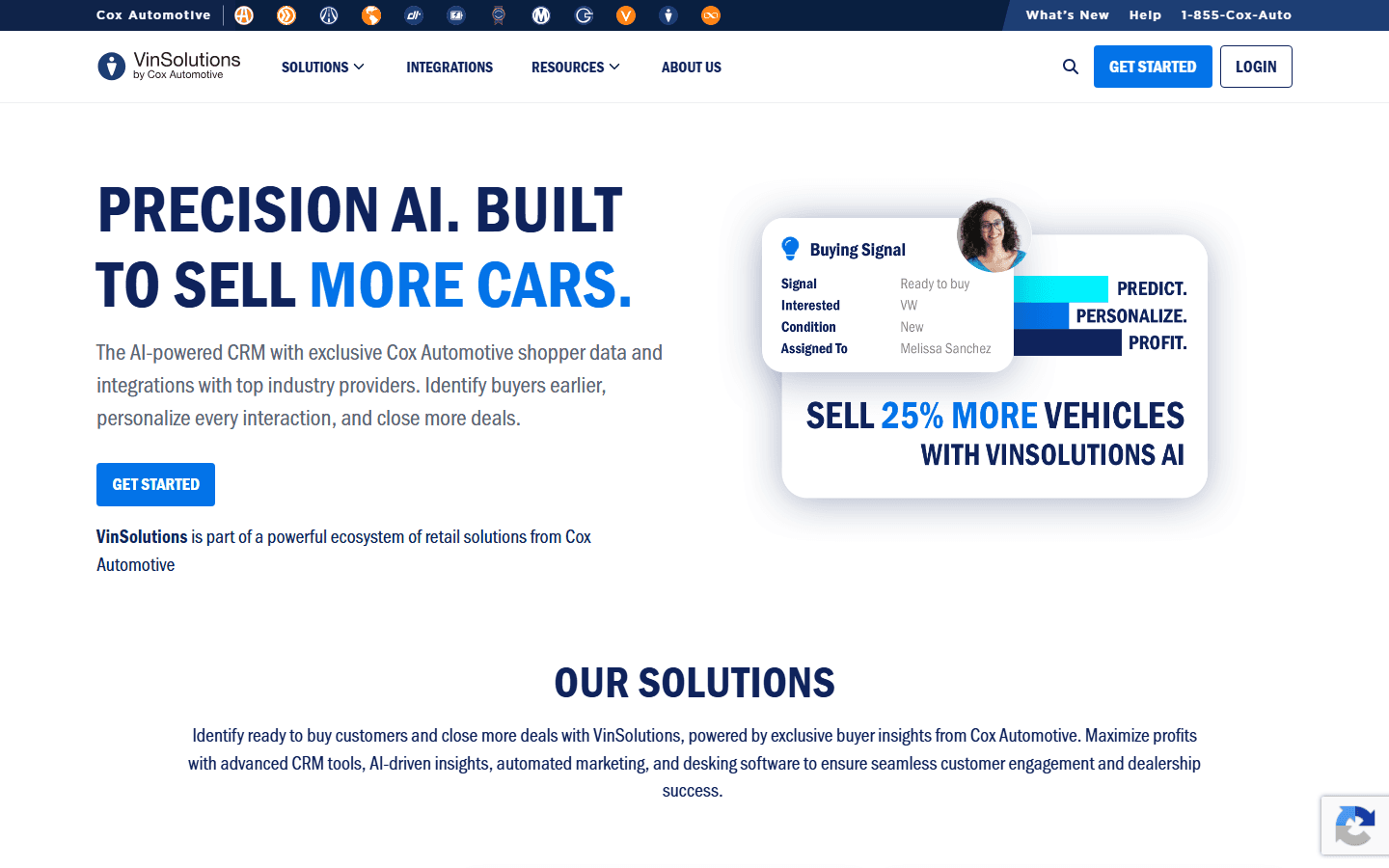
VinSolutions' homepage, with the headline "Precision AI. Built to sell more cars." beside a sample buying-signal card.
What it does: VinSolutions Connect CRM is an automotive-native CRM for dealership lead and deal management, with call tracking and texting available as add-ons.
Best for: Dealers who want their calling and their CRM to speak automotive out of the box.
Key features:
Automotive CRM: Lead, deal, and follow-up management for stores
Cox Automotive tie-ins: Connects to Autotrader and Dealer.com
Call tracking and texting: Customer comms logged against the deal
Automated follow-up: Automated email and text follow-ups with recent customers and leads
Pros | Cons |
|---|---|
Built for dealership workflows | Call tracking and texting are paid add-ons |
Autotrader and Dealer.com leads land in the same CRM | Pricing is quote-only |
Strong lead management | High-volume routing isn't its strength |
Pricing: Contact for pricing (quote-based, typical for dealer platforms).
Our take: VinSolutions is the automotive-native option when your CRM is the center of gravity. If you're running a high-volume inbound floor, treat it as the CRM layer and pair it with a real contact center platform.
9. DriveCentric

DriveCentric's homepage, with the headline "The CRM your dealership wants to use." over a preview of its sales pipeline.
What it does: DriveCentric is an AI-forward dealership CRM and sales-engagement platform with built-in texting, calling, email, video, and AI agents.
Best for: Dealership sales teams and BDCs that want AI-assisted follow-up on every lead.
Key features:
AI Agents: Sales, nurture, prospecting and service-to-sales agents built into the CRM for lead response and follow-up
Video and texting: Personal outreach at scale
Engagement automation: Keeps leads warm without manual work
Dealer CRM: Deal and pipeline management
Pros | Cons |
|---|---|
Modern, AI-first engagement | Priced per rooftop on annual or multi-year agreements |
Strong texting and video | Not built as a high-volume contact center |
Fewer leads go cold while reps are busy | Lighter on formal recording and audit tooling |
Pricing: Quote-based, priced by rooftop and units sold, on an annual or multi-year agreement.
Our take: DriveCentric shines at keeping leads engaged when your problem is follow-through, not call routing. For regulated auto-finance work, you'll want stronger recording and QA alongside it.
How AI is changing automotive call centers
AI is doing real work in dealership call centers now, and it's worth separating the useful parts from the hype. The wins are concrete: answering overflow and after-hours calls, transcribing conversations into the CRM automatically, and pushing predictive outreach for lease maturity and service-due reminders before a customer even thinks to call.
Speed helps too. Faster lead response means fewer buyers calling the next dealer.
After the call ends, every conversation your reps have becomes coaching material, and conversational intelligence software turns those calls into feedback your reps can actually use, so they stop dying in a recording archive.
Be honest about the limits, though. AI can answer a service question at midnight, but it won't close an F&I product or handle a nervous first-time buyer the way a trained closer will. Use it for the repetitive parts, and keep your people on the calls that decide the deal.
Matching software to your automotive use case
The best tool depends on which part of the automotive world you're calling from. A service BDC and an auto-insurance floor have almost nothing in common except the phone.
Use case | Top priority | Best-fit options |
|---|---|---|
Dealership sales / BDC | Lead speed, missed-call capture, CRM sync | Dialpad, JustCall, VinSolutions, DriveCentric |
Service & parts | Scheduling hooks, inbound routing, recall outreach | Genesys, Talkdesk, RingCentral |
F&I / auto-finance | PCI-compliant recording, high-volume outbound, QA | Five9, NICE CXone |
Consumer auto-insurance | TCPA compliance, quote-to-bind speed, QA at scale | Five9, NICE CXone, Genesys |
For F&I and auto-finance teams, compliance drives the decision. You need call recording software with redaction for any payment taken over the phone, plus consent tracking and QA that can actually keep up with the volume.
Consumer auto-insurance call centers carry the heaviest load. High outbound volume means the TCPA (enforced by the FCC), state insurance regulations, and telemarketing rules govern most outbound dials, and quote-to-bind speed decides the month. These high-volume, regulated floors are where coaching and QA at scale stop being nice-to-haves, because a two-point lift in close rate across 150 agents is a very large number.
Final verdict
For a high-volume auto-finance or auto-insurance floor, Five9 is the pick: it handles blended outbound at scale and has the compliance controls for regulated calling needs. NICE CXone is the safer call when every conversation has to stand up to an audit, and Genesys Cloud CX fits large dealer groups that route sales, service, and parts across rooftops.
For a single store or a smaller BDC, Dialpad or JustCall covers calling, texting, and transcripts without an enterprise rollout, and dealers who want calling to live inside their CRM should start with VinSolutions or DriveCentric. Whichever platform you choose, its recordings are only worth as much as the coaching that comes after them.
How Alpharun fits: turning automotive calls into coaching and QA
Every platform above handles routing, dialing, and recording, and most of them do it well.
Auto-insurance call centers, auto-finance floors, and large centralized BDCs all run on the same math, where a handful of top reps carry the number and the middle of the team stays inconsistent. Coaching is what closes that spread, and managers rarely have the hours to listen to more than a few calls a week.
Alpharun sits on top of your existing dialer, whether that's Five9, Genesys, or another platform, and turns your calls into coaching and QA. It builds a playbook from how your best reps actually sell, then scores and coaches the rest of the team against it.
With Alpharun, call center teams can:
Build playbooks from how top reps actually run winning calls
Get feedback tied to exact moments in real calls, down to the sentence
Score every call for compliance steps like disclosures and consent, plus qualification
Give managers a clear read on where each rep needs help without digging through recordings
Connect fast to existing dialers like Five9 and Genesys
Meet enterprise security standards (SOC 2 Type 2 and GDPR) for regulated auto-finance and insurance work
Alpharun already does this at scale in regulated sales, including Medicare brokerages like Chapter, where the compliance bar and the call volume both look a lot like an auto-insurance floor. The result is coaching at scale and a team that closes more consistently.
Book a demo to see how Alpharun turns your automotive calls into coaching your team actually uses.
Frequently asked questions
What features does call center software for the automotive industry need?
Call center software for the automotive industry needs DMS and CRM integration, multichannel support (voice, SMS, and chat), after-hours and missed-call capture, compliance tooling, and coaching or QA. Every unanswered call is a lost sales lead or service booking, so capture and follow-up come first.
Does automotive call center software integrate with my DMS and CRM?
Yes, but depth varies. Automotive-native CRMs like VinSolutions and DriveCentric connect to dealer DMS platforms such as CDK, Reynolds & Reynolds, and Tekion, while general contact center platforms usually need a connector or custom integration. Look for native ADF (Auto-lead Data Format) support so leads and call notes flow automatically.
What is the best CRM for the automotive industry?
An automotive-native CRM like VinSolutions, DriveCentric, or DealerSocket is the best fit for most dealerships, since each is built around vehicle sales and service leads rather than a general sales pipeline. VinSolutions suits stores already using Cox Automotive tools like Autotrader and Dealer.com, and DriveCentric suits teams that want AI agents handling lead follow-up.
How much does call center software for a dealership cost?
Call center software for a dealership typically runs from about $39 per user per month (JustCall) to $240 or more on enterprise tiers like Genesys and NICE CXone, and Five9 requires at least 50 seats. Automotive-native CRMs like VinSolutions are usually quote-based.
Should dealerships use AI in the call center?
Yes, for repetitive work like after-hours answering, call transcription, and predictive service and lease outreach. Keep trained reps on high-value calls like F&I and insurance closes, where judgment and rapport still decide the outcome.
What's the best option for auto-finance or auto-insurance call centers?
The best option for auto-finance or auto-insurance call centers is a compliance-grade platform with 100% recording and QA, like Five9 or NICE CXone, paired with a coaching layer such as Alpharun. High call volume and strict regulation make consistent coaching and airtight documentation the deciding factors.

