
Call a clinic after hours a few years ago, and you got a voicemail box or a hold tone that lasted long enough to make you reconsider the whole appointment. Now something answers. It asks what you need, checks your coverage, and books the slot before you've found a pen.
That shift is already here, and a lot of the AI showing up in healthcare talks to people. The deployments that move numbers tend to be quieter: scheduling, intake, follow-up, and quality checks on the calls themselves. It's the same wave of AI that's reshaping contact centers across every industry.
Here's what conversational AI in healthcare does today, who it helps, and where it still breaks, including call quality review, the use case most guides skip. The examples and numbers below come from published studies, federal hospital data, and the organizations running these tools, and each one links to its source.
What is conversational AI in healthcare?
Conversational AI in healthcare is software that understands and responds to natural human language, by voice or text, to handle tasks like scheduling, patient intake, triage, follow-up, and clinical documentation. Think of the voice assistant that answers a hospital's main line, or the chat window that reschedules your lab work at 11 p.m.
AI in general is already common. In a 2024 Medscape and HIMSS survey, 86% of respondents said their organizations use AI in some form.
Under the hood, it stitches a few technologies together:
Speech-to-text turns a spoken call into words the system can read.
Natural language understanding works out intent ("I need to move my Tuesday appointment") even when the phrasing doesn't match a script.
Large language models generate a response that sounds human and fits the context.
Integrations connect it to the systems of record, the EHR, the CRM, and the phone platform, so it can book the slot, update the chart, and close the loop.
That last piece is where healthcare gets hard, and it's the same plumbing problem teams hit when they wire AI into a call center. (If you want the mechanics, here's how AI actually works inside a call.) A bot that can book an appointment but can't write it back to the chart is a party trick.
Conversational AI vs. healthcare chatbots: What's the difference?
People use the two terms as if they're the same thing. They're close cousins, and the difference shows up fast once a patient asks something off-script.
Dimension | Healthcare chatbot | Conversational AI |
|---|---|---|
How it reads input | Keyword matching and preset decision trees | Intent and context through natural language understanding |
Range of questions | A fixed menu of FAQs | Open-ended, multi-step requests |
Memory | Forgets once you leave the menu | Carries context across the whole conversation |
Voice support | Usually text only | Voice and text |
Integration | Sits on the website surface | Connects to the EHR, CRM, and phone system |
Typical job | Deflects simple questions | Resolves the request, or routes it to a human |
A chatbot is fine when you just need to point people to visiting hours. Conversational AI incurs costs when a request needs interpretation, routing, or documentation, which, in healthcare, is most of them.
9 conversational AI use cases in healthcare
Conversational AI for healthcare is easiest to understand by the job it does. Here are the nine jobs it's doing well right now, from the front desk all the way to the sales floor.
# | Use case | Primary benefit |
|---|---|---|
1 | Appointment scheduling and reminders | Fewer no-shows, lighter front desk |
2 | Patient intake and registration | Faster visits, cleaner data |
3 | Billing and insurance verification | Fewer surprise bills, less hold time |
4 | Symptom triage and self-service | Right care, right level, sooner |
5 | Medication adherence and follow-up | Better outcomes after discharge |
6 | Call routing and 24/7 support | Nobody waits, nothing drops |
7 | Clinical documentation | Clinicians get their evenings back |
8 | Patient-call QA and conversation intelligence | Coaching across every call |
9 | Sales and enrollment calls | Higher enrollment, clean compliance |
1. Appointment scheduling and reminders
This is the workhorse. A voice or text assistant books, reschedules, and cancels appointments around the clock, then sends reminders so people actually show up.
The reminder piece pays for itself. Across 29 studies, automated reminders (recorded calls and texts) cut no-shows by a weighted mean of 28.9%, and calls from staff cut them by 39.1%. Conversational AI sits between the two: it's automated, and it can still hold a real conversation when a patient needs to reschedule.
The bonus is what it takes off your staff. Your team keeps the calls that need a human, and the AI clears the routine booking traffic.
2. Patient intake and registration
Nobody enjoys the clipboard. Conversational AI runs intake as a conversation: it collects demographics, insurance details, reason for visit, and medical history, then writes it straight to the chart.
Done before arrival, it shrinks waiting-room time and cuts the transcription errors that creep in when a rushed coordinator retypes a form.
3. Billing and insurance verification
Billing questions are the calls patients dread, and staff dread more. Conversational AI checks eligibility, explains coverage, confirms copays, and chases balances without anyone sitting on hold.
Health systems have noticed. Among hospitals using predictive AI, the share using it for billing jumped from 36% in 2023 to 61% in 2024, per ONC's 2025 data brief. Getting the coverage conversation right up front also heads off the surprise bill later, which is the thing that actually erodes patient trust.
4. Symptom triage and self-service checks
A patient describes what's wrong, and the assistant asks follow-up questions to route them to the right level of care: self-care, a nurse line, a visit, or the ER.
One big caveat: triage bots sort patients, and clinicians diagnose them. The best deployments hand off to a clinician the moment anything looks urgent or unclear. Used that way, triage bots take pressure off nurse lines and help people avoid the ER when they don't need it. Used carelessly, they're a liability, and the accuracy risks covered below apply here most of all.
5. Medication adherence and post-discharge follow-up
The weeks after discharge are when things fall apart: missed doses, skipped follow-ups, and symptoms nobody catches until they land back in the ER. Conversational AI checks in by call or text, nudges refills, and flags warning signs for a human to review.
Medication non-adherence costs the US an estimated $100 billion to $290 billion a year. A patient-friendly check-in call won't fix everything, but it catches the problems that a once-a-quarter appointment never will.
6. Call routing and 24/7 patient support
Patients don't get sick on business hours. Conversational AI answers the main line any time of day, understands why someone's calling, and routes them to the right place or handles the request outright if it's routine.
AI voice agents show up here, and they're genuinely useful for high-volume repetitive calls. Their job is to cover the hours your team can't staff, so the 11 p.m. caller with a real question still gets a real answer.
7. Clinical documentation (ambient scribing)
Ambient AI listens to the visit and drafts the clinical note, so the clinician can look at the patient instead of the keyboard. The doctor reviews and signs off; the AI just does the typing.
This one has caught on unusually fast. In a survey of health systems, 100% reported at least piloting ambient documentation, the only use case out of 37 with that kind of universal uptake.
8. Patient-call QA and conversation intelligence
Every patient access call and enrollment call is a conversation you could learn from, and most of them never get reviewed.
Your managers likely review two or three calls per rep per week. At 50-plus agents running dozens of calls a day, that's a sampling rate under 5%, which means more than 95% of calls go unscored for compliance, quality, and coaching.
That blind spot is where conversation intelligence for healthcare earns its keep: AI scores every call against your own standards, flags where disclosures were missed, and shows exactly where a strong call diverged from a weak one.
Alpharun is made for this job. It applies that scoring to 100% of patient access and enrollment calls, using a playbook drawn from each team's own best calls, then turns the findings into coaching for every rep. For a deeper look at the category, here are the current call intelligence solutions worth knowing.
9. Sales and enrollment calls (Medicare)
Healthcare also has a sales side. Medicare brokerages and the health plans that sell Medicare plans by phone run high-volume floors where the enrollment call is the whole business, and the rules around it are unforgiving.
Conversational AI helps on both sides of that call. AI appointment setters can qualify after-hours leads and book consultations.
After the call, QA and coaching AI grade the licensed advisors on discovery quality, enrollment conversion, and compliance. It catches a missed Scope of Appointment or a skipped disclosure before it becomes an audit finding. During the Annual Enrollment Period, when call volume explodes, that coverage is the difference between a clean season and a messy one.
The healthcare call center best practices guide covers the sales-floor side too.
Benefits of conversational AI in healthcare
The value lands differently depending on which side of the call you're on. Split it in two.
For patients
Access on their schedule: Care questions get answered at midnight, when a lot of people look up symptoms.
No more hold music: Routine requests get resolved in the conversation itself.
Language that fits: Voice assistants can handle multiple languages, which widens access for people the phone tree used to lose.
Continuity: Because the AI carries context, patients don't repeat their story to three different departments.
For providers and staff
Repetitive calls disappear: Scheduling, refills, and eligibility checks stop eating the front desk's day.
Documentation time drops: Ambient scribing hands clinicians back the hours they were spending on notes.
Consistent compliance: Every interaction can be checked against the rules.
Real visibility: Managers see how calls actually go, which is where conversation intelligence software turns raw recordings into something coachable.
The through line for providers is time. Conversational AI absorbs the predictable, repeatable work so your people can spend their attention where a human is genuinely needed.
Challenges and risks of conversational AI in healthcare
This is the part the vendor brochures skip. Conversational AI in healthcare is useful and still genuinely hard to get right, and pretending otherwise is how projects blow up.
HIPAA and data privacy
Any system that touches protected health information has to meet the HIPAA Security Rule. No AI tool is HIPAA-compliant by default. In practice, that means signed business associate agreements, access controls, audit logging, and encryption in transit and at rest. Wiring a consumer chatbot to your patient data without those safeguards is a breach waiting to happen.
EHR and system integration
The hardest part is usually connecting the conversation to everything else. If the AI can't read and write to your EHR, CRM, and the underlying contact center AI technology running your phones, you get a smooth-talking bot that can't actually finish the job. Integration is often where healthcare AI timelines slip.
Medical accuracy and hallucination
In a clinical context, a confident wrong answer is dangerous. Language models can fabricate, and "usually right" is not a standard you can run a nurse line on. This is why the serious deployments keep humans in the loop and scope the AI tightly, using it for triage and routing, under clinician oversight, instead of autonomous medical advice.
Accountability and trust
A qualitative study on integrating conversational AI into mental healthcare found that it can widen access and support clients, particularly when it's built and run under professional supervision. Participants flagged unclear accountability when something goes wrong, thin provider training, and the view that fully autonomous systems are premature.
The study's takeaway: conversational AI works best as a complement to clinicians, with a human owning the outcome.
Real-world examples of conversational AI in healthcare
Here are three real deployments, each linked to its source.
WellSpan Health was among the first systems to deploy Ana, a phone-based conversational voice AI built by Hippocratic AI. Ana calls patients to encourage cancer screenings, and WellSpan built it partly to widen access for people with language barriers or trouble using the online patient portal.
Aetna began rolling out a conversational AI navigation assistant to members in late 2025, starting with a beta group. Members can ask it about prior approvals, in-network doctors nearby, and cost estimates, and Aetna said voice access would follow in 2026.
Ada Health shows the consumer side at scale. Ada reports that its AI symptom checker has run more than 20 million assessments for over 13 million users. Each assessment ends with advice on the right level of care, from self-care up to seeing a doctor or going to the emergency room.
What ties these together is restraint. Each one points conversational AI at a specific job, keeps a human in reach, and measures whether it's working.
How Alpharun fits
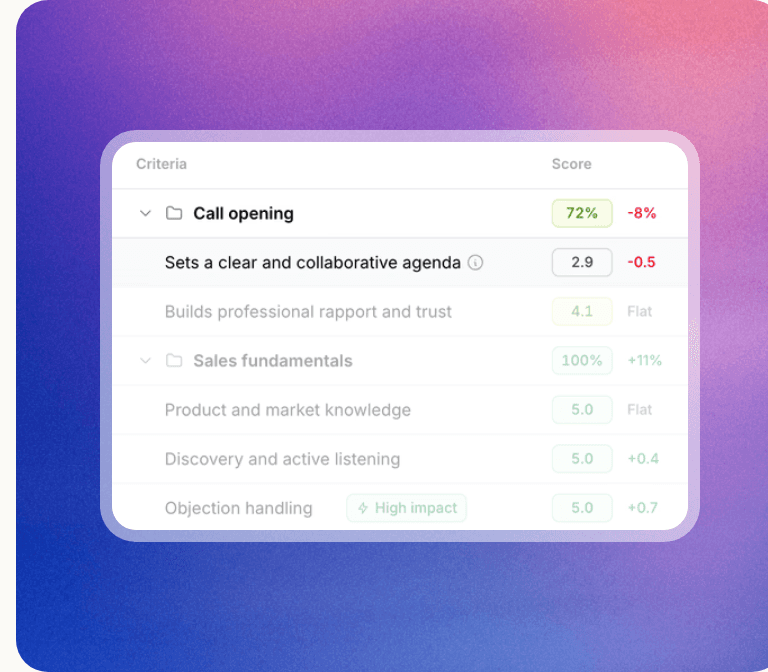
Alpharun's call scorecard, breaking a rep's call opening and sales fundamentals into scored criteria.
Most of this article is about the patient-facing front door: scheduling, triage, follow-up. That side gets a lot of attention. The calls that decide revenue and compliance still ride on people: patient access reps booking and registering patients, and licensed advisors enrolling Medicare members.
And those are the calls teams understand the least. When managers can only review a sliver of them, coaching turns into guesswork and compliance risk builds quietly across the day.
Alpharun sits on top of your existing call center or telephony stack and fixes that side. It gives you the best of both worlds: your human team performing at its best, with AI handling the repetitive parts of the playbook that don't need a person. For the front door, Alpharun's voice agents can handle routine intake, appointment scheduling, and reminders.
With Alpharun, teams can:
Score every patient and enrollment call against a custom playbook.
Surface the exact moments where winning calls diverge from losing ones.
Flag missed Scope of Appointment steps, required disclosures, and other compliance gaps at the sentence level.
Coach every rep with personalized feedback right after each call.
Shorten new-agent ramp time by showing them how top performers actually handle the call.
Give managers call-level visibility across the whole team.
Alpharun works with Medicare brokerages like Chapter, whose advisors handle hundreds of thousands of calls during the Annual Enrollment Period. Since Alpharun started scoring every call against Chapter's playbook, its managers coach four times as many advisors each week.
If you're weighing conversational AI in healthcare for your own call center, book a demo to see how Alpharun scores and coaches your patient access and enrollment calls.
Frequently asked questions
What are examples of conversational AI?
Examples of conversational AI in healthcare include appointment-scheduling voice assistants, symptom-checker chatbots like Ada, member-navigation assistants like Aetna's, and call-QA tools that score patient calls. Outside healthcare, the everyday example is a voice assistant like Siri or Alexa.
Is there a medical AI like ChatGPT?
Yes, there are health-specific AI assistants built on the same large-language-model technology as ChatGPT, such as Hippocratic AI's care agents.
Ada's symptom checker is a different kind of medical AI, built on a probabilistic reasoning engine that its team has developed since 2011. They're tuned for healthcare and kept under clinical oversight, so they guide and triage rather than diagnose on their own.
What are the top AI applications in healthcare?
The top AI applications in healthcare span three areas: administrative (scheduling, intake, billing), clinical (documentation, medical imaging, risk prediction), and contact-center (triage, follow-up, call QA, and enrollment).
In a 2024 survey of health systems, imaging was the most widely deployed clinical AI, and ambient documentation was the only use case that every system was at least piloting.
Is conversational AI in healthcare HIPAA-compliant?
Conversational AI can be HIPAA-compliant, but only with the right safeguards in place: a signed business associate agreement, encryption, access controls, and audit logging. No tool is compliant by default, so compliance depends on how you deploy it.
What's the difference between a healthcare chatbot and conversational AI?
A healthcare chatbot follows preset decision trees and answers a fixed list of questions, while conversational AI understands intent through natural language, carries context across a conversation, supports voice, and connects to systems like the EHR. Conversational AI resolves complex requests; a chatbot mostly deflects simple ones.


