

If your reps spend more time listening to hold tones and voicemail greetings than talking to actual people, a hosted predictive dialer may be worth a closer look. By reducing idle time between conversations, it helps sales teams spend more of the day speaking with prospects.
Here's how it works and when it makes sense to use one.
What is a hosted predictive dialer?
A hosted predictive dialer is cloud-based outbound calling software that dials multiple numbers at once, filters out calls that go nowhere, and connects agents only when a real person answers.
The "hosted" part means the system runs in the cloud on the vendor's infrastructure. Reps can log in through a browser and start making calls without managing on-premise hardware or phone systems.
The "predictive" part is where the technology does the heavy lifting.
The software monitors factors such as average call length and answer rates, then predicts when agents are likely to become available. Based on those predictions, it starts placing calls before a rep finishes their current conversation.
Every minute a rep spends listening to ringing phones, voicemails, or busy signals is a minute they are not speaking with a prospect. Predictive dialers reduce that waiting time, which can make a meaningful difference across a busy sales floor.
How a hosted predictive dialer works
Here is the call flow from the moment your rep logs in to the moment they hang up and the system is already working on the next call.
Step 1: List loaded
Your contact data is pulled from the CRM or uploaded as a CSV. The system scrubs it against the Do Not Call registry before a single number gets dialed.
Step 2: Algorithm reads the room
The system looks at your current answer rate and average call duration to calculate how aggressively to dial.
Low answer rates mean it needs to call more numbers per agent to keep them busy. High answer rates mean it dials more conservatively to avoid situations where calls connect and no agent is available.
Step 3: Multiple lines dial simultaneously
The dialer places two to five calls per agent, depending on pacing settings. These calls are being filtered in real time.
Step 4: Dead calls get dropped automatically
Busy signal? Dropped. Voicemail greeting? Dropped or logged. Disconnected number? Dropped. No answer after a set number of rings? Dropped. None of this reaches an agent.
Step 5: Live answer connects instantly
The moment a real person picks up, the system routes the call to the next available agent. The agent hears the prospect say hello and picks up the conversation.
Step 6: Rep wraps up, cycle repeats
While the rep is finishing their wrap-up notes, the algorithm has already started dialing for their next call. The loop runs until the campaign list is exhausted or the session ends.
On a typical sales floor, agent talk time can increase from roughly 30 to 40% of a shift with manual dialing to 75 to 85% with predictive dialing.
When dozens of agents are making calls throughout the day, those gains can translate into significantly more conversations, more opportunities, and more efficient use of rep time.
Hosted predictive dialer vs. power dialer vs. auto dialer
These three terms get used interchangeably by vendors and buyers alike. They describe meaningfully different things.
☎️ Dialer type | 📞 How it dials | 🎯 Best for | ⚠️ Main risk |
Hosted predictive dialer | Dials multiple lines per agent simultaneously, connects only live answers | High-volume B2C outbound, 50+ reps | Abandoned calls if pacing is misconfigured |
Power dialer | Dials one number at a time, moves to the next automatically after each call | Personalized outreach, smaller teams | Slower throughput than predictive |
Auto dialer | Dials numbers sequentially from a list, no prediction logic | Basic list dialing, low-volume campaigns | No efficiency gain over manual for live calls |
A useful rule of thumb is to look at call volume and agent utilization together.
One additional type worth knowing: A progressive dialer sits between predictive and power dialers, waiting for agent availability before placing each call rather than dialing ahead of it.
It offers more control than predictive dialing with less idle time than a power dialer, making it a common choice for teams that want a middle-ground option.
Teams that make hundreds of outbound calls each day and struggle with low talk time often benefit most from predictive dialing. Teams that need agents to review account history, notes, or previous interactions before every call may be better served by a power dialer.
For smaller campaigns with straightforward outreach requirements, an auto dialer is often enough.
For example, an insurance enrollment team managing 150 agents during a fixed selling window has very different operational demands than a small outbound team.
At that scale, reducing idle time between conversations can have a meaningful impact on productivity, which is why many high-volume sales organizations rely on predictive dialing.
Why high-volume B2C sales floors specifically benefit
Predictive dialing pays off most on high-volume outbound floors where reps work down large contact lists fast, including insurance, lending, financial services, and home services teams.
Here is why the math works especially well for that kind of inside sales operation:
Lead economics are brutal
You paid for every contact on that list. Every call that goes to voicemail without a connection is a paid lead that produced nothing. A predictive dialer does not eliminate that cost, but it compresses the dead time between live contacts so your reps spend their day on the conversations that matter.
Speed-to-lead is a significant conversion factor
A Harvard Business Review study found that companies contacting prospects within one hour of inquiry were nearly seven times more likely to qualify the lead than those who waited even an hour longer.
On a floor where reps handle back-to-back calls, reaching every inbound inquiry within minutes is not possible without automation. The dialer handles initial reach; the rep handles the conversation.
Time-boxed sales windows reward speed
Many high-volume B2C sales floors operate within fixed selling windows that compress urgency. Insurance open enrollment periods, Medicare's Annual Enrollment Period, and seasonal home services demand peaks all create stretches where reaching more prospects per day has an outsized impact on revenue.
A predictive dialer that adds dozens of live conversations per agent per shift across a seven-week window moves the number in ways that manual dialing cannot match.
The metrics that tell you if your dialer is working
Once you are running a hosted predictive dialer, these are the numbers worth watching.
Agent talk time percentage: The share of each agent's shift spent in active conversation. Target 75% or above. Below 60% means your pacing is too conservative or your answer rate is poor.
Connections per hour per rep: How many live conversations each agent has per hour. Track this alongside talk time to catch situations where reps are connecting often but calls are very short (a sign of list quality problems).
Call abandonment rate: The percentage of live answers that connected before an agent was available. Under TCPA guidelines, this must stay below 3% per campaign over a 30-day period. This is the compliance number you cannot afford to ignore.
Contact list penetration rate: How much of your list you are reaching over a campaign. Low penetration often points to list quality rather than dialing efficiency.
Cost per live connection: Total campaign cost divided by live conversations. This is the number that tells you whether the dialer investment is paying off compared to alternative outreach methods.
Compliance: The part that will cost you if you ignore it
Predictive dialers dial fast. That speed creates compliance exposure that slower methods do not.
TCPA abandonment rate
The Telephone Consumer Protection Act limits call abandonment to 3% per campaign over a rolling 30-day window. An abandoned call is one where the system connects a live answer but no agent is available to take it.
Once abandonment rates rise above 3%, compliance concerns can start to emerge. For that reason, many teams monitor the metric in real time rather than waiting for end-of-day reporting.
Do Not Call registry scrubbing
Every contact list must be scrubbed against the National DNC Registry before dialing. Most hosted predictive dialers do this automatically, but confirm it is active on your account before your first campaign.
Calling a number on the DNC registry is a direct violation with penalties of up to $53,088 per violation as of 2025 under the FTC's Telemarketing Sales Rule.
Call recording disclosure
If your dialer records calls (most do), you need to follow state-specific disclosure requirements.
Some states require only one-party consent. Others require you to notify all parties at the start of the call. Check the requirements for every state you dial into, and configure your disclosure settings before going live.
Abandoned call message requirement
When the system connects a live answer but no agent is available, TCPA rules require the system to play a recorded message identifying the caller and providing a callback number. Confirm your dialer handles this automatically.
Permission to Contact for Medicare
If you operate a Medicare brokerage, your contact list management goes beyond the federal DNC registry.
For Medicare organizations, compliance extends beyond federal Do Not Call requirements. CMS marketing rules require documented Permission to Contact (PTC) before outbound calls to beneficiaries, and that permission remains valid for a limited window per CMS guidelines.
As a result, list management processes should account for PTC status and expiration dates alongside traditional compliance requirements.
What to look for when buying a hosted predictive dialer
Not all predictive dialers offer the same level of control, visibility, or flexibility.
Before making a decision, it's worth looking beyond call volume claims and evaluating how the platform performs in day-to-day operations.
Algorithm transparency and pacing controls
Predictive dialing works because the system decides how aggressively to place calls. Understanding how those decisions are made matters, especially for teams operating under compliance requirements.
Look for a platform that provides visibility into dial ratios, pacing settings, and abandonment rates. The ability to adjust pacing as conditions change can help teams balance productivity and compliance.
CRM integration
Call outcomes, notes, and dispositions should flow directly into your CRM without requiring additional work from agents.
The more manual data entry required after each conversation, the less value the dialer provides. Strong integrations help keep customer records accurate while reducing administrative work for the team.
Five9 and Genesys compatibility
Organizations already using platforms such as Five9 or Genesys should understand how a predictive dialer fits into their existing environment.
Some solutions operate as standalone products, while others integrate directly into a broader contact center platform. Knowing how the technology fits into your current stack can prevent costly surprises later.
Real-time abandonment monitoring
Abandonment rates can change throughout the day as answer rates and agent availability fluctuate.
Platforms that provide real-time visibility make it easier to identify issues and adjust dialing behavior before they become larger operational or compliance concerns.
Voicemail detection accuracy
Voicemail detection has a direct impact on both agent experience and customer experience.
When detection accuracy is poor, agents may be connected to voicemails unexpectedly or contacts may hear partial messages before a call disconnects. Asking vendors about detection performance and testing it against your own data can help set realistic expectations.
Seat pricing and scaling costs
Pricing models vary significantly between vendors. Some charge per seat, while others charge based on minutes, connections, or usage volume. Most hosted predictive dialers land somewhere between $15 and $240 per agent per month depending on features and call volume.
Evaluating costs at both your current team size and future growth targets can provide a clearer picture of long-term value.
The part the dialer does not solve
A hosted predictive dialer does not improve how reps perform once a conversation begins. Its role is to help teams connect with more prospects by reducing the time spent waiting for calls to connect.
That creates more opportunities, but it does not automatically create better outcomes. A sales floor that moves from 200 live conversations a day to 500 still depends on the quality of those conversations to generate revenue.
Discovery, objection handling, compliance disclosures, and closing skills remain the responsibility of the rep. When those areas are weak, increasing call volume simply creates more opportunities for the same mistakes to occur.
For high-volume B2C teams, dialing efficiency is only one part of the equation. Reps also need coaching, feedback, and clear performance standards so they can make the most of the conversations the dialer creates.
The strongest sales organizations improve both sides of the process. They invest in technology that helps reps reach more people and in coaching that helps those conversations produce better results.
Where Alpharun fits on top of your dialer
Alpharun works alongside the dialer and contact center tools your team already uses, including Five9 and Genesys. Once the dialer connects a rep with a prospect, Alpharun helps improve what happens during and after that conversation.
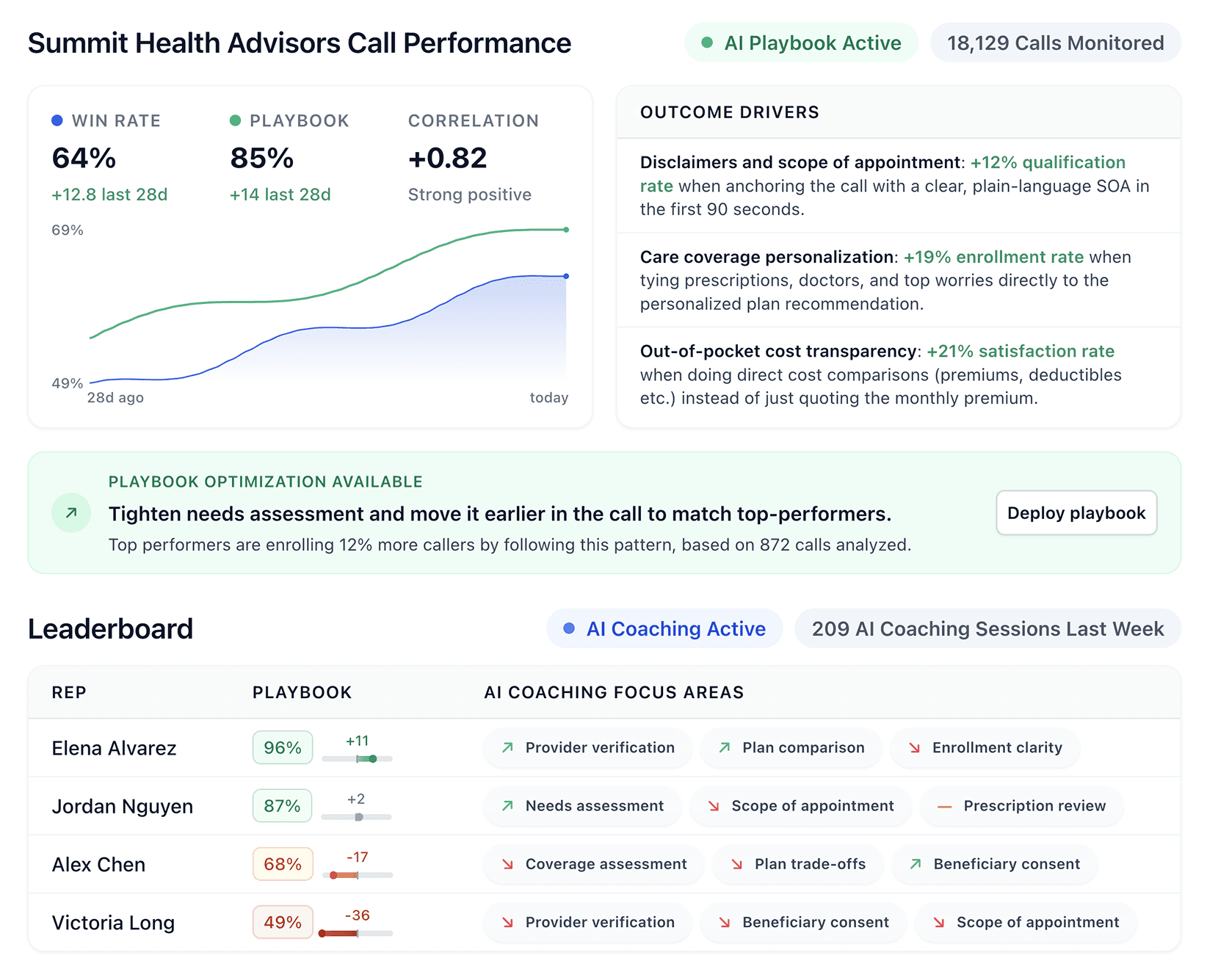
It gives sales leaders a clearer view of rep performance by analyzing every call against a custom playbook built from the team's best conversations.
Alpharun helps teams track and coach the behaviors that matter most, including:
Automated call scoring against your custom sales playbook, helping teams measure performance consistently across every conversation.
Immediate post-call coaching and feedback tied directly to the call that was just completed, making it easier for reps to apply the guidance on their next conversation.
Personalized coaching recommendations tailored to each rep's strengths, weaknesses, and performance trends.
Conversation intelligence and performance insights that help identify the behaviors and patterns associated with stronger outcomes.
Compliance monitoring and adherence tracking to help teams verify that required disclosures, processes, and standards are being followed.
Team and individual performance reporting that gives managers visibility into coaching opportunities across the sales floor.
Your dialer helps reps spend more time talking to prospects. Alpharun helps them make those conversations count.
The combination gives sales teams a practical way to improve both productivity and performance without adding more manual coaching work.
Book a demo to see how Alpharun works with your existing dialer infrastructure.
Frequently asked questions
When should a business use a predictive dialer?
Businesses should consider a predictive dialer when agents spend significant time waiting for calls to connect and outbound call volume is high. Predictive dialers are most effective for teams making hundreds or thousands of calls per day.
What is the difference between a predictive dialer and a power dialer?
The main difference between a predictive dialer and a power dialer is how calls are placed. A predictive dialer places multiple calls simultaneously and connects agents when a live person answers, while a power dialer places one call at a time and automatically moves to the next number after each call ends.
What is the TCPA abandonment rate limit for predictive dialers?
The TCPA abandonment rate limit for predictive dialers is 3% per campaign over a rolling 30-day period. Calls above that threshold can create compliance concerns, which is why many contact centers monitor abandonment rates in real time.
What integrations should I look for in a hosted predictive dialer?
The most important integrations are your CRM and contact center platform. Businesses using Five9, Genesys, or similar systems should confirm that call outcomes, notes, and dispositions sync automatically between platforms.
Does a hosted predictive dialer improve sales performance?
No, a hosted predictive dialer does not directly improve sales skills or conversion rates. It increases the number of live conversations reps have, while coaching, training, and sales execution determine how effectively those conversations turn into revenue.