
Balto AI is a real-time sales coaching platform that guides reps during live calls with prompts and conversation support. If you’re evaluating Balto AI competitors, these 7 platforms stood out in 2026 for their approach to coaching, QA, compliance, and sales performance.
7 best Balto AI alternatives: quick comparison
💻 Tool | ⚡ Strengths | 🎯 Best for | 💰 Starting price | ⭐ Standout feature |
Cresta | Real-time agent assist, conversation intelligence, AI agents | Large enterprises needing automation across voice and chat | Custom pricing | Agent Assist with behavioral guidance during live calls |
Alpharun | Custom playbooks from real calls, real-time coaching, full QA | B2C inside sales teams in Medicare, insurance, home services | Custom pricing | Playbooks built from your actual top performer calls |
Gong | Conversation intelligence, forecasting, pipeline analytics | GTM teams needing revenue-cycle visibility | Custom pricing | Revenue AI across the full deal cycle |
Observe.AI | Voice-first AI agents, QA automation, compliance monitoring | Healthcare and finance teams reducing call volume | Custom pricing | Voice-first AI agents that handle routine calls |
Five9 | Predictive dialer, outbound campaigns, CRM integrations | Inside sales teams with 50+ reps | $119/user/month | Predictive dialer for high-volume outbound |
NICE CXone | 100% call recording, AI-powered QA, compliance at scale | Large enterprises with strict compliance requirements | $110/agent/month | Full interaction recording across all tiers |
AmplifAI | Cross-system data unification, coaching recommendations, gamification | Enterprise contact centers and BPOs across multiple systems | Custom pricing | Coaching Effectiveness Index tied to KPI movement |
How these Balto AI alternatives were researched
Each of these Balto AI competitors was reviewed using official product documentation, pricing pages, and verified customer feedback from G2 and Gartner.
When trial access was available, core workflows were tested directly to see how the platforms handled live coaching, QA reviews, integrations, and day-to-day rep workflows.
Features: How well the platform handles real-time call guidance, QA automation, coaching workflows, and compliance monitoring for high-volume sales teams.
Usability: Whether reps and managers can actually use the platform day to day without long onboarding cycles or heavy admin overhead.
Integrations: How smoothly the tool connects with existing dialers, CRMs, and contact center infrastructure already running in the sales workflow.
Pricing: What the platform actually costs once advanced features, AI tools, or compliance capabilities are added.
Use cases: Which environments the platform fits best, including outbound sales, regulated industries, manager coaching, and QA-heavy operations.
The goal was to separate platforms built around improving sales conversations from tools designed more for support operations or broader contact center management.
1. Cresta: best for enterprise real-time agent assistance

What it does: Generative AI platform for enterprise contact centers that guides agents during live calls, automates routine conversations with AI agents, and surfaces performance insights across voice and chat.
Best for: Large enterprises that need both automation and live agent assistance across multiple channels, particularly teams running a mix of sales and support interactions.
Cresta describes itself as human-centric AI. Its Agent Assist surfaces prompts and behavioral guidance during live conversations, while Conversation Intelligence gives leaders visibility into what drives performance across the team.
Broad integrations with Salesforce, Genesys, NICE, Twilio, and Amazon Connect make it flexible across most enterprise stacks. Enterprise pricing and a noticeable learning curve put it out of reach for smaller or less structured teams.
Key features
AI Agent: Handles full conversations across voice and chat, automating common requests without human intervention.
Agent Assist: Real-time prompts, behavioral guidance, and AI-generated summaries during live calls.
Knowledge Assist: Connects agents to relevant content and speeds up responses during complex conversations.
Conversation Intelligence: Surfaces insights, manages quality, and coaches teams at scale across all interactions.
Enterprise integrations: Connects with Salesforce, Genesys, NICE, Twilio, and Amazon Connect.
Pros and cons
✅ Pros | ❌ Cons |
AI-native platform combines models, workflows, and orchestration in one unified system. | Noticeable learning curve before the platform delivers strong results across the team. |
Custom model fine-tuning improves accuracy using proprietary business data and synthetic datasets. | Enterprise pricing puts it out of reach for smaller teams or operations with tighter budgets. |
Enterprise-grade testing and guardrails help teams deploy AI with more confidence and reliability. |
What users say
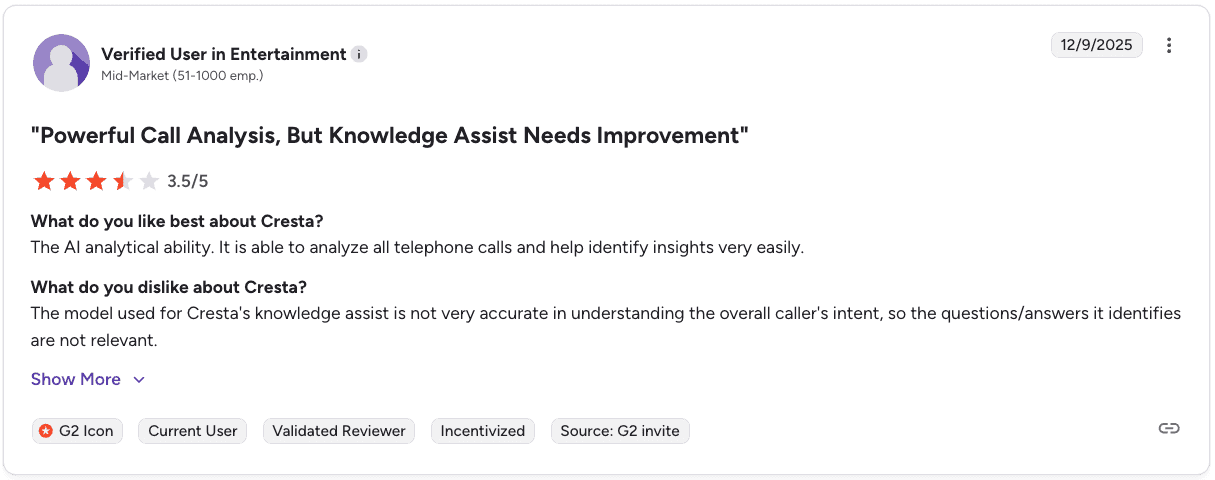
Pro: “The AI analytical ability helps identify insights from telephone calls very easily.” — Verified User in Entertainment, G2 Review (Dec 9, 2025)
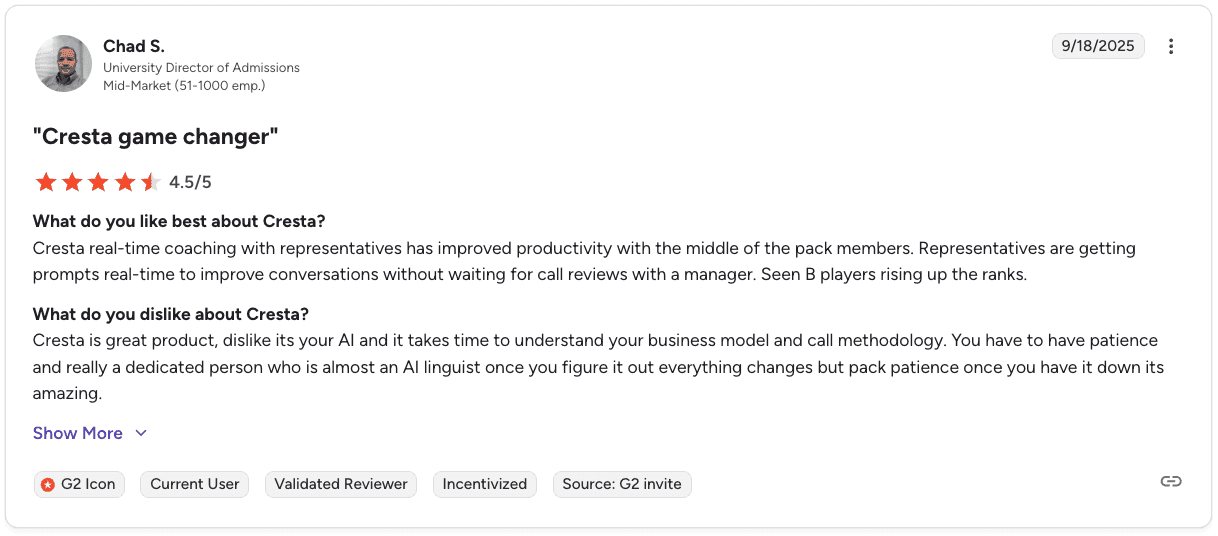
Con: “It takes time to understand your business model and call methodology.” — Chad S., G2 Review, (Sep 18, 2025)
Pricing
Custom pricing based on your team size, use case, and AI deployment needs.
Cresta vs. Balto AI: our verdict
Cresta is better suited for enterprises that want AI agents, workflow automation, and end-to-end customer journey orchestration across voice and chat. Balto focuses more on real-time agent coaching and assistance for human reps.
If your goal is improving live agent performance quickly, Balto is a strong option. But for deeper automation and enterprise-scale AI workflows, Cresta offers the more advanced platform.
Looking for a Cresta alternative? Explore the top Cresta competitors for AI sales coaching, agent assistance, and contact center automation.
2. Alpharun: best for B2C sales coaching built from your actual calls

What it does: AI-powered sales coaching platform that analyzes thousands of your team’s actual calls, identifies what top performers do differently, and coaches every rep to replicate those behaviors through immediate post-call feedback.
Best for: High-volume B2C inside sales teams in Medicare, insurance, home services, and pest control with 50+ reps where performance gaps between top and average reps directly impact revenue.
Alpharun builds coaching around your team’s actual winning calls by analyzing the talk tracks, rebuttals, and conversation patterns tied to conversions, then delivering sentence-level feedback immediately after each conversation.
For regulated industries, compliance rules and required disclosures are built directly into the scoring model so every call is reviewed automatically instead of spot-checked manually.
Key features
Custom playbook intelligence: Analyzes thousands of your top performers’ actual calls to find the specific behaviors driving conversions, then builds those into a playbook the whole team can follow.
Sentence-level post-call coaching: Scores every call and delivers specific, moment-by-moment feedback immediately after the conversation.
Automated QA across 100% of calls: Scores every call against your playbook and compliance criteria so managers see the full team picture, not a sample.
AI agents for repetitive tasks: Handles scheduling, after-hours qualification, and initial consultations so reps focus on high-value conversations.
Weekly performance breakdowns: Managers get clear visibility into who is improving and where coaching should focus, with coaching notes sent directly to reps.
Pros and cons
✅ Pros | ❌ Cons |
Built for regulated Medicare sales teams with SOC 2 Type 2 compliance and secure handling of sensitive customer data. | Custom pricing requires a demo before teams can evaluate total costs. |
Fast onboarding helps large call centers launch in about a week with low operational overhead. | Best suited for 50+ rep teams, so smaller operations may see less value from the coaching infrastructure. |
Works with existing call center systems like Five9 and Genesys, reducing disruption during rollout. | Depends on existing call center infrastructure to access and analyze call recordings. |
Pricing
Alpharun uses custom pricing based on team size and feature requirements. Contact their team for a quote. Setup takes approximately one week and connects to your existing dialer.
Alpharun vs. Balto AI: our verdict
Alpharun fits teams that want coaching tied directly to how their own highest-performing reps sell, with QA, compliance monitoring, and post-call coaching connected to actual call outcomes.
Balto AI makes more sense for teams that already have a structured script and want reps following that process more consistently during calls.
3. Gong: best for GTM revenue cycle visibility

What it does: Revenue AI platform that records and analyzes sales conversations, then turns that data into pipeline visibility, forecasting insights, and rep coaching across the full revenue cycle.
Best for: B2B revenue teams managing longer deal cycles, multi-touch sales processes, and pipeline forecasting across prospecting, demos, and renewals.
Gong gives sales and revenue leaders visibility into how deals are progressing, where pipeline risk is building, and how reps are handling customer conversations across the funnel.
The platform is heavily oriented around B2B GTM workflows, which makes it stronger for account-based sales environments than high-volume B2C call floors where conversations are shorter and outcomes happen faster.
Key features
Conversation intelligence: Records and analyzes calls and meetings to surface coaching insights, deal risks, and rep performance trends.
Pipeline forecasting: Tracks deal movement and pipeline health to improve forecasting accuracy for revenue leaders.
AI-driven workflow automation: Automates follow-ups, CRM updates, and forecast adjustments based on conversation data.
Sales engagement tools: Prioritizes outreach and helps reps manage sequences and customer follow-up activity.
Multi-language support: Supports 70+ languages for distributed sales organizations and international teams.
Pros and cons
✅ Pros | ❌ Cons |
Strong visibility across deals, rep activity, and pipeline movement. | Built primarily around B2B sales cycles rather than high-volume B2C environments. |
Forecasting and pipeline analytics are valuable for revenue leadership teams. | Custom pricing can become expensive as teams grow. |
Broad language support helps global teams stay aligned. | Some users report limited reporting customization. |
What users say
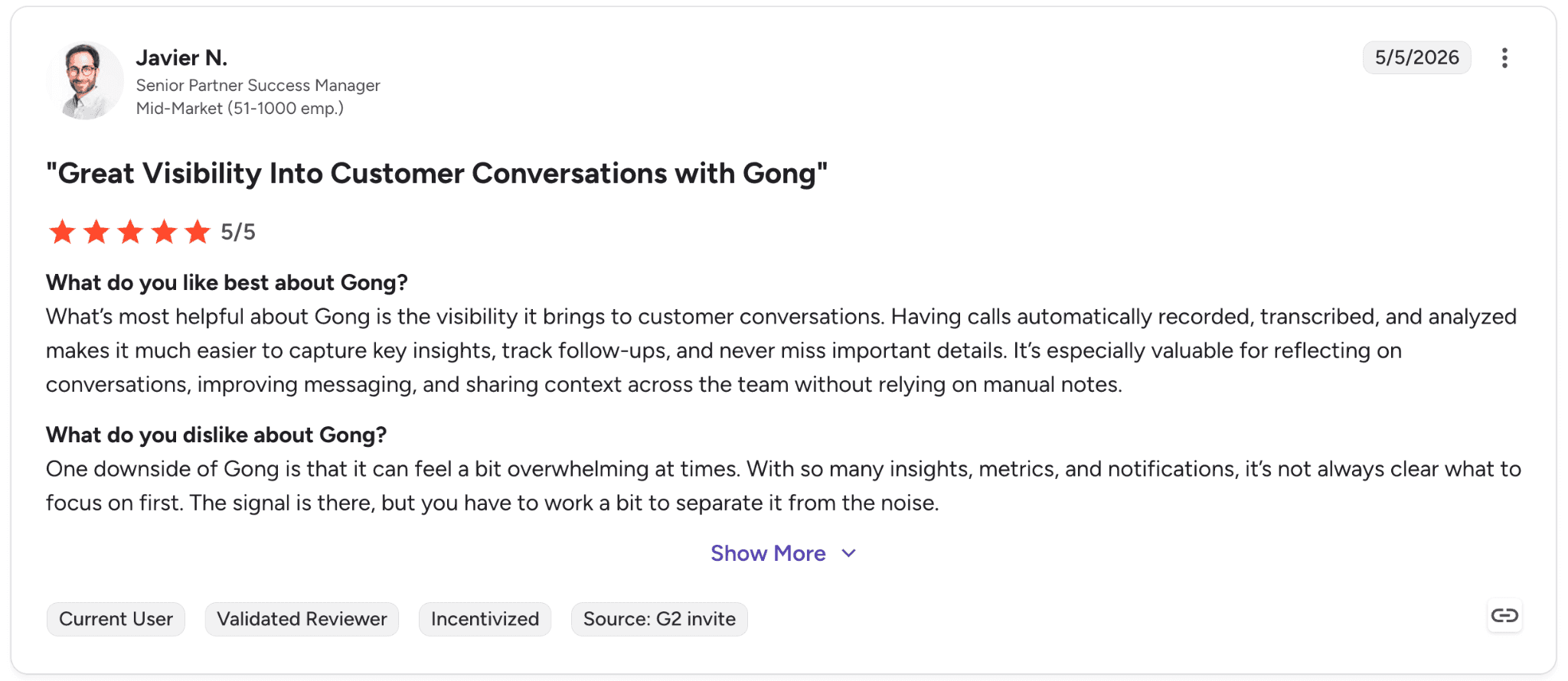
Pro: “Having calls automatically recorded, transcribed, and analyzed makes it much easier to capture key insights, track follow-ups, and never miss important details.” — Javier N., G2 Review (May 5, 2026)

Con: “At times, it takes extra effort to translate call insights into immediate next steps.” — Mohith N., G2 Review (May 1, 2026)
Pricing
Gong uses custom pricing based on team size and product usage, with platform fees and per-user licensing. Pricing is only available through a sales conversation.
Read our full Gong pricing guide for a breakdown of costs, plans, and the best alternatives in 2026.
Gong vs. Balto AI: our verdict
Gong makes more sense for organizations focused on pipeline visibility, forecast accuracy, and tracking how deals progress across a longer sales cycle. The platform is strongest when leadership teams need conversation data tied directly to revenue operations and GTM reporting.
Balto AI is more centered around influencing the conversation while it is happening, which aligns better with faster-paced inside sales environments where rep execution on live calls matters more than pipeline analysis.
Read what real users say about Gong’s features, pricing, and overall experience in our detailed Gong review.
4. Observe.AI: best for voice-first AI agents and QA automation
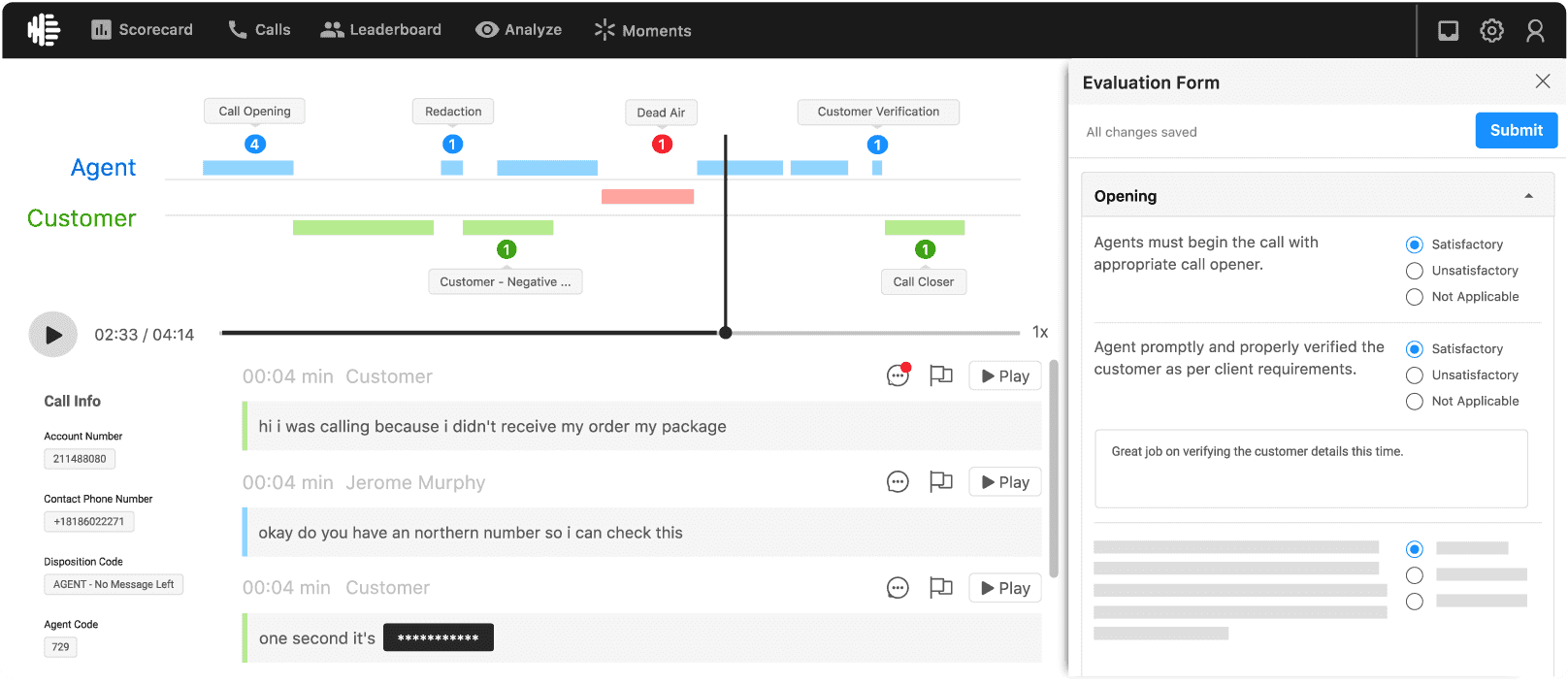
What it does: Conversation intelligence and QA platform that combines AI voice agents, automated call reviews, and compliance monitoring across customer interactions.
Best for: Healthcare, finance, and service teams that want AI agents handling repetitive conversations while maintaining visibility across every customer interaction.
Observe.AI leans heavily into automation. The platform is designed to reduce the amount of routine call handling human agents deal with by using voice AI agents for repetitive conversations, while still tracking and reviewing the calls handled by live reps.
That combination makes it appealing for operations focused on efficiency and compliance monitoring, especially in heavily regulated environments.
Key features
Voice AI agents: Handles repetitive inbound conversations and escalates more complex situations to human reps when needed.
Real-time agent assistance: Surfaces prompts and workflow support during live calls to help reps stay on track.
Automated QA reviews: Reviews 100% of interactions with sentiment tracking, compliance checks, and topic analysis.
Digital AI agents: Supports chat automation and lead qualification across digital channels.
CRM and CCaaS integrations: Connects with major contact center platforms and customer systems already used by support and sales teams.
Pros and cons
✅ Pros | ❌ Cons |
Strong automation for repetitive call handling and QA reviews. | Accuracy can drop in noisy or fast-moving conversations. |
Good fit for compliance-heavy environments. | Coaching recommendations can feel less actionable for managers. |
Flexible integrations with major contact center systems. | Some teams still rely on manual QA review to validate results. |
What users say

Pro: “Observe.AI has impressive customer interaction analytics capabilities, which gives us 100% visibility on efficiency and reliability.” — Ifeoma E., G2 Review (October 20, 2025)

Con: “There’s an opportunity to go further by pairing those insights with more actionable recommendations.” — Sammy P., G2 Review (July 23, 2025)
Pricing
Observe.AI uses custom pricing based on team size, AI usage, and compliance requirements. Pricing is available through a sales conversation.
Observe.AI vs. Balto AI: our verdict
Observe.AI is more automation-focused, especially for teams trying to reduce repetitive call handling and increase QA coverage across large call volumes.
Balto AI stays more centered on guiding reps during live conversations, which may feel more useful for sales floors where the outcome depends heavily on how reps handle objections and move calls forward in real time.
5. Five9: best for high-volume outbound dialing

What it does: Cloud contact center platform focused on outbound dialing, inbound routing, call recording, and AI-assisted agent workflows.
Best for: Large inside sales operations running heavy outbound call volume with dedicated sales floors and structured dialing workflows.
Five9 is built around moving a large number of calls through the system reliably. The platform’s predictive dialer is the main draw here, especially for sales organizations where reps spend most of the day on outbound calls and connection rates directly affect revenue.
It also gives supervisors strong visibility into live activity across the floor, from call monitoring to QA tracking and agent performance.
Key features
Predictive dialing: Keeps reps moving through outbound call lists with minimal idle time between conversations.
AI Agent Assist: Provides live prompts and suggestions during active calls.
Automated call summaries: Generates notes and post-call summaries automatically to reduce admin work.
Quality management tools: Tracks QA scoring and call performance across teams.
CRM integrations: Connects with Salesforce, HubSpot, Microsoft Dynamics, and other major sales systems.
Pros and cons
✅ Pros | ❌ Cons |
Strong predictive dialer for outbound-heavy sales environments. | Requires a 50-seat minimum and annual contracts. |
Reliable infrastructure for large call volumes. | Advanced AI and QA features require higher pricing tiers. |
Good supervisor visibility and live call monitoring. | Workforce management and deeper QA tools cost extra. |
What users say
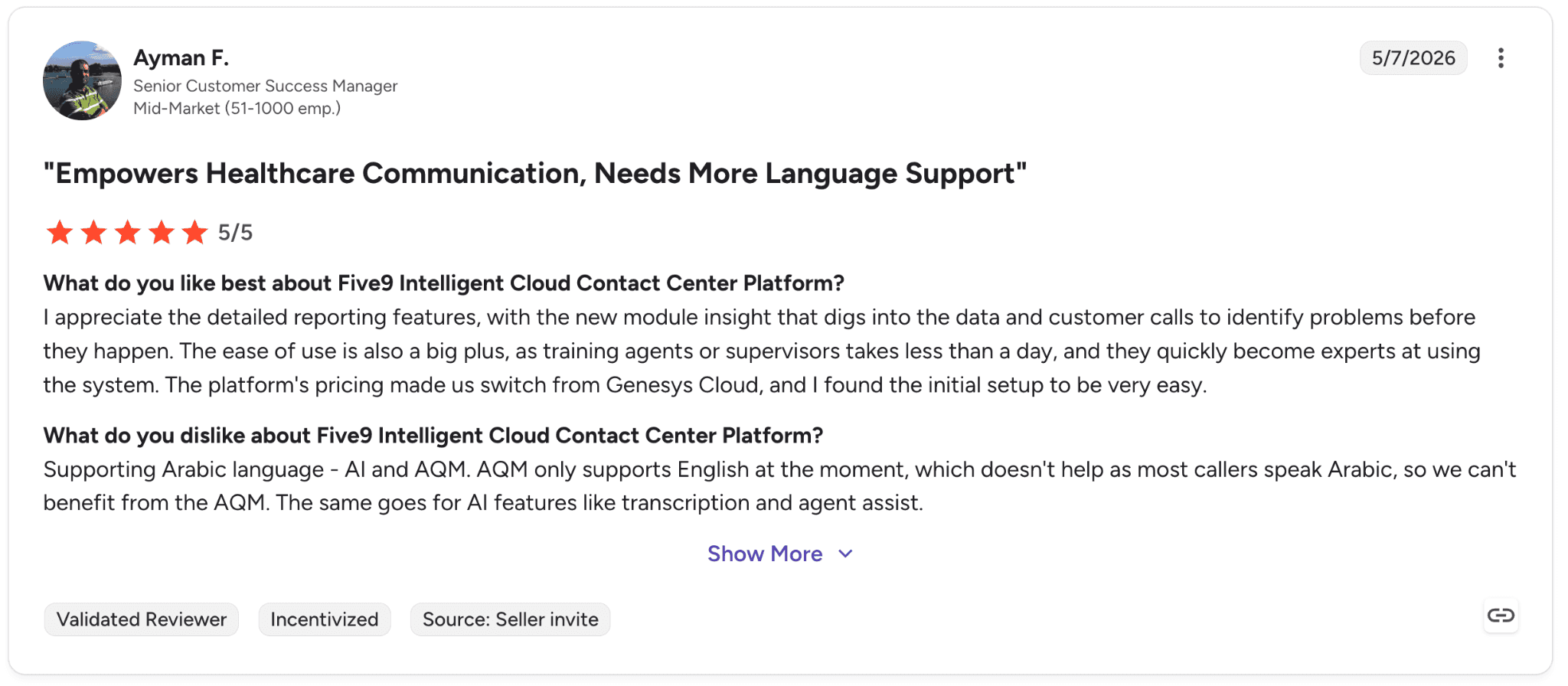
Pro: “The new module insight digs into the data and customer calls to identify problems before they happen.” — Ayman F., G2 Review (May 7, 2026)
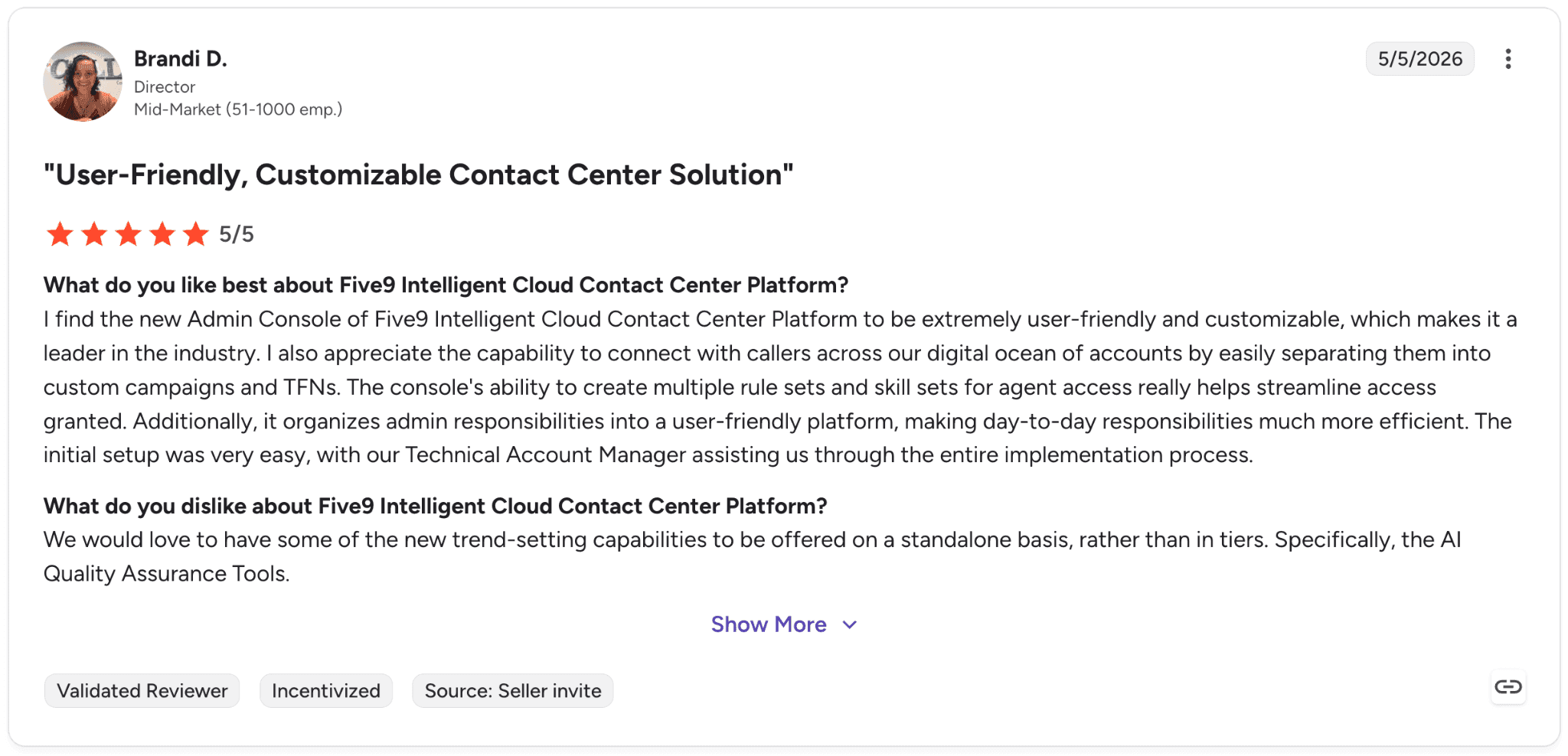
Con: “We would love to have some of the new trend-setting capabilities to be offered on a standalone basis, rather than in tiers.” — Brandi D., G2 Review (May 5, 2026)
Pricing
Digital: $119/user/month
Core: $159/user/month
Plus, Pro, Enterprise: Custom pricing
Five9 requires annual contracts and a 50-seat minimum.
Not sure if Five9 is the right fit? View our Five9 pricing guide for plans, costs, and top alternatives.
Five9 vs. Balto AI: our verdict
Five9 is the stronger choice when the priority is dialing infrastructure, outbound reliability, and managing large call volumes across a sales floor.
Balto AI fits better as a coaching layer during live conversations, especially for teams trying to improve rep execution rather than optimize call routing and dialing operations.
6. NICE CXone: best for enterprise compliance and QA
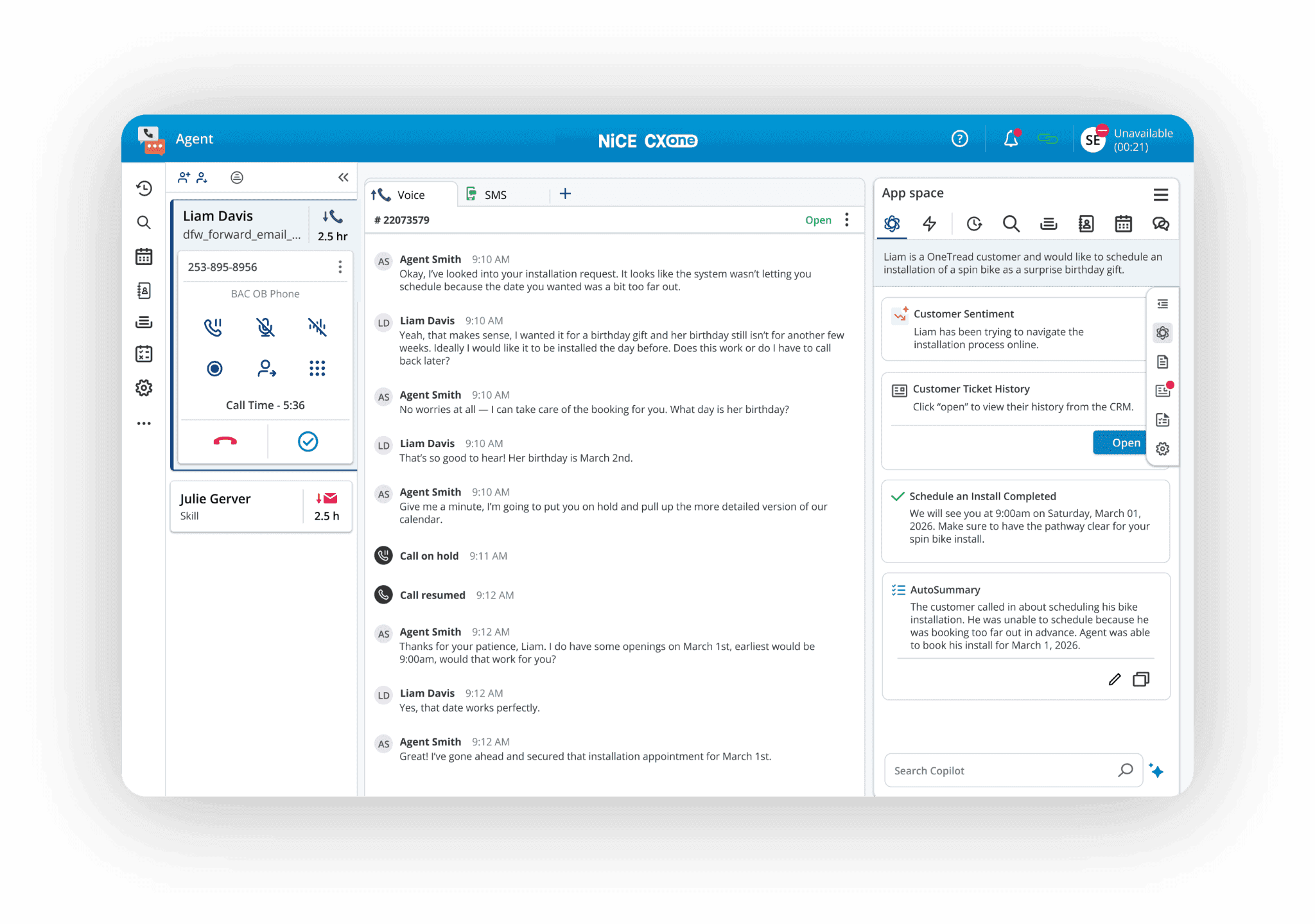
What it does: Enterprise contact center platform focused on interaction recording, AI-powered QA, workforce management, and compliance monitoring across voice and digital channels.
Best for: Large organizations in regulated industries that need full interaction visibility, automated QA, and centralized compliance controls.
NICE CXone is built for contact centers where every interaction needs to be recorded, reviewed, and tracked for compliance.
It combines AI-driven QA, workforce management, analytics, and reporting in one platform, giving enterprise teams visibility across both live operations and historical performance, though smaller teams may find the system more involved than they need.
Key features
Full interaction recording: Captures every conversation across voice and digital channels for compliance and QA review.
AI-powered QA: Automatically scores interactions and flags performance or compliance issues.
Conversation analytics: Tracks sentiment, keywords, and topic trends across large interaction volumes.
Automated summaries: Generates call notes and interaction summaries to reduce manual wrap-up work.
Built-in workforce management: Includes forecasting, scheduling, and staffing tools inside the same platform.
Pros and cons
✅ Pros | ❌ Cons |
Strong fit for compliance-heavy enterprise environments. | Setup and administration can feel heavy for smaller teams. |
AI QA and interaction analytics cover the full call volume. | Some admin tools and scripting workflows feel slow. |
Workforce management and reporting are built into the platform. | Higher pricing tiers can become expensive quickly. |
What users say

Pro: “Cxone helps us make calls and also keeps our schedules saved, replacing the need for two separate apps.” — Nilesh S., G2 Review (April 29, 2026)
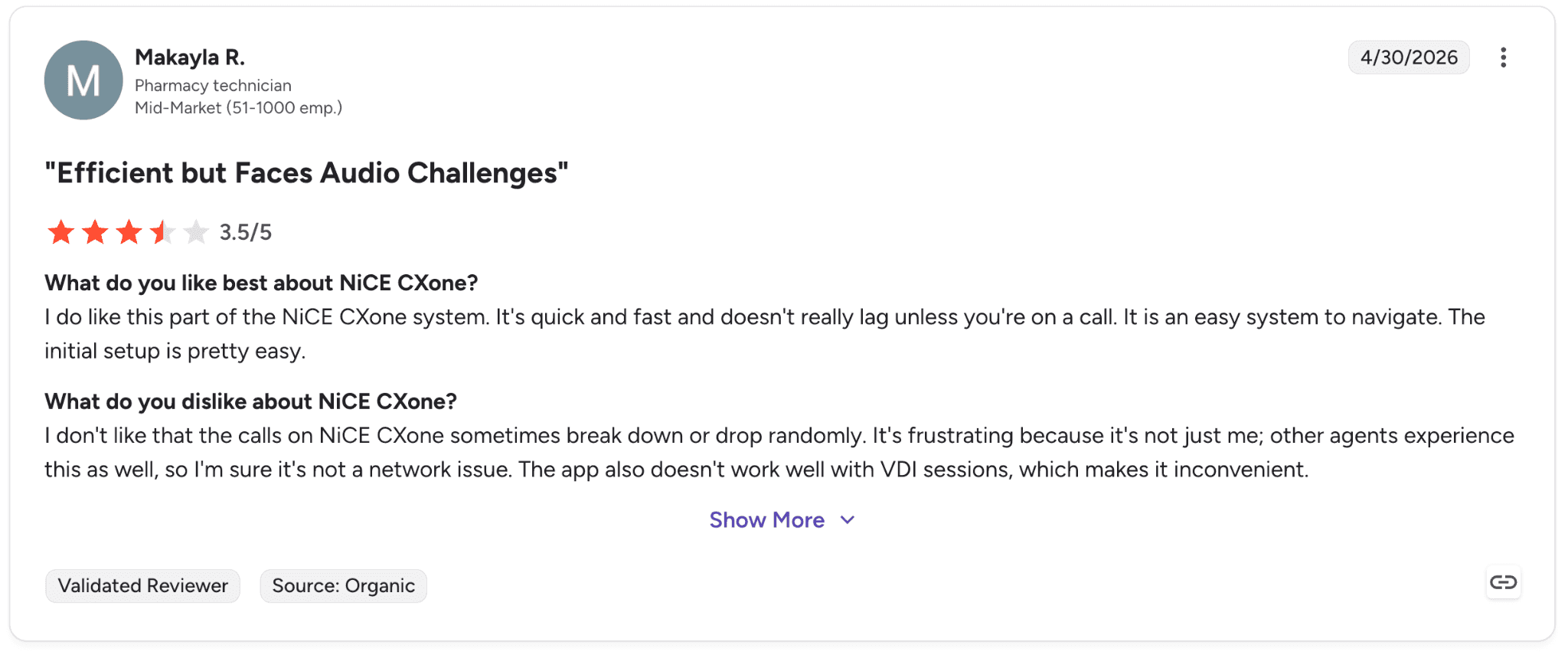
Con: “Calls on NiCE CXone sometimes break down or drop randomly, and the app doesn’t work well with VDI sessions.” — Makayla R., G2 Review (April 30, 2026)
Pricing
NICE CXone pricing starts at $110 per agent per month for the Omnichannel Suite and goes up to $249 per agent per month for the Ultimate Suite. AI routing, outbound engagement, and advanced automation features may cost extra depending on your plan.
NICE CXone vs. Balto AI: our verdict
NICE CXone is stronger for enterprise teams that need centralized QA, compliance oversight, workforce management, and analytics across large contact center operations.
Balto AI is more focused on improving rep execution during live calls through real-time guidance and scripting. The better fit depends on whether the priority is managing the operation or improving conversations as they happen.
7. AmplifAI: best for enterprise performance visibility across systems
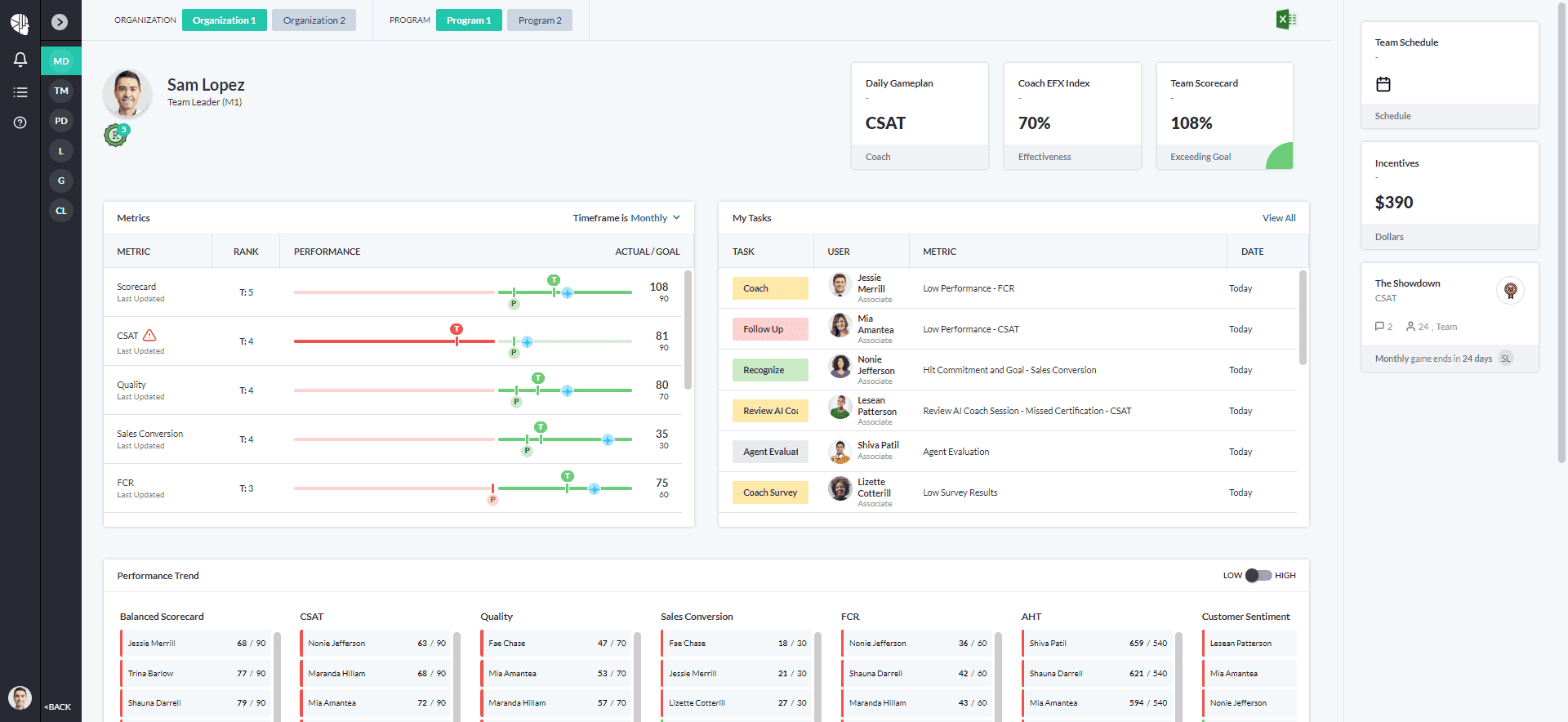
What it does: AI-powered performance management platform that pulls data from QA tools, workforce systems, CRMs, and contact center platforms into one centralized view.
Best for: Large enterprises and BPOs managing multiple teams, clients, and systems where performance data is spread across disconnected tools.
AmplifAI is less focused on the live conversation itself and more focused on connecting operational data across the entire contact center environment.
Instead of replacing QA or workforce tools, it sits across them, helping managers see how coaching, staffing, QA scores, and performance metrics connect in one place. That visibility is especially useful for larger organizations running different systems across teams or clients.
Key features
150+ integrations: Connects workforce management, QA, CRM, speech analytics, and CCaaS platforms into one reporting layer.
Role-based dashboards: Gives agents, supervisors, QA teams, and executives different views tied to their responsibilities.
AI-driven recommendations: Surfaces coaching priorities and performance actions based on combined operational data.
Coaching Effectiveness Index (CEfx): Tracks whether coaching sessions actually improve KPI performance over time.
Gamification tools: Uses leaderboards, contests, and recognition programs tied to performance metrics.
Pros and cons
✅ Pros | ❌ Cons |
Strong visibility across disconnected systems and teams. | Setup depends heavily on integrations and data quality. |
Useful for enterprise reporting and coaching management. | Can feel heavy for smaller or simpler sales operations. |
Coaching impact tracking adds accountability to manager workflows. | Less specialized for live sales coaching and rep guidance. |
What users say
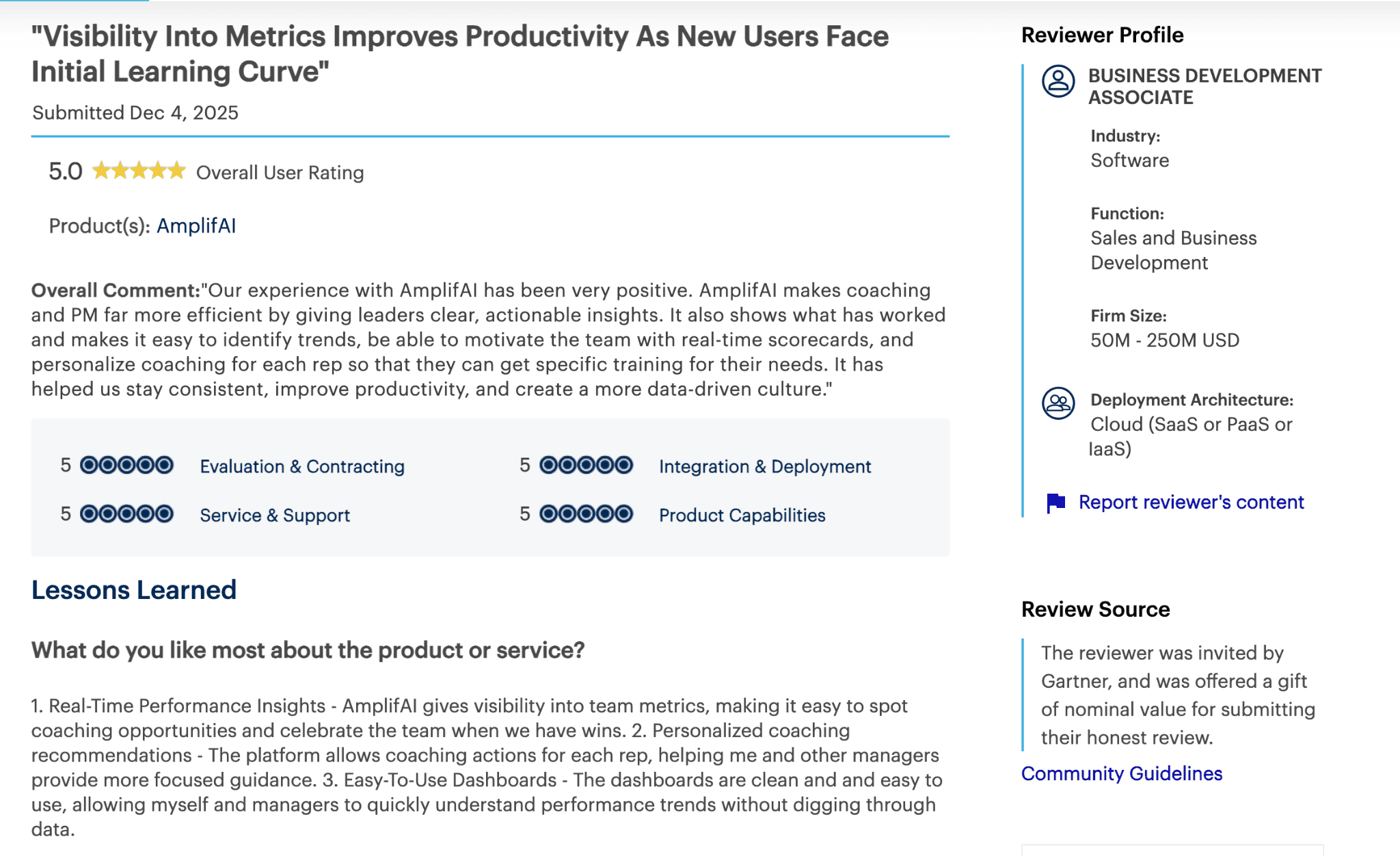
Pro: “AmpliAI gives leaders clear, actionable insights and makes it easy to identify trends, motivate teams with real-time scorecards, and personalize coaching for each rep.” — Gartner Review (December 4, 2025)

Con: “One area for improvement is the learning curve for first-time users, as some advanced features are not immediately intuitive.” — Gartner Review (January 4, 2026)
Pricing
AmplifAI does not publish pricing publicly. Teams need to contact sales for a custom quote based on seats, integrations, and deployment requirements.
AmplifAI vs. Balto AI: our verdict
AmplifAI is better suited for organizations trying to unify performance management across multiple systems, teams, and operational workflows.
Balto AI stays much closer to the live sales conversation itself, with more emphasis on guiding reps during calls instead of aggregating broader contact center performance data.
Which Balto AI competitor should you choose?
The right choice depends on whether your primary need is real-time call guidance, full contact center infrastructure, compliance-first QA, or coaching built from your team’s actual call data. Alpharun sits in that last camp, combining 100% QA coverage with rep-level sales coaching rather than live script prompts.
Choose Alpharun if you:
Run a high-volume B2C inside sales floor in Medicare, insurance, or home services.
Want coaching built from what your top performers actually do on calls, not generic prompts.
Need fast, sentence-level coaching on every call alongside 100% QA coverage.
Operate in a regulated industry where compliance scoring needs to run on every call.
Choose Cresta if you:
Run a large enterprise contact center handling both sales and support interactions.
Need AI agents to automate routine conversations alongside real-time agent assistance.
Have the budget for enterprise contracts and the time for multi-week implementation.
Choose Gong if you:
Run a B2B sales team that needs visibility across the full deal cycle, not just call-level performance.
Need revenue forecasting and pipeline analytics alongside conversation intelligence.
Have distributed teams across multiple languages and regions.
Choose Observe.AI if you:
Want to reduce call volume by deflecting routine inquiries to AI agents.
Operate in healthcare or finance where compliance monitoring is the primary driver.
Need QA automation across 100% of calls with fast setup.
Choose Five9 if you:
Run outbound-heavy B2C sales campaigns with 50+ reps.
Need a reliable predictive dialer with strong CRM integration.
Are ready to commit to annual contracts at scale.
Choose NICE CXone if you:
Operate a large enterprise with strict regulatory compliance requirements.
Need 100% interaction recording built into every plan tier.
Have the admin resources to manage a complex enterprise platform.
Choose AmplifAI if you:
Manage performance across multiple disconnected systems, including QA, WFM, CRM, and CCaaS.
Run a large BPO or multi-site operation that needs cross-system visibility.
Want gamification and next-best-action recommendations tied to unified performance data.
Skip this category entirely if you:
Have fewer than 20 reps where direct manager coaching doesn’t yet require a platform layer.
Only need basic call recording without any QA, coaching, or guidance features.
Final verdict: which Balto AI competitor is best?
Most teams evaluating a Balto AI competitor end up choosing between three directions:
Better rep coaching: Alpharun stands out for B2C sales floors that want coaching built from their own highest-converting calls, with live guidance and QA tied directly to rep behavior.
Broader enterprise operations: NICE CXone and Five9 are stronger when the priority is contact center infrastructure, compliance oversight, routing, and workforce management.
Revenue and analytics visibility: Gong and AmplifAI make more sense for organizations focused on pipeline visibility, operational reporting, and cross-system performance management.
The biggest takeaway from this category is that most platforms specialize in one layer of the operation.
Some are strongest at routing and infrastructure, others focus on QA and compliance. A smaller group focuses heavily on improving how reps actually sell during live conversations.
For regulated B2C sales environments, the strongest setups usually combine both: a dedicated contact center platform handling dialing and routing, paired with a coaching layer that improves rep execution using real call data.
See how Alpharun compares to other Balto AI competitors by turning your own top-performing calls into live coaching.
Frequently asked questions
1. What is the best Balto AI competitor for high-volume B2C sales teams?
Alpharun is one of the strongest Balto AI competitors for high-volume B2C sales teams because it builds coaching from your own highest-converting calls instead of relying on static prompt libraries. It also combines live guidance, automated QA, and compliance scoring in the same workflow.
2. How does Balto AI compare to Cresta?
The main difference between Balto AI and Cresta is that Cresta is built more for large enterprise contact centers running both sales and support operations, while Balto AI stays more focused on live rep guidance during calls. Cresta also includes AI agents and broader automation capabilities.
3. Is Gong a good Balto AI competitor?
Yes, Gong is a strong Balto AI competitor for B2B revenue organizations that need conversation intelligence tied to forecasting, pipeline visibility, and deal tracking. Teams running high-volume B2C sales floors may find Gong more focused on long sales cycles than fast-moving call environments. If Gong lands close but not quite right, our full Gong competitors roundup compares the alternatives.
4. What should I look for in a Balto AI competitor?
The most important things to evaluate in a Balto AI alternative are how the platform delivers live guidance, whether coaching is based on your own call data, how QA and compliance monitoring work, and how easily the tool connects to your existing dialer and CRM systems.
5. Which Balto AI competitor is best for compliance-heavy industries?
NICE CXone and Alpharun are both strong options for compliance-heavy industries. NICE CXone focuses more on enterprise QA, recording, and oversight, while Alpharun combines compliance monitoring with sales coaching and live rep guidance for regulated B2C sales teams.


